-
-

Playground
-
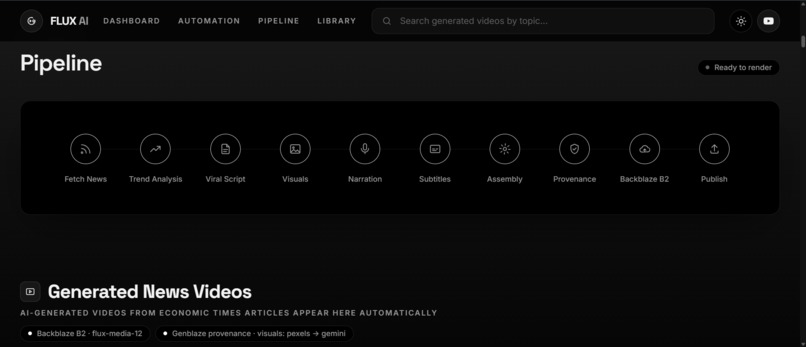
Pipeline
-

Landing
-

YouTube Channel
-

Library - Light Mode
-

Library





Flux AI: From Trending News to Verified Video
Inspiration
Short form video is becoming one of the fastest ways people consume news, but creating a quality news video still requires multiple manual steps: finding a trending story, writing a script, sourcing visuals, recording narration, adding subtitles, editing, and publishing.
I wanted to build a system where this entire workflow could happen autonomously, while solving a second problem: trust in AI generated content. Generating a video is easy. Proving how it was generated is much harder.
That led to Flux AI, an autonomous news to video pipeline that can turn trending news into a publish ready short video in roughly two minutes, while making every generation step verifiable.
How We Built It
Flux monitors Economic Times RSS feeds, ranks fresh stories using recency and cross feed trend momentum, and selects the most relevant stories.
The selected article moves through an automated pipeline:
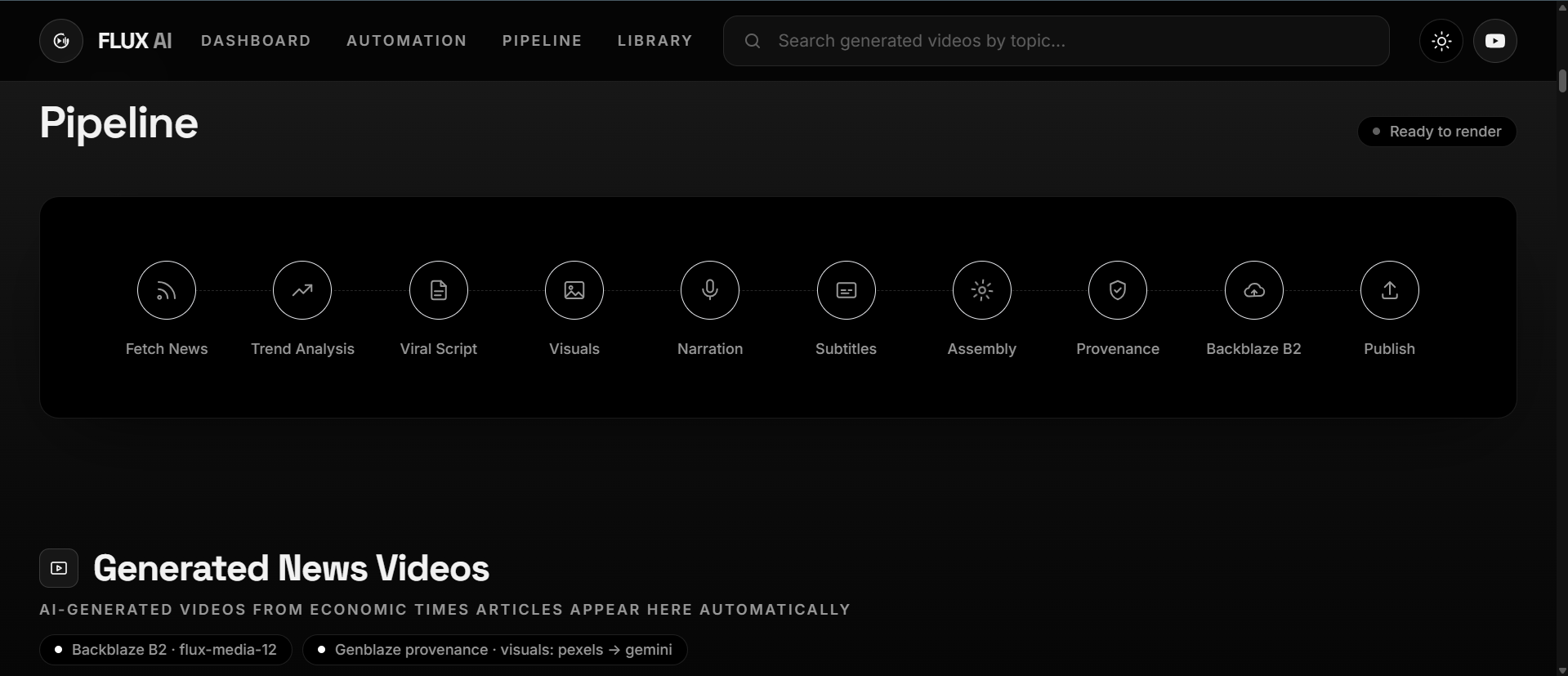
News → Trend Detection → Script → Visuals → Narration → Subtitles → Assembly → Provenance → Storage → YouTube
For scripts, Flux uses Gemini 2.5 Flash, with Ollama available as a local alternative. For visuals, it searches Pexels and Unsplash and uses Gemini generation when suitable stock content is unavailable. Narration uses Edge TTS by default, with additional provider options.
The final video is assembled vertically in 9:16 format and can be automatically published to YouTube.
The most important part is the provenance layer. Using Genblaze, Flux creates a manifest containing the generation chain, providers, models, parameters, and SHA 256 hashes of generated artefacts. The manifest is stored alongside the video and embedded into the MP4, allowing the content to be independently verified.
What We Learned
Building Flux taught us that an autonomous AI system is not just about connecting APIs. Reliability, provenance, fallbacks, and resource constraints matter just as much as generation quality.
We learned to design every stage so that failure in one provider would not bring down the entire pipeline. We also learned how important deterministic ranking and verification are when building systems that operate without human supervision.
Most importantly, we learned that AI generated content should not only be easy to create, it should be easy to audit.
Challenges
One of our biggest challenges was keeping the pipeline fast and reliable. Early renders took significantly longer, and redundant storage operations added unnecessary latency. We optimized the pipeline by making uploads concurrent, reducing unnecessary processing during video assembly, and using faster narration.
Memory was another major challenge. Video rendering can quickly exceed the limits of smaller cloud containers. Flux now detects the container's available memory and dynamically limits the number of video scenes it processes, preventing renders from being killed by out of memory errors.
We also encountered the problem of unreliable stock media search results. APIs can return visually similar but contextually incorrect footage. To solve this, Flux ranks results based on how closely their captions match the scene prompt and prioritizes relevant footage.
The Result
Flux became more than an automated video generator. It became a provenance aware AI content pipeline that can discover a story, create a complete video, publish it, and preserve evidence of how that video was generated.
Our goal is simple:
Make AI generated news as easy to produce as it is to verify.

Log in or sign up for Devpost to join the conversation.