-
-
Pipeline
-
Selection
-

Customisation
-

Library
-

YouTube
-

Landing




Inspiration
Creating content is only half the work. Creators still spend hours finding trending topics, writing scripts, sourcing visuals, recording narration, creating captions and thumbnails, and finally publishing. We wanted to eliminate that repetitive workflow and build an AI system that could take a trending story all the way to a publish-ready video with minimal human intervention.
What it does
Flux AI is an autonomous news-to-video automation platform that turns trending stories into publish-ready vertical videos.
It:
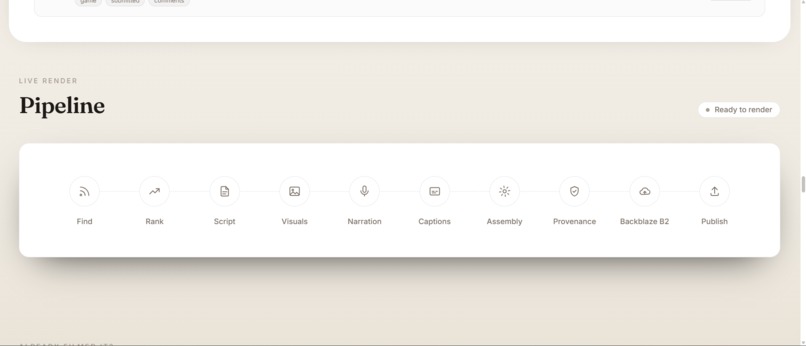
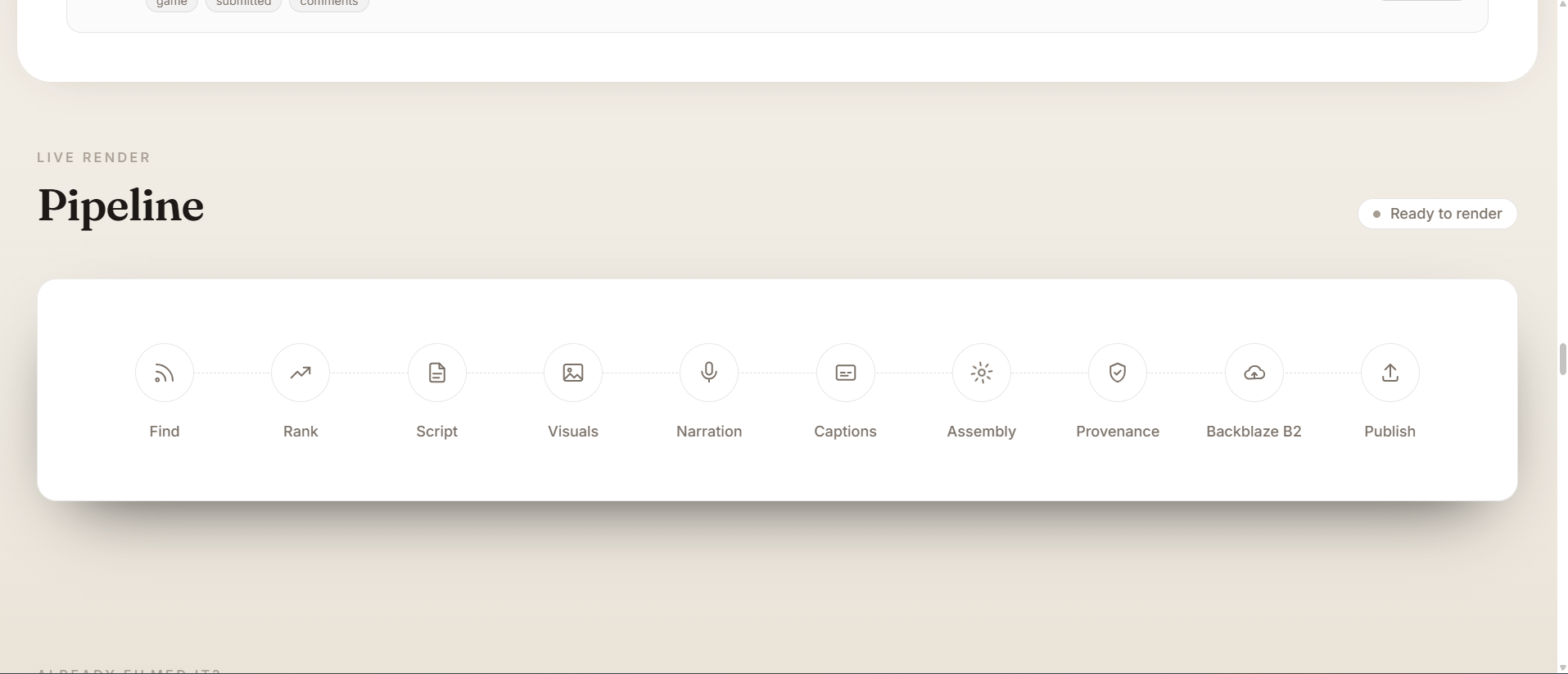
- Scans multiple sources including Google Trends, Reddit, Hacker News, YouTube Trending, and RSS.
- Merges, deduplicates, and ranks stories based on recency and cross-source momentum.
- Generates the script and segments it into scenes.
- Finds relevant stock videos/images and falls back to AI-generated visuals when needed.
- Generates narration and synchronized captions.
- Assembles the final 9:16 video and generates a thumbnail.
- Creates a signed provenance manifest containing SHA-256 hashes for generated artifacts.
- Stores assets on Backblaze B2 and can automatically publish to YouTube.
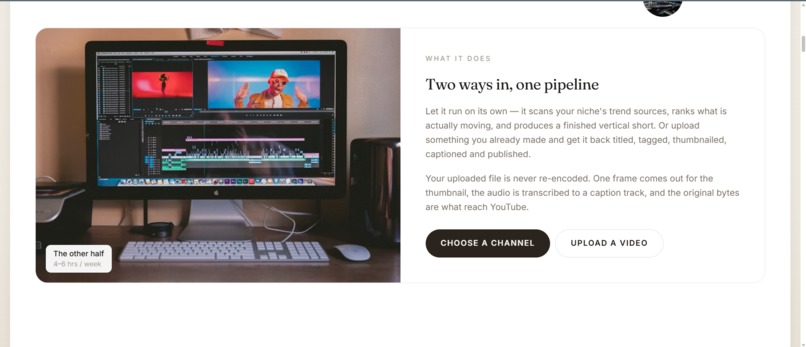
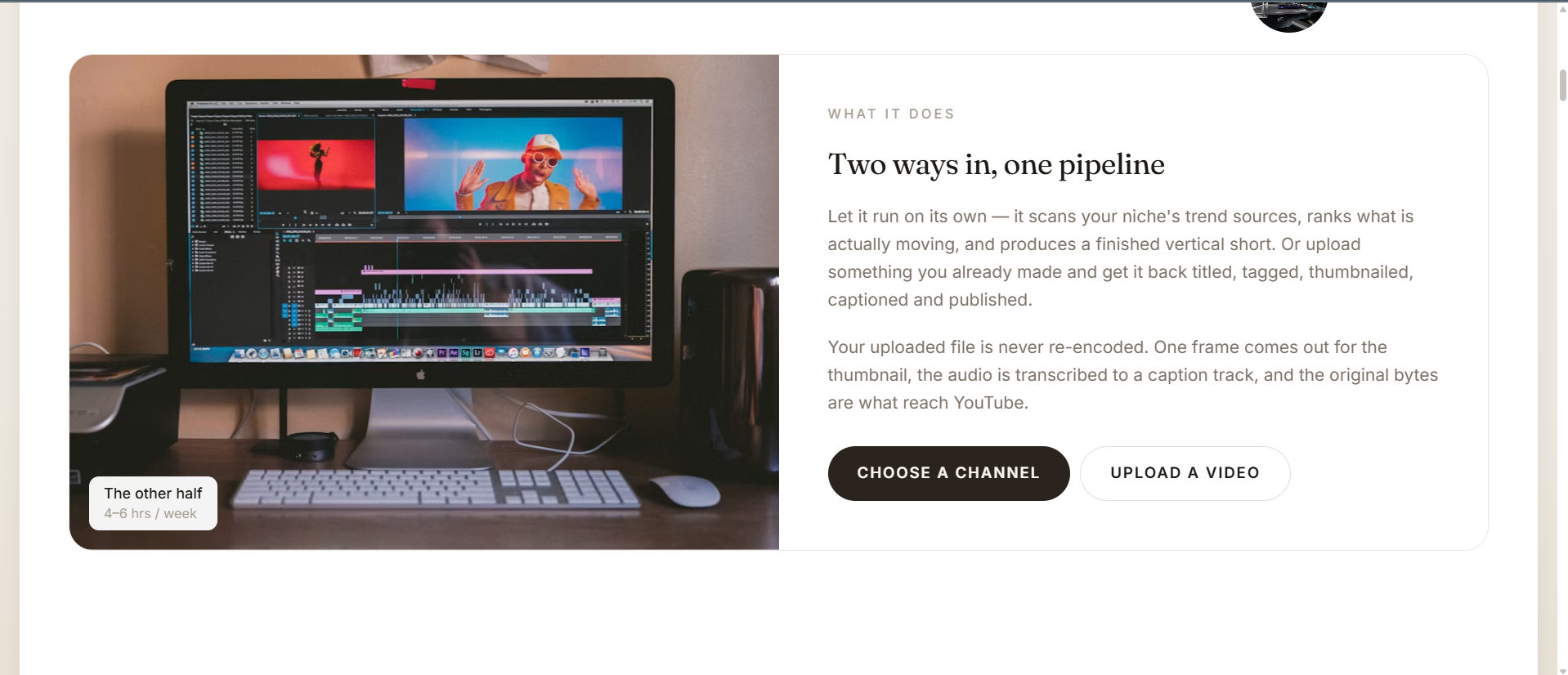
- Supports Bring Your Own Video, automatically generating titles, descriptions, tags, thumbnails, captions, and Shorts timestamps without re-encoding the original video.
How we built it
Flux AI uses FastAPI + React as its core application, with APScheduler handling automated runs.
The pipeline follows:
Trend Sources → Deduplication → Ranking → Script → Visuals → Narration → Captions → Assembly → Provenance → Storage → YouTube
We use Gemini 2.5 Flash for script generation, Pexels and Unsplash for visual search, Edge TTS/Kokoro for narration, and MoviePy + FFmpeg for video assembly.
For reliability and traceability, Genblaze orchestrates media generation and creates signed provenance manifests, while Backblaze B2 provides durable storage. The entire application is containerized with Docker and deployed as a single service.
Challenges we ran into
One of our biggest challenges was making the pipeline reliable on constrained cloud infrastructure.
Video processing was particularly memory-intensive. A single video decoder could consume significant memory, causing renders to be killed on smaller instances. We solved this by dynamically detecting the container's memory limit and adjusting the number of video scenes accordingly.
We also had to deal with unreliable stock-search results, API quotas, TTS latency, duplicate uploads, and scheduler state being lost across redeployments.
We implemented relevance ranking, fallback providers, Gemini key rotation, persistent scheduler state, concurrent uploads, and graceful degradation to keep the pipeline running reliably.
Accomplishments that we're proud of
We're proud that Flux isn't just a prototype that generates a video—it is a complete autonomous publishing pipeline.
A typical short can be rendered in roughly 35 seconds, including scripting, visuals, narration, captions, assembly, provenance, and storage.
We're especially proud of:
- Building a fully automated trend-to-video pipeline.
- Supporting multiple content niches through configurable YAML profiles rather than hard-coded logic.
- Creating verifiable provenance for every generated artifact.
- Building a BYO-video workflow that preserves the original video bytes instead of re-encoding them.
- Making the system resilient through provider fallbacks and memory-aware rendering.
- Deploying the same Docker image across multiple cloud platforms.
What we learned
We learned that building an AI application is much more than choosing an LLM.
The difficult parts were orchestration, reliability, media processing, resource constraints, provenance, API limits, and graceful failure.
We also learned that deterministic systems can be extremely valuable alongside AI. For example, our trend-ranking system uses cross-source momentum rather than spending an LLM call on every candidate.
Most importantly, we learned to design AI pipelines around fallbacks and observability rather than assuming every external service will always work.
What's next for Flux AI
Next, we want to move Flux from automated content creation toward a complete AI content operating system.
Our roadmap includes:
- More content platforms beyond YouTube.
- Smarter personalization based on channel performance.
- Automatic A/B testing of titles, thumbnails, and hooks.
- Analytics-driven topic selection.
- More advanced AI-generated visuals and video.
- Multi-language content generation and localization.
- Better creator controls for brand voice and visual identity.
- A multi-agent architecture where specialized agents independently handle research, scripting, editing, publishing, and performance optimization.

Log in or sign up for Devpost to join the conversation.