Inspiration
Having a financial goal is one thing. Understanding what it takes to reach it is another.
A goal like buying a car is about more than finding the right vehicle or knowing its price. It means understanding how that decision could affect monthly cash flow, savings, debt, and the other goals that matter just as much.
We wanted to explore how people could make financial decisions with greater confidence, without feeling overwhelmed or giving up control of their finances.
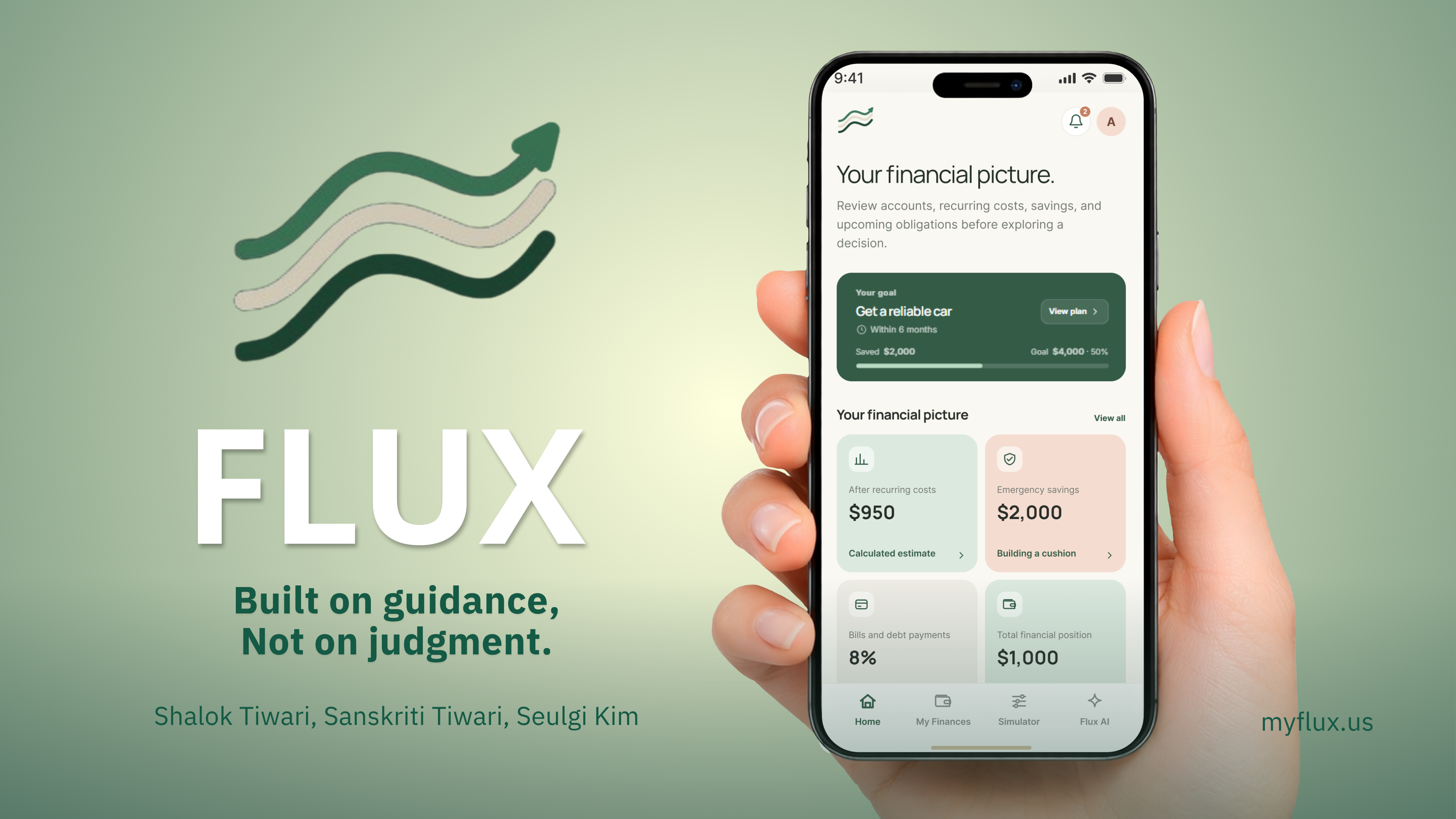
That inspired Flux: a personalized financial guide that helps users connect their decisions to their goals. Rather than telling users what to do, Flux helps them explore possible outcomes, understand tradeoffs, and choose the path that works for them.
Research and Discovery
We combined secondary research with an exploratory survey of 12 participants.
Secondary research
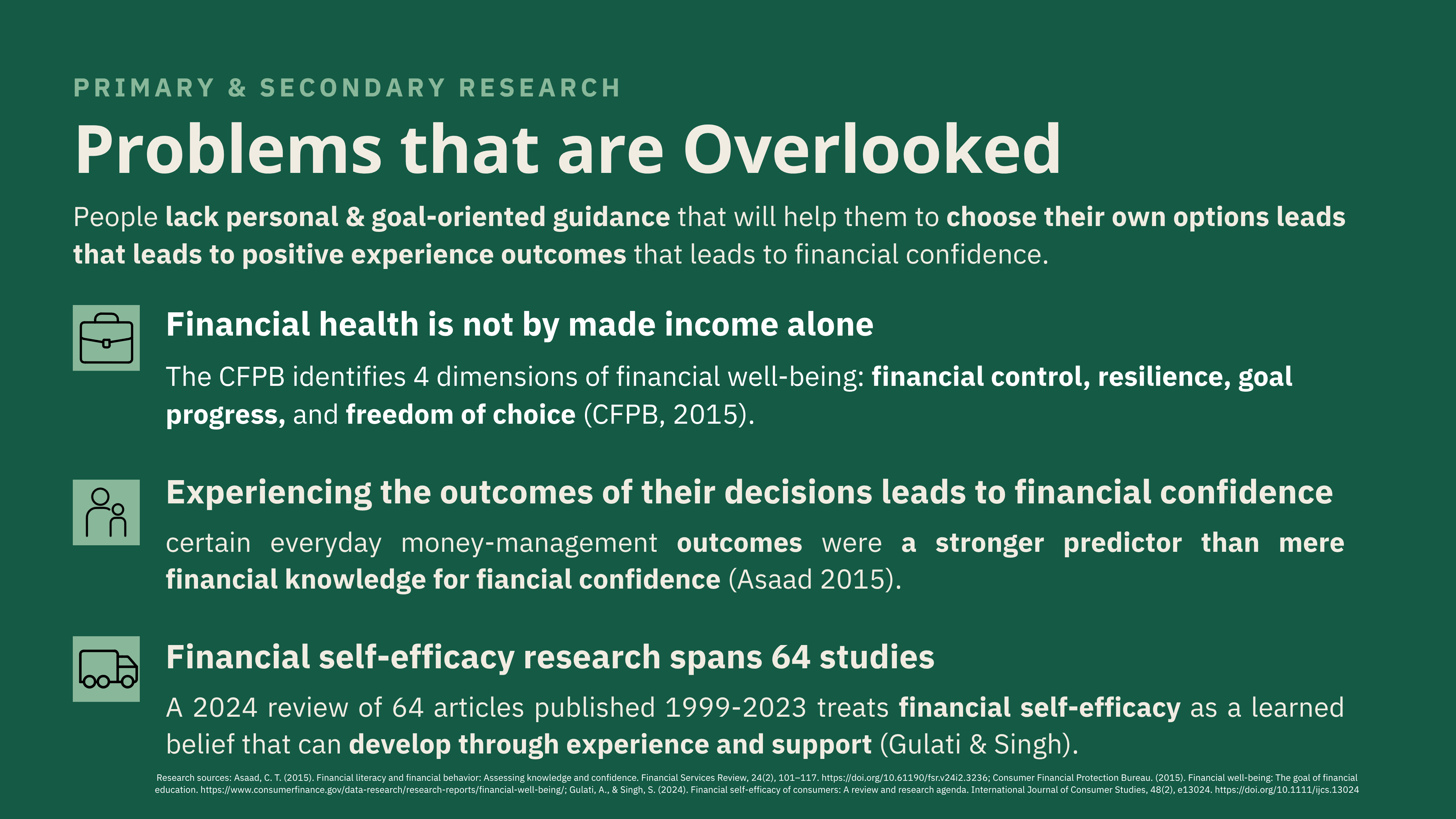
Research on financial confidence, financial self-efficacy, and financial well-being revealed that:
- Financial confidence is connected to everyday financial experiences and outcomes, not just financial knowledge (Asaad, 2015).
- Financial self-efficacy can develop through experience and support (Gulati & Singh, 2024).
- Financial well-being extends beyond income to include financial control, resilience, goal progress, and freedom of choice (CFPB, 2015).
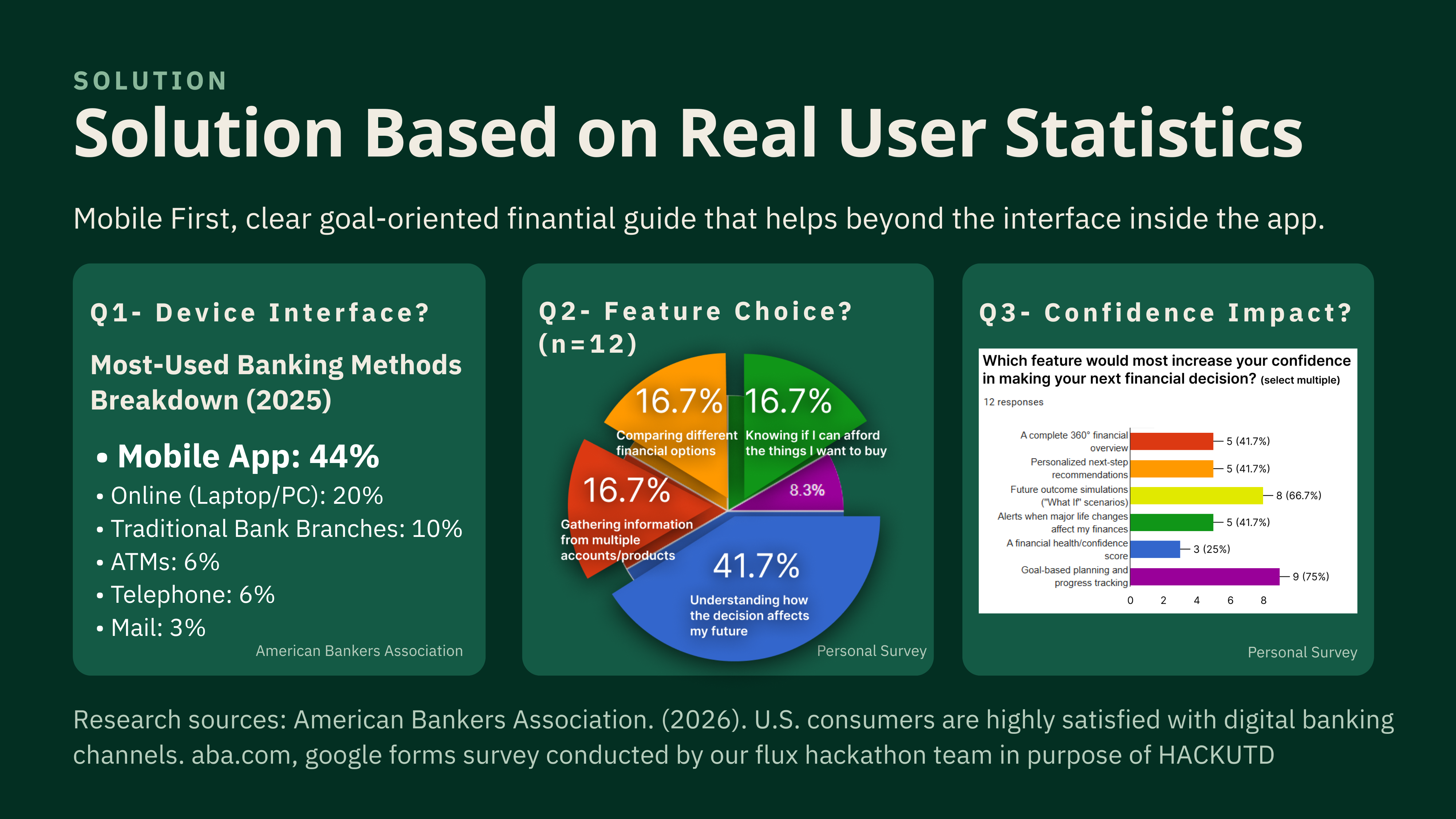
Our survey (n=12)
- 41.7% struggled to understand how a financial decision would affect their future.
- 75% selected goal-based planning and progress tracking as confidence-building features.
- 66.7% wanted future outcome simulations.
These findings led us to a central insight: people need more than financial information. They need personalized guidance that helps them understand how their decisions connect to their goals, while keeping the control in their hands.
From Research to Flux
We designed Flux to help users explore how financial decisions could affect their cash flow, savings, debt, and goals before committing.
Instead of making decisions for users, Flux helps them see the potential ripple effects of their choices and understand the tradeoffs along the way.
Our vision is simple:
Your financial journey should be guided by support, not judgment.
What it does
Flux is a financial decision-support platform that helps users understand how major purchases could affect their broader financial picture.
Our current prototype focuses on buying a car, demonstrating how Flux can support users from financial planning to real-world shopping. Users can explore different scenarios, understand how each option connects to their goals, and make informed decisions with personalized AI guidance.
Flux puts users in control of their financial decisions. AI helps them understand the possibilities.
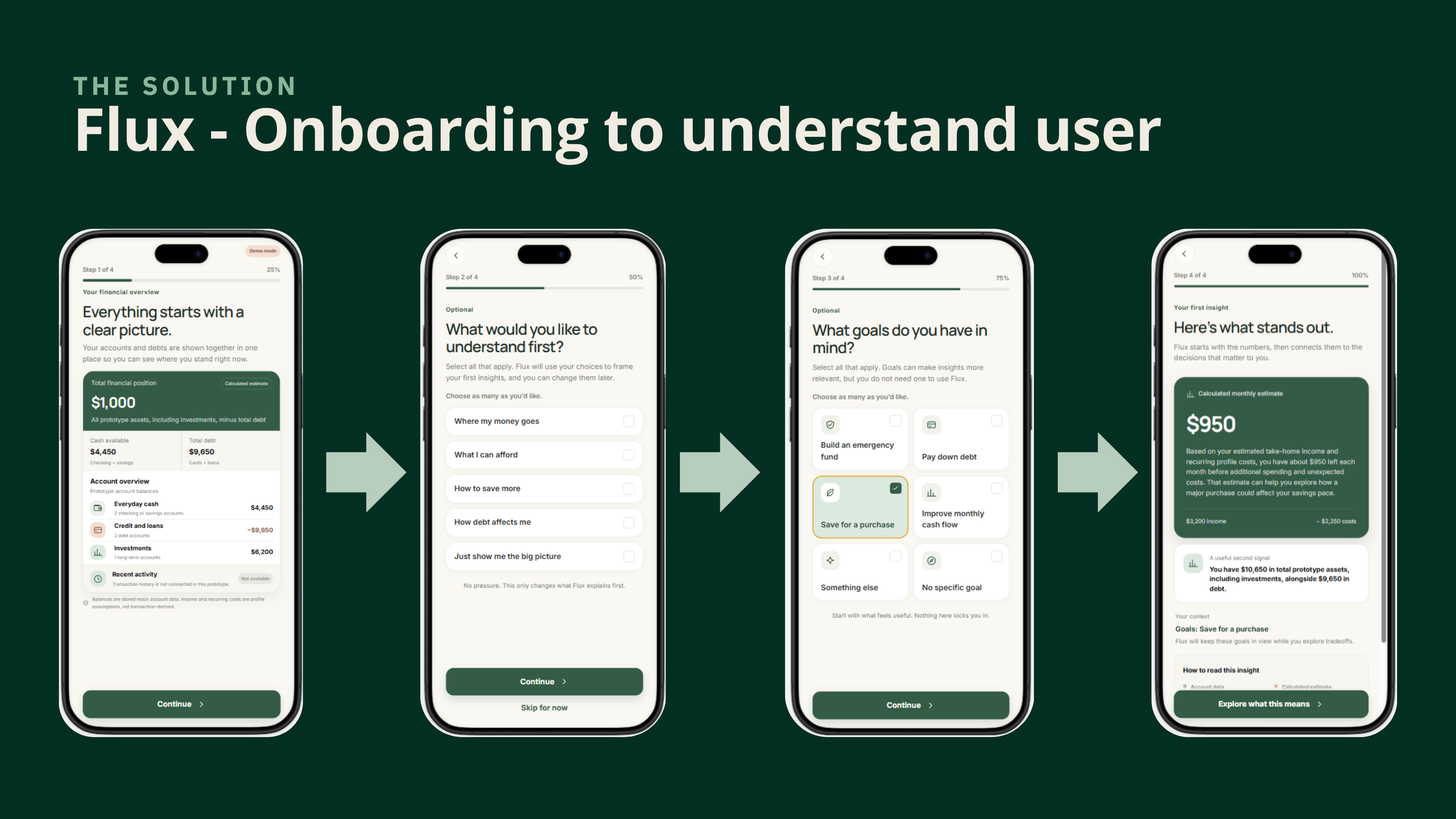
1. Understand Your Financial Picture
Users begin by creating an account or exploring a sample financial profile.
Through guided onboarding, users identify what they want to understand, where their money goes, and what financial goals matter to them.
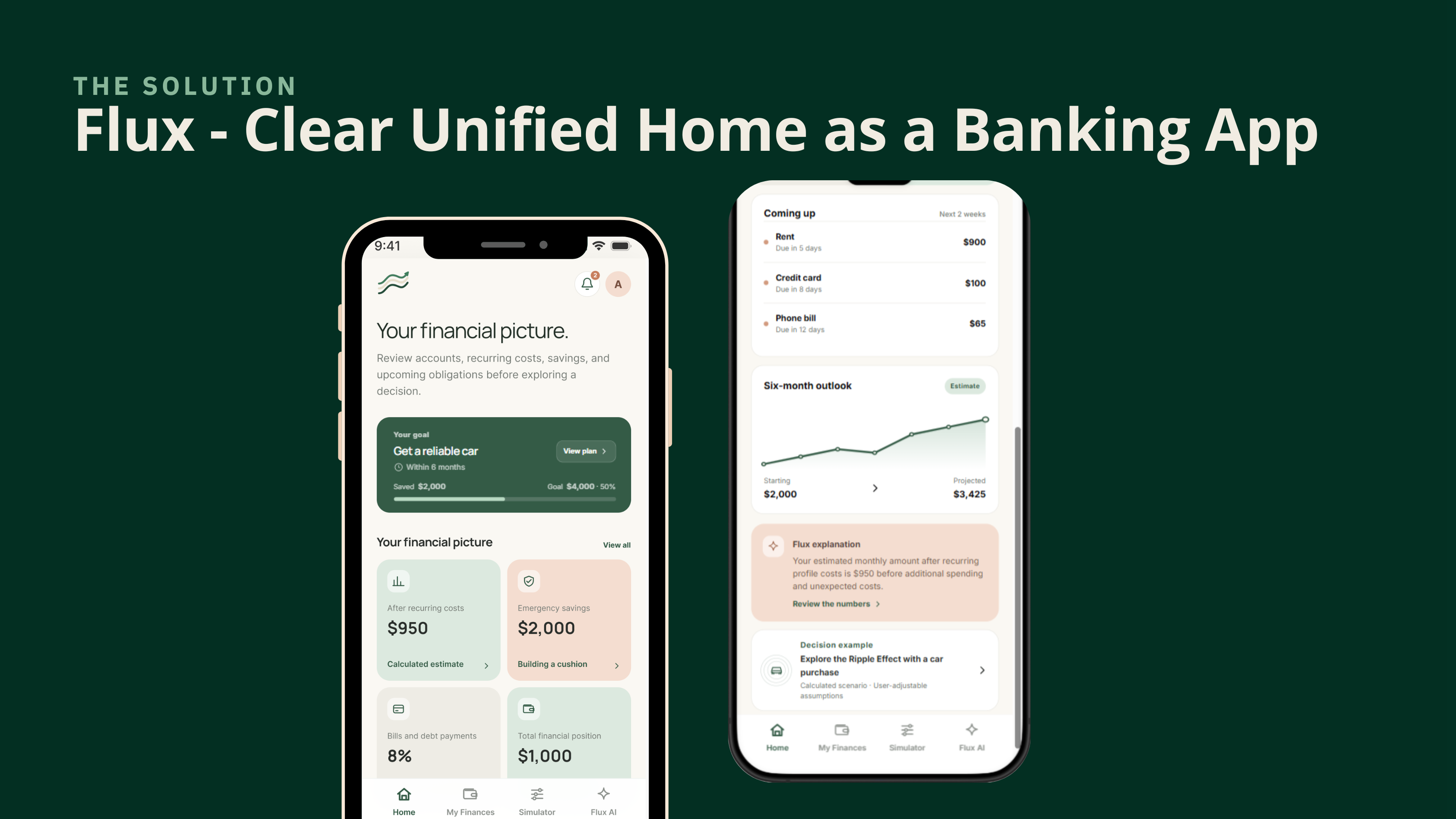
Using mock financial data provided through the PNC pack (which replaces real user data in bank), Flux brings together income, recurring expenses, savings, investments, and debt to create an understandable financial overview.
2. Explore Your Financial Future
The dashboard helps users understand their current financial position through:
- Monthly cash flow
- Available savings
- Emergency savings
- Financial goals
- Upcoming obligations
- Personalized next steps
Instead of simply displaying numbers, Flux helps users connect their financial situation to what they want to accomplish.
3. Experience the Financial Simulator
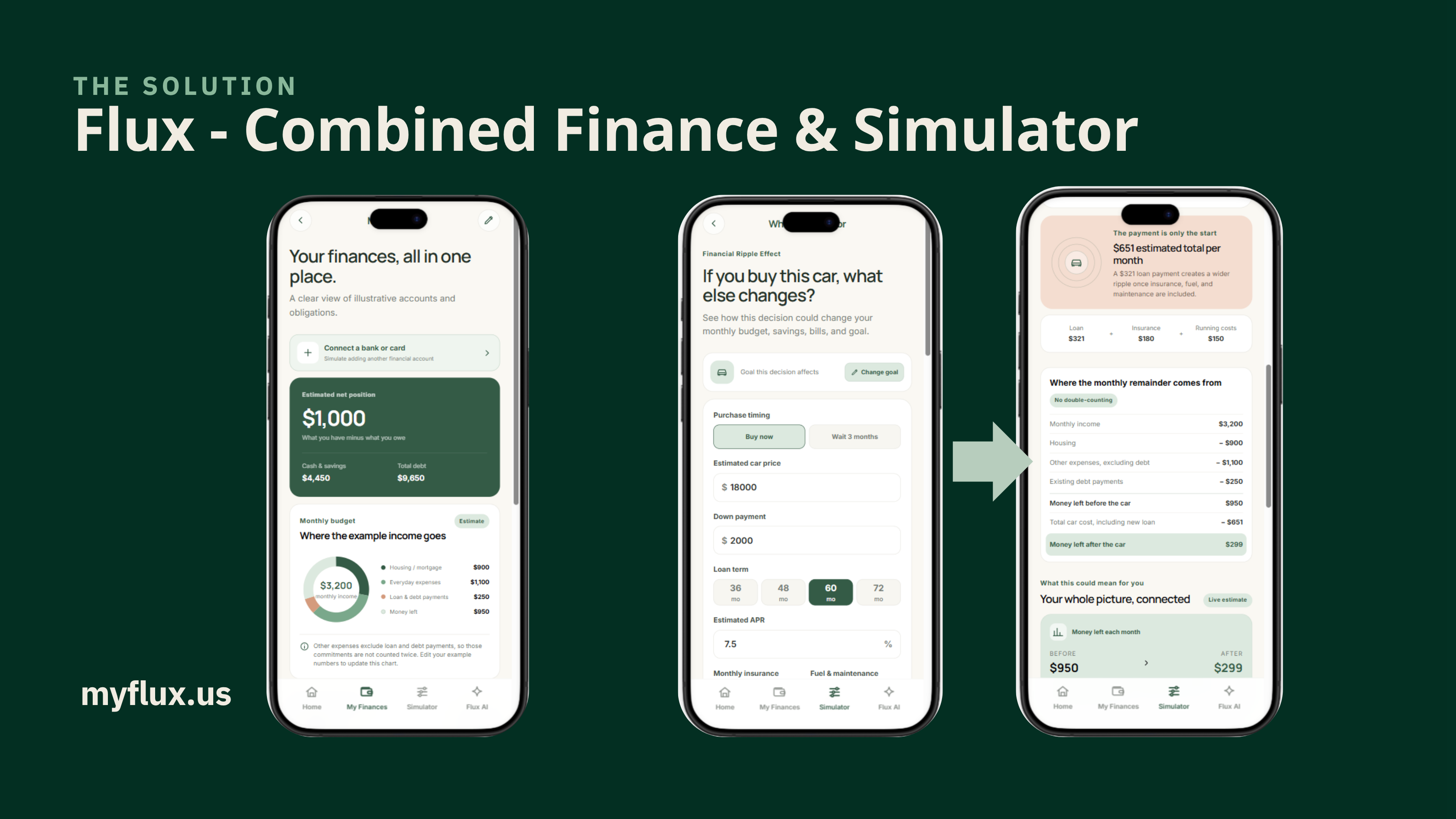
Our central feature is the What-If Simulator.
Users can adjust a vehicle's price, down payment, loan term, APR, insurance, fuel, maintenance, and upfront fees.
Flux estimates how the purchase could affect:
- Monthly car payments
- Total monthly ownership costs
- Remaining monthly cash flow
- Savings after the purchase
- Emergency savings
- Total interest paid
Users can compare different scenarios, such as buying their current choice, waiting and saving more, or exploring a lower-priced vehicle.
Rather than declaring a purchase affordable or unaffordable, Flux makes the tradeoffs visible.
4. Bring Financial Guidance Into the Shopping Experience
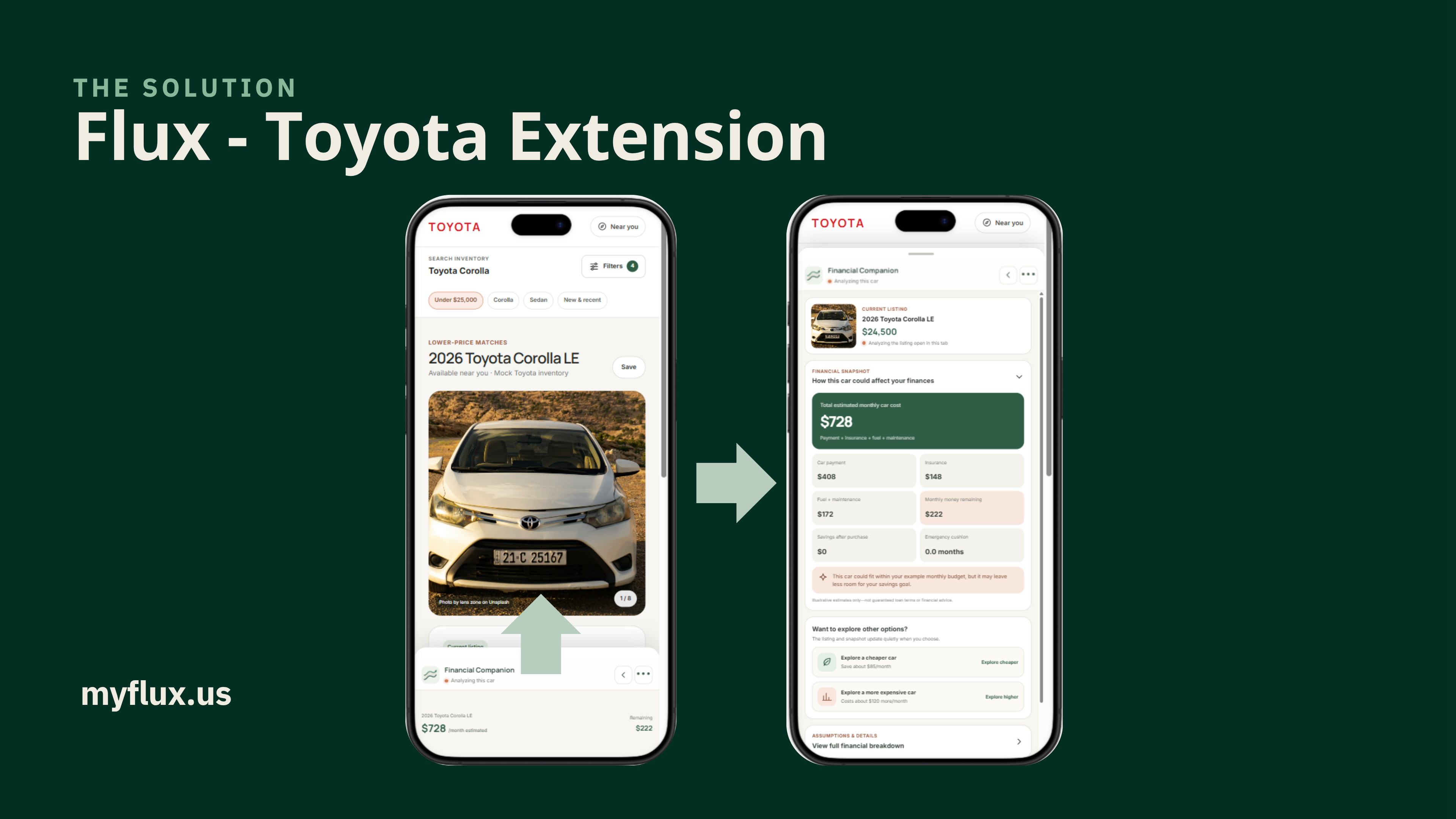
We wanted to address a problem traditional budgeting apps often overlook: financial decisions happen outside the app. When people shop for a car, they often focus on the price or monthly payment without seeing how the purchase could affect their overall financial health.
Flux bridges this gap through a financial companion and a Toyota vehicle-shopping website with a browser extension experience. As users explore car options, Flux helps them understand how a purchase could affect their monthly cash flow, savings, existing obligations, and personal financial goals with Toyota Starting pack. Users can also explore cheaper or more expensive vehicles and see how the financial estimates change.
On this mobile experience, the extension becomes a draggable bottom sheet that lets users continue browsing while accessing financial guidance.
This demonstrates how a future browser extension could help users make more informed decisions without interrupting their shopping experience.
5. Ask Flux
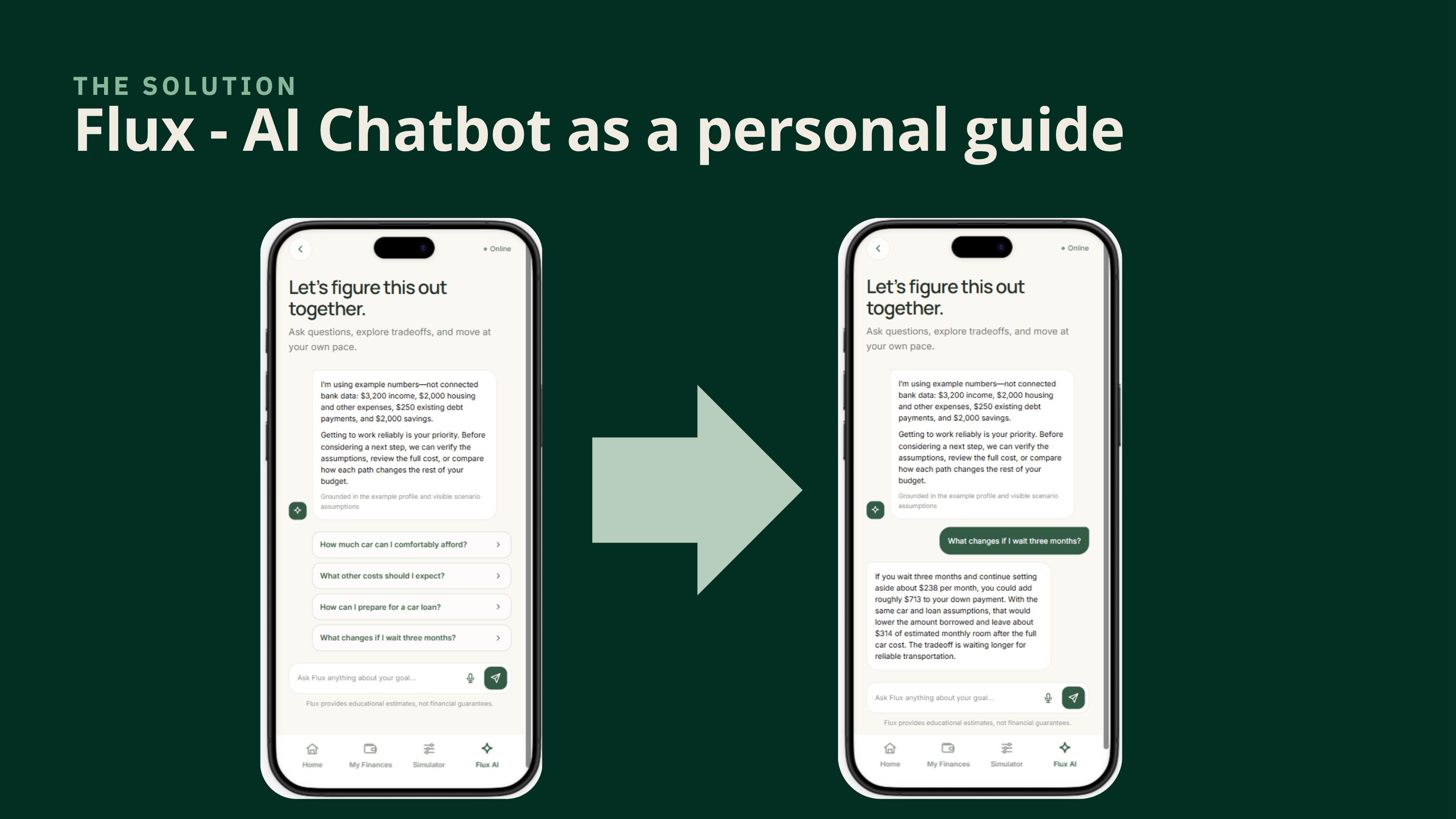
Flux also includes conversational financial guidance.
Users can ask questions such as:
- "Can I afford this car?"
- "What if I wait three months?"
- "Show me a cheaper option."
- "Compare another car."
Flux explains financial tradeoffs using the visible assumptions and example financial profile.
The goal is not to make decisions for users. It is to help them understand their options and make decisions with greater confidence.
How We Built It
We built Flux as a financial decision-support platform with one backend powering two experiences: a financial health coach and a contextual “See Plans” companion for better expense managing experience.
Design and Frontend
We designed the mobile-first interface in Figma and Figma Make and developed it using Next.js and TypeScript. The experience includes guided onboarding, a financial overview, a dashboard, interactive what-if scenarios, and a contextual Toyota shopping companion.
The Car choosing experience demonstrates how financial guidance can accompany users while they browse vehicle options, helping them understand the financial impact of a purchase without leaving the shopping experience.
Backend and Financial Logic
Flux uses a FastAPI backend to interpret user questions and determine which financial calculations or scenarios are relevant.
We use deterministic Python functions for financial calculations, including:
- Financial health indicators
- Vehicle affordability estimates
- Retirement calculations
- Financial forecasts
- What-if scenarios
- Toyota vehicle options
This separates financial calculations from AI-generated explanations, helping keep results consistent and grounded in structured data.
AI-Powered Guidance
After the backend calculates the relevant results, Gemini receives only the information needed to answer the user's question.
Gemini turns these structured results into plain language explanations that help users understand their financial situation and compare possible decisions.
Responses are streamed back to the interface, while commonly asked questions can be served through caching to improve responsiveness.
The chatbot also supports optional listening and voice interaction through its listen and microphone button to provide accessibility to better support user throughout the experience designed around the financial dashboard, scenario exploration, and contextual guidance.
Toyota Shopping Companion
We developed a “See Plans” experience that connects vehicle shopping with personalized financial insights.
The companion uses Toyota starter data to explore vehicle options and show how a selected vehicle could affect a user's financial picture.
Our prototype uses synthetic data, including generated financial profiles and Toyota's starter data pack, rather than real customer financial information.
Responsible AI and Guardrails
We designed the backend to apply guardrails before generating AI responses.
Financial calculations come from structured data and deterministic logic, not from the language model. Flux presents estimates rather than guaranteed approvals or financial advice.
The broader backend design also supports human handoffs for sensitive situations, respects marketing consent, and treats “no eligible offer” as a valid outcome rather than forcing a recommendation.
Deployment and Infrastructure
We deployed the frontend to Vercel at myflux.us and the FastAPI backend to virtual machine at api.myflux.us.
Caddy provides HTTPS and reverse-proxy support, while Uvicorn runs the API. We use Pydantic for data validation and pytest for testing.
Our technology stack includes:
- Frontend: Next.js, TypeScript, pnpm
- Backend: Python, FastAPI, Uvicorn, Pydantic
- Financial logic: Deterministic Python
- AI: Google Gemini API
- Testing: pytest
- Deployment: Vercel, Caddy, systemd
- Design: Figma, Figma Make
- Development: Cursor
Challenges We Ran Into
Integrating the Financial Companion Into the Toyota Shopping Experience
Our “See Plans” experience needed to work alongside a vehicle-shopping interface while communicating with a separately hosted API.
This introduced challenges around cross-origin requests, HTTPS, API connectivity, and streaming responses through the reverse proxy.
We configured the API infrastructure to support the frontend and adjusted Caddy's response buffering so streamed responses could reach the interface properly.
We also learned that deployment decisions, including domains, HTTPS, CORS, and proxy behavior, need to be considered early when building an experience that spans multiple interfaces.
Making Financial Guidance Reliable and Understandable
Financial questions often require calculations involving multiple variables. We did not want the language model to invent numbers or perform financial calculations inconsistently.
We separated the calculation process from the explanation process: Python handles the financial logic, and Gemini explains the resulting information.
This helped us design Flux around structured results, visible assumptions, and concise explanations.
Making the Chatbot Responsive
We wanted users to receive useful financial guidance without waiting for a long response.
We used a fast Gemini model, streamed responses to the interface, and explored caching for common questions.
The chatbot also includes a microphone button for optional voice interaction. Supporting browser microphone permissions, speech-to-text, and browser compatibility introduced additional implementation considerations.
What We Learned
One of our biggest takeaways was that financial confidence is not simply about knowing more. It is about understanding how financial decisions affect your own life.
People may understand financial concepts but still struggle to apply them to their circumstances. A major purchase, such as buying a car, can feel overwhelming because its impact extends beyond the initial price. It can affect monthly cash flow, savings, debt, and progress toward other goals.
This shaped how we approached Flux. We learned that financial guidance should be:
- Personalized: Connected to the user's financial situation and goals.
- Goal-oriented: Focused on what the user wants to accomplish.
- Experiential: Helping users explore possible outcomes before committing.
- Contextual: Available when users are actively making decisions.
- Supportive: Explaining tradeoffs without judgment.
We also learned that AI should explain financial calculations, not replace them. By separating deterministic financial logic from the language model, we made the experience more predictable while still allowing users to ask questions naturally. The calculations provide structured results, and AI helps turn those results into clear, approachable explanations.
Building Flux also showed us that contextual financial guidance requires more than a chatbot. The interface needs to connect users' financial information, goals, and possible decisions so they can understand the tradeoffs and explore different paths.
Finally, bringing the experience across a financial platform and a shopping interface taught us the importance of planning for API architecture, HTTPS, cross-origin communication, and streaming from the beginning. We also learned to distinguish financial estimates from guarantees. A useful financial tool should make its assumptions visible and help users explore possibilities rather than presenting a single answer as the truth.
What's next for Flux
We envision Flux becoming a financial companion that supports people throughout their financial journey, not just when they open a budgeting app.
Our next steps include:
1. Develop the Financial Companion Extension Expand the current shopping prototype into a browser extension that can provide contextual financial guidance while users browse external websites.
2. Expand Beyond Car Purchases Support other major financial decisions, including housing, travel, education, and other significant purchases.
3. Improve Personalized Financial Guidance Develop the backend process to support more personalized insights, financial forecasting, and conversational guidance based on users' financial profiles and goals.
4. Conduct User Testing Evaluate whether users can understand the Financial Ripple Effect, interpret financial estimates, compare alternatives, and feel more confident about their decisions.
5. Build Toward a More Connected Financial Experience
Explore secure financial data integrations and additional ways to help users understand their financial situation while maintaining transparency and user control.
Our long-term vision is simple:
Flux helps people move toward what matters by making the financial consequences of their decisions easier to understand.


