Inspiration
Early-career women are earning income for the first time in their lives, often without ever having been taught how to actually handle it. Fidelity's own 2026 retirement planning research found women report 63% confidence in retiring on their own terms — 18 points behind men — a gap driven less by what people know and more by career interruptions and never having had a low-stakes way to practice financial decisions. At the same time, existing financial literacy tools are either intimidating (dense articles, spreadsheets) or completely disconnected from the career decisions — negotiating an offer, understanding benefits, asking for a raise — that actually move the needle early on. We wanted to build something that made the process of learning to handle money feel like visible progress instead of homework, and that treated career and money as the same conversation instead of two separate apps
What it does
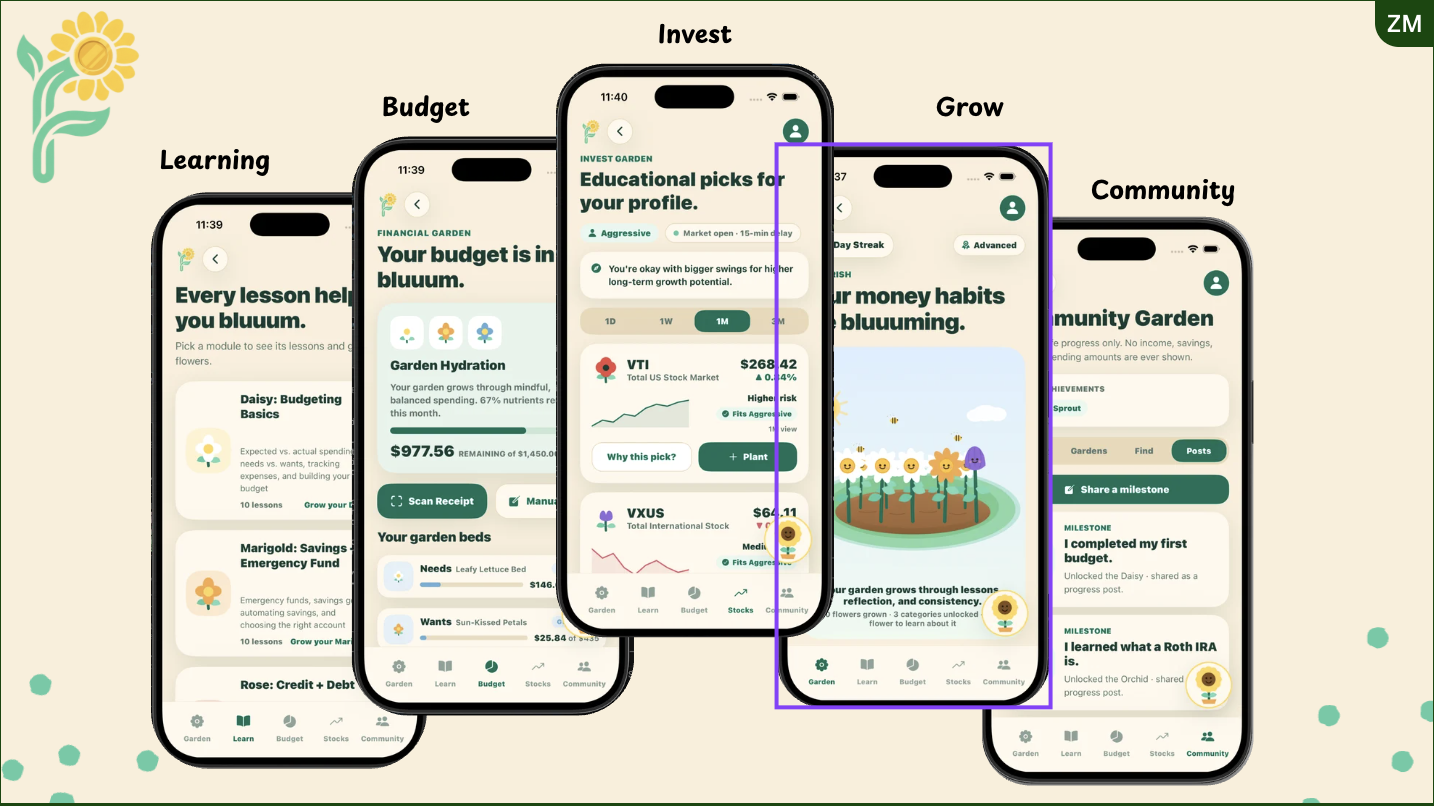
Fluuurish is a gamified financial literacy app built around a simple loop: as users complete lessons, track their budget, and build consistent habits, their garden grows. Users start with a single bluuum, and new ones are unlocked as they learn and act — growth in number, not size, so the garden reflects consistency and learning rather than dollar amounts. Progress never regresses; a missed week just means the garden waits. Core features include: Budget tracking with a pie chart breakdown comparing expected vs. actual spending across categories Receipt scanning that lets users log expenses by photographing a receipt instead of manual entry A community garden, where users can view each other's progress and post about their own wins An LLM-powered chatbot companion for plain-language answers to financial questions, built on the Gemini API A top 5 bonds view, surfacing simplified, beginner-relevant investment information Financial literacy lessons and quizzes covering budgeting, credit, and investment account basics
How we built it
We used React Native for a cross-platform mobile frontend, with PostgreSQL as our database and Docker to containerize our services for consistent local development. The Gemini API powers our AI companion chatbot. We deployed our frontend on Vercel and backend on Railway.
Challenges we ran into
Getting PostgreSQL running smoothly was a real time sink — most hackathon teams default to Supabase for a reason, but we deliberately chose to set up and manage our own Postgres instance because we wanted to actually learn the underlying database and deployment work instead of relying on a managed shortcut, and debugging that setup under time pressure was harder than we expected. Building the receipt scanning feature was another major challenge, since parsing inconsistent receipt formats into clean, categorized expense data reliably is a much harder problem than it looks like from the outside. We also spent a lot of time iterating on how to make the learning experience itself engaging rather than just another set of articles and quizzes, which pushed us to think harder about interactivity than we originally planned for.
Accomplishments that we're proud of
We're proud of shipping a working receipt scanner under time pressure, building a community garden feature that made the app feel social instead of solitary, integrating an LLM-based chatbot that gives users real, conversational answers instead of static FAQ content, and building a simplified top-5-bonds view that makes investing feel approachable rather than overwhelming. We're also proud that we chose to build our own Postgres backend instead of taking the easy route, since it meant we actually understood every part of our stack by the end of the weekend.
What we learned
We learned that financial literacy content is only as good as its format — the same information lands completely differently depending on whether it's a static article or something interactive, and that difference is where most existing tools fail. We also learned a lot about the tradeoffs of managing our own database infrastructure versus using a managed backend, and about the practical complexity of parsing unstructured real-world data like receipts.
What's next for Fluuurish
Deeper personalization, including an improved onboarding questionnaire that shapes each user's lessons and recommendations Real bank account integration and exploring a Fidelity API partnership to connect the app to users' actual accounts Expanding and refining our lessons, budgeting tools, and investment features (including deeper stock and bond content) Introducing an in-app currency layer on top of the garden mechanic to add another dimension of reward and progression Improving accessibility for users with disabilities, including screen reader support and alternative interaction modes
Built With
- budgeting
- community
- docker
- flower
- gemini-api
- learning
- postgresql
- railway
- react-native
- relative-growth
- saving
- stocks
- vercel

Log in or sign up for Devpost to join the conversation.