-
-
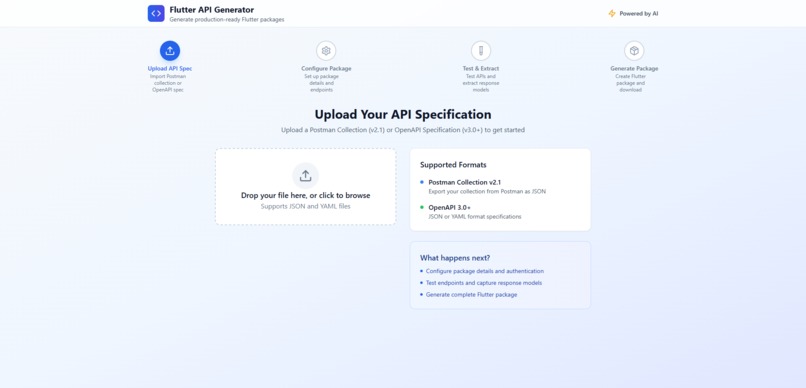
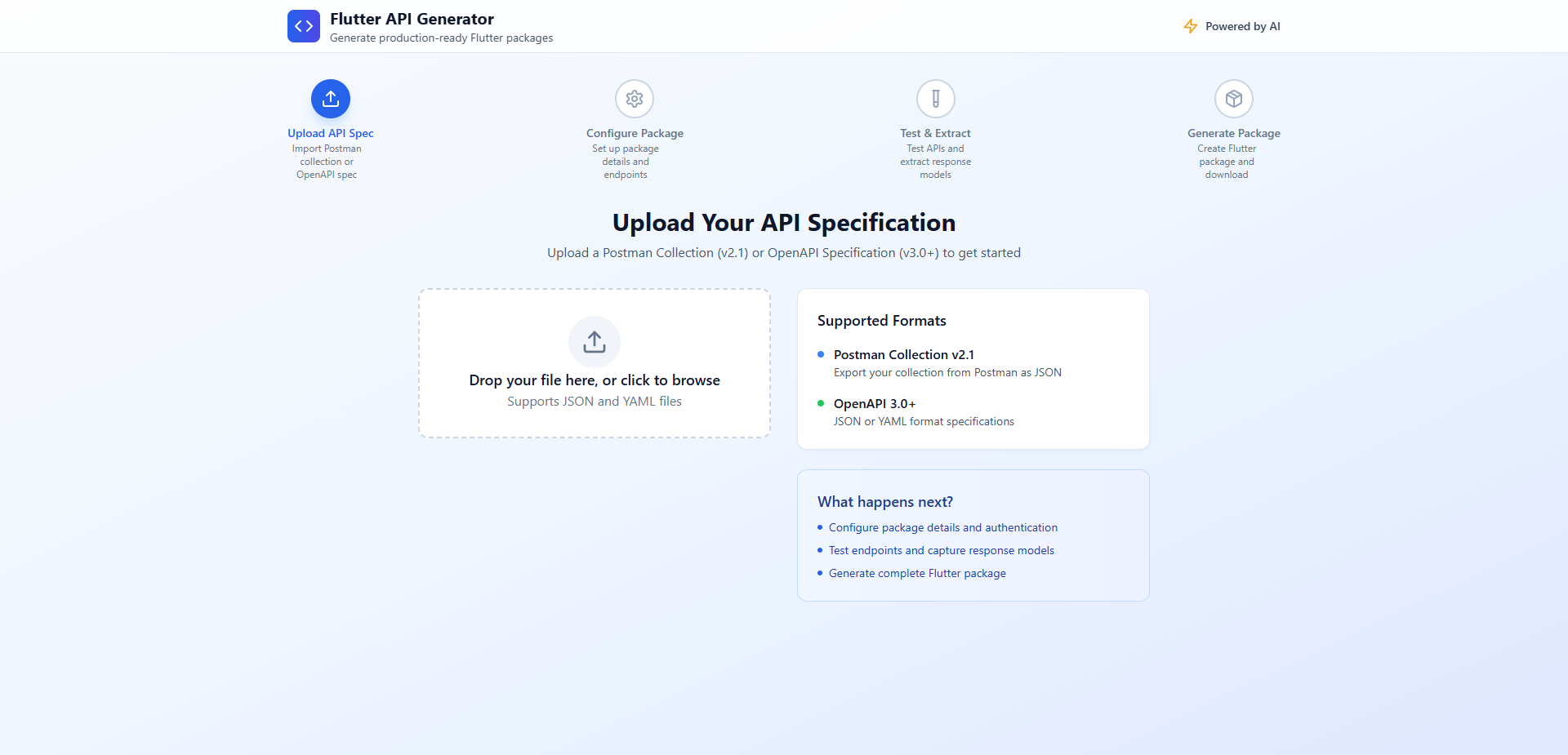
Upload Your API Specification
-
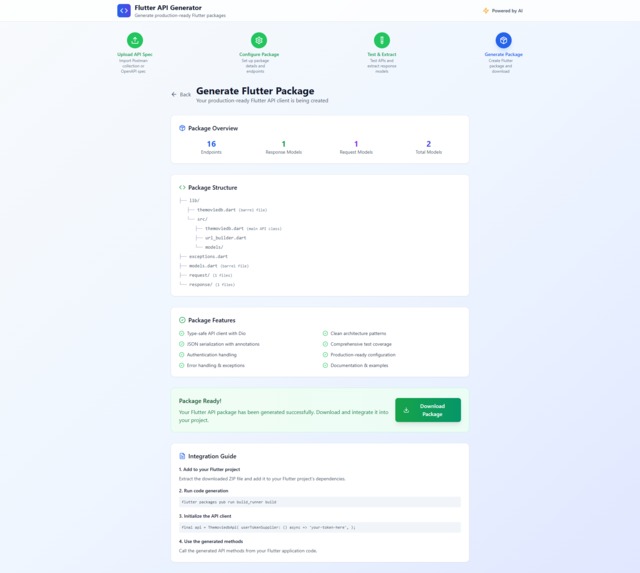
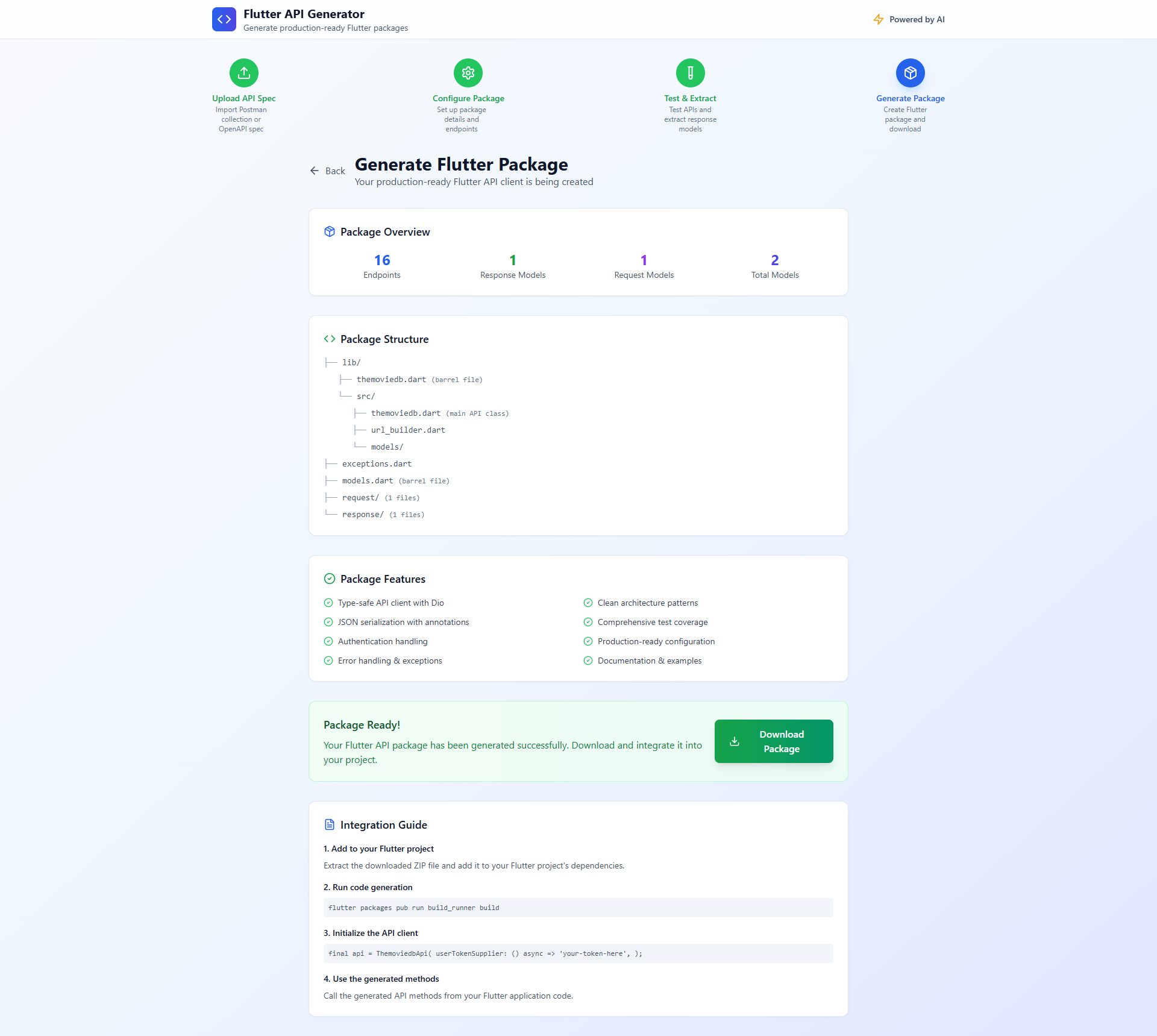
Generate Flutter Package
-
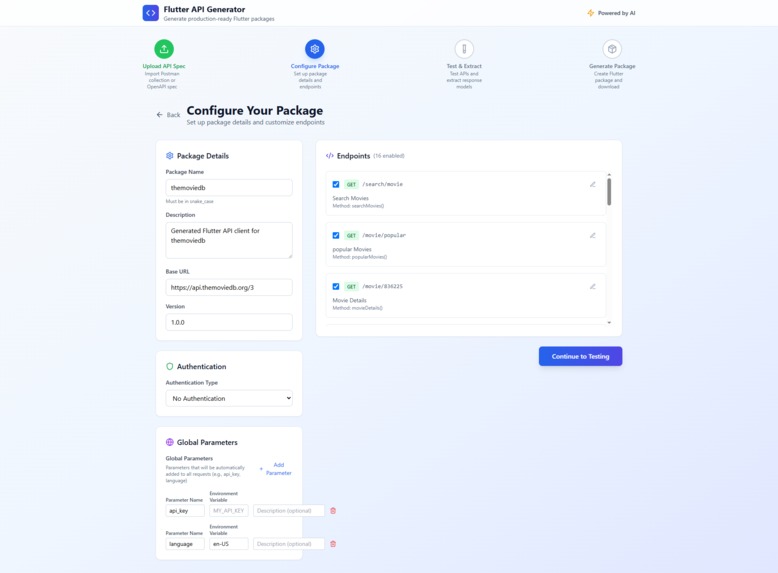
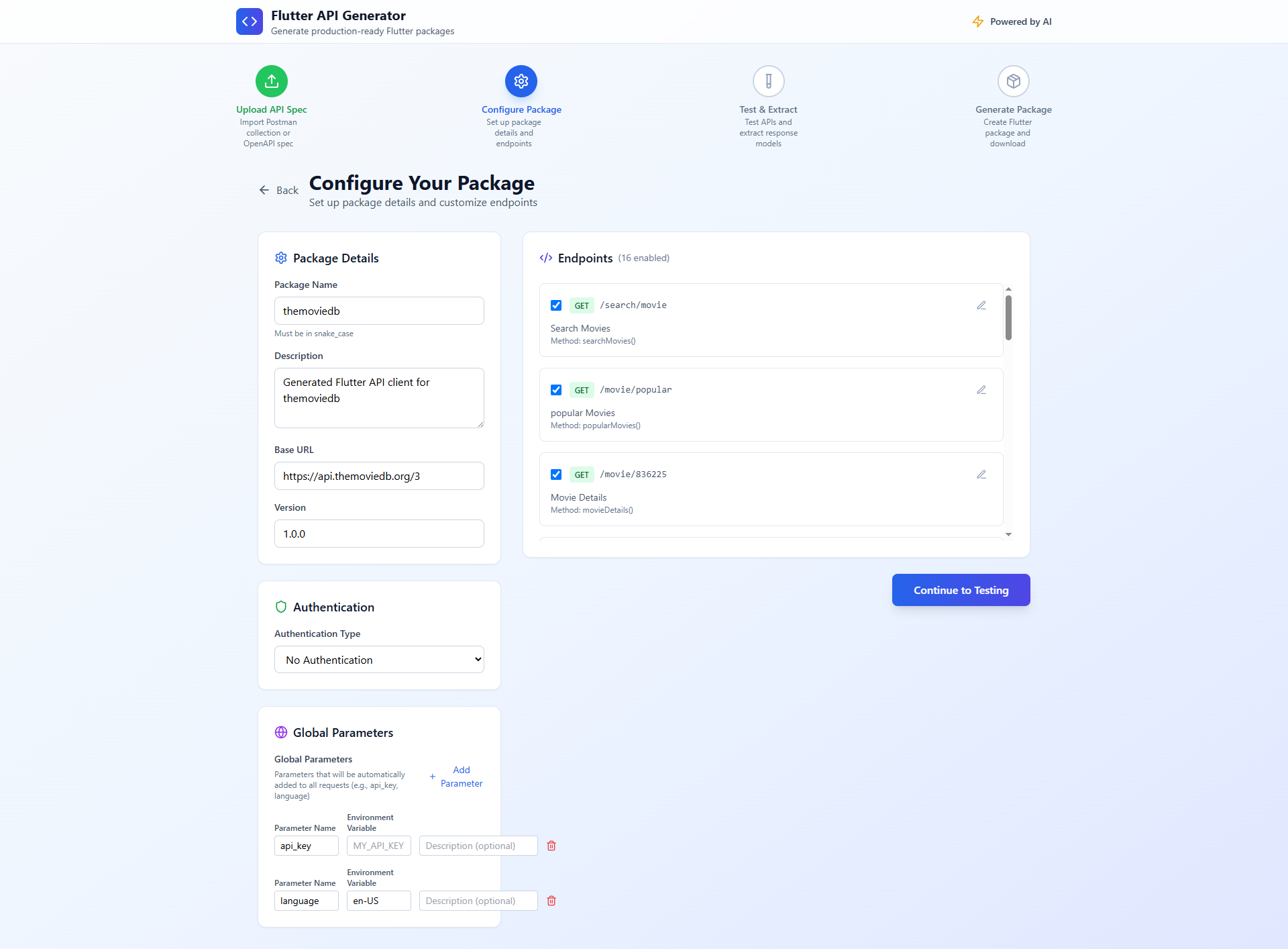
Configure Your Package
-
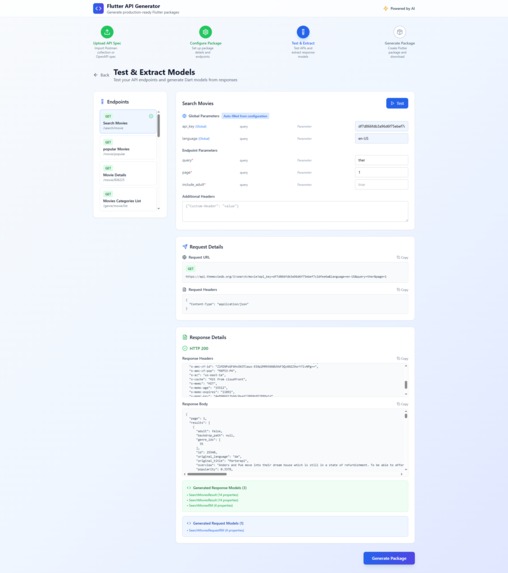
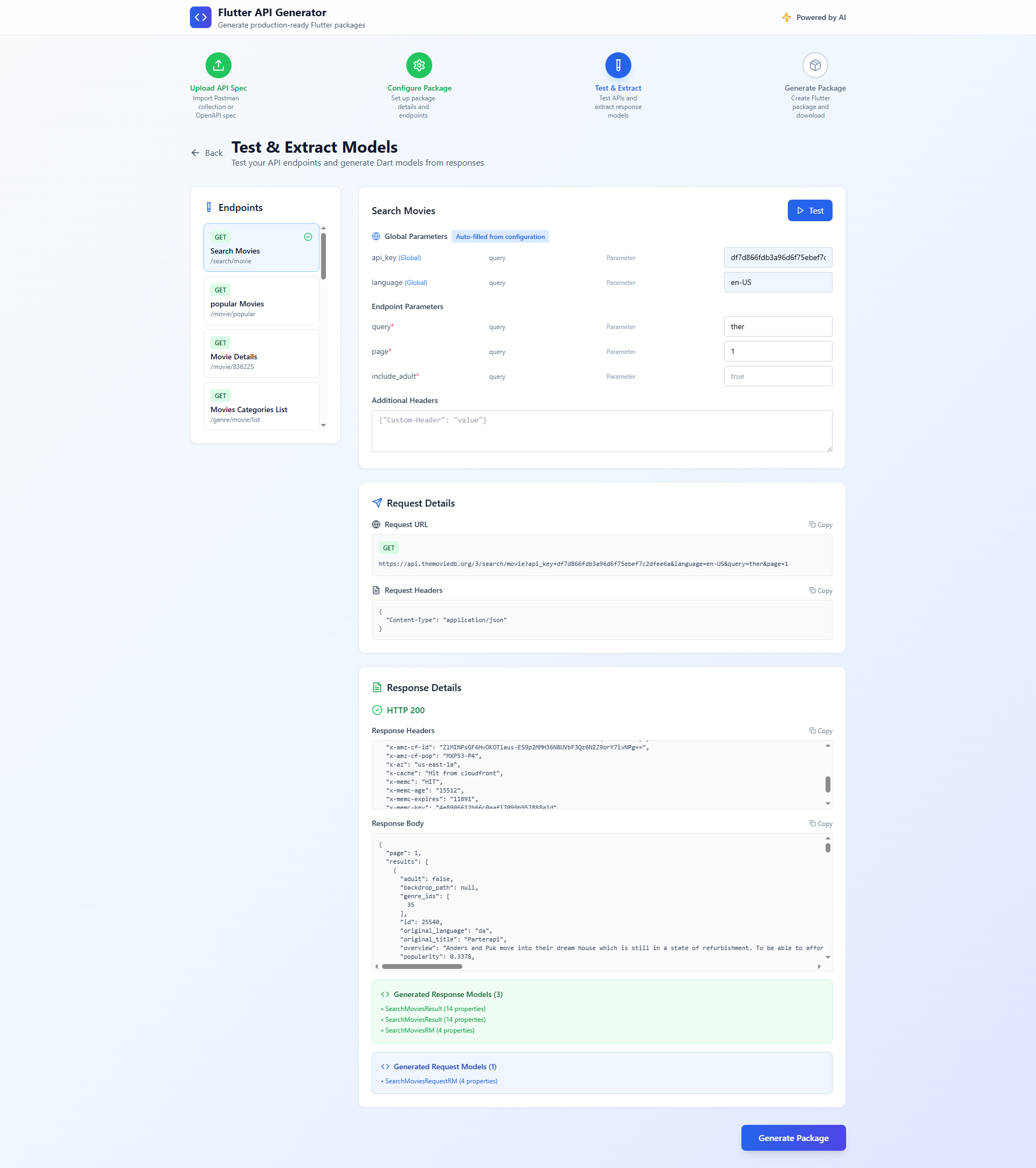
Test & Extract Models
Flutter API Generator - Project Story
Inspiration
As a Flutter developer, I've always been passionate about creating well-structured, maintainable applications. Over time, I developed a comprehensive Flutter template that was architecturally sound but admittedly over-engineered. While it provided excellent structure, it became time-consuming to work with, especially when implementing API integrations and managing data models.
The breaking point came when I realized how much time I was spending on repetitive tasks: parsing Postman collections, creating Dart models, writing API client code, and setting up proper error handling. I had been planning to learn Go or TypeScript to build a code generation tool, but time constraints kept pushing this project to the back burner.
When Bolt.new opened its AI-powered development platform to everyone, I saw an opportunity to revolutionize how I approach this problem. Instead of spending months learning a new language and building from scratch, I could leverage AI to create exactly what I needed in a fraction of the time.
What it does
Flutter API Generator is a comprehensive web application that transforms API specifications into production-ready Flutter packages. It bridges the gap between API documentation and Flutter implementation by:
- Parsing Multiple Formats: Supports both Postman Collections (v2.1) and OpenAPI Specifications (v3.0+)
- Intelligent Configuration: Automatically extracts endpoints, authentication methods, and parameters while allowing fine-tuned customization
- Live API Testing: Enables real-time endpoint testing to capture actual response structures
- Smart Model Generation: Creates type-safe Dart models with proper JSON serialization, including nested objects and arrays
- Complete Package Creation: Generates a full Flutter package with proper structure, documentation, tests, and best practices
The generated packages include authentication handling, error management, URL building utilities, and comprehensive test coverage - everything needed for production use.
How we built it
The application is built using modern web technologies:
- Frontend: React with TypeScript for type safety and maintainability
- Styling: Tailwind CSS for responsive, production-quality design
- State Management: React hooks for clean, functional component architecture
- File Processing: Custom parsers for Postman and OpenAPI formats
- Code Generation: Sophisticated algorithms that analyze API structures and generate corresponding Dart code
- Package Assembly: JSZip for creating downloadable Flutter packages
The architecture follows a multi-step wizard approach:
- Upload & Parse: Intelligent parsing of API specifications
- Configure: Package customization with authentication and global parameters
- Test & Extract: Live API testing to capture real response models
- Generate: Complete Flutter package creation with proper file structure
Challenges we ran into
Complex Model Generation: Creating a system that could handle deeply nested JSON structures and generate proper Dart classes with correct type inference was challenging. We had to implement recursive model generation that maintains proper naming conventions and handles edge cases like arrays of objects and nullable fields.
Authentication Abstraction: Supporting multiple authentication methods (API keys, Bearer tokens, Basic auth) while keeping the generated code clean and maintainable required careful design of the authentication interceptor system.
Real-time API Testing: Implementing a system that could make actual API calls, handle CORS issues, and extract meaningful model information from responses while maintaining security was complex.
Package Structure: Ensuring the generated Flutter packages follow best practices, include proper dependencies, and are immediately usable required deep understanding of Flutter package conventions.
Accomplishments that we're proud of
- Production-Ready Output: The generated packages are not just proof-of-concepts but actual production-ready code with proper error handling, documentation, and tests
- Intelligent Naming: Our model generation system creates meaningful class names by combining parent context (e.g.,
SearchMoviesResultinstead of genericResult) - Zero Configuration: The tool works out-of-the-box with minimal configuration while still allowing advanced customization
- Beautiful UX: Created an intuitive, visually appealing interface that makes complex code generation feel simple
- Comprehensive Feature Set: From authentication to testing to package generation, we built a complete solution
What we learned
AI-Powered Development: This project demonstrated the incredible potential of AI-assisted development. What would have taken months to build traditionally was accomplished in days, allowing us to focus on solving real problems rather than boilerplate implementation.
User Experience in Developer Tools: We learned that developer tools need the same attention to UX as consumer applications. Making complex processes feel simple and intuitive is crucial for adoption.
Code Generation Complexity: Building robust code generation requires deep understanding of both the source format and target language conventions. Edge cases and real-world scenarios add significant complexity.
API Design Patterns: Working with various API specifications taught us about common patterns and anti-patterns in API design, which informed our generation algorithms.
What's next for Flutter API Generator
Enhanced Language Support: Expand beyond Flutter to support other frameworks like React Native, Swift, and Kotlin, making it a universal API client generator.
Advanced Testing Features: Add support for automated test generation, mock data creation, and API contract validation.
CI/CD Integration: Build plugins for popular CI/CD platforms to automatically update generated packages when API specifications change.
Collaborative Features: Add team collaboration features, allowing developers to share configurations and maintain consistency across projects.
Advanced Model Inference: Implement machine learning to better infer model structures from API responses and suggest optimal configurations.
Real-time Sync: Create a system that can monitor API changes and automatically update generated packages, keeping client code in sync with evolving APIs.
This project represents a new paradigm in developer tooling - leveraging AI to eliminate repetitive tasks and let developers focus on building amazing applications rather than wrestling with boilerplate code.
Built With
- dart
- json
- typescript


Log in or sign up for Devpost to join the conversation.