-
-
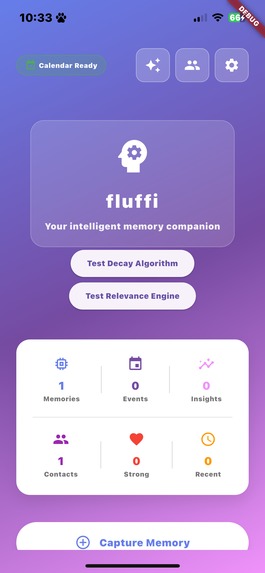
Home screen
-
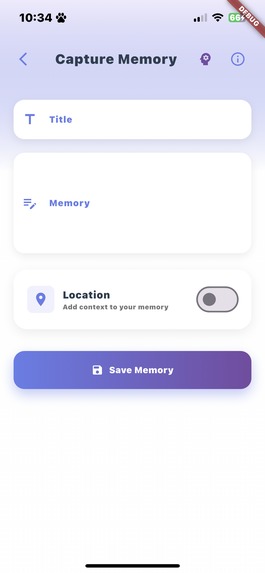
Capture memories screen
-
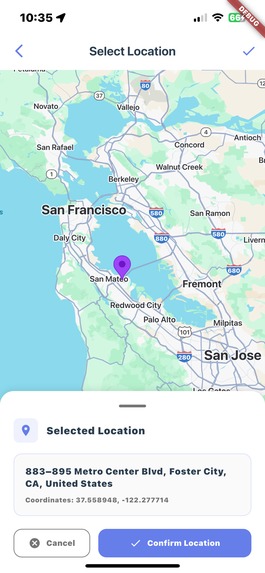
Location adding screen


Inspiration
I was inspired by the principles of contextual computing — particularly the idea that truly intelligent systems don’t just respond, but adapt to a user’s real-world context. I wanted to go beyond generic reminders or note-taking tools and create a system that interacts with the user’s cognitive processes, specifically contextual memory. Drawing from research on contextual memory trees and agentic AI, I saw an opportunity to design a memory augmentation system that retrieves relevant moments using location, time, and semantic cues — just like human recall.
What it does
fluffi is an AI-powered contextual memory assistant. It passively collects metadata (location, time, activity) and semantically enriched memory snippets, then uses Google Maps Platform, semantic embeddings, and on-device AI to resurface those memories exactly when and where they’re most relevant.
For example: walk into the lab where you prototyped a feature, and fluffi reminds you of your last debugging notes. Or revisit a spot where inspiration struck, and it resurfaces your recorded idea. It’s not just a journaling tool — it’s a context-aware recall system that mimics human memory, helping you stay cognitively in sync with your personalized activities.
How we built it
- Flutter for cross-platform mobile UI
- Google Maps SDK (google_maps_flutter) to tag memory locations
- Geolocation + Geocoding APIs for spatial awareness
- Hive for efficient on-device data persistence
- Background services for passive data collection (location, activity, voice input)
- Agentic AI architecture inspired by recent work to prioritize and resurface memories
Challenges we ran into
One of the biggest challenges I faced was designing the AI in a way that felt truly context-aware rather than just reactive. I didn’t want fluffi to function like a glorified reminder system; I wanted it to truly emulate aspects of human memory: associating thoughts with meaning, space, and time. Building a semantic memory system using embeddings was difficult, especially with sparse, messy user inputs and no large dataset. It was hard to balance relevance and noise, as I had to make sure the AI resurfaced useful memories without being distracting. Fine-tuning the trigger logic for geofencing and semantic overlap required deep iteration, especially to avoid false positives or overwhelming the user. Building agentic behavior, where the AI suggests things proactively, was conceptually hard too, as I had to think about how memory and attention work together without overstepping user intent.
Accomplishments that we're proud of
I am proud of actually being able to design and execute an agentic AI memory model that works in real-world time and space. Having struggled a bit with integrating APIs and external apps to incorporate data, I'm proud that I was able to seamlessly include the Google Maps Platform, calendar data, and mobile data (contacts, messages, etc.) with the AI reasoning layer.
What we learned
I learned that personalization isn’t just within user settings, it’s also about understanding the user’s mind and context, which is why augmentation systems are able to tailor themselves. I also researched that agentic AI requires a careful balance between autonomy and relevance. Through this project, I learned a lot refining that boundary.
What's next for fluffi
I hope to include more data points, so that fluffi can become even more detailed within analysis. I can also see fluffi being able to be integrated into wearables and physical devices to support memory.

Log in or sign up for Devpost to join the conversation.