-
-
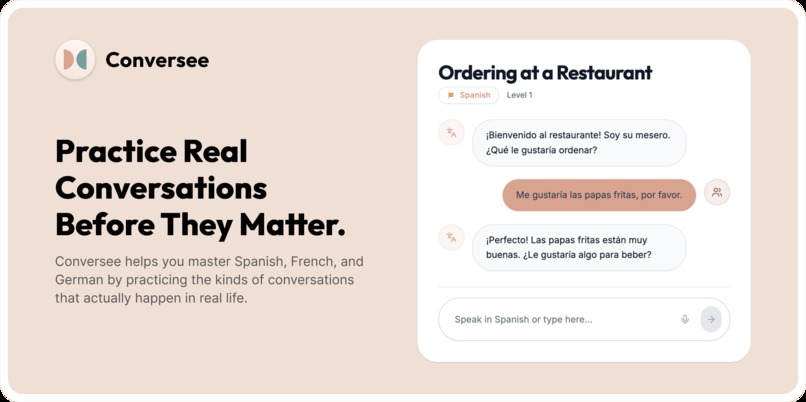
Conversee - Practice real conversations before they matter
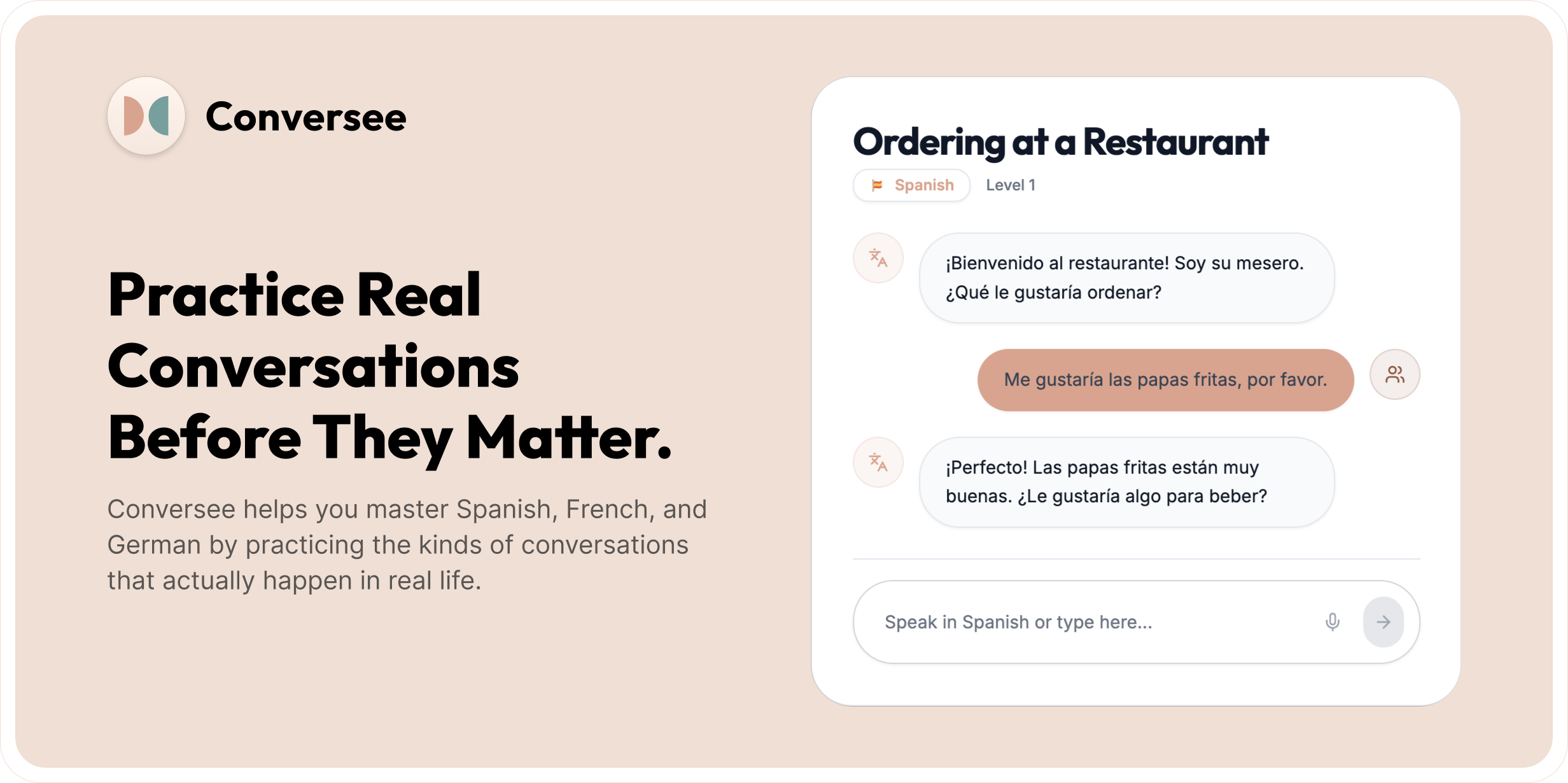
Inspiration
I learned Spanish in school and picked up a decent amount of vocabulary. Same with German, I know quite a few words. But when I actually traveled and needed to use the language, ordering food in Spain or trying to go beyond small talk in Germany, I realized I wasn’t confident. I’d forget phrases, pause too long, or give up on saying what I meant. Flashcards weren’t the issue. What I lacked was time spent actually speaking. That’s what led me to build Conversee.
What it does
Conversee is an AI-powered rehearsal tool for real-world conversations. You choose your language (Spanish, French, or German), set a goal like travel or business, and enter a realistic scenario. The tutor responds to your voice, tracks what you say, and adapts the conversation based on what you say and your skill level. After the session, you get personalized feedback on how it went. Corrections, tips, and a readiness score to show how prepared you are for similar situations in real life.
How I built it
I used bolt.new with React and TypeScript to build the app, designed flows in Figma, and leaned on Claude and GPT for support with tough bugs and copywriting. Voice interactions work across three languages. I started with ElevenLabs for speech and loved the quality, but I ran through credits fast while testing. To make things stable and cross-browser compatible, I switched to OpenAI’s Whisper API for both transcription and text-to-speech.
GPT-4 powers the dialogue and feedback logic. Conversations stay within the context of a situation, but the system reacts to your intent, not a script. Supabase handles authentication, profiles, and progress tracking.
Challenges I ran into
Natural dialogue was tricky. Early versions would just repeat themselves or move in weird directions no matter what the user said. I had to build logic that tracks user input and adjusts the AI’s responses accordingly.
Voice input had its own issues. Safari struggled with the Web Speech API, and I used up ElevenLabs credits quickly during prototyping. Whisper ended up solving both problems. It worked reliably across browsers and handled multi-language input with more flexibility. While integrating it, I added a feature that transcribes both the target language and any fallback language you use. You can say something like “Me gustaría una cerveza and how do you say bread,” and the tutor helps you with what to say and you can keep the convo flowing.
I also spent a lot of time getting the feedback system to feel helpful. Telling someone they’re wrong isn’t useful. The goal was to give a suggestion, explain the reasoning, and offer alternatives in a tone that doesn’t break the momentum.
Accomplishments that I’m proud of
I built this solo, as a product designer, in a month. It’s fully functional and voice-driven.
The tutor conversations feel responsive in a way I haven’t seen in most language apps. You don’t have to get everything right. You can speak how you naturally would, and the system meets you where you’re at. That’s something I’ve always wanted in a language tool.
The feedback system helps with better phrasing, explains the cultural context, and helps you move forward with more clarity.
What I learned
Most people don’t struggle with vocabulary. They struggle because they haven’t practiced using the words in unpredictable situations. Rehearsal builds fluency, but more importantly, it builds confidence.
I also learned what it takes to build a truly responsive voice interface. One that works in real time, across languages, and delivers meaningful feedback. A lot of small design and technical decisions had to work together to make the experience feel seamless.
What’s next for Conversee
I want to push the feedback closer to the moment you speak, so you can see a tip or suggestion right after you speak instead of when you end a conversation. I’m working on better reporting that shows trends across sessions and helps you know where to focus next. Pronunciation scoring is also on the roadmap.
There are more scenarios I want to add, like checking into a hotel, navigating a job interview, or making small talk at a meetup. I’m also looking at regional language support and building a mobile version so it’s easier to practice anywhere.
I've been testing with a small closed beta group but am planning on an open beta to get more feedback. After that, I’ll launch a paid version with expanded features and deeper tracking.
Eventually, I’d like Conversee to be the thing you open when you’re preparing for a real interaction and want to run through it one more time. Just enough to shake off the nerves and feel like you’ve already been there once.
Built With
- bolt.new
- figma
- openai
- react
- typescript
- whisper

Log in or sign up for Devpost to join the conversation.