-
-
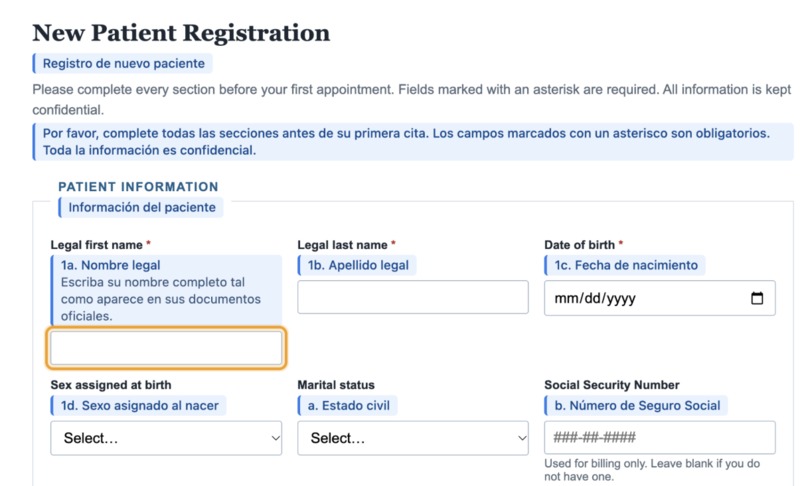
Translation and explanation pop-up on the form
-
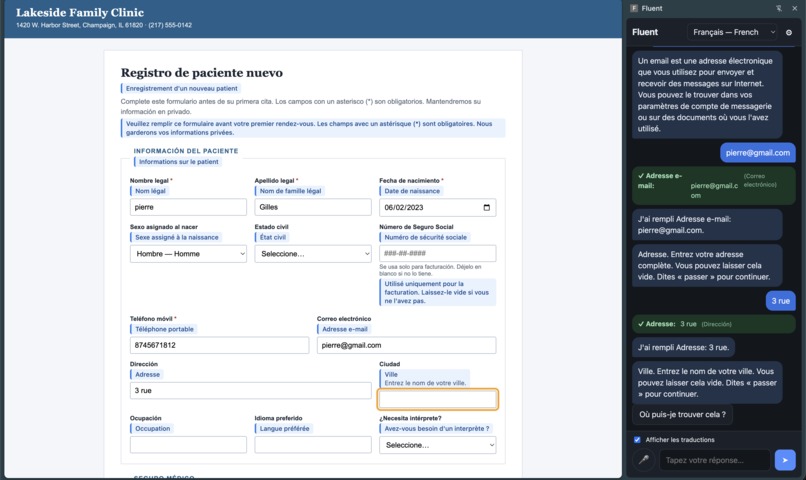
Spanish - English
-

choose-language
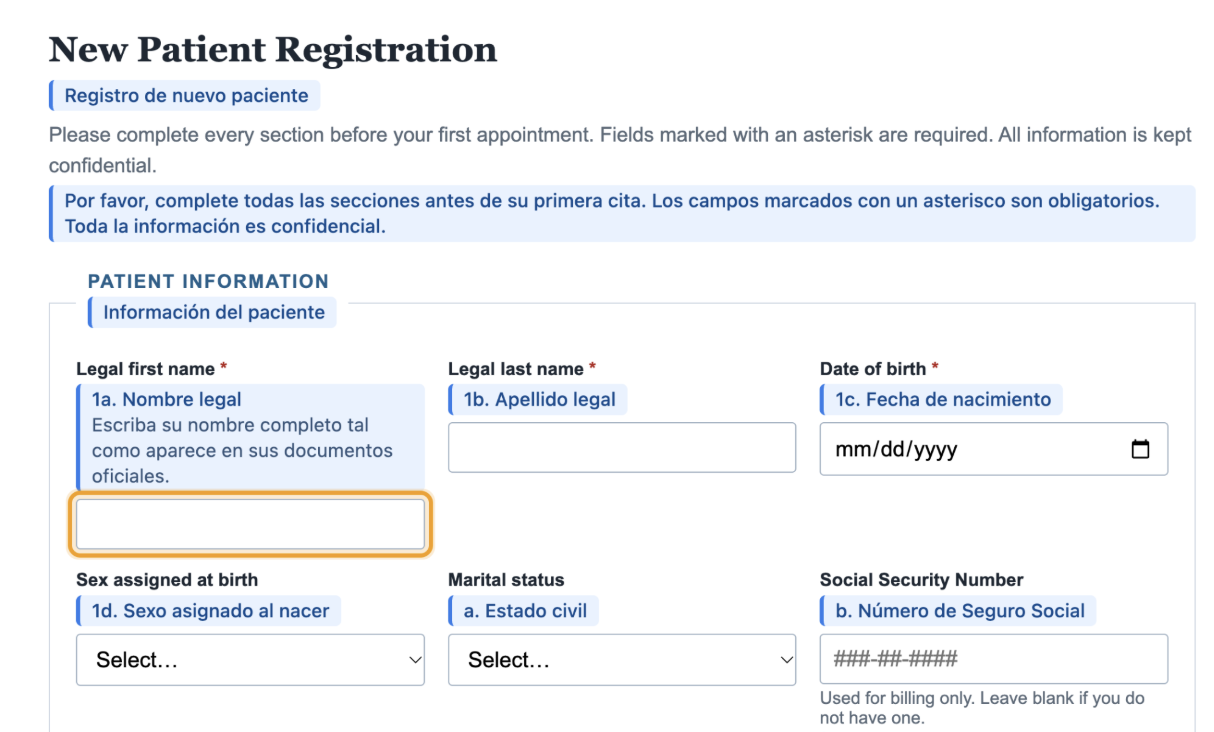
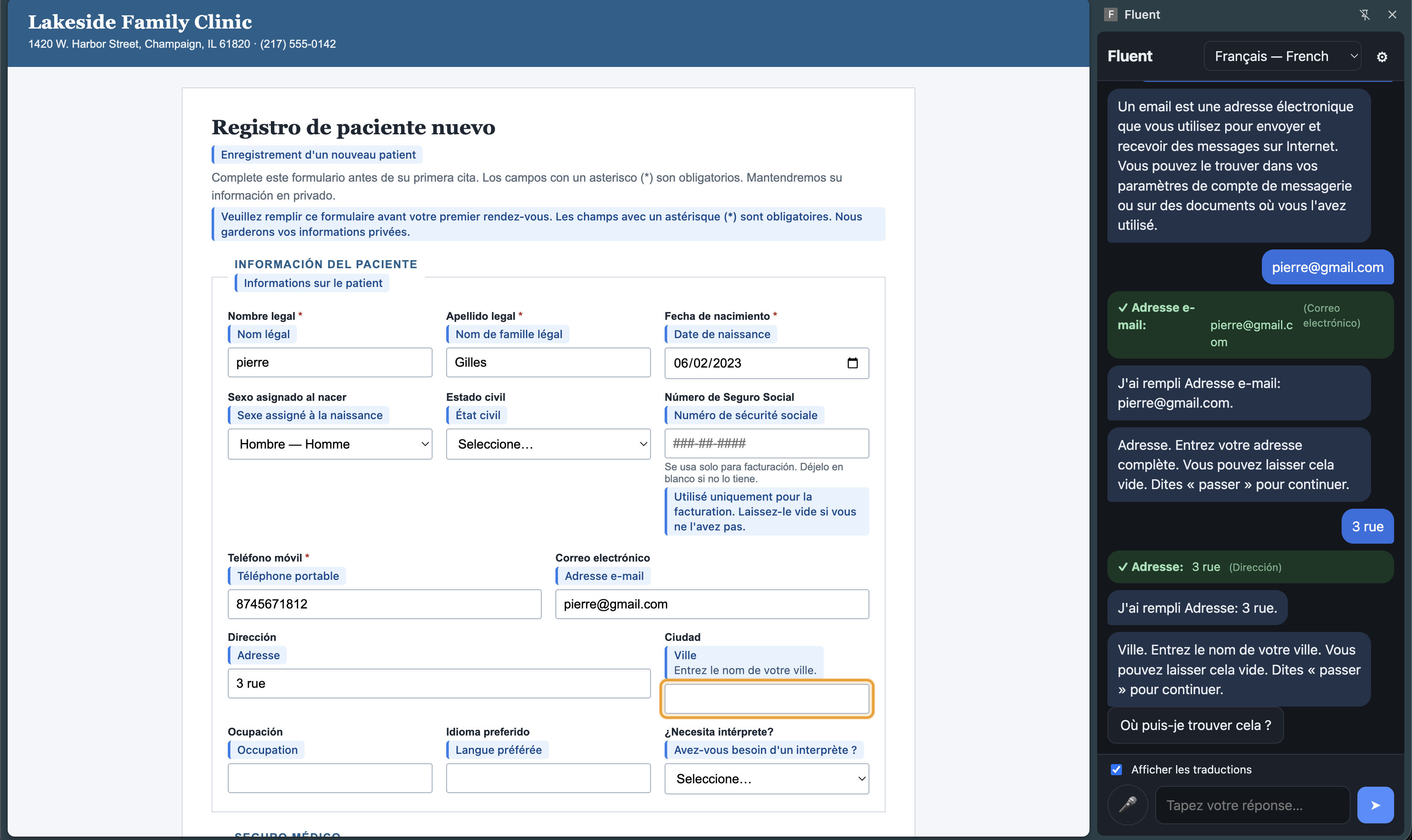

Fluent AI
One of the largest parts for immigrants or people with Limited English Proficiency (LEP) is filling out immigration forms, tax filings, medical intake forms, visa applications and insurance paperwork. All of these forms and many others require users to know the complex jargon and be fluent in English or whatever language the form is in. In 2024, around 30 million dwellers of the United States had LEP. Immigrants made up over ¾ of this group. (Batalova, 2026). The paperwork required on a monthly basis isn't routine, it is stressful and tedious. A single mistake on a question can cause a large fine or even revoking of an immigration status.
To come up with this solution and idea group discussion was required. Brainstorming was done and the idea was refined based on our entire group's opinions and knowledge bases. We considered three different groups, non native English speakers, people with various disabilities, and elderly people. Non native were the largest group by far who could benefit from our software. We observed that existing translation equipment such as google translate didn't lead to understanding. “Translation doesn't equal understanding.”
Pure translation may get words right but likely misses meaning. On Form I-485, the green card application, "paroled" can read as criminal parole, and "expunged" can read as "erased," this leads applicants to leave out records which are legally required to include. Every word needs to be understood. Before actually building a product we needed to see if this was just an artificial problem or if it was a harm causing issue. For Form I-485 incorrectly filling it out can cause denial but on other documents more severe penalties occur. For employer-facing forms such as Form I‑9, clearer guidance could also help reduce costly paperwork mistakes. I‑9 paperwork penalties can range from $288 to $2,861 per form, depending on the circumstances and ICE’s penalty calculation; the maximum across 200 forms would be $572,200, though actual penalties vary. (ICE, 2009) Our conversations with judges verified the demand. Some companies even send staff to people's homes to aid in the completion of the form. This solution isn't cost effective and doesn't scale at all.
At this point we were faced with two solutions, a pure summary or an AI agent which works an individual through the four step step. It was apparent the AI agent would be better, just more complex. We took on the task. Our agent Fluent AI works question bank to question bank both in text and verbally with a user. A user can dictate or type answers in any language. In addition a user can ask what a given prompt means and Fluent will provide where to get the information and what it may mean. Fluent is there to aid in any way possible related to filling out any form or website.
To build fluent we used Claude Code CLI to build a JavaScript Chrome extension, tested it with local language models, and used Chrome’s built-in Web Speech API for text-to-speech. We focused on making the experience conversational, so users can answer in their own words instead of having to interpret each form question on their own. Sensitive information is safe as it is through local models and will stay on the user's device. Fluent is strictly interpretive and will not change an answer or make one up for a user. Fluent AI has nearly infinite applications. In terms of language, kiosks or qr codes can be provided at government facilities, doctors offices, insurance agencies and financial institutions. These qr and kiosks will link to Fluent on a user's phone or the kiosk itself and will be able to assist with any questions or paperwork. Fluent can be used for forms and PDF’s but it can also be used on websites. Even if something is in your native language it can help limit sophisticated terminology and boost a user's understanding. Users of vision impairment or other disabilities can use Fluent to fill out forms using the audio speech tool. Fluent AI can be marketed beyond the Google Chrome Webstore and other substitutes and can go directly to companies. These companies can be Public Sector, HR firms, or Medical foundations. They would purchase the right to use Fluent AI on their websites for any user. Translation gives people the words. Fluent gives them meaning.
Jeanne Batalova, "Frequently Requested Statistics on Immigrants and Immigration in the United States," Migration Policy Institute, March 12, 2026, link
U.S. Immigration and Customs Enforcement (ICE), "Form I-9 Inspection Overview," fact sheet, U.S. Department of Homeland Security, December 1, 2009, 1, link
Built With
- claude
- codex
- gemeni
- geminideepresearch
- littlebird


Log in or sign up for Devpost to join the conversation.