Inspiration
💡 Inspiration
In an increasingly connected world, language remains one of the final frontiers separating global builders, creators, and communities. Traditional translation tools feel mechanical—you speak, you pause, you wait for a text block to process, and the natural flow of human conversation is lost.
We wanted to build FlowTalk to bring the "flow" back into cross-lingual interactions. Inspired by the desire to make real-time, global verbal collaboration completely frictionless, we set out to create a voice-to-voice translation experience that feels as instant and natural as talking to a neighbor.
⚙️ How we built it
FlowTalk is designed around a high-performance, low-latency pipeline optimized for real-time speech processing:
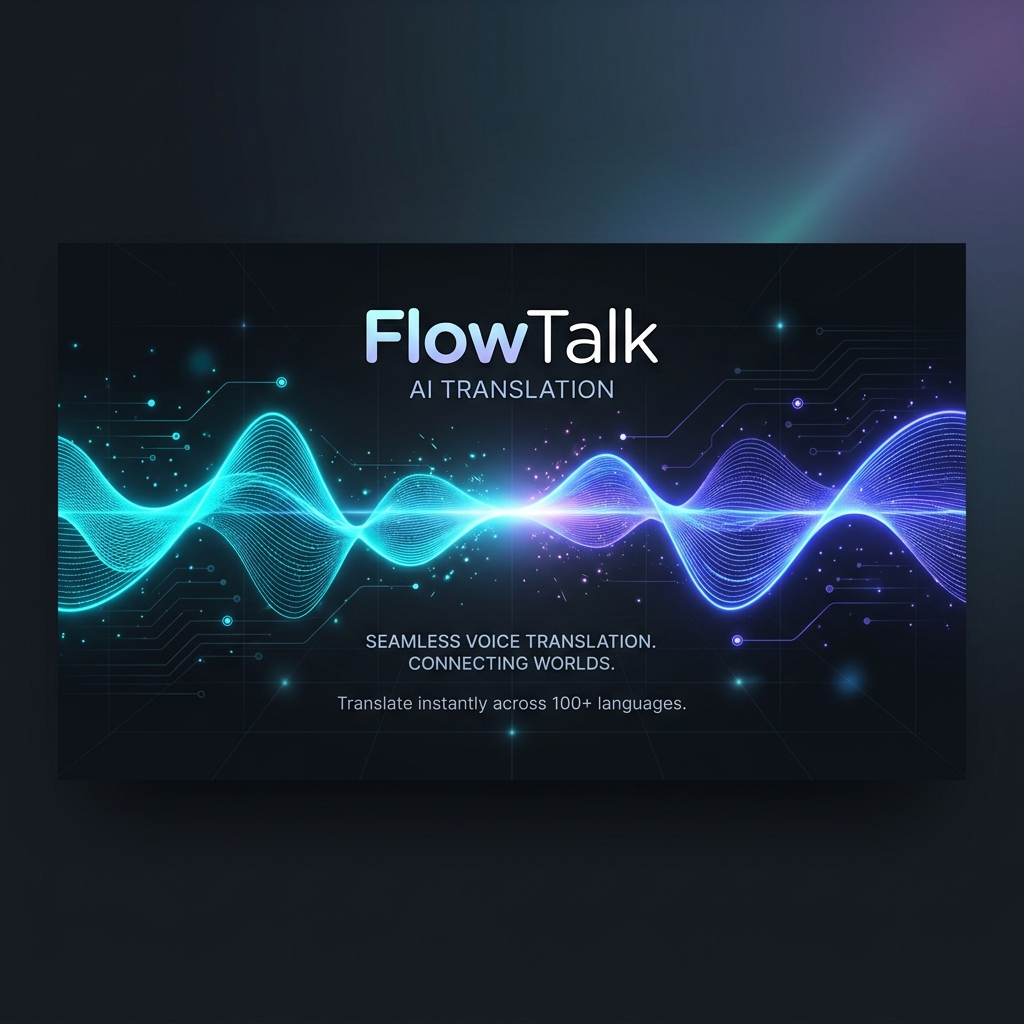
- Frontend & UX: Built a sleek, responsive interface focusing on minimalist "vibe design" elements that give users immediate visual feedback during live audio streaming.
- Audio Streaming Pipeline: Leveraged WebRTC / WebSocket connections to capture microphone input and stream raw audio data seamlessly to the backend with minimal overhead.
- AI Engine & Orchestration: * Speech-to-Text (STT): Utilized high-accuracy whisper-based models to transcribe incoming audio chunks on the fly.
- Translation & Fluidity: Routed transcriptions through advanced LLMs optimized for contextual translation, ensuring conversational idioms aren't lost in literal translation.
- Text-to-Speech (TTS): Integrated ultra-fast, natural voice generation APIs (like ElevenLabs) to stream the translated audio back to the listener instantly.
🛑 Challenges we ran into
- The Latency Battle: The biggest challenge was minimizing the time between the speaker finishing a sentence and the translated audio playing. Standard serial processing (STT → Translate → TTS) took too long. We solved this by implementing an aggressive chunk-based streaming pipeline, processing speech fragments concurrently.
- Context Preservation: Translating audio in real-time chunks can lead to broken grammar because the AI lacks the context of the full sentence. We had to implement a rolling context window buffer to allow the translation engine to intelligently adjust its output as more words were spoken.
- Audio Noise Cancellation: Managing background noise and audio artifacts from user microphones required fine-tuning the audio threshold configurations before the stream hit the AI models.
🏆 Accomplishments that we're proud of
- True Real-Time Feel: Achieved an ultra-low latency response time that allows for fluid, back-and-forth verbal communication without awkward, multi-second pauses.
- Exceptional Voice Clarity: The translated output doesn't sound like a robotic machine; it retains natural human cadence and tone.
- Robust Core Architecture: Built a modular state-management system that can easily scale to support dozens of concurrent languages.
🧠 What we learned
We learned an immense amount about the complexities of audio buffer streaming and WebSocket connection lifecycles. We also realized that when building AI-native agentic experiences, user perception of speed and UI feedback loops (like real-time waveform animations) are just as critical to the experience as the underlying model's raw processing speed.
🚀 What's next for FlowTalk
- Voice Cloning: Allowing the translated voice to match the original speaker's distinct vocal timbre and emotional inflection.
- Multi-Peer Rooms: Expanding FlowTalk from 1-on-1 conversations to entire real-time, multi-lingual collaborative meeting spaces.
- Native Desktop & Mobile Apps: Bringing FlowTalk directly to OS-level audio inputs for seamless translation across apps like Zoom and Discord. ## What it does

Log in or sign up for Devpost to join the conversation.