-
-
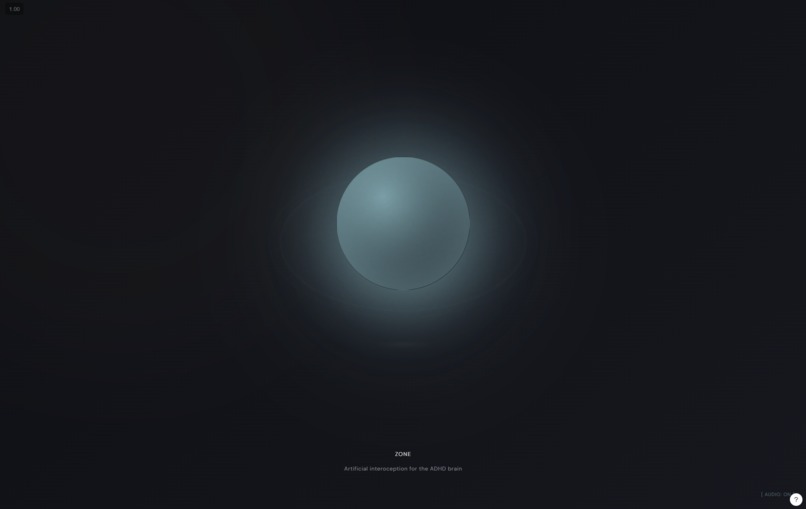
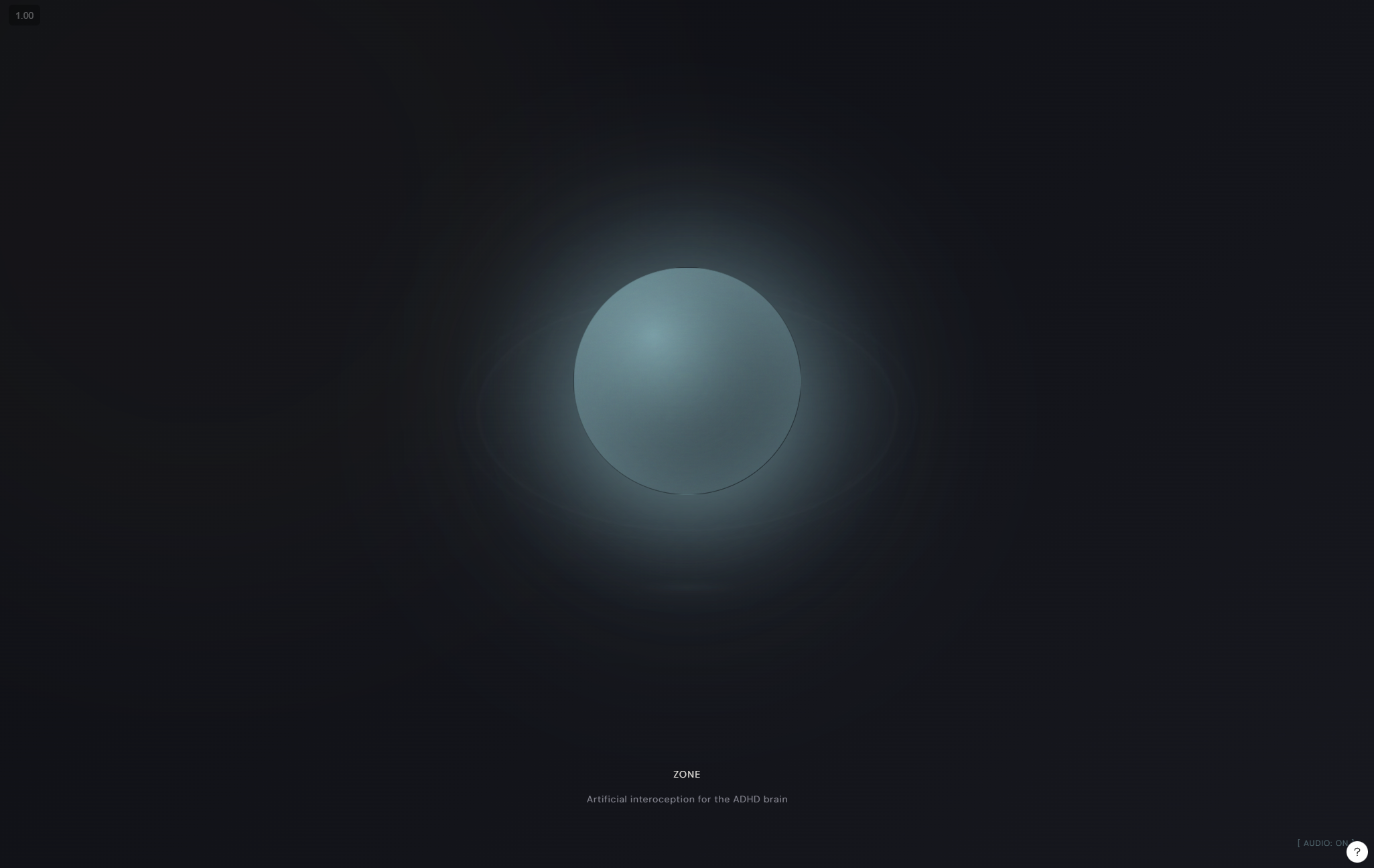
Welcome Screen
-
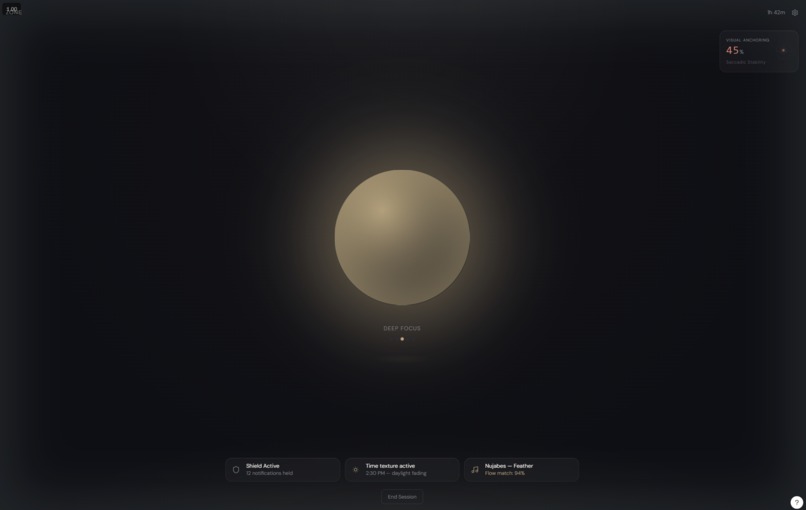
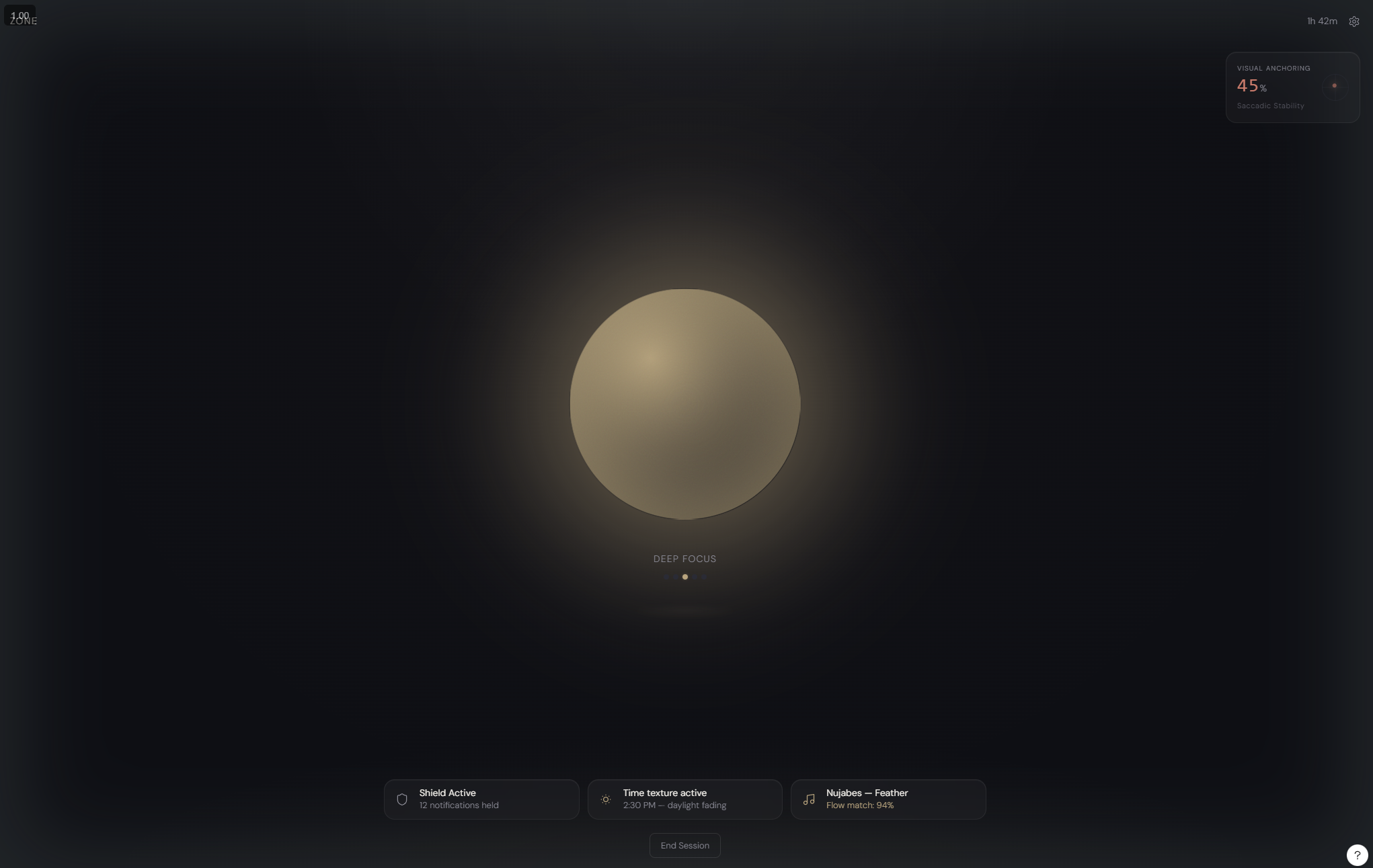
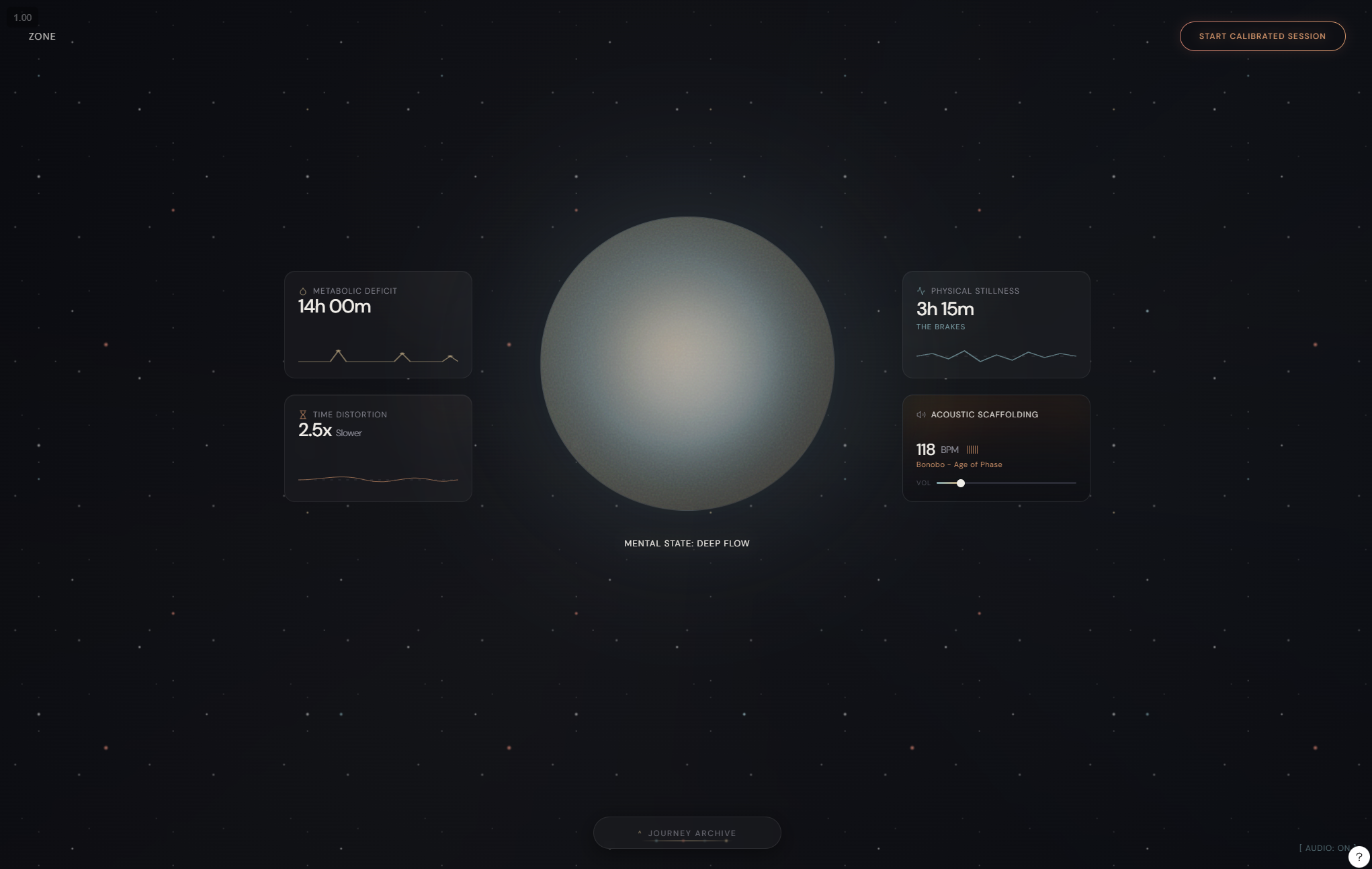
Active Session [Deep Focus]
-
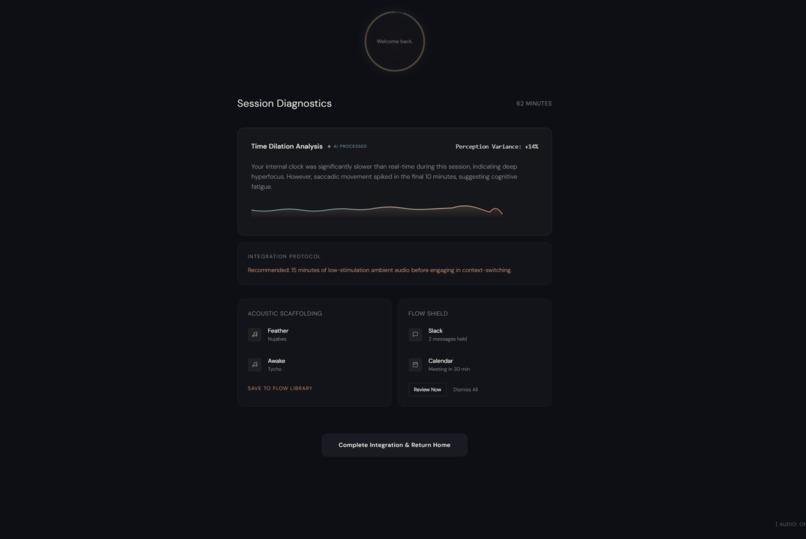
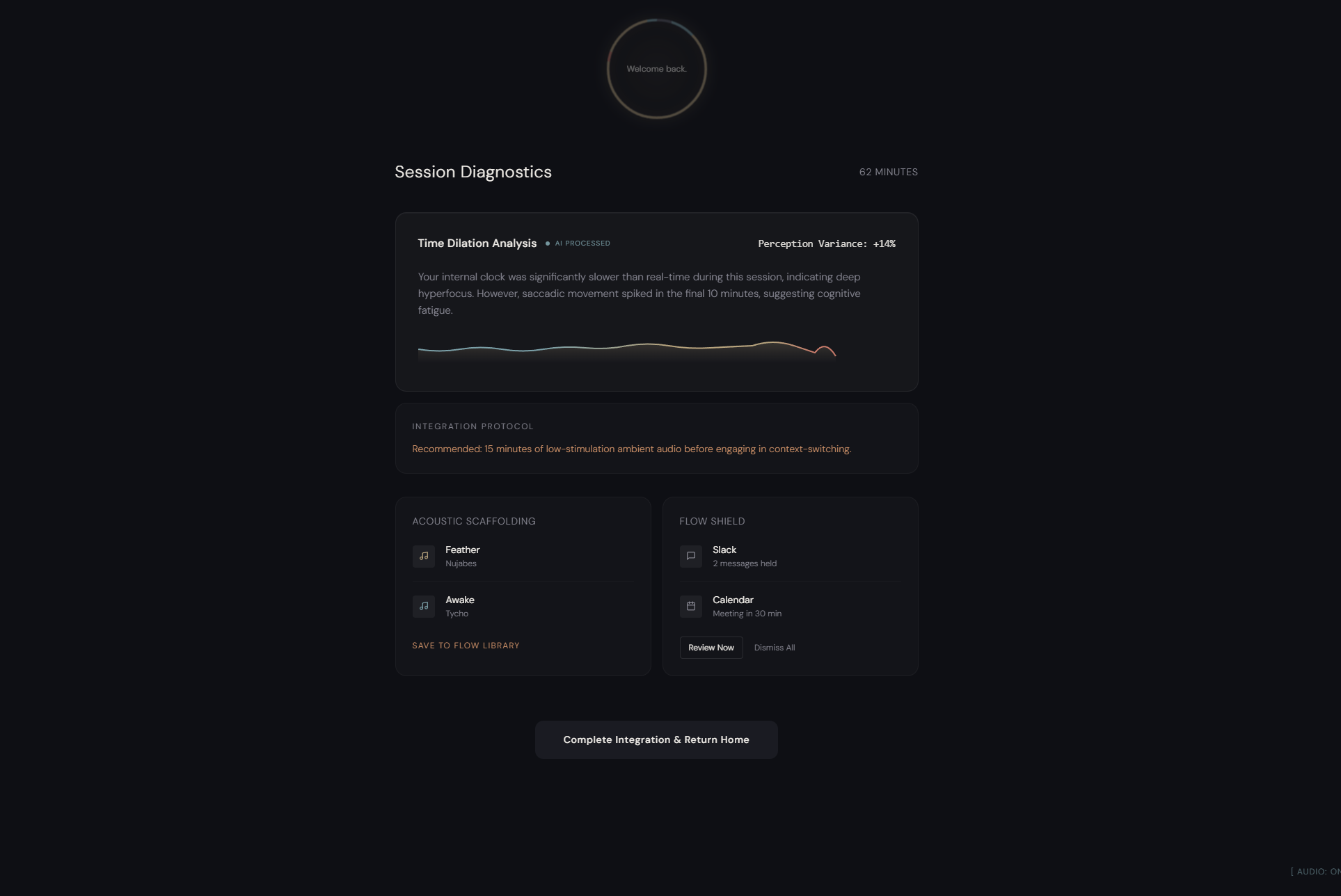
Recap of Active Session
-
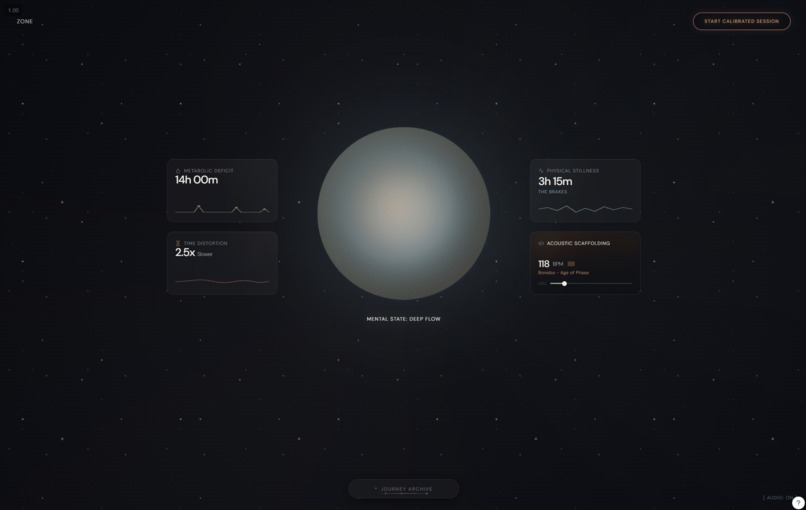
Home Dashboard - Design for Low Stimulation to not overwhelm user.
-
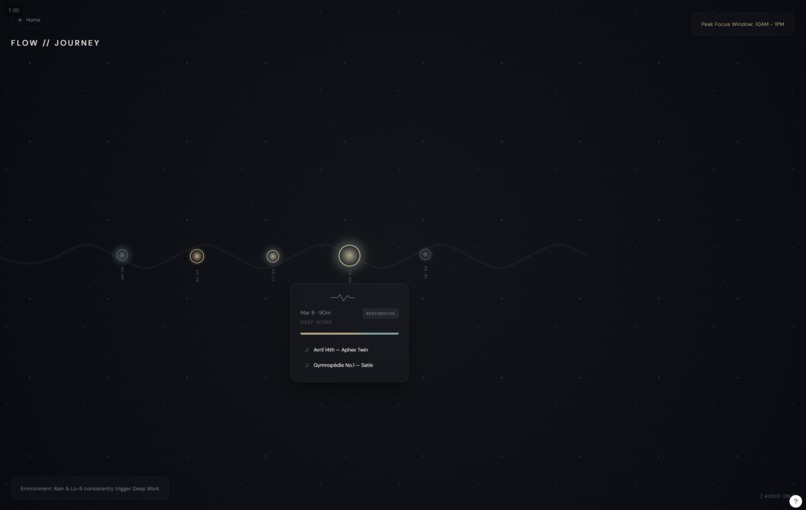
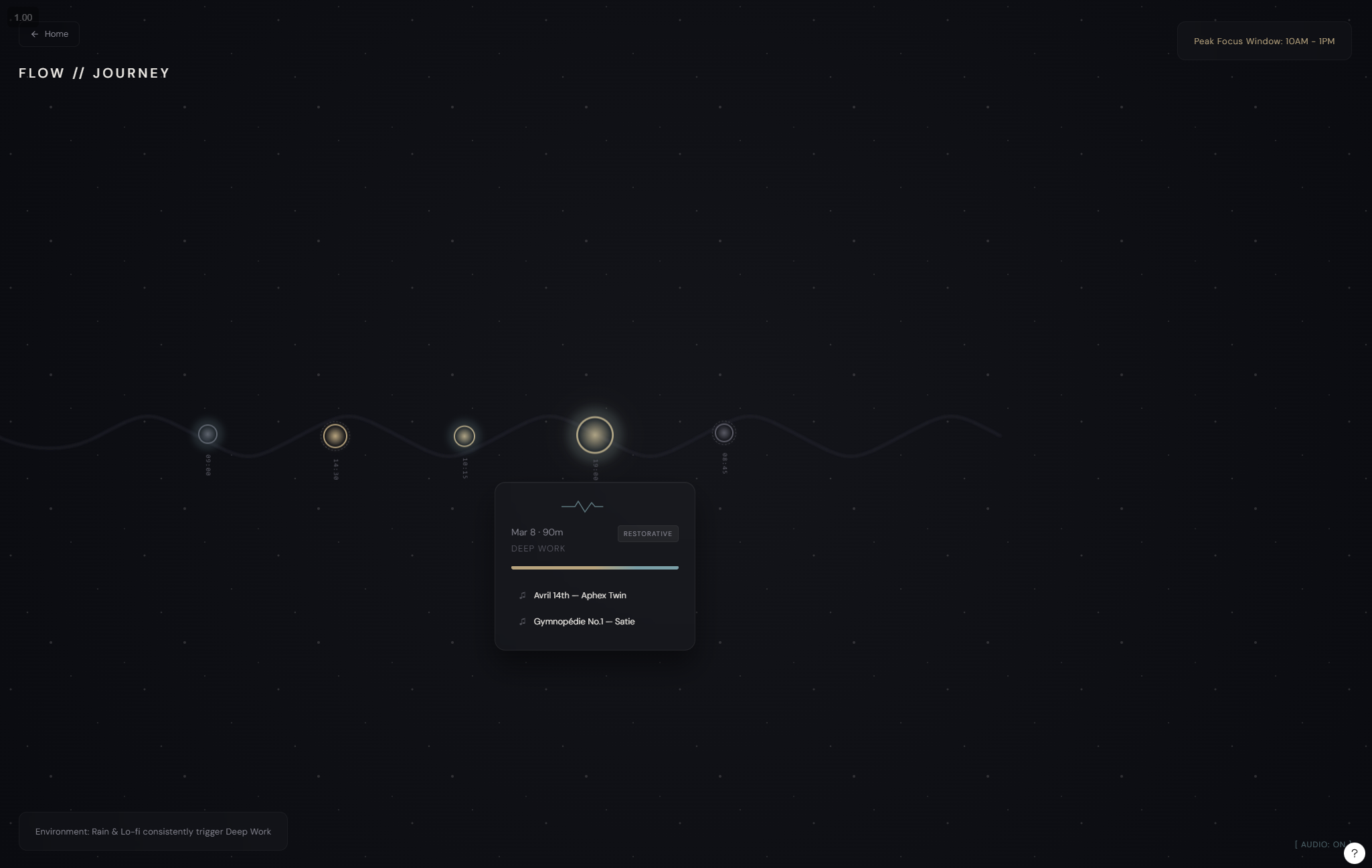
Session Logs - Session History is saved as stars in a constellation.
Zone
Take back the body awareness that hyperfocus takes away
Inspiration
It starts as curiosity. You're working on something, and it clicks. You finish one piece and immediately want to make it better. Then better again. There's this constant feedback loop where every small win pushes you forward, and before you know it hours are gone, your body gave out, and the thing you were so excited about the night before feels impossible to look at the next morning.
That's the cycle. Excitement, hyperfocus, burnout, reset. Repeat.
I have ADHD, and time blindness isn't something I manage well. When I'm locked into something I care about, my brain doesn't just deprioritize eating or drinking water or getting up. It shuts those signals off completely. I've tried Pomodoro timers. I either ignore them mid-session or they yank me out of the only productive state I've managed to reach in hours and I can't get back in. I've tried body doubling, focus music, site blockers. None of them understood the actual problem.
The actual problem is that most apps treat hyperfocus like a bug. For a lot of us it's the only superpower we have. We just can't control when it turns on or off, and we definitely can't control what it costs us when it does.
I wanted to build something that felt like the part of your brain that's supposed to regulate all of this but doesn't. Not an interruption. Not a barrier. Something that just quietly keeps you tethered while you're in it.
What it does
Zone is a standby companion that dynamically adjusts to your mental state in real time. Think of it like a freeway. When you're in hyperfocus, Zone isn't trying to stop traffic. It's building you a safe off-ramp so you don't crash at the end.
It runs quietly underneath your session, tracking behavioral signals like typing cadence, mouse movement, and tab switching to understand where you're at cognitively. Not to judge it. Not to interrupt it. Just to know, so it can respond appropriately.
There are five core systems:
Detect reads your behavioral signals and classifies your state into four categories: Drifting, Ramping Up, Deep Focus, and Overwhelm. It understands context, switching between research tabs isn't distraction, it's work. Over time it learns your specific patterns rather than comparing you to a generic baseline.
Protect activates when you're in Deep Focus. Notifications queue silently. The environment simplifies. You stay in the zone without losing anything waiting on the other side.
Ground is the core innovation. Instead of interrupting you, Zone feeds two sensory channels that research identifies as primary inputs for how the brain tracks time: a slow ambient color gradient called Time Texture that shifts from cool to warm across your session, and Daylight Drift, subtle background brightness changes that mirror natural circadian light. Both operate below the conscious attention threshold. Your nervous system registers them without your focus ever noticing.
Flow Frequency learns which music actually sustains your specific focus state and quietly skips tracks that would break it. After three sessions it reaches over 70% accuracy. It's not a playlist. It's a personalized sound environment that adjusts to you.
Hard Ceiling is the safety system that most focus apps skip entirely. There's a real abusability problem with study and focus apps, especially for people who are cramming or pushing through exhaustion. Zone has a four stage escalation from a whisper to unmissable that makes sure you can't hyperfocus into actual harm. It never forces you to stop. But it makes sure you can't pretend you didn't see the warning.
The stimulation level throughout all of this is adjustable and responsive. Zone starts at the lowest possible friction and stimulation by default. It only scales up when your behavioral signals say you need to be reeled back in. This was one of the hardest things to figure out because most apps designed for ADHD brains ironically require sustained focus just to set up and adopt. Zone is designed to work from the moment you open it with almost no configuration required.
How we built it
Zone was built over the FigBuild 2026 weekend in Figma Make as a full React and TypeScript application.
The design system is called Liquid Obsidian. It's built around deep glassmorphism, strict dark mode only, warm off-white text against layered dark backgrounds, and DM Sans throughout to keep cognitive load low. Every visual element had to pass one test: noticeable enough for your body to register, subtle enough that your conscious mind never catches it moving. If you can see it changing, it's already too stimulating.
The ambient time system composites four visual layers together: a border glow that slowly shifts from cool to warm tones, a background brightness layer that drifts over a two hour session, a central breathing Orb whose respiration rate is calibrated to slow the nervous system down without asking for attention, and dual SVG arcs showing perceived versus actual time divergence.
Challenges we ran into
The hardest problem was figuring out how to give someone critical feedback about their body without destroying the cognitive state that makes body feedback hard in the first place. Every notification based approach created the same binary I was trying to escape. Either you stop completely or you ignore it completely. There's no middle ground with ADHD.
The answer was to stop thinking about feedback entirely and start thinking about ambient signaling. Not telling the user something. Becoming a layer that the nervous system reads without ever routing through conscious attention.
Calibrating where that threshold sits for each system took most of the build time. Too subtle and the body doesn't register it. Too obvious and the focus breaks. Finding that line for color, brightness, breathing rate, and audio required more iteration than I expected.
Designing the Hard Ceiling was also harder than it sounds. Building a safety system that protects users from themselves without taking control away from them is a genuinely difficult UX problem. The goal was accountability without control, and getting that balance right took a lot of back and forth.
Accomplishments we're proud of
The Time Texture and Daylight Drift system targeting temperature and brightness perception channels to create artificial time awareness is, to my knowledge, the first consumer interface that has tried to do this deliberately. It's not a timer. It's not a notification. It's a synthetic sense.
The frictionless onboarding. Zone works from the moment you open it. That sounds simple but it's actually one of the most specific decisions in the whole product. The people who need this app most are the least able to build the habits or sit through the setup that most apps require. Zone meets you where you are, not where it wishes you were.
The Journey Map, which shows past sessions as a constellation of glowing nodes rather than bars on a chart, makes reflection feel like something worth doing rather than a performance review.
And the Hard Ceiling. I'm genuinely proud that Zone has a safety system that takes the abusability problem seriously. Most focus apps don't. They'll let you run yourself into the ground and call it productivity.
What we learned
Most apps for ADHD are designed around the assumption that the user can consistently build habits and follow structured systems. That assumption is the problem. Zone taught me that designing for your hardest moment, not your best one, changes almost every decision you make about defaults, onboarding, and interaction models.
The research wasn't background reading either. Weissenberger et al. (2021) on impaired time perception as a central ADHD symptom, Bruton et al. (2025) on measurably decreased interoception during focused states, and scalar expectancy theory's identified sensory channels directly determined which features got built and how.
And designing for neurodivergent users didn't narrow the product. Zone is genuinely useful for anyone dealing with cognitive overload, which at this point is most people who spend significant time online. The ADHD specific design just made it better for everyone.
What's next for Zone
Extending Time Texture and Daylight Drift into smart room lighting so the entire physical environment shifts with your session, not just the screen.
Wearable haptic integration so grounding signals reach you even when you're not looking at the screen.
Predictive modeling trained on individual session data to anticipate hyperfocus crashes before they happen rather than reacting after.
Flow Frequency expanding into cross-session learning and streaming API integration for truly personalized focus soundtracks.
Anonymized community patterns surfacing insights across users with similar profiles, with strict privacy by default.
Built With
- figma


Log in or sign up for Devpost to join the conversation.