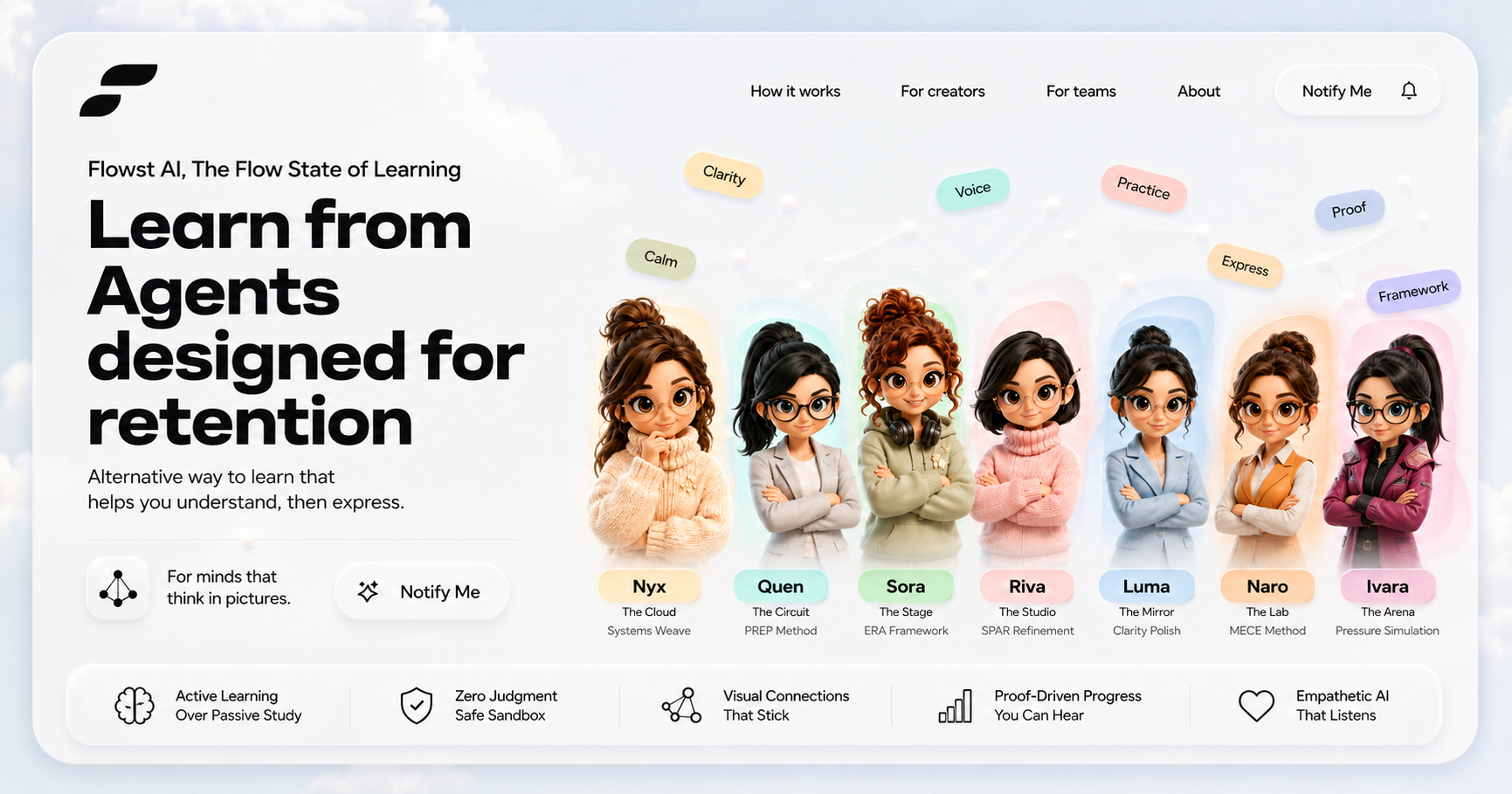
Flowst is an AI-powered learning environment that helps learners turn information into clearer understanding and evidence they can explain it.
Instead of rewarding course completion, Flowst guides learners through a bounded Flowstate: one concept, one explanation, one spoken practice, and one evidence-based reflection.
Rather than asking:
Did you finish the lesson?
Flowst asks:
Can you explain this in your own words, and can you see what needs more practice?
In the live demo, Miro prepares one focused concept, Sofia helps the learner make it clear, Amira captures one spoken explanation, Kai reflects on the evidence, and Miro records the completed Flowstate with a learning proof.
How we built it
Flowst began with ideation and product discovery in ChatGPT. I used those conversations to refine the learning framework, challenge assumptions, find clearer language for the product, and shape the direction of the experience.
I then built the project collaboratively in Codex with GPT-5.6 Terra and GPT-5.6 Luna. Codex helped translate product decisions into working software, develop and refactor features, debug end-to-end flows, improve the mobile experience, and iterate quickly on the interface and deployment.
I remained responsible for the product direction, learning philosophy, design choices, and final decisions. AI accelerated the work; it did not replace the judgement behind the product.
Rather than using AI only to generate code, I used ChatGPT and Codex across the product-development lifecycle: from the initial framework and architecture through implementation, testing, refinement, and submission preparation.
Challenges we ran into
One of the biggest challenges was realising that the AI agents were not the product.
Early versions revolved around individual agents. Through continuous iteration, I realised the real product was the learning environment: the focused concept, the learner's explanation, the evidence created during practice, and the calm path to a clear next step.
That shift changed the architecture, user experience, and direction of Flowst. The agents now have distinct roles, but the learner's Flowstate remains the centre of the product.
Another challenge was balancing educational theory with practical product design while staying focused on one polished, end-to-end learning journey within the Build Week timeline. The result is a deliberately bounded demo: one concept from Miro through Sofia, Amira, Kai, and Miro again.
Accomplishments that we're proud of
I am proud that Flowst evolved from a personal learning framework into a working product with a clear educational philosophy and a live, mobile-ready demo.
I am proud that the product does not pretend that passive completion is proof of understanding. It asks the learner to explain an idea, practise it aloud, and leave with a record of the evidence they created.
I am also proud of the collaborative build process: using ChatGPT for ideation and Codex with GPT-5.6 Terra and Luna to turn the product into a functioning experience while keeping the learning goal and product decisions human-led.
Most importantly, I am proud that Flowst treats AI in education not as a replacement for learning, but as a partner that helps people build understanding that lasts.
What we learned
The biggest lesson from building Flowst is that access to information is no longer the biggest challenge.
Helping people build genuine understanding is.
I also learned that ChatGPT can be a valuable thought partner during ideation, while Codex can be an effective engineering collaborator when paired with clear product direction and careful review.
Ultimately, the best AI experiences do not replace human thinking. They make more room for it.
What's next for Flowst
Build Week is only the beginning.
The long-term vision is for Flowst to become learning infrastructure that helps people retain, understand, and confidently apply what they are learning. That could mean supporting learners independently, or integrating with schools, universities, online learning platforms, bootcamps, corporate learning systems, and educational service providers.
Flowst is not trying to replace those institutions. It can become an intelligence layer that helps learners move beyond memorisation toward genuine understanding.
Because information is everywhere.
Understanding should be everywhere too.
Built With
- adk
- alibaba
- caddy
- codex
- compose
- dashscope
- docker
- ecs
- elevenlabs
- firebase
- firestore
- node.js
- nuxt
- omni
- typescript


Log in or sign up for Devpost to join the conversation.