Inspiration
It started with a question I kept asking while preparing for technical interviews:
Do I actually understand this, or do I just recognise it?
I had completed courses, earned scholarships, and taught others, yet I could still freeze when asked to explain a concept clearly or apply it in a new situation.
The problem was not access to information. It was the gap between consuming information and being able to retrieve, explain, and defend knowledge in your own words.
Flowst was created to make that gap visible—and help learners close it through one focused learning loop at a time.
What it does
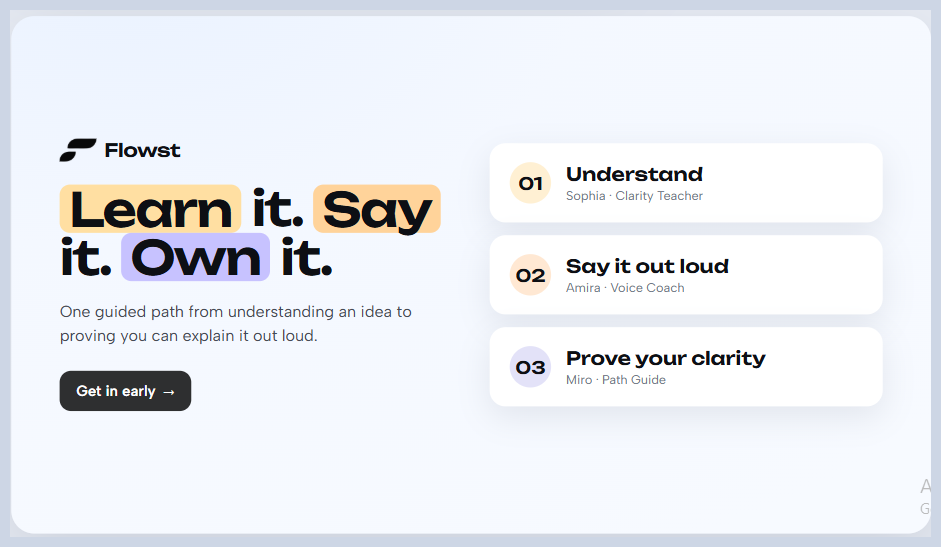
Flowst is a Qwen-powered learning environment that turns one chosen topic into a focused Flowstate: learn it, explain it aloud, get evidence-based feedback, and leave with proof of progress.
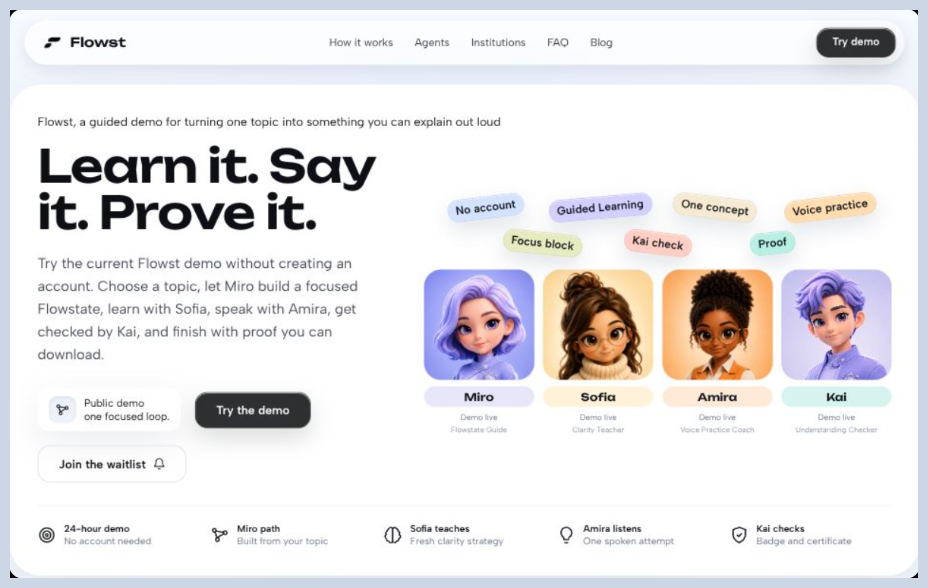
Instead of an endless tutoring conversation, Flowst coordinates a small society of specialist agents:
- Miro narrows a topic into one clear, learnable concept.
- Sofia teaches the concept using a fresh explanation strategy.
- Amira guides one real spoken explanation, helping the learner practise communicating what they know.
- Kai reviews the learner’s evidence and highlights what is clear and what needs attention.
- Miro closes the loop with the next step, progress evidence, a badge, and a downloadable certificate when earned.
Each agent has a distinct responsibility, and the learner moves through a deliberate path rather than being left to scroll through an unlimited AI chat.
How we built it
I built Flowst as a full-stack Nuxt and Vue Progressive web application with a live multi-agent workflow.
Qwen Cloud models power the core learning experience through Alibaba Cloud Model Studio / DashScope. Miro plans focused learning paths with Qwen, Sofia generates adaptive teaching and follow-up questions, Amira uses Qwen Omni reasoning for voice-practice feedback, and Kai evaluates the learning evidence.
The system uses Firestore to store learning sessions, agent runs, progress, and compact variation metadata. This helps Flowst avoid immediately repeating the same teaching strategy or question shape while keeping prior learner answers private from future prompts.
The production application runs on Alibaba Cloud ECS using Docker Compose and Caddy for HTTPS. The public demo is designed as a bounded, judge-friendly journey: one concept, one Sofia session, one spoken Amira practice, one Kai review, and one Miro completion.
Challenges we ran into
The hardest challenge was learning that multiple AI agents do not automatically create a useful multi-agent product.
Early versions risked feeling like a fixed script with AI text inside each step. I had to separate three things clearly:
- Firestore remembers what happened.
- The protocol controls what must happen.
- Qwen generates how it happens this time.
I also had to make the experience reliable under real provider delays. A blank loading state can feel broken in a live demo, so the product now gives immediate feedback when Sofia, Amira, or Kai is preparing a response, while preserving real live AI behaviour instead of replacing it with mock conversation.
Another challenge was balancing focus and flexibility. Learners need a journey that is short enough to complete, while still receiving explanations that feel fresh, responsive, and personal.
Accomplishments that we're proud of
I’m proud that Flowst is more than a collection of agent personas. It is a working Agent Society where each agent has a clear role, a handoff, and a shared goal: help the learner build knowledge they can explain.
I’m also proud of the focused demo experience. A learner can move from a topic to a clear concept, teach-back practice, assessment, and downloadable learning proof in one intentional loop.
Most importantly, Flowst treats AI as a partner in thinking not a machine for producing more information to consume.
What we learned
I learned that the best learning experience is not necessarily the one that gives the longest answer.
Understanding grows when a learner has to retrieve an idea, express it in their own words, hear where their explanation is strong, and try again with purpose.
I also learned that strong multi-agent systems need clear boundaries. Distinct roles, compact memory, visible handoffs, fallback handling, and meaningful completion states make the system feel dependable rather than theatrical.
What's next for Flowst
Next, I want to expand Flowst from one focused learning loop into a learning infrastructure that supports longer-term growth without losing clarity.
That includes richer learner memory, adaptive difficulty, source-aware learning materials, deeper evidence tracking, and Flowst integrations for bootcamps, schools, universities, and workplace learning.
The long-term goal is simple:
Help people move beyond finishing content and toward knowledge they can explain, apply, and own.
Built With
- adk
- alibaba
- caddy
- compose
- dashscope
- docker
- ecs
- elevenlabs
- firebase
- firestore
- node.js
- nuxt
- omni
- typescript
- vue.js


Log in or sign up for Devpost to join the conversation.