Inspiration
For the past five years, I've learned almost everything online, from software engineering to AI. But despite completing countless courses, I still struggled to connect ideas and confidently explain what I knew during interviews and real-world projects.
As a former teacher and a visual learner, I realized I learn best by seeing how concepts connects especially to real life experiences, then explaining them in my own words. Inspired by the Feynman Technique, I designed Flowst to have a team of AI agents that help learners understand concepts, connect ideas, visualize knowledge, and identify gaps in their understanding.
What it does
Flowst is a multi agents learning platform that adapts to how each person learns. It helps learners understand complex concepts, connect ideas, and explain what they've learned through a team of specialized AI agents. By supporting visual learning, active recall, and personalized guidance, Flowst makes learning more engaging and easier to apply in real life. It's also the beginning of an AI-native learning community where students can learn, build with AI, earn achievements, and grow together.
How we built it
Flowst combines large language models with a team of specialized AI agents, each designed to support a different part of the learning process.
Instead of relying on one AI assistant, I created different agents that help learners break down concepts, reinforce memory, reflect on what they've learned, and adapt explanations based on their progress.
I attempted to make the Agents’ design to be as human as possible, with names personalities and skills than helps reduce cognitive loads as much as possible during study.
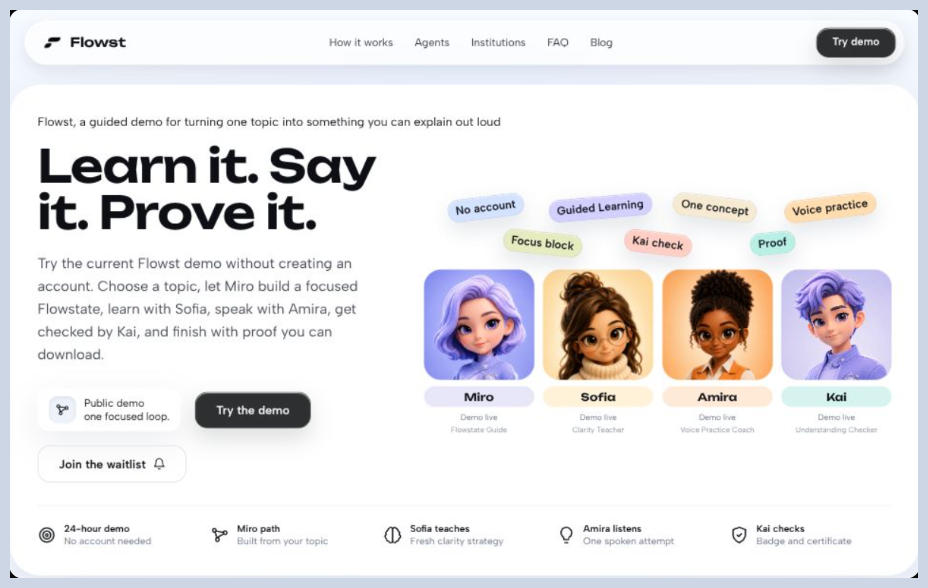
I have Miro who is the planner and memory agent, she structures concepts based on learners need, creates learning paths, and offers rewards or next best step to continue studying.
Sofia is the clarity agent, you interact via text, she designed to be curious about what you already know and would help guide learners to create mental models and explain it like they would to a really smart 5 year old
Then there’s Amira, she’s the voice agent, she’s designed to guide learners in a conversational style voice interaction with text transcription using Eleven labs doesn’t stop her from identifying communication gaps and filler words that’s can help learners be better communicators of what they’ve learnt and the personal mental models they’ve created around it and this helps better retention
Kia is the Assessor Agents, He assesses both your interactions with Sofia and Amira, identify gaps and suggests areas for improvement
In the future would be an imagegen agent for cognitive exercises and games.
Together the help learning become easy and enjoyable.
For this hackathon, I also explored ways to make the experience more accessible by introducing multiple explanation styles, simplified learning paths, and interfaces that reduce cognitive load as much as possible.
Challenges we ran into
One of my biggest challenges was preventing the agents from having endless conversations. I didn't want learners stuck in long chats that felt repetitive or mentally exhausting. Instead, I designed each teaching agent to follow a structured learning framework that helps learners move from confusion to clarity as efficiently as possible.
I also introduced time-based learning sessions, where each Flowstate has a clear beginning and end, encouraging learners to make meaningful progress before moving to the next stage. To promote healthier learning habits, I built in short five-minute breaks between Flowstates, giving learners time to step away from the screen, recharge, and return with better focus.
Accomplishments that we're proud of
I'm proud that this experience reshaped my product thinking and strengthened my empathy for learners.
Instead of treating accessibility as an extra feature, I started designing it into the foundation of Flowst.
I'm also proud that Flowst has grown beyond helping people simply complete lessons. It's becoming a platform that recognizes different learning styles and adapts to them, creating a more personal and engaging learning experience.
Most importantly, I've taken the first step toward building a platform that celebrates different ways of thinking instead of treating them as exceptions.
What we learned
The biggest lesson I learned is that designing for inclusion benefits everyone.
As I built for learners who need more flexibility, clearer explanations, and lower cognitive load, I realized those same improvements made the experience better for every learner, not just neurodivergent learners.
For what may seem like the first time ever, I actually see the possibility in a personalized learning experience that helps not just students but educators to have a personalized assessment of students that’s based thier personal learning styles, ability and cognitive skills rather than only on how well they memorize and thanks to AI I can continue to build towards this possibility
What's next for Flowst - Flowstate for Learning
My next milestone is a 30-day pilot with students and educators to test how Flowst can support learning both inside and outside the classroom.
For learners, I want to build a community where learning is something worth sharing. Students will be able to earn badges for meaningful milestones, document their learning journeys, showcase projects they've built with AI, and encourage one another as they grow. I want Flowst to become a place where curiosity is visible, progress is celebrated, and learning feels social rather than isolating.
As AI becomes part of everyday life, I also want Flowst to help the next generation develop AI literacy from an early age. Beyond using AI to get answers, learners will discover how to collaborate with AI to explore ideas, solve problems, create projects, and build with confidence. My goal is to help raise a generation that doesn't just consume AI, but knows how to think, create, and learn alongside it responsibly.
I'm equally excited about what Flowst can do for educators. In the classroom, teachers will be able to use Flowst as a visual learning assistant while gaining personalized insights into how each student learns. Instead of relying on one-size-fits-all instruction, they'll be able to identify where students are struggling, understand their learning patterns, and provide support that's tailored to each learner.
Long term, I see Flowst becoming more than a learning platform. I envision it as a home for the next generation of learners, a place where students, teachers, and AI learn alongside one another to create experiences that are more personalized, more inclusive, and that complement, rather than replace, traditional education.
Built With
- alibaba-cloud
- caddy
- chatgpt
- codex
- docker
- firebase
- firestore
- google-adk
- gpt-5.6
- node.js
- nuxt.js
- qwen
- typescript
- vue.js

Log in or sign up for Devpost to join the conversation.