Inspiration
Our journey began with a race against time. We discovered the Meta Horizon Start Developer Competition 2025 nearly two weeks after it had already launched. Determined to catch up, we dove into intense brainstorming sessions, plastering our walls with sticky notes until we completely ran out. Just as we were heading out to buy more, a teammate stopped us with a pivotal question: 'Why are we wasting all this paper? Why don't we build a Mixed Reality app that helps us generate these ideas instead?' That moment of realization was the spark that ignited FlowSpace.
What it does
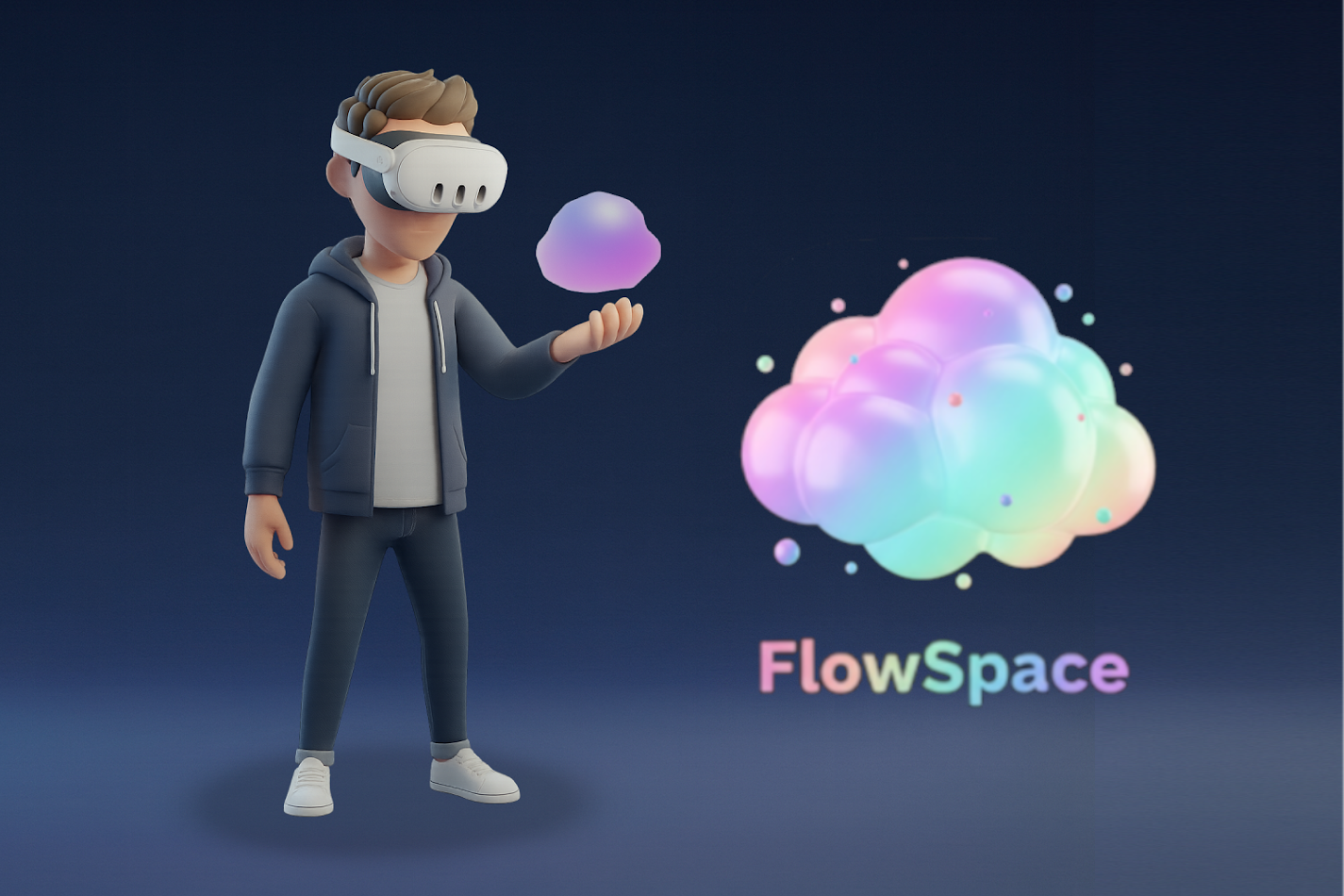
FlowSpace transforms your physical room into a shared, infinite creative canvas. Designed as a Mixed Reality Native experience, it prioritizes Intuitive Hand Controls (Controller-Free), allowing you to interact with your ideas naturally without the barrier of holding hardware.
Voice-to-Cloud: Simply speak, and your thoughts instantly materialize as floating "Idea Clouds" using Voice Dictation.
AI Assistant: Stuck on an idea? Just ask our AI Assistant. It processes your input and generates related idea clouds to expand your thinking (powered by LLMs).
Co-location: Collaborate in the real world. Two people can be in the same physical room and interact with the same clouds in real-time.
Persistence: Your ideas stay where you left them. Leave the room and come back later; your spatial mind map is anchored exactly in place.
How we built it
We developed FlowSpace using Unity and the Meta Presence Platform, prioritizing a controller-free, hand-first experience.
Core Mechanics: We leveraged the Interaction SDK to create a completely diegetic interface without 2D menus. We implemented custom Gesture Sequences (transitioning from a Fist to an Open Palm) to spawn Idea Clouds, which are dynamically generated using Procedural Meshes and custom shaders. Users can manipulate objects via Distance Grab, grip their hand to activate the AI, and use a unique two-handed "stretch" gesture to trigger voice dictation.
MR Integration: The Mixed Reality Utility Kit (MRUK) and Scene Understanding were used to enable physics interactions, allowing virtual clouds to bounce off real-world walls.
Voice & AI: We integrated Meta Voice SDK for speech-to-text conversion and connected to OpenAI's API to power the AI Assistant's logic and generate spoken responses.
Multi-user: We implemented Shared Spatial Anchors to synchronize the precise position and state of clouds between multiple headsets in the same local space.
Challenges we ran into
Balancing Innovation with Time: We joined the competition late, leaving us with a very compressed timeline. Despite this, we refused to compromise on our core philosophy: a fully _ Controller-Free experience_ . Redefining Interaction: Our biggest technical challenge was designing hand interactions that felt simpler and more intuitive than standard SDK gestures (like standard pinching). We spent significant time iterating on custom mechanics—such as the "Fist-to-Palm" sequence—to ensure users could express ideas naturally without learning complex controls.
Accomplishments that we're proud of
Setting a New Standard for Hand Interactions: We are proud to have developed a "Best Practice" implementation of MR hand interactions that feels significantly simpler and more intuitive than standard SDK gestures.
Bridging the Gap for Non-Gamers: By removing the learning curve, we have made FlowSpace accessible to a mainstream audience—users who might be new to devices like the Meta Quest 3/3S. Instead of struggling with controls, they can jump straight into their "Flow State" and focus entirely on unleashing their creativity.
What we learned
From Manual Coding to Building Blocks: Despite our team's extensive background in Immersive Technology dating back to 2016 (including early hand tracking experiments with Leap Motion), this hackathon was a revelation.
The Power of the Ecosystem: We learned just how powerful the Meta Presence Platform and Building Blocks truly are. Unlike our previous experiences building VR/MR from scratch in Unity, leveraging these standardized blocks significantly accelerated our development timeline. This "crash course" has not only enabled FlowSpace but has also equipped us with a rapid-prototyping workflow that we will use to build many future applications for the Horizon ecosystem.
What's next for FlowSpace
From MVP to Reality: We are fully committed to continuing this journey. While this hackathon version is just the beginning, it has validated our core belief: productivity tools can be fun, intuitive, and visually engaging.
Expanding Horizons: Beyond being a Lifestyle showcase, we see huge potential in scaling FlowSpace for the Enterprise market—bringing new, non-gamer demographics into the immersive world.
The Ultimate Goal: We aim to evolve our features to achieve a true "J.A.R.V.I.S.-like" experience. Our vision is to empower users to sculpt complex ideas and prototypes in mid-air with their hands and voice, bringing the sci-fi dream of creating like Tony Stark into reality.


Log in or sign up for Devpost to join the conversation.