The story behind FlowSpace
There's a moment most productive people know well.
It's 2 PM. Your to-do list is full. You open your task manager, stare at it for a few seconds, and close it. Not because you're lazy. Not because the work isn't important. But because something is off — your energy, your mood, your mental state — and no app in the world can see that.
That moment is why FlowSpace exists.
The problem with productivity apps
Every major productivity tool built over the last two decades shares the same quiet assumption: that you are a machine.
They track what you need to do. They remind you when to do it. They measure how much you get done. But none of them ask the one question that actually determines whether any of it happens: how are you showing up today?
A task that takes 20 minutes when you're in flow can take two hours when you're scattered or anxious. A deep work session scheduled for 9 AM means nothing if you slept badly and your brain isn't there yet. Productivity isn't just about time — it's about energy, state, and momentum. And yet we keep building tools that ignore all three.
A different starting point
FlowSpace started from a simple observation: the most effective people don't just manage their tasks. They manage themselves.
They know when they do their best thinking. They protect their peak hours for deep work. They have rituals that signal the start of focus and the end of effort. They check in with themselves throughout the day — not as an act of self-indulgence, but as a performance strategy.
FlowSpace is built to make that kind of self-awareness accessible to everyone, not just those who've spent years developing it through trial and error.
What FlowSpace does differently
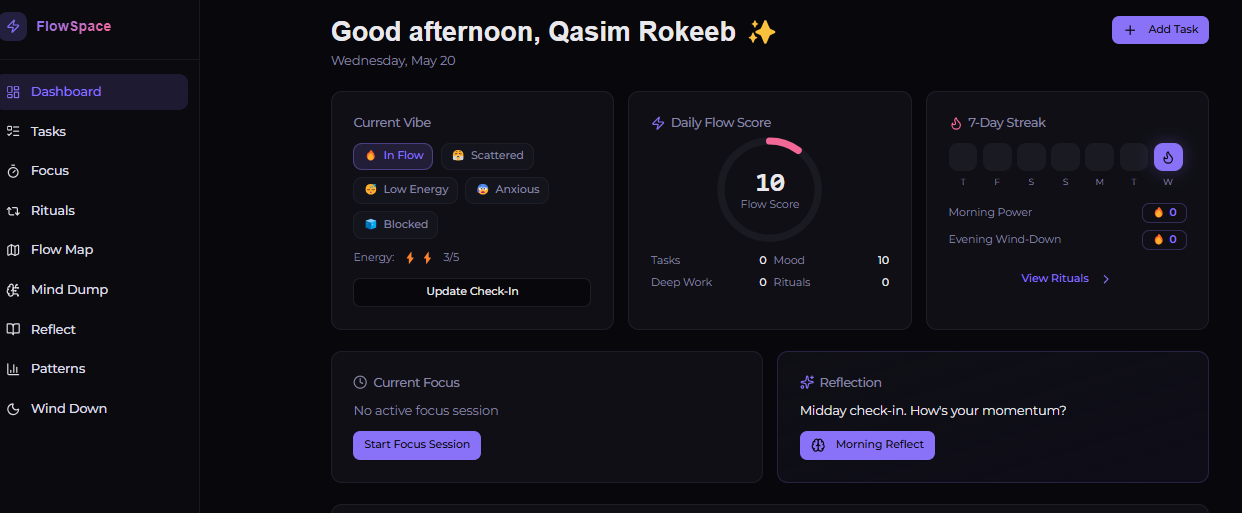
It starts with how you feel. Five times a day, FlowSpace asks a simple question: how are you showing up right now? In flow, scattered, low energy, anxious, blocked — your answer reshapes the task list in real time, surfacing work that fits your current state.
It treats energy as a resource. Every task in FlowSpace carries an energy cost — light, moderate, or heavy. The app learns your rhythms and helps you match the right work to the right moments, so you stop grinding through deep work when you're drained and stop wasting peak hours on low-stakes admin.
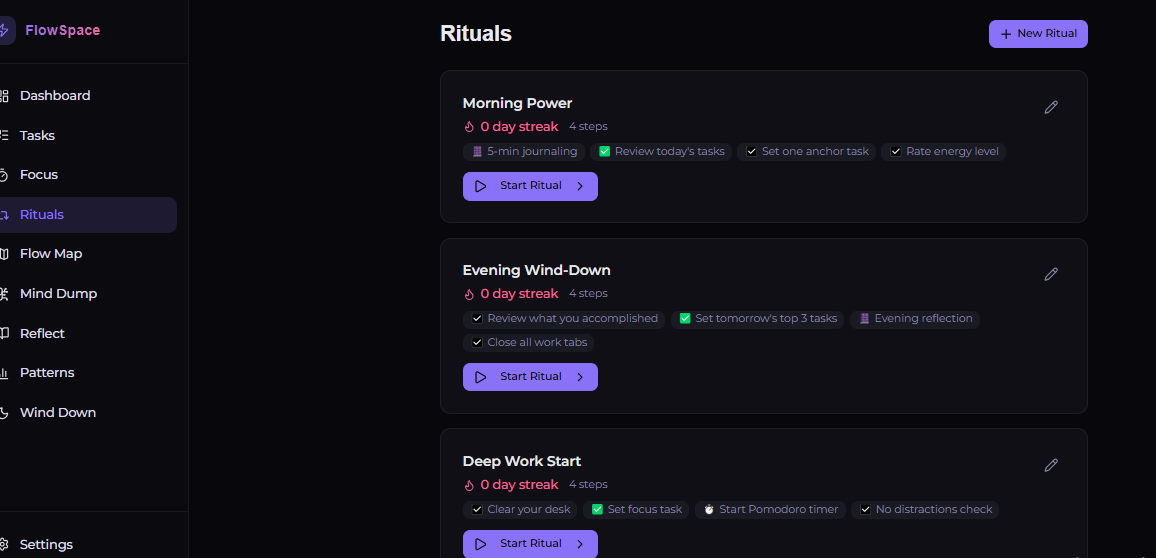
It builds rituals, not just habits. Habits are individual actions. Rituals are transitions — from sleep to work, from work to rest, from scattered to focused. FlowSpace lets you bundle micro-actions into named rituals that launch as a guided sequence, helping you shift states deliberately instead of drifting between them.
It helps you stop, not just start. Wind-down mode is one of FlowSpace's quietest but most radical features. At a set time each evening, the app shifts into a calmer mode, runs you through a short closing checklist, and then — gently, firmly — locks itself until morning. No other productivity app has ever been designed to help you put it down.
It reflects, not just records. Each morning and evening, FlowSpace opens a short AI-guided reflection — three minutes of honest questions about what you're aiming for, what's in the way, and what actually happened. Over time, these reflections surface patterns you'd never notice otherwise: the days you're most energized, the tasks that always get pushed, the hours when your best work happens.
The name
Flow isn't a productivity buzzword here. It's a specific psychological state — the condition where challenge and skill align perfectly, where time distorts, where work feels effortless and output is at its highest. Psychologist Mihaly Csikszentmihalyi spent decades studying it.
FlowSpace is built around the belief that flow isn't something that happens to you by accident. It's something you can design conditions for. The right task, at the right energy level, in the right environment, at the right time of day — that's the formula. FlowSpace helps you find it, every day.
Who it's for
FlowSpace is for anyone who's realized that the problem isn't discipline — it's design.
Founders who switch between creative and operational work and need to protect their thinking time. Writers and designers who do their best work in short, intense windows. Knowledge workers who are technically "productive" all day but finish feeling like they didn't do anything that mattered. Anyone who's downloaded five productivity apps and is still looking for something that actually fits how they work.
Where it's going
The MVP is a dashboard, a task list, a focus timer, and a mood check-in. But that's just the first layer.
The longer vision is a productivity layer that learns you — that gets better at predicting your peak windows, that notices when your mood patterns are shifting, that suggests ritual adjustments when your streak starts slipping. A tool that doesn't just record what you do, but helps you understand why some days work and others don't.
The goal isn't to make you more productive in the narrow, output-maximizing sense. It's to help you do your best work without burning out. To close your laptop at the end of the day and feel like you actually showed up.
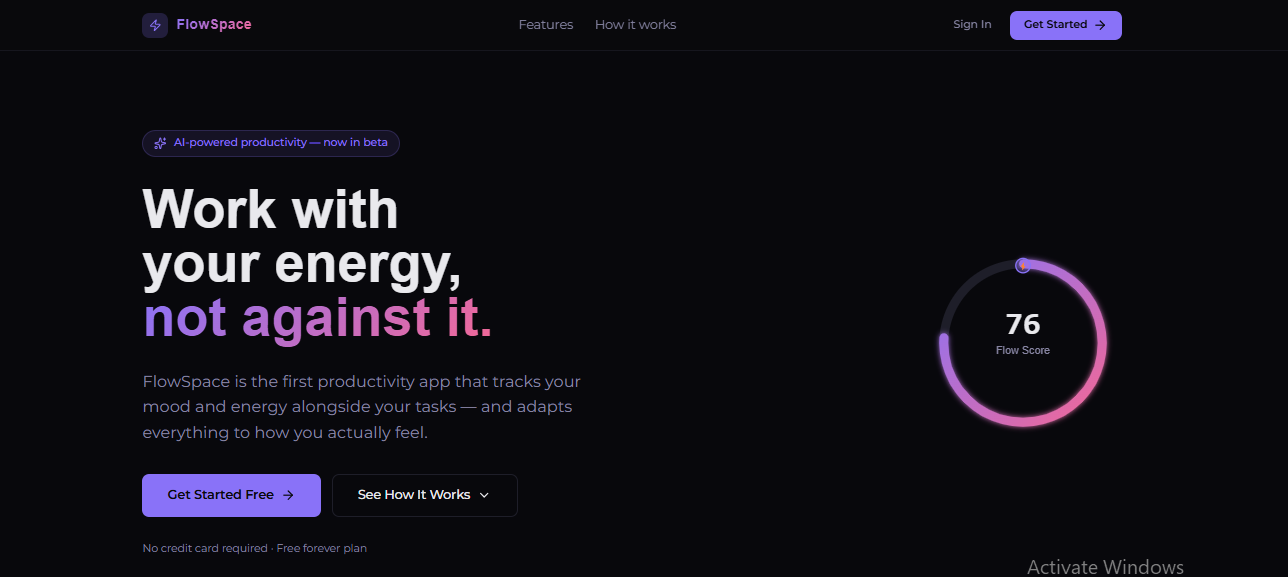
Work with your energy, not against it.

Log in or sign up for Devpost to join the conversation.