-
-
Main Logo
-
Architecture Diagram
-

Img-2
-

Img-1
-
Img-3
-
Img-4


Inspiration
Payment platforms have made sending and receiving money easier, but the business processes surrounding payments often remain fragmented across multiple tools, manual operations, and disconnected workflows.
We wanted to explore how AI agents could make these processes more intelligent by connecting natural-language interactions, product discovery, workflow orchestration, and real payment infrastructure.
This inspired FlowPayAI — an AI-powered commerce and financial workflow platform that connects intelligent agents with PayPal to simplify shopping, automate multi-step workflows, and make payment operations more observable.
Our vision was to go beyond traditional payment dashboards and create a platform where users can describe what they want to accomplish, interact with specialized AI agents, build and execute workflows, discover products, and complete payment operations while retaining control over financial decisions.
What it does
FlowPayAI brings AI-powered workflow automation, multi-agent shopping, and PayPal payment capabilities together in one platform.
Its key capabilities include:
- AI-assisted workflow creation: Provides a conversational interface for describing automation requirements and a visual canvas for working with workflow components such as triggers, actions, connectors, conditions, loops, and completion steps.
- Agent catalogue: Provides a centralized interface for discovering and interacting with specialized agents.
- AI-powered product discovery: Users describe what they are looking for in natural language, including product categories, budgets, and technical requirements.
- Multi-agent shopping: A LangGraph workflow coordinates planning, product research, deterministic evaluation, and personalized recommendations.
- Intelligent product evaluation: Assesses products against mandatory requirements and preferences, distinguishes qualified products from partial matches, and explains why recommendations qualify.
- Context-aware shopping: Users can refine previous recommendations and compare products without necessarily repeating the entire research process.
- Shopping cart and checkout: Selected products can be added to an on-site shopping cart and converted into a PayPal checkout order.
- PayPal payment operations: Supports order creation, buyer approval, payment capture, refunds, and payment-status tracking through PayPal Sandbox.
- Webhook-driven processing: Receives asynchronous PayPal events, verifies webhook signatures, and deduplicates previously processed events.
- Operational dashboards and audit trail: Provides visibility into workflow activity, product discovery, payment orders, execution history, and audit events.
A fundamental design principle is that AI agents assist with discovery, evaluation, and recommendations, while financial execution remains under explicit user control. AI agents cannot independently authorize or execute financial transactions.
How we built it
We built FlowPayAI using Python, Streamlit, FastAPI, LangChain, LangGraph, Nebius Token Factory, Channel3, and PayPal Developer APIs, following a modular-monolith architecture.
The final demonstration brings together the workflow portal and the commerce application, showcasing both workflow-oriented capabilities and an end-to-end AI-assisted shopping and payment journey.
AI and multi-agent orchestration
We use Nebius Token Factory as our model inference platform, with NVIDIA-Nemotron-3-Nano-30B-A3B (nvidia/NVIDIA-Nemotron-3-Nano-30B-A3B) as the configured default model.
The model is accessed through LangChain's ChatOpenAI client using Nebius's OpenAI-compatible API.
Our LangGraph shopping workflow coordinates specialized components:
- Planner Agent: Understands natural-language shopping requests and extracts product categories, budgets, mandatory requirements, preferences, and search queries.
- Research Agent: Converts the shopping plan into product searches and retrieves product listings through Channel3.
- Evaluation Engine: Uses deterministic Python logic to assess product listings against user requirements and rank their suitability. It does not rely on an additional LLM call.
- Shopping Advisor Agent: Generates user-facing recommendations and explains the results using the research and evaluation context.
- Existing Products Agent: Reuses previously retrieved products when users refine their requirements, avoiding unnecessary repeated searches.
This combination of LLM-powered reasoning and deterministic evaluation provides flexibility while keeping product qualification grounded in explicit criteria.
Product discovery
We integrated the Channel3 SDK to retrieve product listings through its product search capabilities.
The Research Agent normalizes the returned product information, while the evaluation engine assesses available listing evidence against the user's requirements.
The application can present product comparisons, technical specifications, pricing, and explanations of why particular products qualify. Missing or unverified product information is not automatically treated as confirmed.
PayPal integration
We integrated the PayPal Developer Platform using its free Sandbox environment.
The payment implementation uses:
- PayPal Orders v2 API: Creates checkout orders from confirmed shopping carts.
- PayPal Payments Captures API: Captures buyer-approved payments and supports refunds against completed captures.
- PayPal Webhooks: Receives asynchronous payment events, including order approval, capture completion, denial, pending, and refund events.
- PayPal Webhook Signature Verification API: Verifies incoming webhook notifications before processing them.
The buyer approves checkout through PayPal. The application then processes the relevant PayPal events and updates its persisted payment records.
The final demonstration shows a complete Sandbox payment journey: creating an order, redirecting the buyer to PayPal, approving the payment, completing the capture, and displaying the resulting transaction details.
It also demonstrates a successful refund of the captured USD 1,359.00, with PayPal returning a completed refund status and refund ID.
Application architecture and data
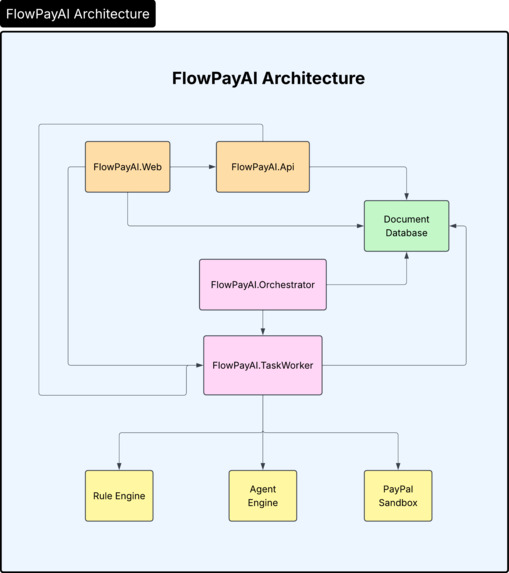
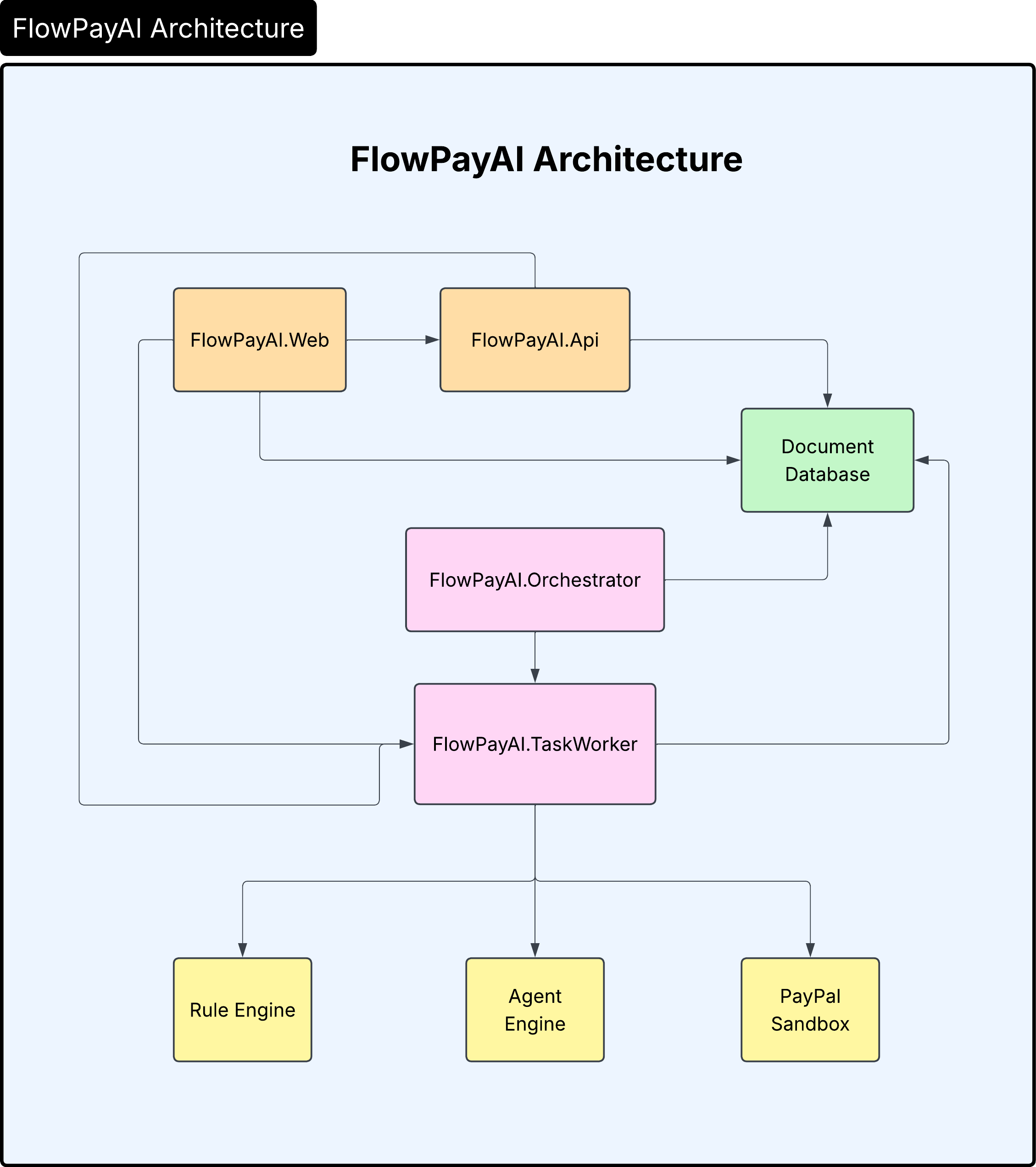
The application is organized into several components:
- Streamlit: Provides the multipage commerce application, including the dashboard, e-commerce experience, PayPal operations, and audit reports.
- FastAPI: Exposes externally reachable PayPal webhook and browser return/cancel callback endpoints.
- LangGraph: Coordinates the multi-agent shopping workflow.
- PaymentService: Encapsulates PayPal order creation, capture, refund, and payment-status operations. The Streamlit application calls this shared service directly.
- SQLite: Acts as the operational source of truth for shopping sessions, workflow executions, products, carts, payment orders, webhook events, and audit records.
- DuckDB: Provides an optional analytical read model for operational dashboards and reporting.
- Workflow portal: Demonstrates the broader FlowPayAI experience through its dashboard, agent catalogue, conversational workflow interface, visual canvas, monitoring, plugins, and execution views.
The architecture separates AI reasoning from deterministic business logic and financial execution. It also uses webhook event deduplication based on PayPal event IDs, retry-aware processing, and audit records to improve payment traceability.
Challenges we ran into
One of our biggest challenges was bringing together AI agent orchestration, external product discovery, workflow automation, and payment processing while maintaining clear boundaries between intelligent decision-making and financial execution.
Some of the challenges included:
- Multi-agent coordination: Maintaining consistent workflow state while coordinating planning, product research, evaluation, and recommendations.
- Product data quality: Handling inconsistent product listings, missing specifications, pricing information, and unverified attributes without presenting assumptions as facts.
- Context-aware refinement: Allowing users to modify previous shopping requirements while reusing relevant product results instead of unnecessarily repeating searches.
- Payment reliability: Handling asynchronous PayPal events, duplicate webhook notifications, payment-status transitions, and capture outcomes.
- Security and trust: Verifying PayPal webhook signatures and ensuring AI-generated recommendations cannot independently authorize financial transactions.
- Architectural boundaries: Integrating the user interface, AI orchestration, payment services, external callbacks, and persistence without tightly coupling their responsibilities.
- Observability: Making workflow executions, product discovery, payment records, and audit events traceable through a unified experience.
We learned that connecting an LLM to a payment API is only one part of building an intelligent commerce application. Reliable state management, deterministic business logic, security, and observability are equally important.
Accomplishments that we're proud of
We are proud to have brought together AI-assisted commerce, multi-agent orchestration, workflow automation, and PayPal payment operations in a working application.
Some of our key accomplishments include:
- Building a multi-agent shopping workflow using LangGraph and NVIDIA Nemotron through Nebius Token Factory.
- Integrating Channel3 product discovery into the AI research workflow.
- Implementing deterministic product evaluation alongside LLM-powered planning, research, and recommendations.
- Demonstrating product shortlisting against multiple technical requirements, with explanations for the recommended products.
- Connecting the shopping cart and checkout experience to PayPal Sandbox.
- Successfully demonstrating PayPal order creation, buyer approval, payment capture, and transaction-status confirmation.
- Demonstrating a successful PayPal Sandbox refund against the completed capture.
- Implementing PayPal webhook signature verification and event deduplication.
- Establishing SQLite as the operational source of truth, with DuckDB for analytical reporting.
- Creating a broader workflow experience with an agent catalogue, visual workflow canvas, conversational workflow interface, dashboards, and monitoring.
Most importantly, we demonstrated an end-to-end journey in which a natural-language shopping request leads to AI-assisted product discovery, technical evaluation, recommendations, cart creation, PayPal checkout, successful payment capture, and a subsequent refund.
What we learned
This project helped us understand that building AI-powered commerce and financial applications requires more than connecting an LLM to a payment API.
We learned the importance of:
- Designing specialized agents with clearly defined responsibilities.
- Using graph-based orchestration to coordinate multi-step AI workflows.
- Combining LLM reasoning with deterministic evaluation and business logic.
- Handling imperfect external product data and distinguishing verified information from missing or uncertain details.
- Separating AI reasoning from payment authorization and execution.
- Processing asynchronous payment events through verified webhooks.
- Designing payment workflows with idempotency, reconciliation, and auditability.
- Providing users with visibility and control over AI-assisted financial workflows.
A key takeaway was that AI should make commerce and financial workflows more intelligent, but reliability, transparency, security, and user control must remain central to the design.
What's next for FlowPayAI
We envision FlowPayAI evolving from an AI-assisted shopping and payment application into a broader AI-powered commerce and financial workflow platform.
Our next steps include:
- Expanding the catalogue of specialized agents for shopping, payments, and business operations.
- Improving agent collaboration, planning, and context-aware workflow execution.
- Connecting conversational workflow creation more deeply with executable visual workflows.
- Enhancing workflow monitoring, retry mechanisms, and failure handling.
- Expanding PayPal capabilities and improving payment reconciliation.
- Introducing human approval checkpoints for sensitive or high-impact financial actions.
- Extending the plugin and integration ecosystem to connect additional services.
- Strengthening authentication, authorization, and production deployment readiness.
Our long-term vision is to make FlowPayAI a platform where users can describe what they want to accomplish, intelligent agents can coordinate the necessary steps, and users retain visibility and control over every important operation — especially when money is involved.


