-
-
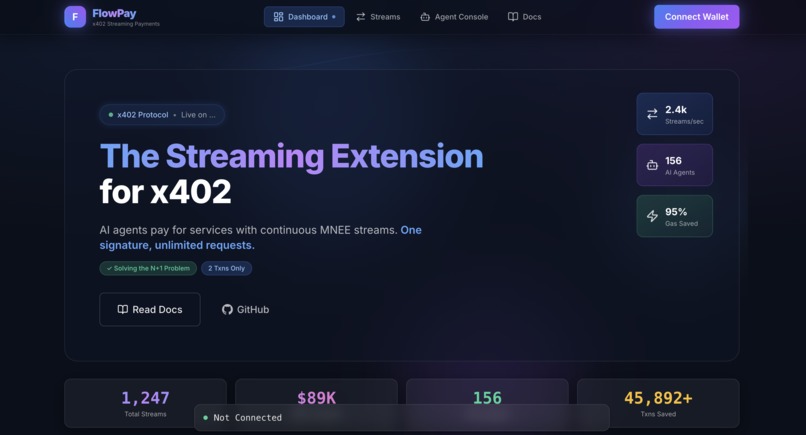
dashboard
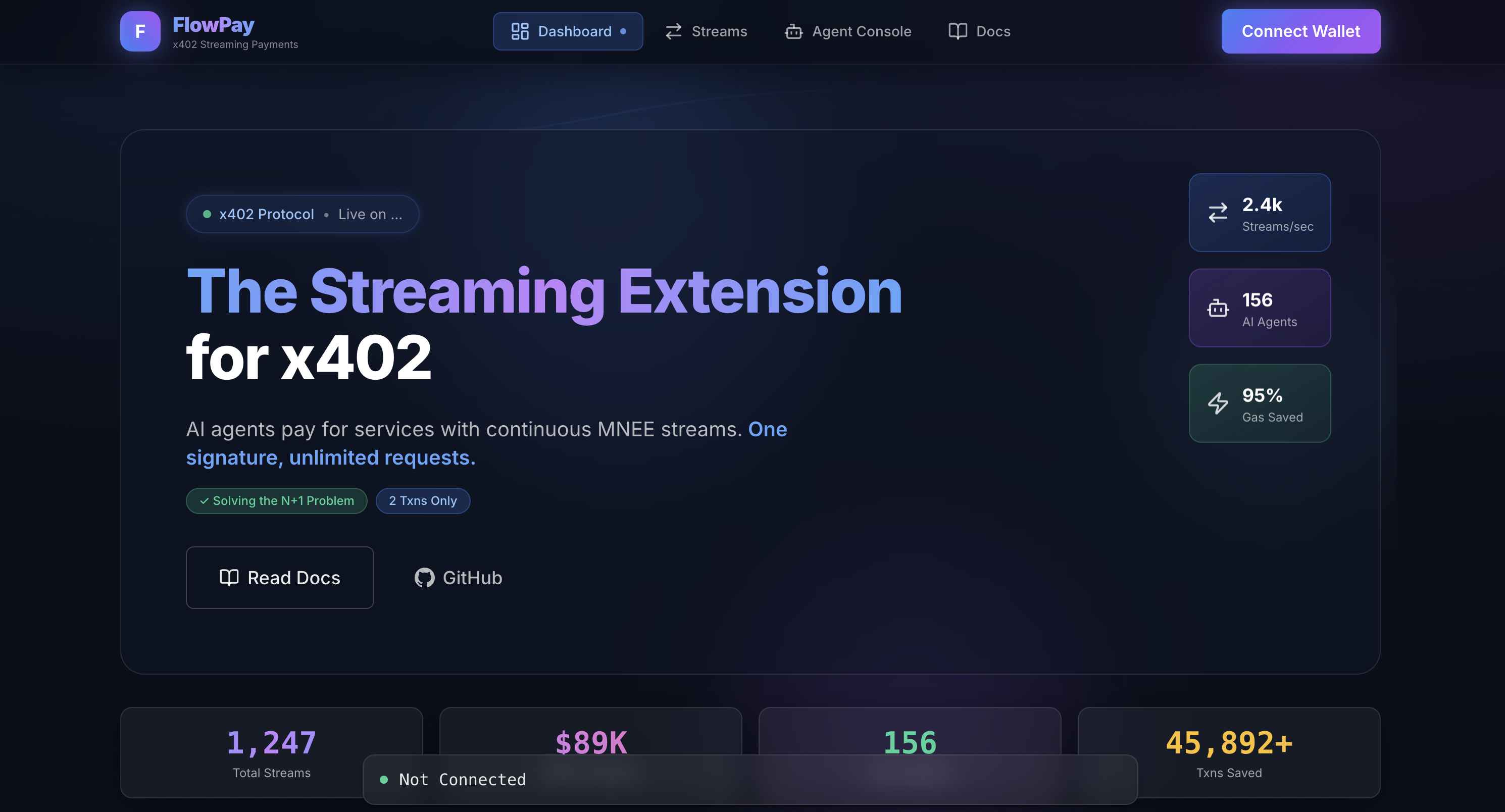
FlowPay
Inspiration
Ethereum gas fees are brutal. A single transaction can cost $5-50+ depending on network congestion. Now imagine an AI agent that needs to make 1,000 API calls to a paid service — that's potentially $50,000 in gas fees alone just to pay for the service.
This is the N+1 payment problem: every API request requiring its own blockchain transaction. It's not just expensive — it's fundamentally broken for the age of autonomous AI agents.
We looked at the x402 protocol (HTTP 402 "Payment Required") and asked: what if we could batch hundreds of payments into a single transaction?
What it does
FlowPay turns the payment model upside down. Instead of paying per-request, agents open a payment stream — a single on-chain transaction that authorizes continuous value transfer over time.
The math is simple:
- Traditional: 100 API calls = 100 transactions = ~$500 in gas
- FlowPay: 100 API calls = 2 transactions (open + close) = ~$10 in gas
That's 98% gas savings.
How it works:
- Agent hits a paywall (HTTP 402 response)
- SDK automatically negotiates and opens a MNEE token stream (1 transaction)
- Agent makes unlimited requests against that stream (0 transactions)
- Stream closes when done, unused funds refund automatically (1 transaction)
Key features:
- x402 Protocol Integration: Automatic payment negotiation when agents encounter paywalls
- Real-time Streaming: Money flows like a utility meter — pay only for what you consume
- AI-Powered Optimization: Gemini AI decides whether streaming or direct payment is more cost-effective
- Human Oversight: Dashboard with real-time spending visibility and emergency stop controls
- Automatic Refunds: Unused stream funds return to the agent when the stream closes
Live Demo & Deployments
🌐 Live Dashboard: flowpay-dashboard.netlify.app
📜 Smart Contracts on Sepolia:
| Contract | Address | Etherscan |
|---|---|---|
| FlowPayStream | 0x155A00fBE3D290a8935ca4Bf5244283685Bb0035 |
View |
| MockMNEE Token | 0x96B1FE54Ee89811f46ecE4a347950E0D682D3896 |
View |
💻 GitHub: github.com/ola-893/flowpay
How we built it
Smart Contracts (Solidity on Ethereum)
- FlowPayStream.sol: Core streaming logic — stream creation, real-time balance calculation, withdrawals, cancellations
- MockMNEE.sol: Test ERC-20 token for Sepolia deployment
- Deployed to Sepolia testnet, designed for Ethereum mainnet with real MNEE tokens
SDK (TypeScript)
- FlowPaySDK: Handles x402 negotiation, token approvals, stream lifecycle
- GeminiPaymentBrain: AI engine that optimizes payment strategy based on expected usage
- SpendingMonitor: Safety limits and anomaly detection
Server Middleware (Node.js/Express)
- x402-compliant middleware that validates payment streams on-chain before serving protected content
Frontend (React/Vite)
- Real-time dashboard for monitoring agent activity
- Stream balance visualization
- Manual controls for stream management
Architecture:
Agent → API Request → 402 Response → SDK Negotiates →
Open Stream (1 tx) → Unlimited Requests (0 tx) →
Close Stream (1 tx) → Refund Unused
Challenges we ran into
Gas Optimization Pressure: Every byte of calldata costs gas on Ethereum. We obsessed over minimizing on-chain storage and computation.
Real-time Balance Math: Computing claimable balances based on elapsed time required precise BigInt arithmetic — rounding errors at scale would mean lost funds.
RPC Reliability: Public RPCs are flaky. We implemented fallback endpoints and graceful timeout handling.
Gemini Models: We ran out of credits for the gemini-3-pro model mid-hackathon. So we pivoted to gemini-1.5-flash with fallback heuristics.
Stream Header Design: The x402 headers needed to distinguish between token address and payment recipient — we carefully designed the header schema to avoid ambiguity.
Accomplishments we're proud of
- 98% Gas Reduction: From 100 transactions to 2. The savings are real and verifiable on-chain.
- Working on Real Blockchain: Not mocks — actual MNEE token streams on Ethereum Sepolia. See our contracts live.
- Full Stack Integration: Smart contracts, SDK, middleware, and frontend all working together seamlessly.
- AI-Powered Decisions: Gemini analyses usage patterns to choose the optimal payment strategy.
- Developer-Friendly: One line of code:
sdk.makeRequest(url)handles everything.
What we learned
- HTTP 402 is underutilized: It's the perfect handshake for machine-to-machine payments.
- Streaming beats per-request: For high-frequency interactions, the gas savings are transformative.
- AI agents need guardrails: Spending limits, emergency stops, and human oversight aren't optional — they're essential.
- Ethereum gas is the real enemy: Building for gas efficiency changes every design decision.
What's next for FlowPay
- Ethereum Mainnet: Deploy with real MNEE tokens (
0x8ccedbAe4916b79da7F3F612EfB2EB93A2bFD6cF) - Multi-token Support: USDC, USDT, and other ERC-20 tokens
- Predictive Streaming: AI that pre-sizes streams based on historical usage
- Agent-to-Agent Payments: Agents paying each other directly, no human in the loop
- L2 Integration: Even cheaper streams on Arbitrum, Optimism, Base
Built With
- Blockchain: Solidity, Hardhat, Ethers.js, Ethereum (Sepolia Testnet)
- Backend: Node.js, Express, TypeScript
- Frontend: React, Vite, TailwindCSS
- AI: Google Gemini API
- Tokens: MNEE (ERC-20 stablecoin)
- Protocol: x402 (HTTP 402 Payment Required)
Built With
- express.js
- hardhat
- react
- solidity
- vite


Log in or sign up for Devpost to join the conversation.