-
-
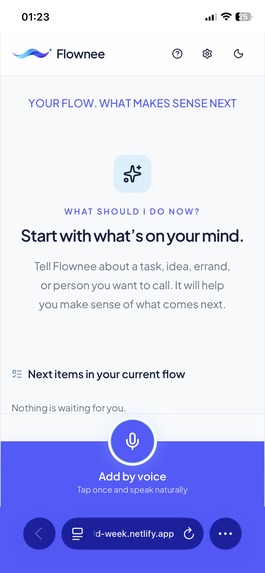
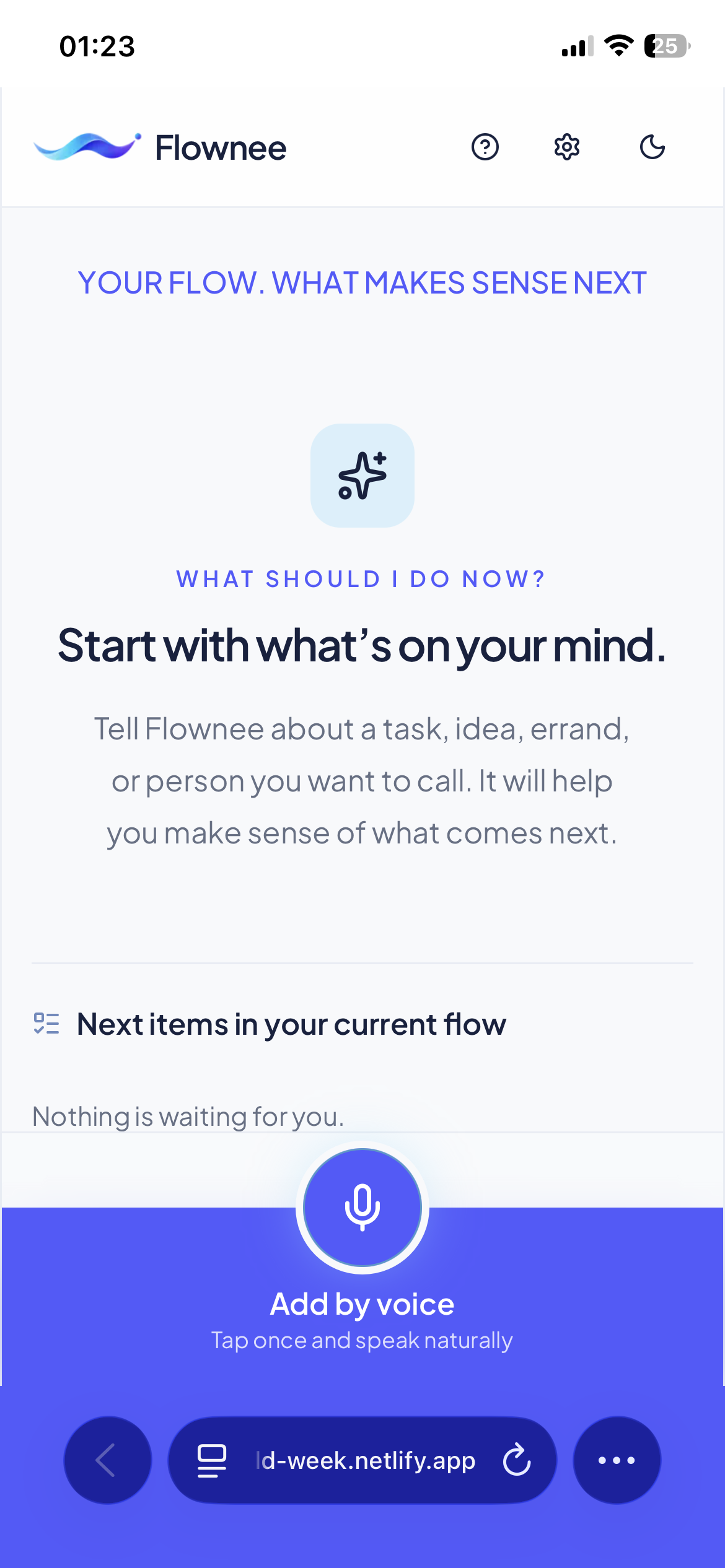
Flownee: home screen
-
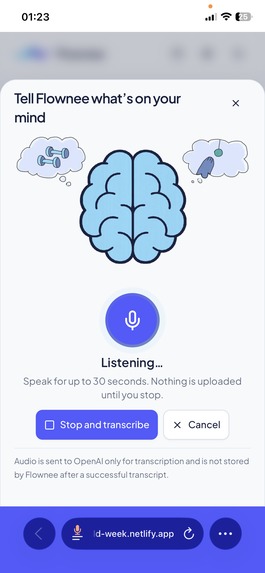
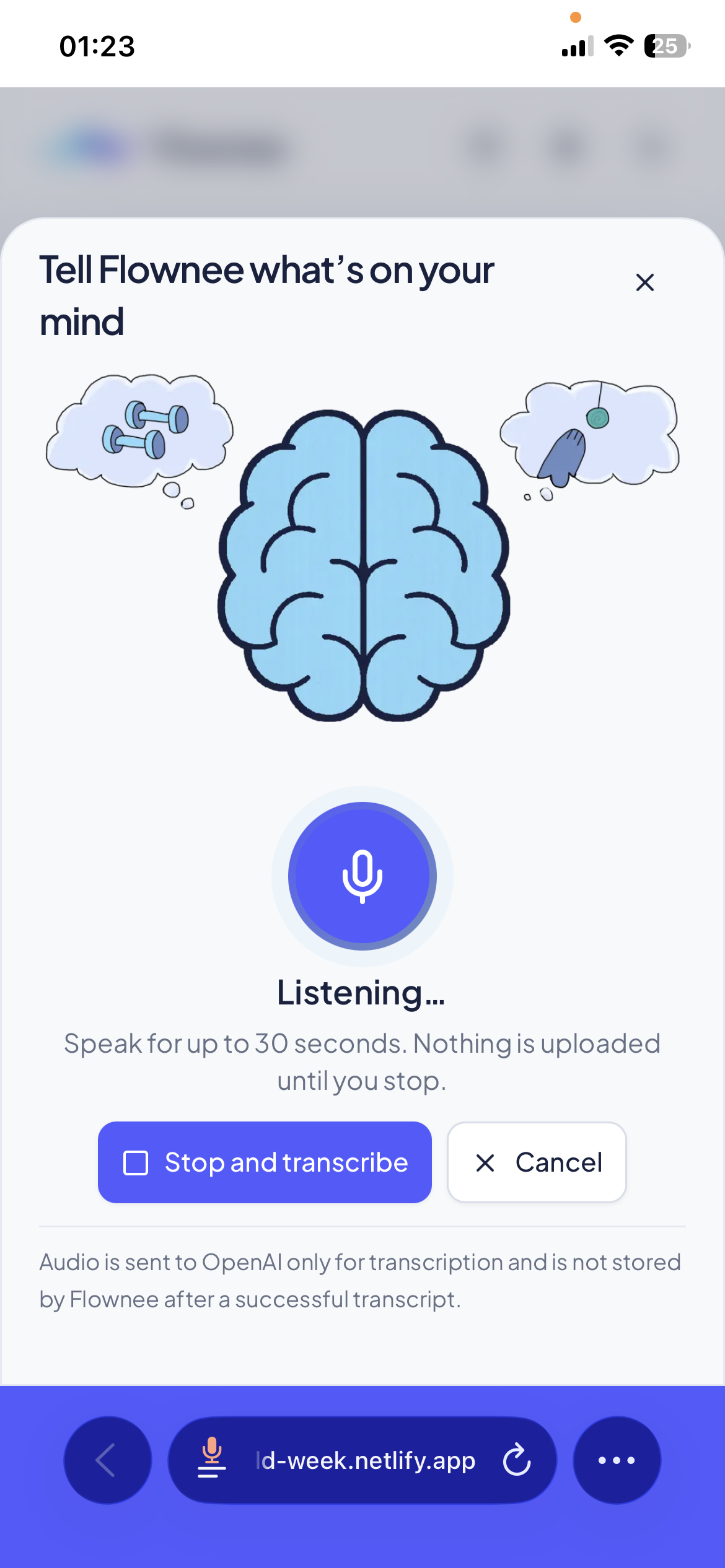
Flownee: one-tap voice capture
-
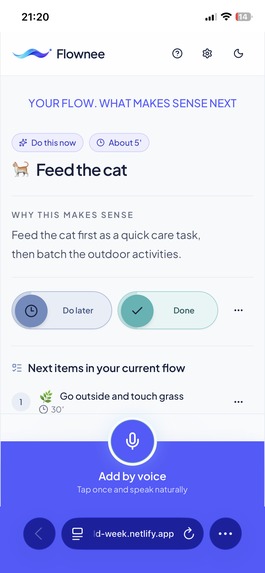
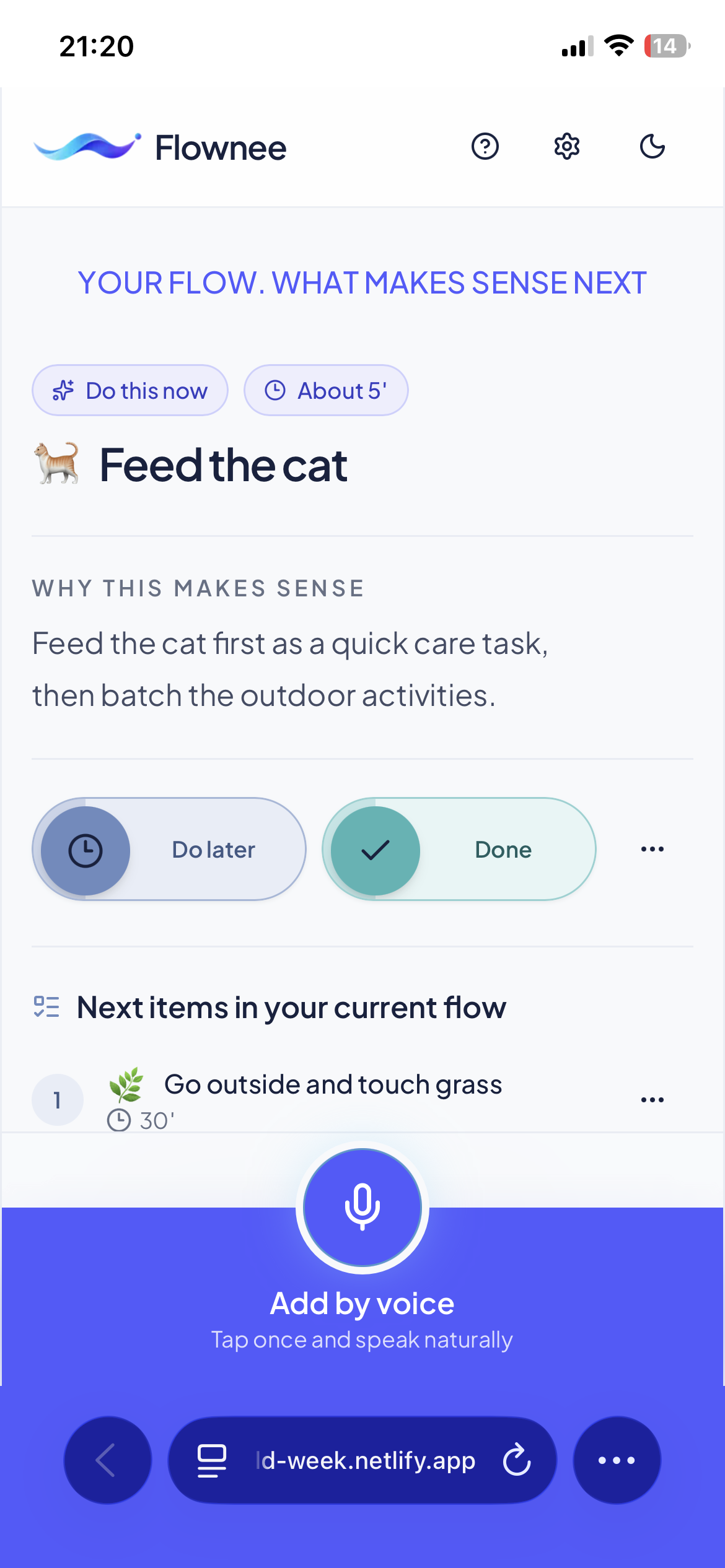
Flownee: explained recommendation: what makes sense next
-
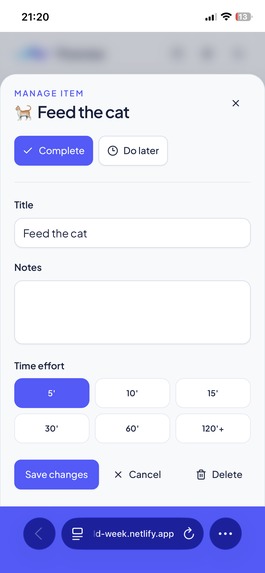
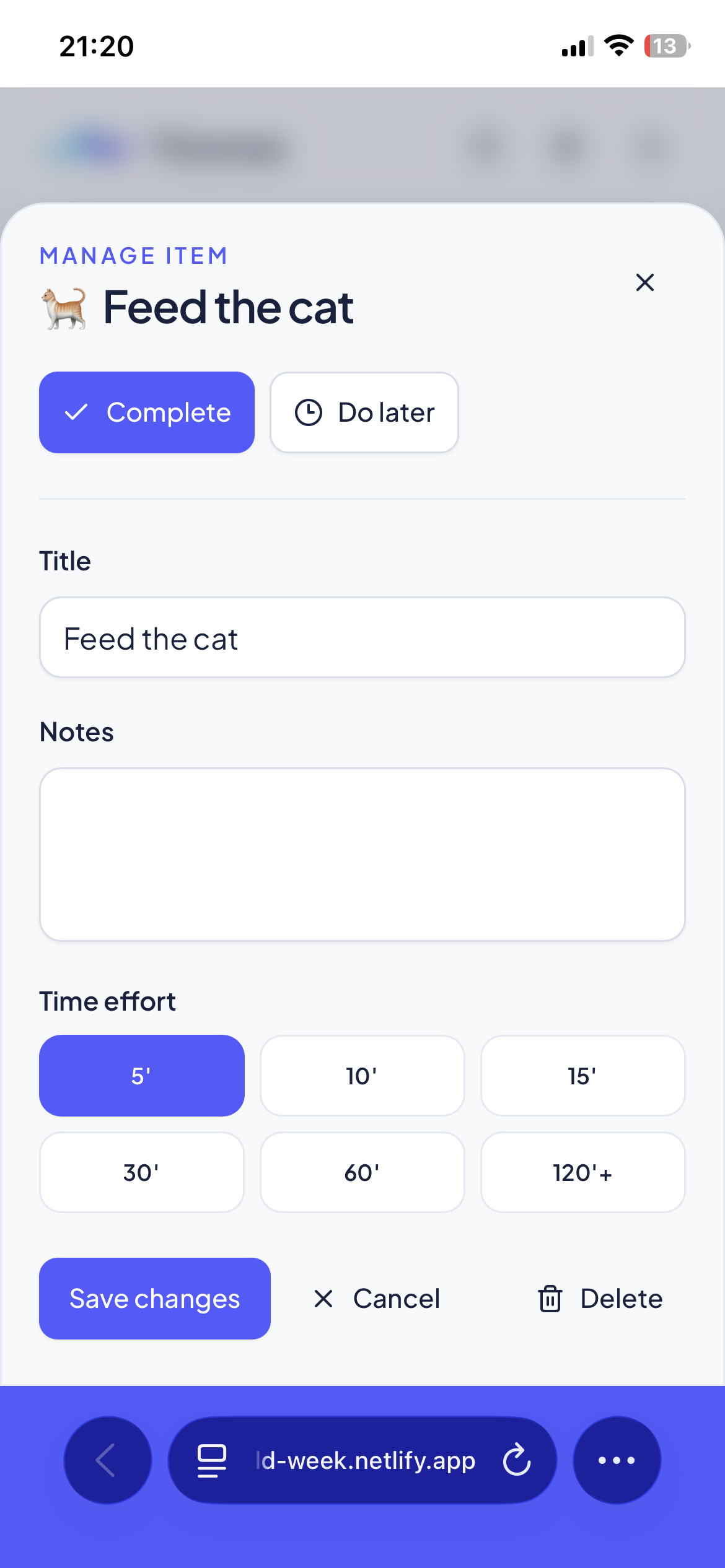
Flownee: item management
-
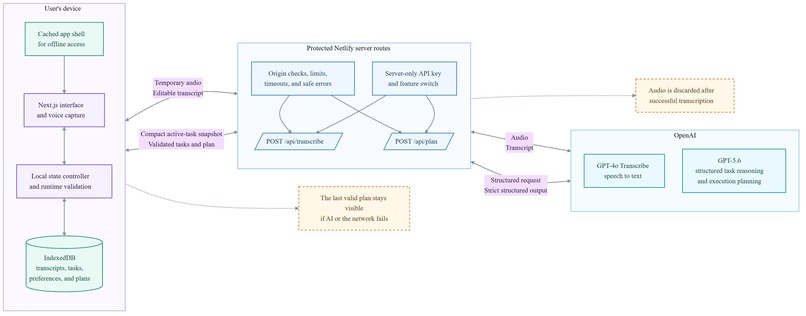
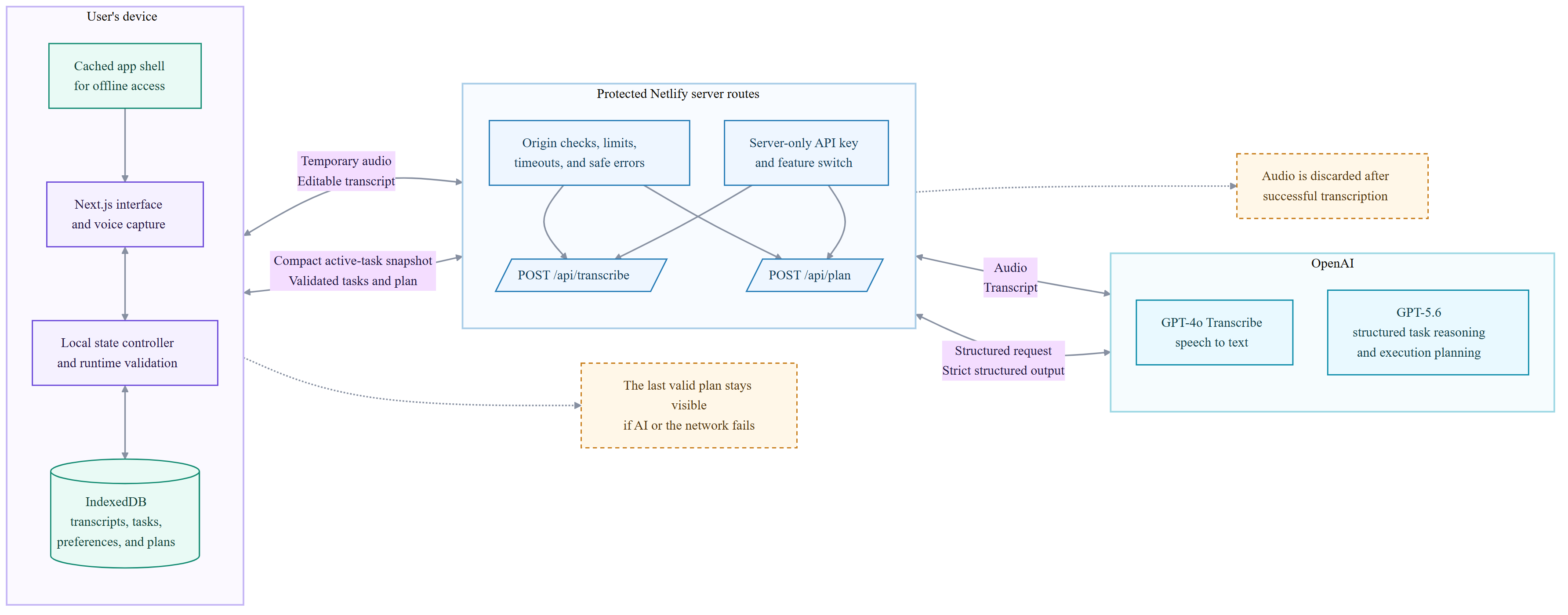
Flownee technical architecture
Inspiration
Flownee started with a problem we kept seeing in our own lives: dozens of small intentions sitting in our heads.
Call a friend. Compare a service provider. Buy something for dinner. Plan an activity with the kids. None of these feels important enough for a calendar, but together they create a surprising amount of mental noise.
After hearing the same frustration in conversations with friends and family, we wanted to build something that captured these thoughts naturally and helped answer a much simpler question: “What should I do now?”
Who we built it for
Flownee is designed for busy adults, especially working parents, who carry many small household, family, shopping, social, and administrative intentions in their heads.
In ten informal interviews with friends, we kept hearing versions of the same problem. Later qualitative validation during and after development also supported the voice-first approach, with users reporting fewer forgotten everyday tasks, less mental clutter, and greater day-to-day satisfaction.
What it does
Flownee is a voice-first app for capturing everyday intentions and deciding what makes sense next.
You tap the microphone and speak naturally, including several intentions in one recording. Flownee transcribes what you said, lets you correct it, and turns it into editable tasks. It then considers everything currently on your list and recommends one action to do now, with an estimated effort and a short explanation.
When you add, complete, postpone, edit, or delete something, Flownee updates the rest of your flow automatically.
There is no account to create. Tasks and plans stay in the browser, and the most recent recommendation appears immediately when the app is reopened.
Why Flownee is different
Voice notes remember what you said. Voice assistants create isolated reminders. Traditional task managers store what you manually organize. Flownee reasons across the complete set of active intentions and keeps one explained recommendation for what makes sense next, without requiring an account or another productivity system to manage.
How we built it

We built Flownee as an installable PWA using Next.js, React, TypeScript, Tailwind CSS, and shadcn/ui-style components. Confirmed transcripts, tasks, preferences, and plans are stored locally in IndexedDB.
GPT-4o Transcribe handles speech-to-text. GPT-5.6 separates spoken intentions, estimates effort, identifies important assumptions, and creates the recommended execution order. AI-generated tasks and plans follow strict schemas and are validated before they are committed to local storage.
OpenAI requests go through protected server-side routes, so API keys are never exposed in the browser. Audio is kept only long enough to complete transcription and is not saved afterward by default.
We used Codex throughout implementation and debugging. It helped us translate product requirements into strict GPT-5.6 schemas, implement atomic IndexedDB persistence and stale-response rejection, add recovery for failed AI requests, diagnose a Netlify proxy issue, and expand the test suite to 133 automated tests. The consequential architecture, product, privacy, and release decisions remained with our team.
Challenges we ran into
The hardest part was not getting AI to produce a task list. It was making the experience reliable when AI or the network was slow, unavailable, or returned something unexpected.
We had to make sure a confirmed intention could never disappear because planning failed. Flownee saves changes locally first, keeps the last valid plan visible while updating, validates every model response, and rejects stale results if the user changes something while a request is still running.
Voice recording also behaved differently across browsers and devices. We had to handle microphone permissions, audio formats, cancellations, retries, and temporary recording recovery carefully.
One particularly tricky production issue involved same-origin validation behind Netlify's reverse proxy. Requests that were valid in the browser appeared different on the server, so we had to trace the forwarded host and protocol before the live voice workflow worked correctly.
Accomplishments that we're proud of
We are proud that Flownee became a complete working product rather than only a voice-input demo.
A user can speak several intentions, review the transcript, correct the interpretation, save the tasks, receive an explained recommendation, and watch the flow update after every task action. Confirmed items remain safe even if replanning fails, and the app continues to work with its stored data offline.
We also kept the experience account-free and local-first while protecting the OpenAI API behind server routes. The complete journey worked during testing on physical Android and iPhone devices, and 133 automated tests cover storage, AI contracts, server routes, recovery behavior, and interface states.
Most importantly, the final experience still feels simple: open Flownee and see what makes sense next.
What we learned
Using Codex extensively changed how our small team could divide the work. Our product manager was able to make and test several design improvements herself, turning ideas into working interface changes without waiting for the developer to implement each one.
That allowed our developer to stay focused on architecture, data safety, the AI workflow, and production reliability. A large part of his role became reviewing and validating Codex's output: checking the code, questioning technical decisions, running tests, and making sure every change matched the product requirements.
We learned that Codex is most useful when people provide clear direction and remain responsible for the result. It did not replace product judgment or engineering experience. It helped each team member apply that judgment across a much larger amount of work.
What's next for Flownee
Our next step is to test Flownee with more busy adults and learn whether its recommendations genuinely reduce decision fatigue over repeated daily use.
We also plan to localize Flownee for more languages and regions, adapting both the interface and voice experience so people can speak naturally in the language they use every day.
We will explore a sustainable paid model only after validating repeated use. Any business model must preserve Flownee's calm experience and must not depend on selling personal task data.
Longer term, we would explore careful personalization and optional integrations, but only if they make Flownee feel lighter. The goal is not to build another complicated productivity system. It is to help people move from what is on their mind to what makes sense next.
Fast judge path
- Open the Flownee app (https://flownee-build-week.netlify.app), voice your first intention and try other functions
- Read the complete testing guide (https://github.com/vixfounder/flownee/blob/main/TESTING_INSTRUCTIONS.md)
- Review the source code (https://github.com/vixfounder/flownee)
Built With
- css3
- github
- gpt-4o-transcribe
- gpt-5.6
- html5
- indexeddb
- mediarecorder-api
- netlify
- next.js
- openai-api
- openai-codex
- pnpm
- progressive-web-app
- react
- responses-api
- service-workers
- shadcn/ui
- structured-outputs
- tailwind-css
- typescript
- vitest


Log in or sign up for Devpost to join the conversation.