-
-
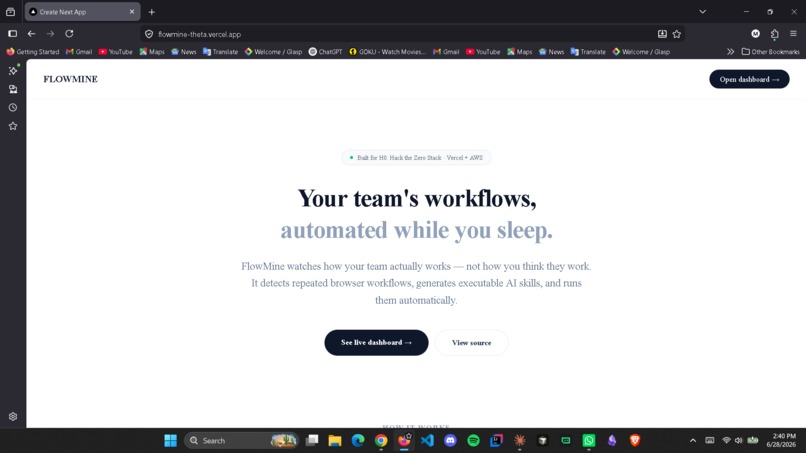
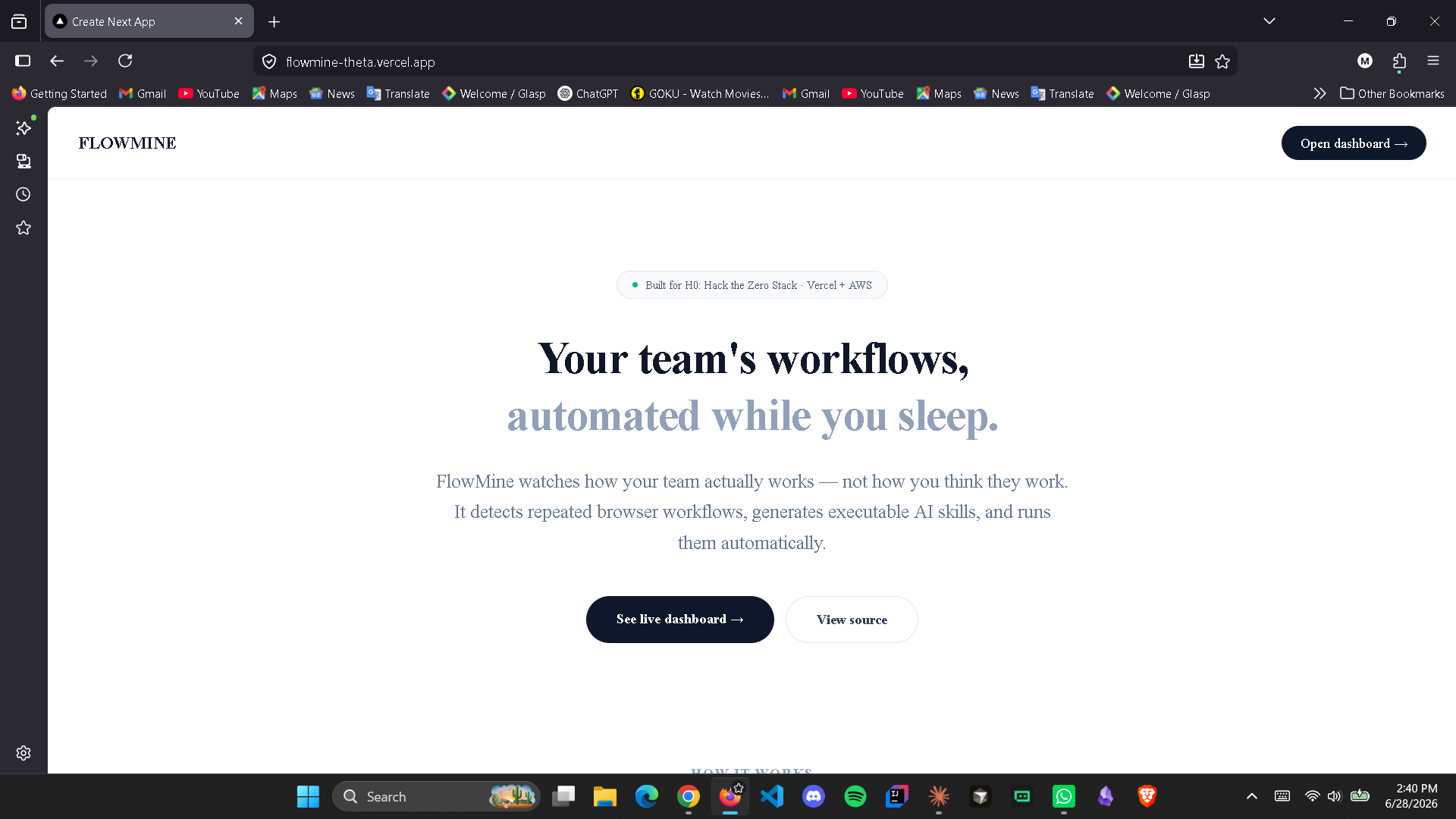
overview of the website
-
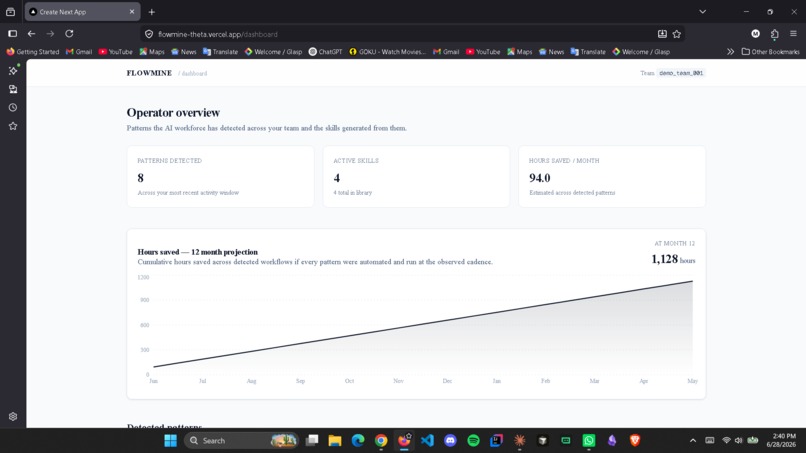
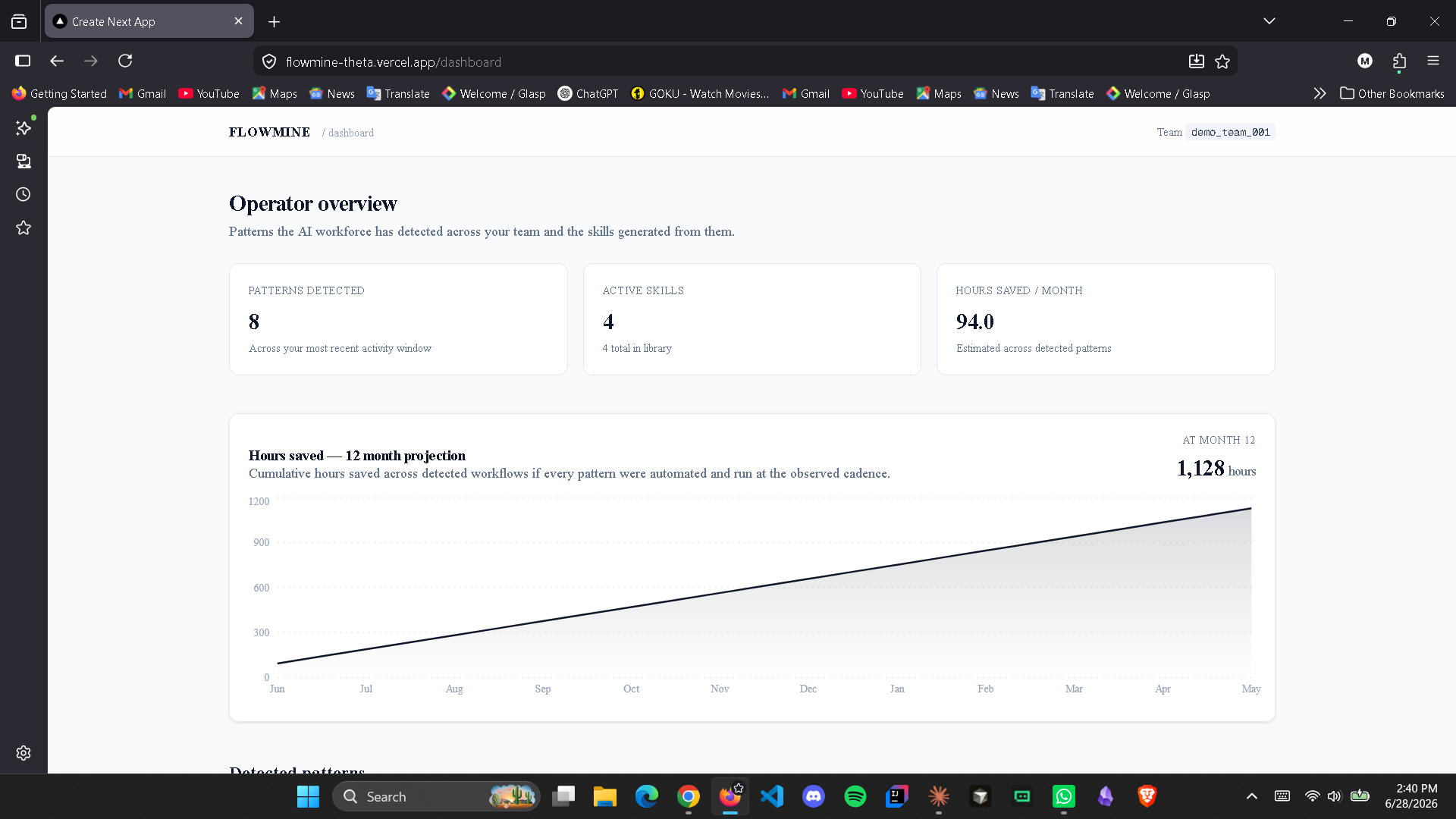
dashboard showing time saved in a year
-
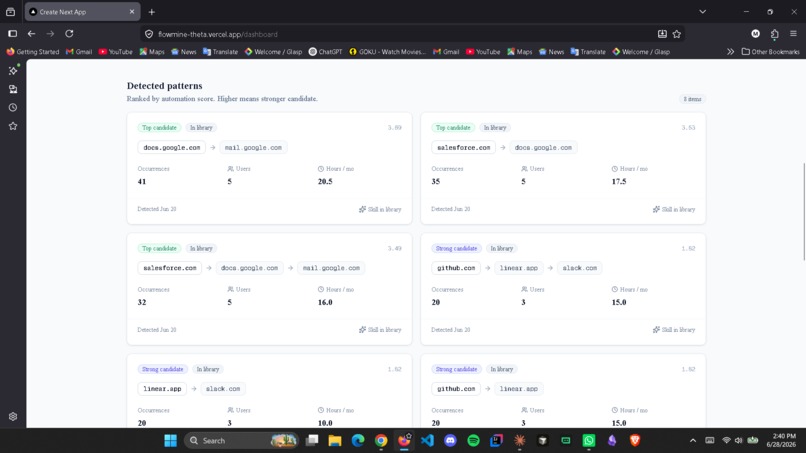
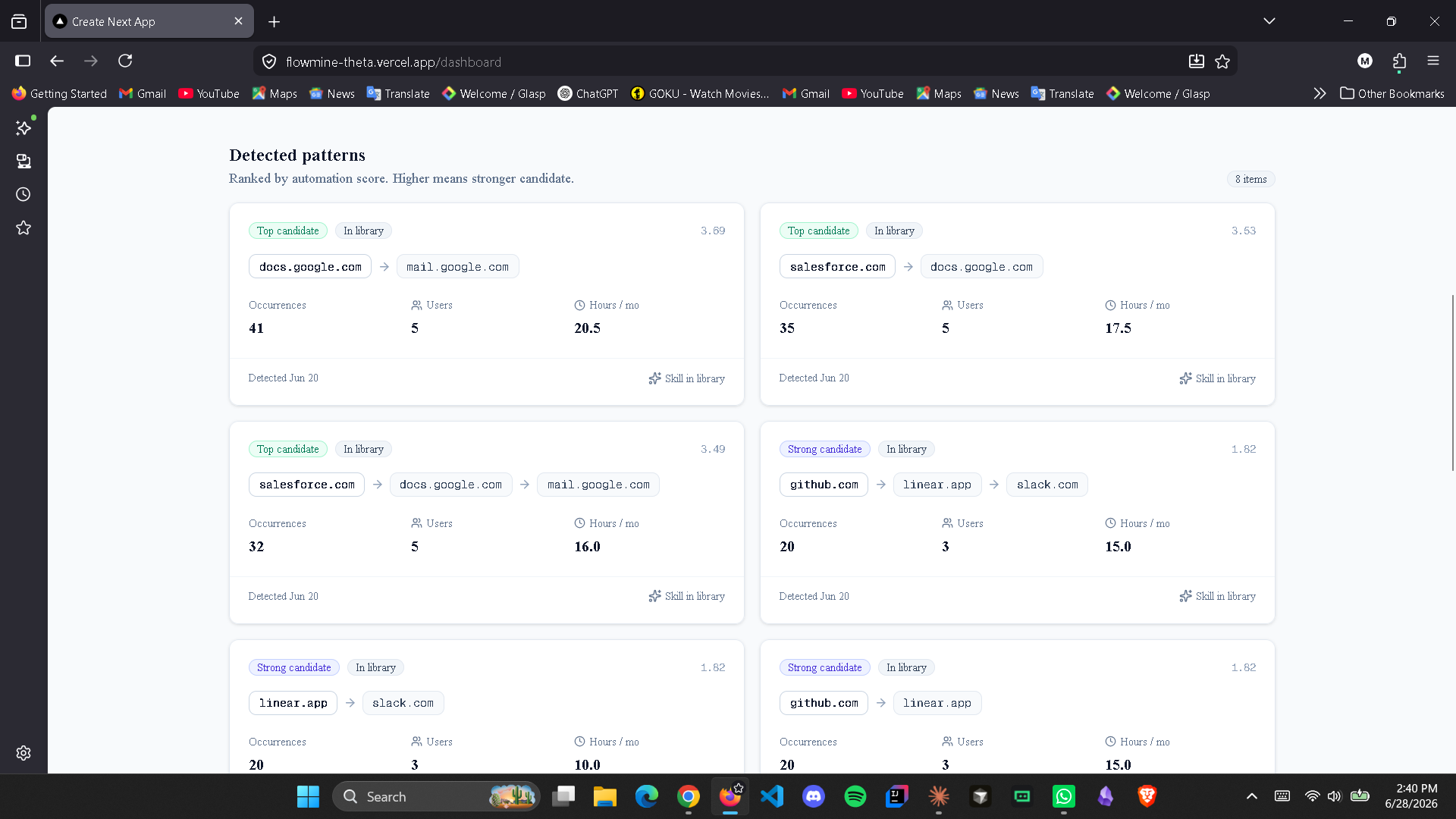
detected patterns list
-
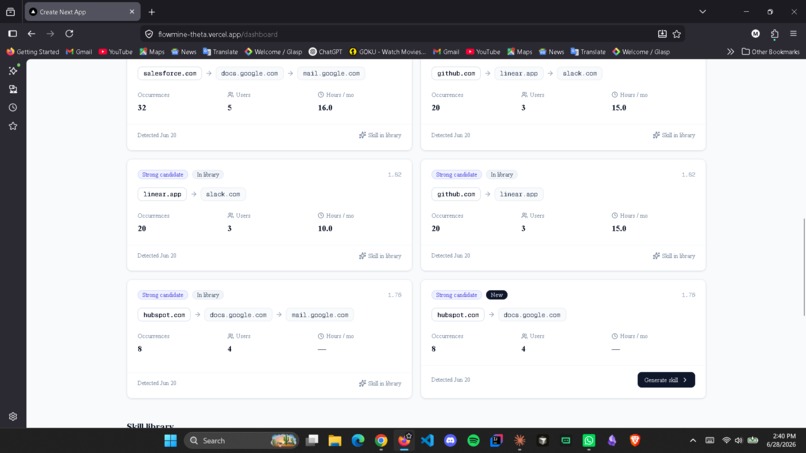
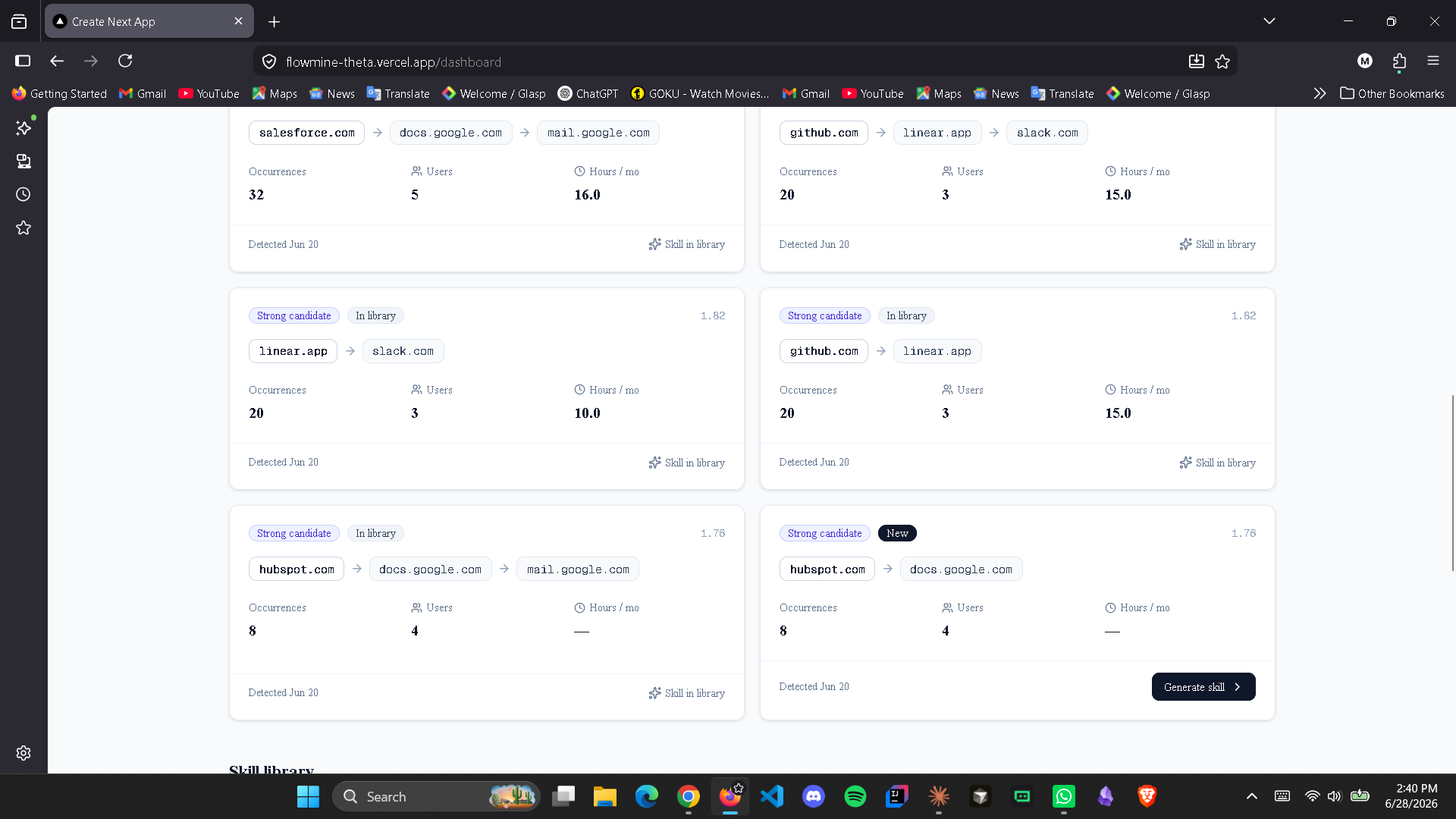
detected pattern list 2
-
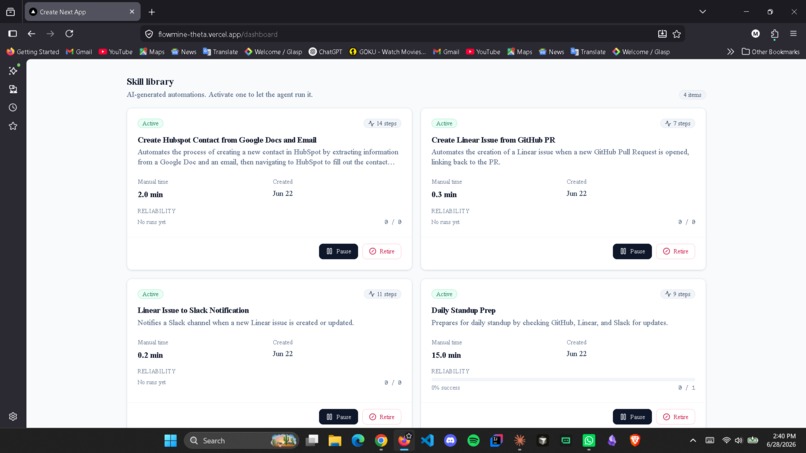
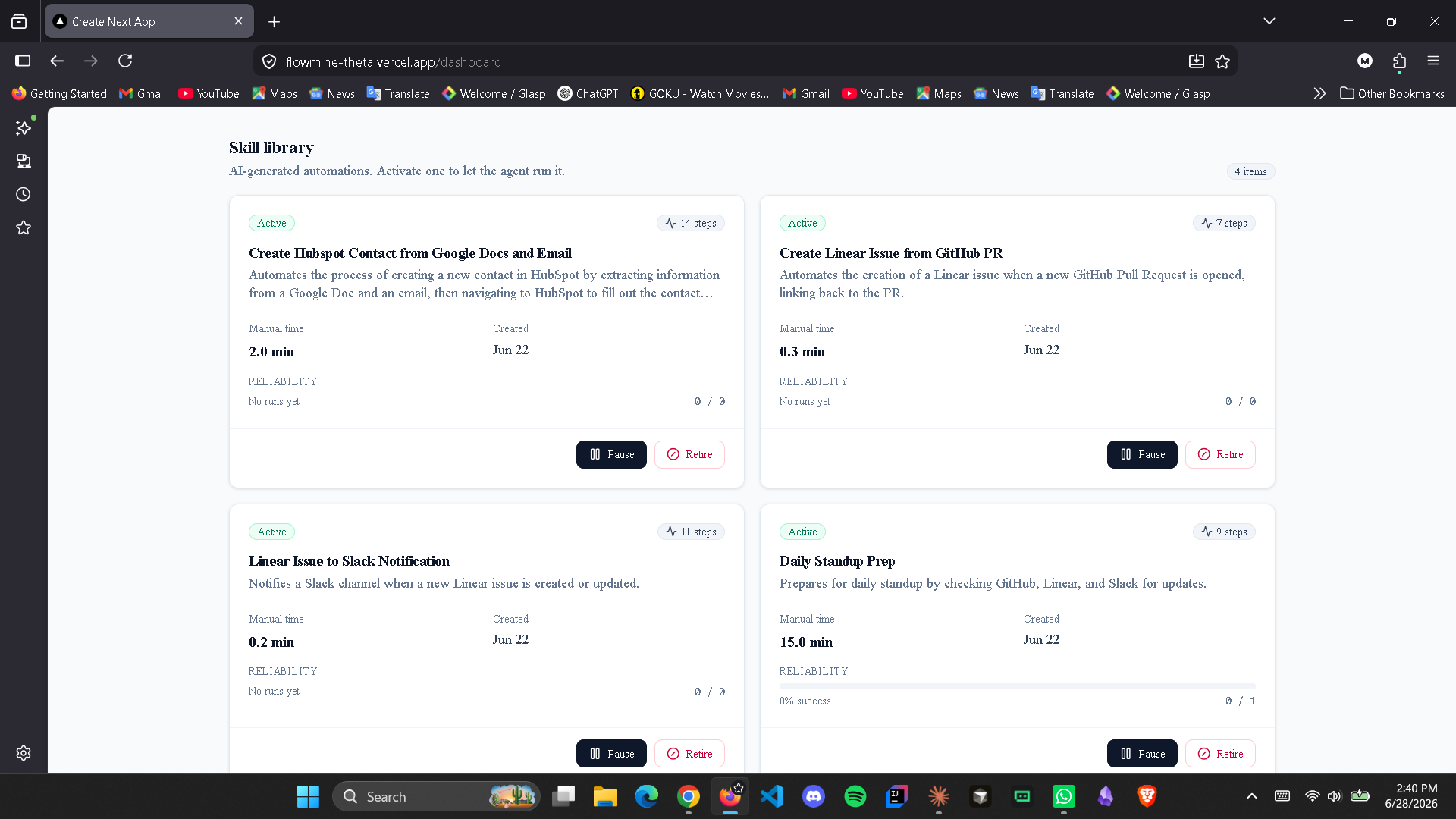
skill library
Inspiration
Every team has invisible work — the 6-tab routine to onboard a customer, the copy-paste dance between a CRM and a billing tool, the weekly report nobody wrote down how to make. It never shows up in a process doc because it lives in people's muscle memory. Automation tools exist, but they all start with the same impossible ask: "first, map out your workflow." Nobody does, so nothing gets automated.
I wanted to flip it. What if the tool figured out the workflow on its own — by just watching the browser — and then offered to do it for you?
What it does
FlowMine closes a full observe → detect → generate → execute loop:
Observe — A Chrome extension captures lightweight browser metadata (domain, navigation, tab switches). No keystrokes, no page content, no passwords. Events stream to the backend in batches.
Detect — A streaming pattern-detection algorithm finds multi-step domain sequences that recur across multiple employees, and scores each by how frequent, how widely shared, and how time-consistent it is.
Generate — Google Gemini turns each high-scoring pattern into a structured, executable skill specification, and estimates the hours/month the team would save by automating it.
Execute — The extension runs the skill back in the user's browser — navigate, click, fill, submit — with adaptive selector recovery when the DOM shifts.
On the demo team's three weeks of activity: 1,003 events → 8 detected patterns → 6 generated AI skills → ~94 hours/month saved → a 1,128-hour 12-month ROI projection.
How we built it
The architecture is the product. FlowMine deliberately uses two AWS databases because the two halves of the problem have opposite shapes:
AWS DynamoDB absorbs the high-write event firehose from every browser — on-demand capacity, a GSI for team-scoped queries, and TTL so raw events expire automatically.
AWS Aurora PostgreSQL + pgvector stores the structured output (patterns, skills, attribution, executions) and powers semantic dedup: every generated skill is embedded with gemini-embedding-001 (1536-dim) and checked against existing skills by cosine distance, so the same workflow is never generated twice.
The rest of the stack:
Vercel hosts a Next.js 16 (App Router) app. Server components read Aurora directly; API routes (```/api/events, /api/detect, /api/generate-skill, /api/execute```) handle ingestion, detection, and generation.
Google Gemini 2.5 Flash does both skill generation and pattern interpretation (ROI estimation), with strict JSON output.
Pusher Channels pushes realtime updates to the dashboard as patterns and skills appear.
Chrome Manifest V3 extension (TypeScript, esbuild) handles both capture and execution.
Detection algorithm: a sliding window over each user's event stream at window sizes k = 2, 3, 4 produces candidate sequences. Each candidate is scored log(1 + frequency) × (users / teamSize) × (1 − timeInconsistency) — rewarding workflows that are frequent, shared across the team, and habitual (done at consistent times of day) rather than one-off.
Challenges I ran into
i) Gemini's "thinking" tokens silently ate my output budget. Skill generation kept returning truncated JSON. The cause wasn't a bad prompt — 2.5 Flash spends part of maxOutputTokens on internal reasoning, so the visible JSON got cut off. Fixed by setting thinkingBudget: 0 and raising the output ceilings. ii) Designing two databases that don't overlap. It was tempting to force everything into Postgres. Keeping DynamoDB strictly for the append-only event stream and Aurora for everything queryable/relational/semantic kept both fast and made the cost story clean. iii) Vercel Hobby function timeouts. Detection over thousands of events exceeded the default limit; raising maxDuration and trimming the read path fixed the 503s. iv) Migrating off paid APIs mid-build. I started on a paid LLM + embedding stack and migrated the entire generation and embedding layer to free Google Gemini without changing the product surface — proof the LLM layer was cleanly abstracted.
Accomplishments that I'm proud of
i) A genuinely end-to-end loop — not a mockup. Events really flow from a browser through two AWS databases and come back out as a skill the extension runs. ii) A privacy-respecting capture model: metadata only, never content. iii) Semantic dedup with pgvector that keeps the skill library clean. iv) A clean, deployed product with a live dashboard and real ROI numbers.
What I learned
i) How to split a workload across the right storage primitives instead of forcing one database to do everything. ii) The operational realities of LLM output budgets, JSON-mode reliability, and grounding model output so it never invents data. iii) pgvector as a practical dedup engine, not just a RAG buzzword.
What's next for FlowMine
i) Cross-application capture beyond the browser. ii) Human-in-the-loop approval and step-by-step "explain this skill" views. iii) Confidence scoring and automatic selector self-healing using Gemini. iv) Team analytics: which automations actually saved time, measured against the projection.
Built With
- aws-aurora
- aws-dynamodb
- chrome
- framer-motion
- google-gemini
- next.js
- pgvector
- postgresql
- pusher
- tailwindcss
- typescript
- vercel


Log in or sign up for Devpost to join the conversation.