-
-
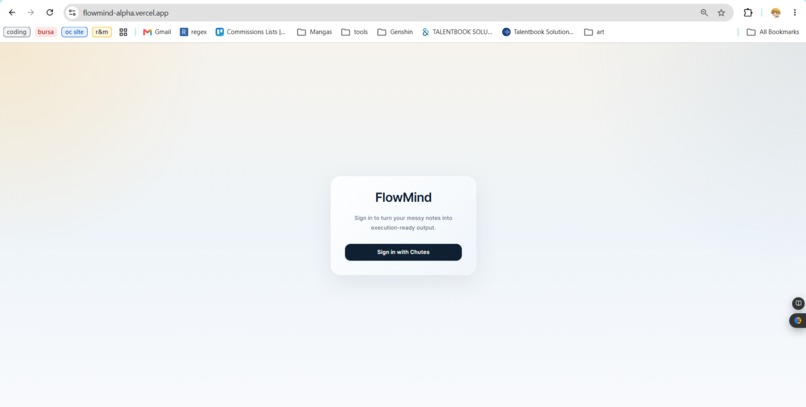
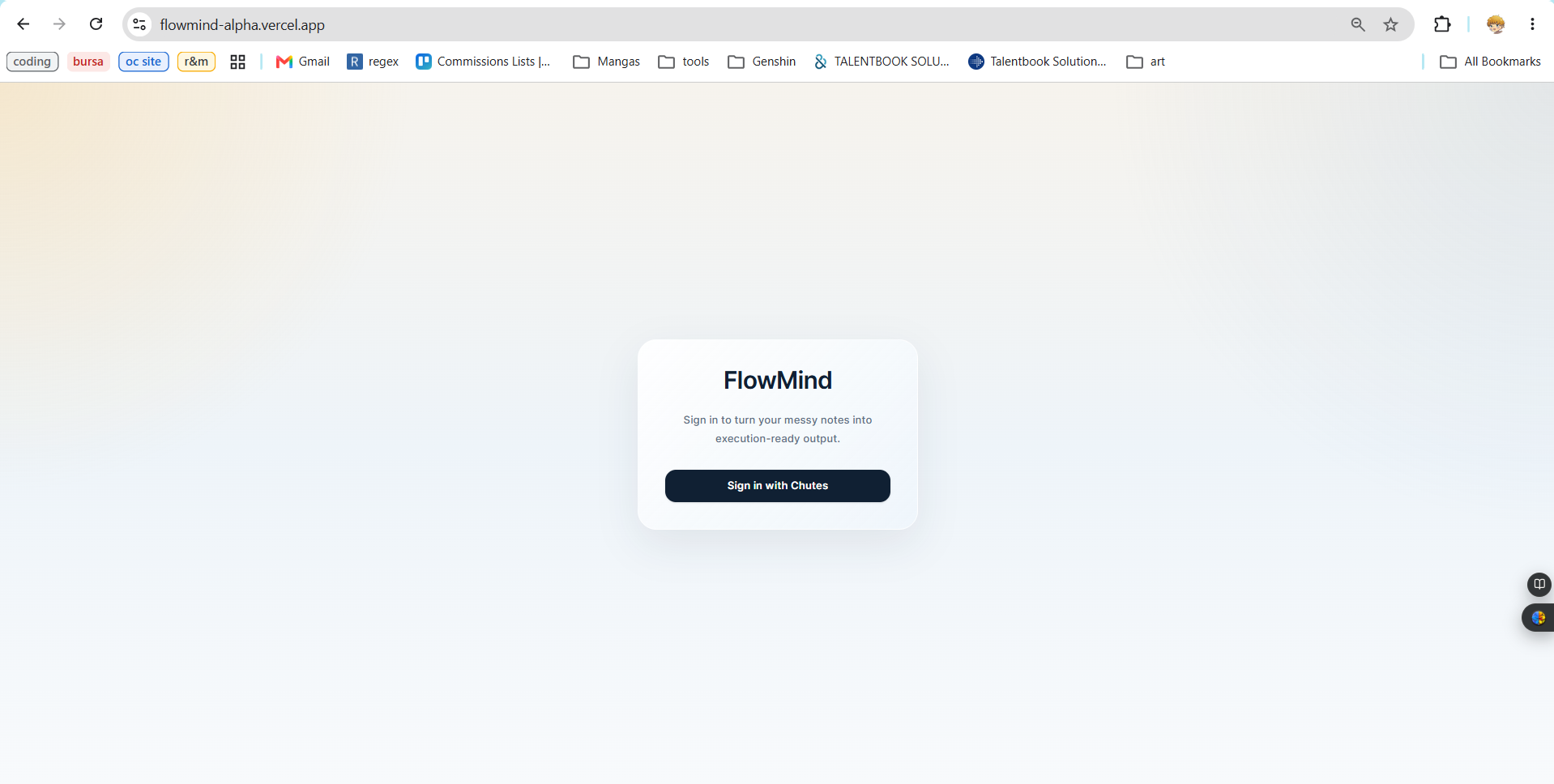
Login page
-
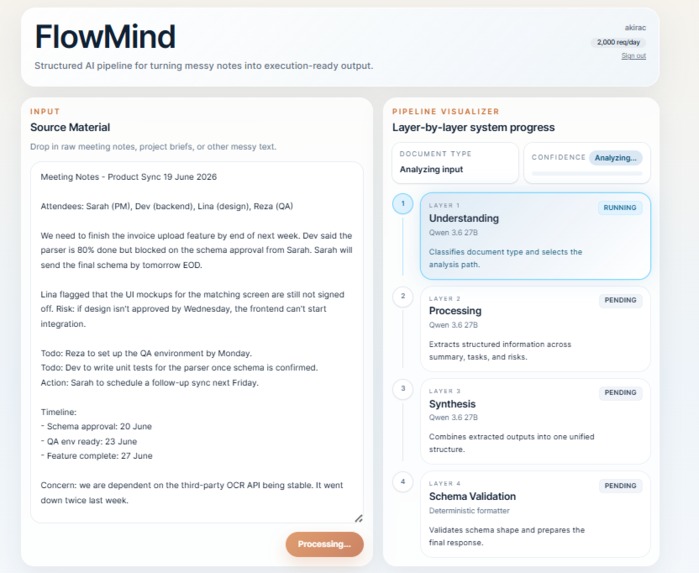
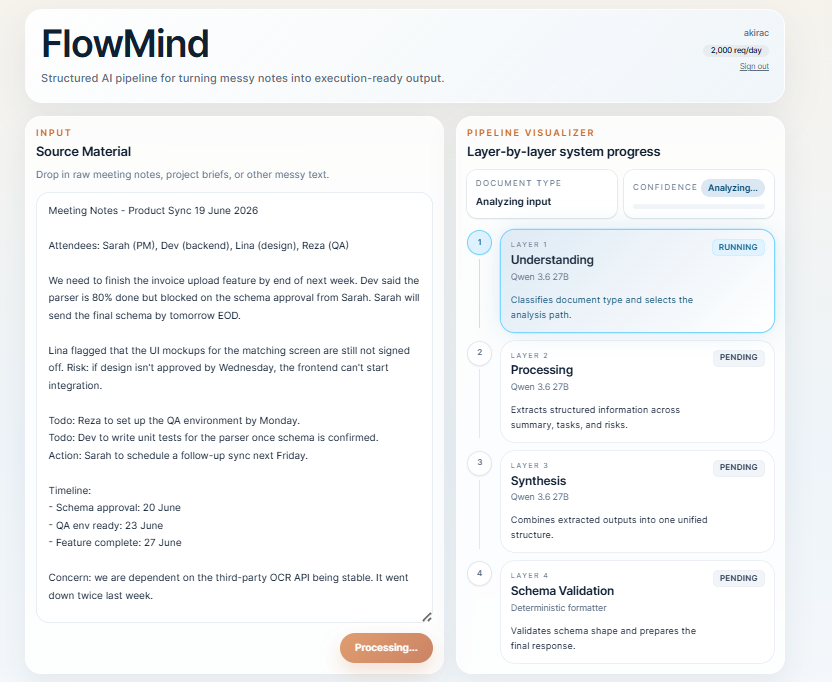
Main page
-
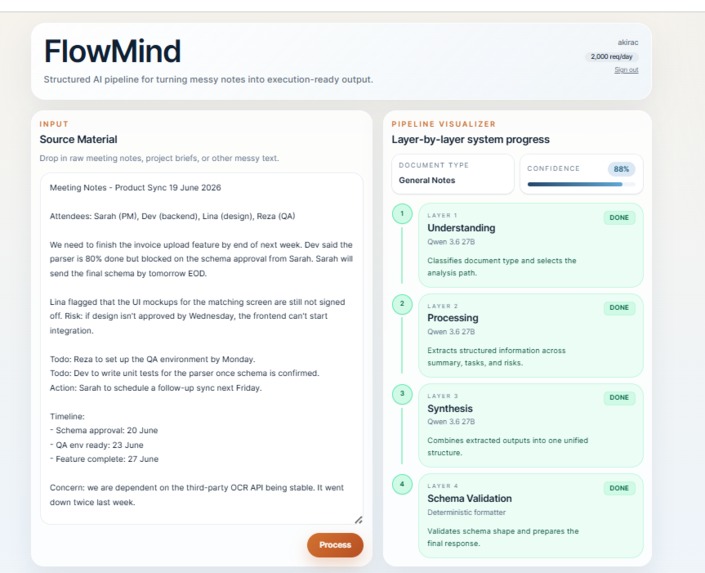
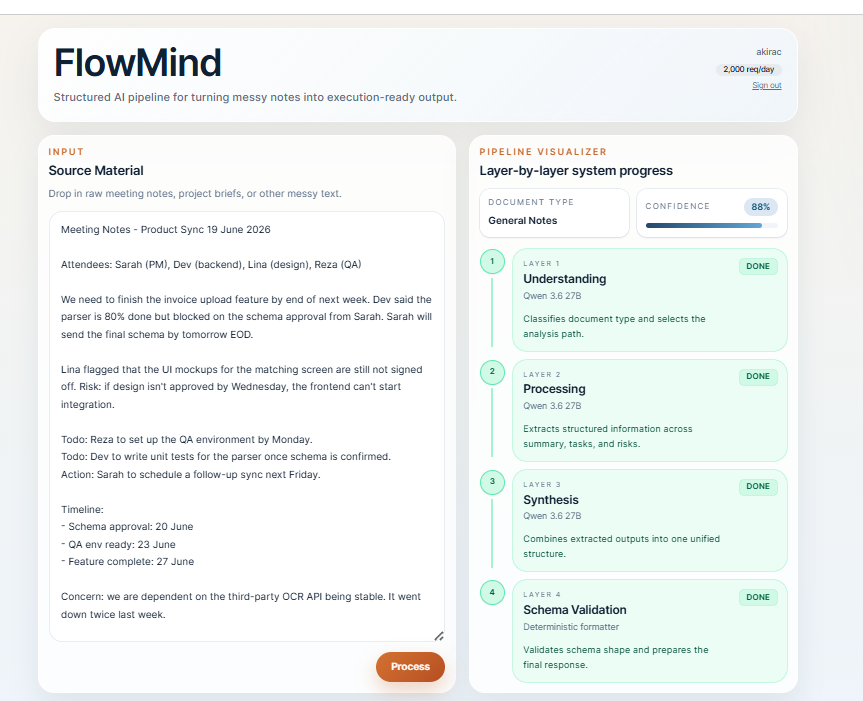
Four-layer processing pipeline
-
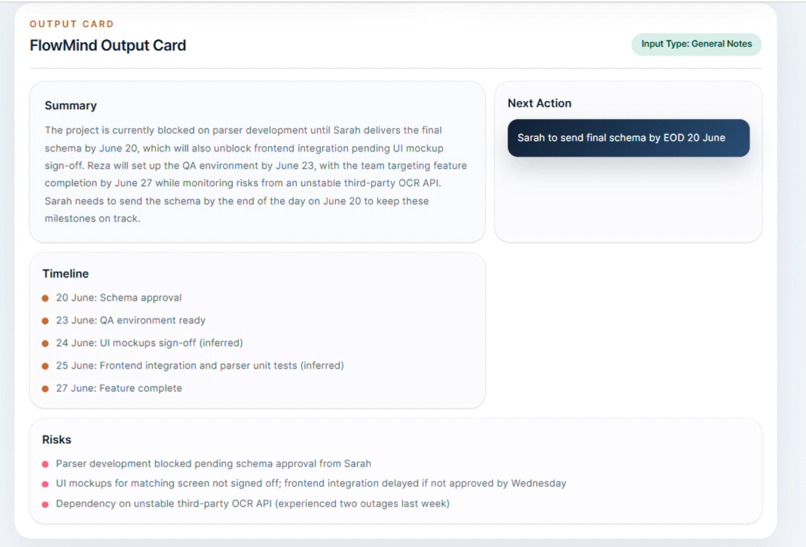
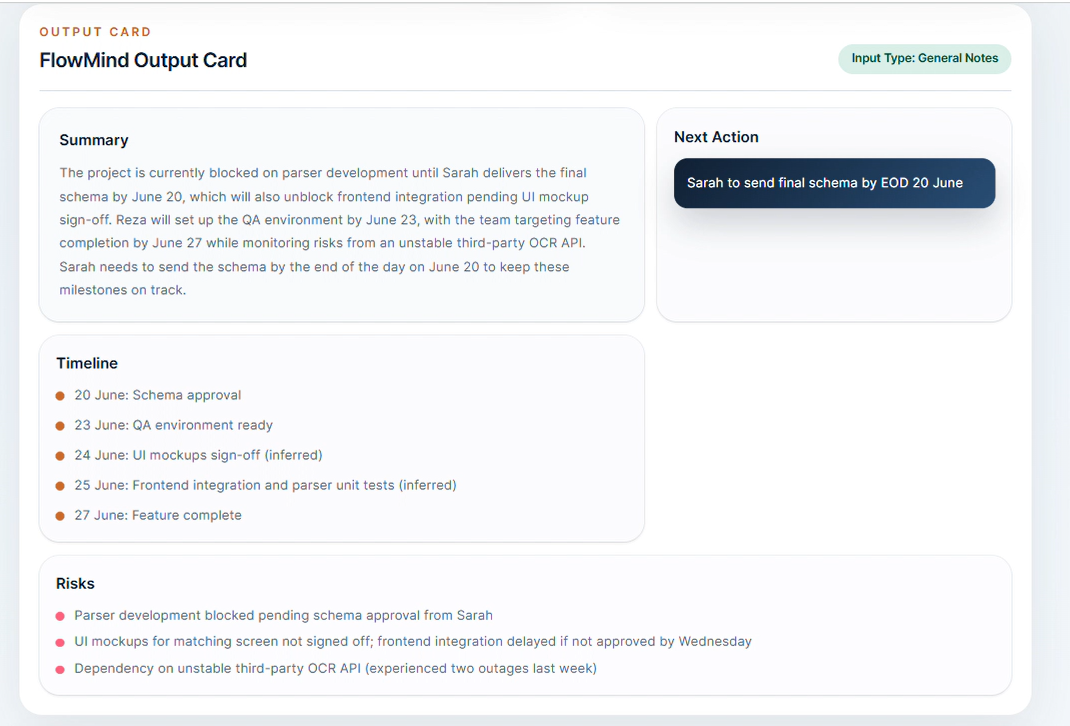
Output card
Inspiration
FlowMind didn't start with a grand epiphany. I was brainstorming hackathon ideas with AI when the concept surfaced — what if AI could turn messy meeting notes into a structured task board?
The idea landed because it was relatable. My own notes are manageable, but I could see how it spirals for teams with more moving parts: action items buried in paragraphs, owners never assigned, deadlines implied but never written down. The gap between "things we discussed" and "things that actually get done" is surprisingly wide — and it almost always starts with notes nobody wants to re-read.
The AI I used to brainstorm the idea ended up becoming the engine running inside what I shipped. That felt like a good sign the project was worth building.
What it does
FlowMind takes any block of unstructured text — a meeting transcript, a project brief, a wall of bullet points — and converts it into a structured, execution-ready work card in seconds.
- Task extraction — pulls out every action item with its owner and deadline
- Risk detection — surfaces blockers buried in the text
- Timeline summary — builds a chronological view of milestones and due dates
- Next action — AI recommends the single most important thing to do right now
- Kanban board — all cards drop into a drag-and-drop board, ready to track
Users sign in with their own Chutes account, so AI usage bills directly to them.
How I built it
FlowMind is a full-stack app: React + Vite on the frontend, FastAPI on the backend, and Qwen/Qwen3.6-27B-TEE on Chutes as the AI layer. Auth flows through Chutes OAuth 2.0 with PKCE.
The core is a four-stage pipeline where each stage's output feeds the next:
$$\mathcal{T}(\text{notes}) = f_4 \circ f_3 \circ f_2 \circ f_1(\text{notes})$$
| Stage | Name | What it does |
|---|---|---|
| f1 | Understanding | Classifies the input type and intent with a confidence score |
| f2 | Processing | Extracts tasks, owners, deadlines, timeline, and risks |
| f3 | Synthesis | Writes a unified summary and picks the recommended next action |
| f4 | Formatting | Validates the schema and fills any missing fallback values |
Tech stack: React · Vite · TailwindCSS · FastAPI · Python · Chutes API · OAuth 2.0 + PKCE
Challenges I ran into
The UI had no obvious shape. I knew what the output should look like — cards on a board — but the journey between "paste your notes" and "here's your board" took a lot of iteration. There's no template for what that middle experience should feel like.
JSON schema drift between platforms. Without Chutes plan access during early development, I tested locally with Ollama using the same model family. The pipeline worked perfectly. When I finally switched to the Chutes API, things broke.
Even with the same model $m$ and input $x$, the response structure differed across platforms:
$$f(x\,;\, m,\, p_1) \neq f(x\,;\, m,\, p_2)$$
Variables I was parsing didn't exist, or lived under different keys. I had to load real API responses from both sides, compare schemas, and remap the entire parsing layer by hand.
Accomplishments that I'm proud of
- The pipeline is reliable. Paste any real meeting notes and it produces a coherent work card — not just on clean test inputs, but on genuinely messy real-world text.
- OAuth with Chutes works end to end. Implementing PKCE from scratch and getting the full sign-in → token → AI call → sign-out cycle working cleanly was a real milestone.
- The Kanban board is actually usable. Cards drag, stack, and reorder correctly — it feels like a tool, not a demo.
- Provider flexibility. The backend supports both Chutes and any OpenAI-compatible endpoint via a single config switch — no code changes needed.
What I learned
Debugging LLM JSON is its own discipline. Response shape can vary by runtime, quantization, or prompt temperature. I now validate structure before parsing values and write code that degrades gracefully when the schema drifts.
Chutes was a genuine discovery. I didn't know the platform existed before this hackathon. Renting direct API access to a specific model — without managing infrastructure — makes the gap between prototype and deployed product much smaller than I expected.
Sometimes the idea finds you. I went in without a strong concept and came out with something I'd actually use. The best sign a project is worth building is when you find yourself reaching for it.
What's next for FlowMind
- Team workspaces — shared boards where multiple members can own cards, comment, and track progress together
- Export integrations — push generated cards directly into Notion, Jira, Linear, or Trello
- Richer input types — support for audio transcripts, PDFs, and pasted Slack threads
- Pipeline transparency — show confidence scores and extraction reasoning so users can understand and correct what the AI decided


Log in or sign up for Devpost to join the conversation.