-
-
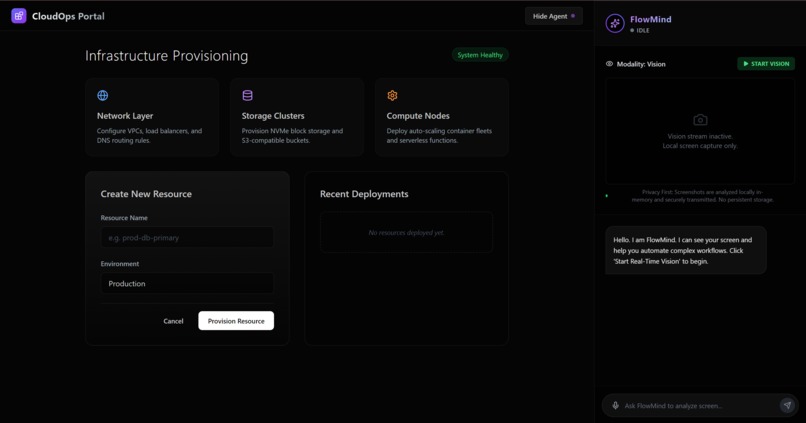
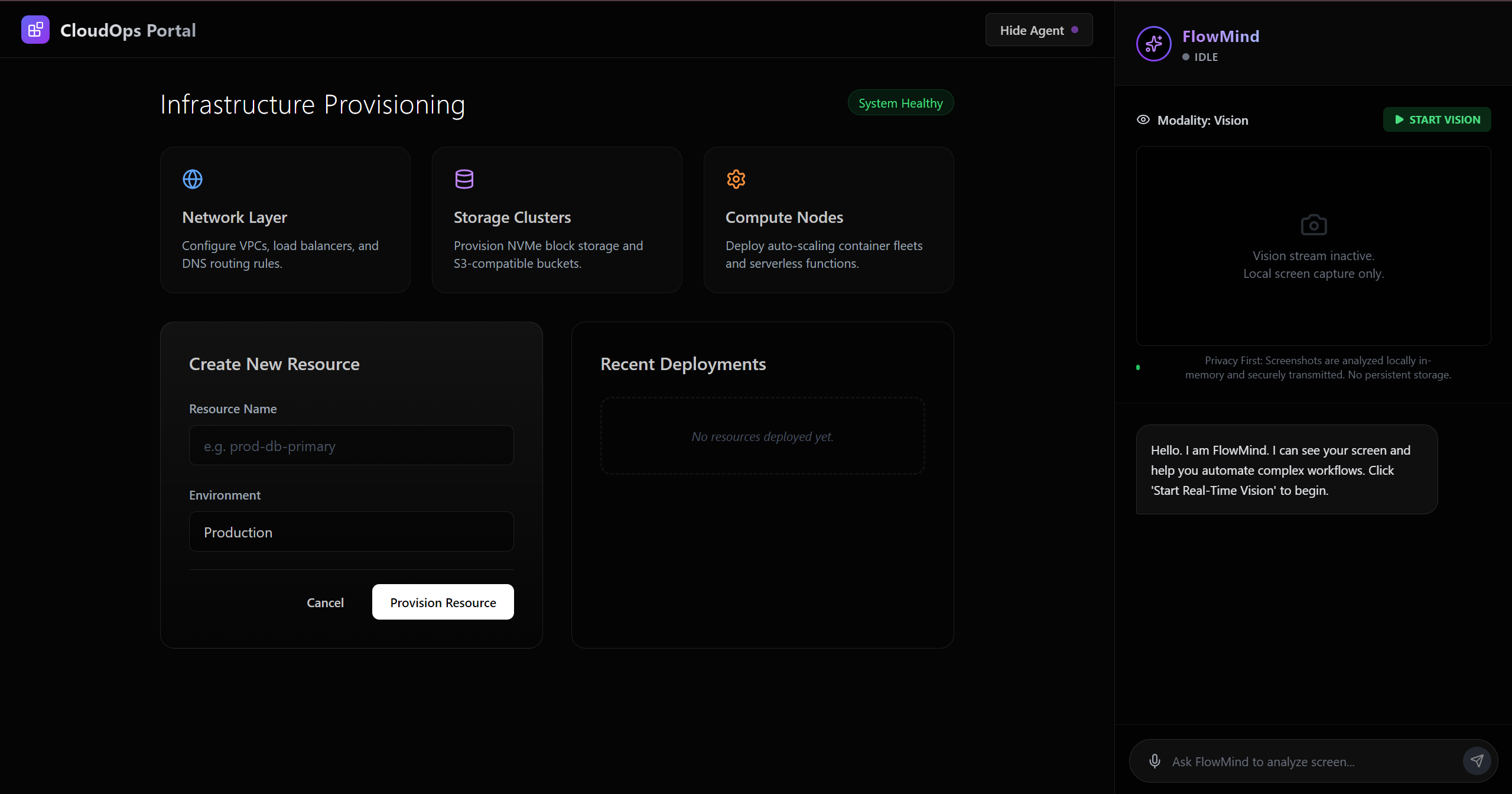
dashboard
-
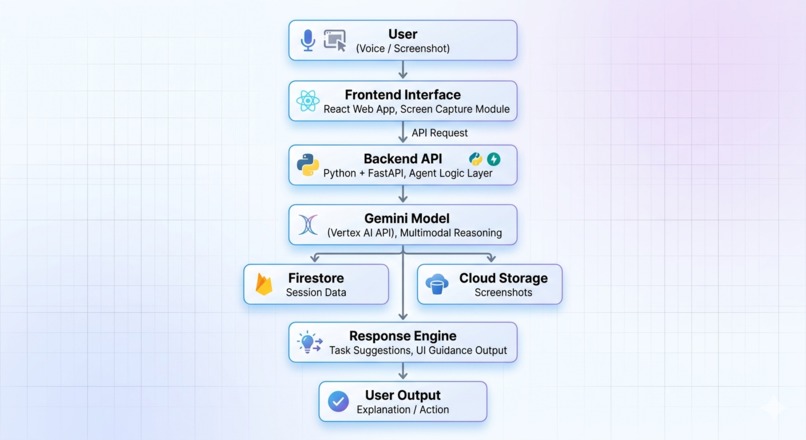
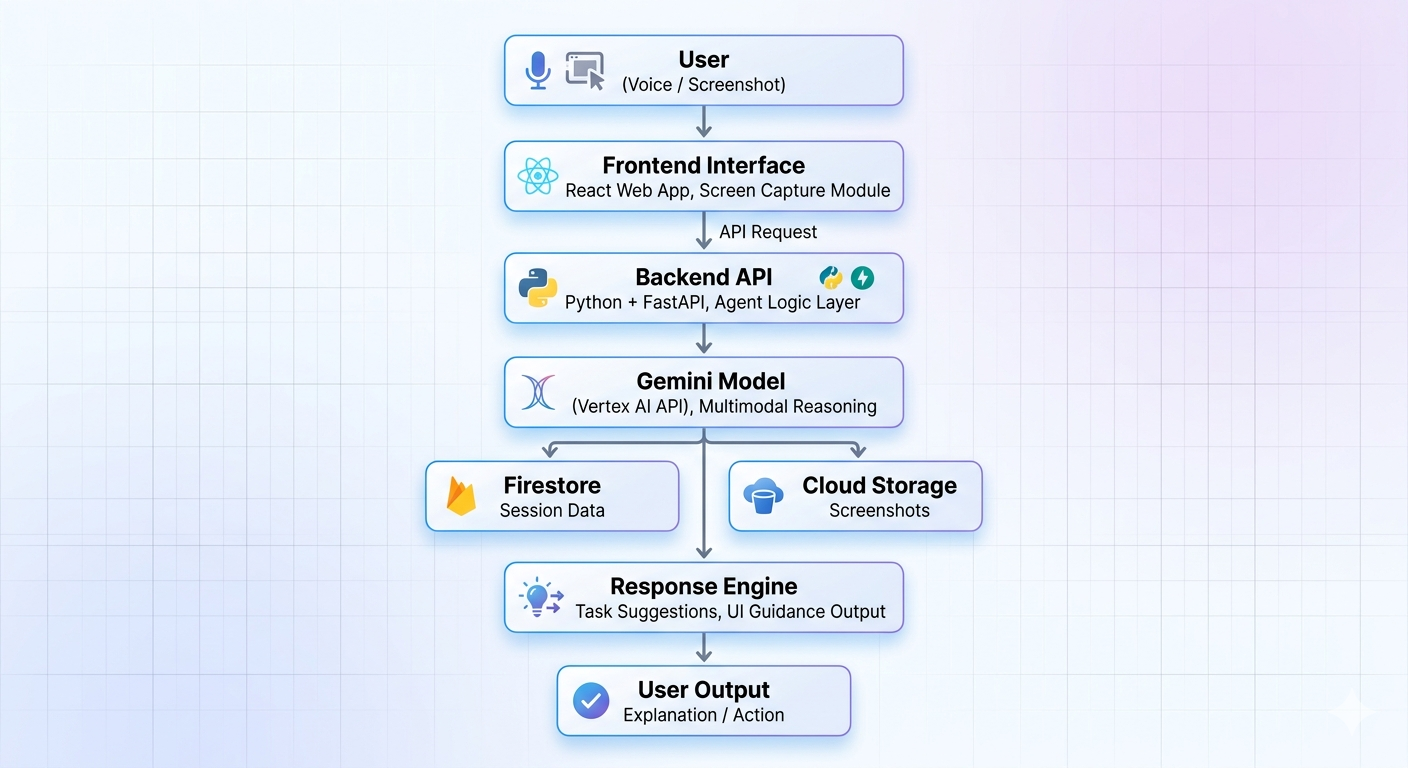
Architecture
Inspiration
Modern software environments are becoming increasingly complex. Users interact with dashboards, forms, and multiple applications every day, often spending significant time navigating interfaces rather than focusing on meaningful work.
This project was inspired by a simple question:
\( \textbf{What if AI could understand what we see on our screens and help us interact with digital systems naturally?} \)
FlowMind AI was created to explore a new form of human–computer interaction where AI agents can interpret visual interfaces, understand user intent, and provide intelligent assistance in real time.
The vision is to move beyond traditional chat assistants and create multimodal AI agents that can see, reason, and guide users through complex workflows.
What It Does
FlowMind AI is a multimodal AI interface assistant that analyzes screen content and provides contextual guidance to users.
The system allows users to:
- Capture a screenshot of their current interface
- Ask questions about what appears on the screen
- Receive explanations about interface elements
- Get guidance for completing tasks such as forms or workflows
Using Gemini’s multimodal reasoning capabilities, FlowMind AI interprets screenshots and generates contextual insights.
Example interaction:
“Explain what this interface does.”
FlowMind AI analyzes the screenshot and describes the key interface elements.
The interaction model can be summarized as:
$$ \text{User Intent} + \text{Visual Context} \rightarrow \text{AI Understanding} \rightarrow \text{Guided Action} $$
This allows users to interact with digital systems more intuitively and efficiently.
How We Built It
FlowMind AI combines a web interface, backend AI agent, and cloud-based AI infrastructure.
Workflow
- The user captures or uploads a screenshot.
- The frontend sends the image to the backend service.
- The backend forwards the screenshot to Gemini through Vertex AI.
- Gemini analyzes the interface and extracts contextual information.
- The system returns structured guidance to the user.
Architecture Overview
User ↓ Web Interface (React) ↓ Backend API (FastAPI) ↓ Gemini Multimodal Model (Vertex AI) ↓ AI Reasoning Layer ↓ Response to User
The backend is deployed using Google Cloud Run, ensuring scalable and secure execution of the AI agent.
Session context and interaction data are stored in Firestore, enabling contextual responses.
This architecture follows a cloud-native design principle:
$$ \text{Scalable AI Interaction} = \text{Cloud Compute} + \text{Multimodal Intelligence} $$
Challenges We Ran Into
Interface Interpretation
Screenshots can contain many visual elements. Designing prompts that help the AI accurately detect buttons, forms, and navigation structures required iterative experimentation.
Contextual Understanding
Ensuring that the AI response matches the user’s intent required building a reasoning layer that structures Gemini’s outputs into meaningful explanations.
Latency Optimization
Multimodal processing requires careful orchestration of API calls and cloud services to maintain responsive interaction.
Privacy Considerations
Handling screen content responsibly was a major design consideration. Screenshots are processed temporarily and are not permanently stored to ensure user privacy.
What We Learned
Building FlowMind AI demonstrated how multimodal AI can significantly improve digital interaction.
Key insights include:
- Visual context dramatically improves AI understanding
- Multimodal models enable more natural interactions
- Cloud-native architectures simplify AI deployment
Conceptually, the AI reasoning pipeline can be expressed as:
$$ AI_{response} = f(\text{Visual Input}, \text{User Query}, \text{Context}) $$
Where \(f\) represents Gemini’s multimodal reasoning capabilities.
What's Next
Future improvements for FlowMind AI include:
- Real-time screen stream analysis
- Voice-based interaction with the agent
- Automated UI actions across applications
- Integration with productivity platforms
The long-term goal is to create an AI assistant that works alongside users across digital environments, making technology more intuitive, accessible, and efficient.
Built With
- agents
- architecture
- cloud
- cloud-native
- computer
- fastapi
- firestore
- gemini
- genai
- javascript
- machine
- multimodal
- python
- react
- sdk
- vertex
- vision

Log in or sign up for Devpost to join the conversation.