Inspiration
Traditional language learning is a battle against human nature. We buy textbooks we never finish because they feel like "work," yet we can scroll through social media for hours without fatigue. This is because social media feeds satisfy our immediate curiosity and emotional needs.
I realized that the problem isn't a lack of resources—it's psychological friction. I wanted to build a platform where learning a language isn't the primary goal, but a natural byproduct of personal growth. This led to the philosophy of Dual Learning: using a foreign language as a tool to solve real-life problems—like healing from a breakup or acing a market analyst interview—while acquiring fluency in the "flow."
What it does
Flowly is an AI-native social media feed designed for language acquisition.
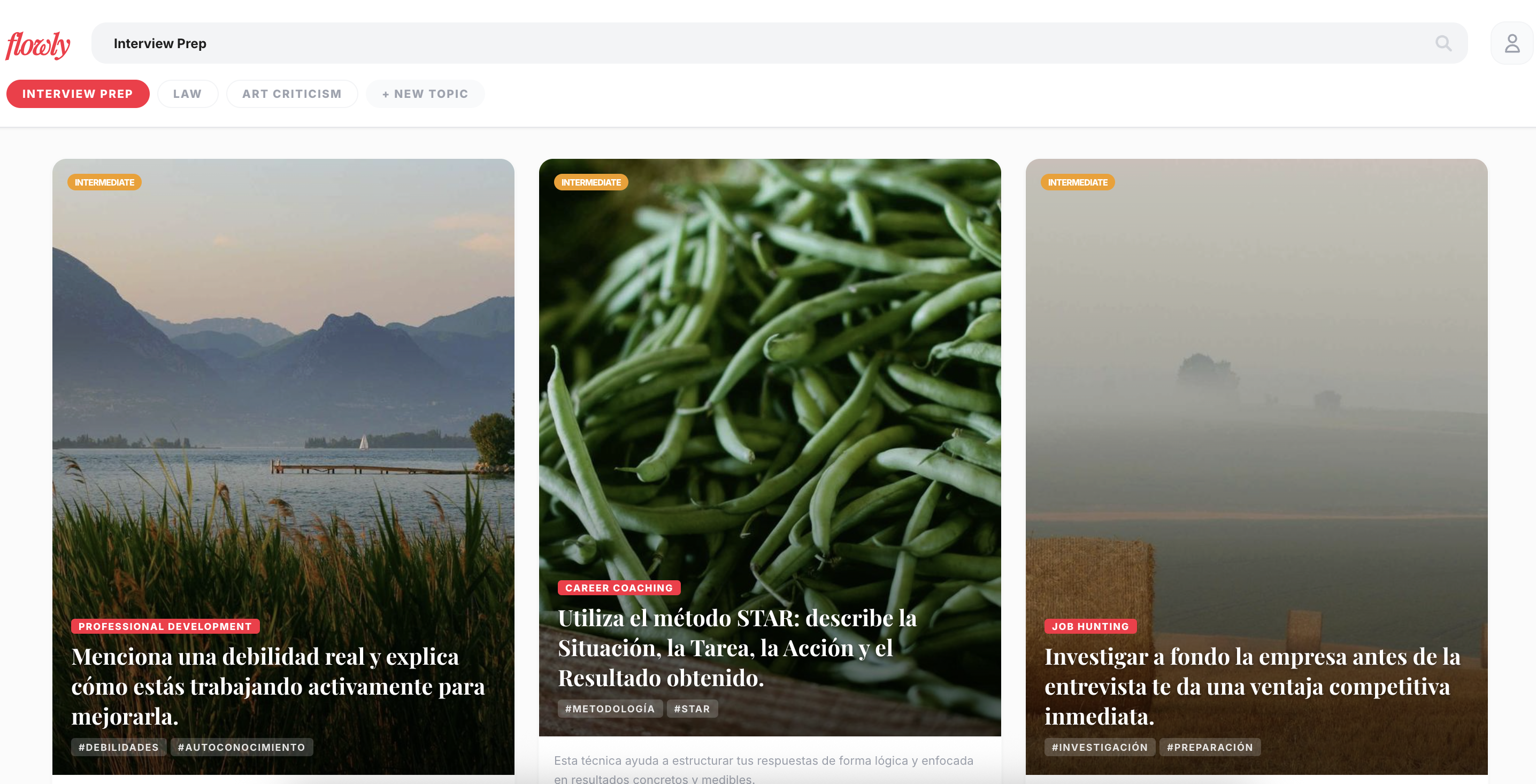
Dual-Learning Feed: Instead of dry lessons, users scroll through "Golden Sentence" cards that offer psychological comfort, career insights, or professional knowledge.
Instant Roleplay Quests: Users can jump from reading a post into a 3-minute simulated conversation. An AI interviewer or mentor challenges them to use the vocabulary they just saw in a real-world scenario.
Contextual Asset Library: Users can long-press any word to see its meaning within that specific context and save it to a personal library that records the original sentence and the AI's nuanced explanation.
Invisible Leveling: The system tracks user goals (like IELTS, TOEFL, or JLPT) and dynamically adjusts the linguistic complexity of the feed behind the scenes.
How we built it
Flowly is a true "AI-Native" project, built by leveraging the full power of the Google AI ecosystem to move from concept to creation with unprecedented speed:
Ideation & Strategy: We collaborated with Gemini 3.0 to refine the core product logic and brainstorm the "Dual Learning" framework. Its advanced reasoning capabilities helped us bridge the gap between language習得 science and social media engagement.
Business Planning: We utilized NotebookLM to synthesize our research on language learning pain points and market trends. It acted as our intelligent research assistant, helping us draft a robust and data-driven Business Plan (BP) by "grounding" the AI in our specific project goals.
Visual Identity: Our branding and logo were brought to life using the Nano Banana model. We used its state-of-the-art text-to-image capabilities to iterate on a visual style that captures the "fluidity" and "modernity" of the Flowly experience.
Prototyping & Development: The core AI engine was built and tested within Google AI Studio. This allowed us to rapidly prototype our complex persona-based prompts and "Quest" logic, ensuring that the transitions between content reading and roleplay were seamless and high-context.
Challenges we ran into
The biggest technical hurdle was the Linguistic Alignment Problem. It is difficult to force an AI to generate deep, professional insights while strictly adhering to a specific CEFR level (e.g., A2 or B1). We solved this by implementing a "Multi-Pass Refinement" logic:
Generate the core insight (Value).
Rewrite for the specific language level (Accessibility).
Inject exam-specific vocabulary (Utility). Another challenge was the Social Cold-Start, which we bypassed by creating a repository of "AI Personas" who pre-populate the feed with diverse perspectives.
Accomplishments that we're proud of
Reinventing the Flashcard: We successfully moved away from isolated word lists to "Contextual Assets," where every saved word is tied to a memory and a specific insight.
Frictionless Transition: The "Quest" feature feels magical—it turns a passive reader into an active speaker in less than two seconds.
Dual Learning Logic: We proved that users spend more time on the app because they are actually interested in the content (e.g., "How to handle workplace stress"), making the language learning "accidental" and painless.
Built With
- gemini2.5flash
- gemini2.5flashtts
- gemini3.0pro

Log in or sign up for Devpost to join the conversation.