-
-
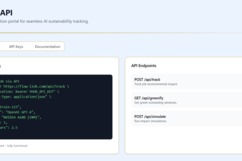
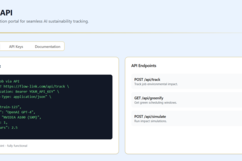
Developer integration portal with comprehensive API access and key management.
-
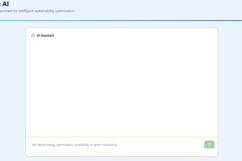
Intelligent sustainability optimization assistant with proactive recommendations.
-
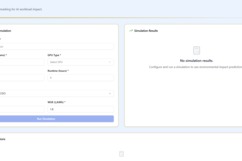
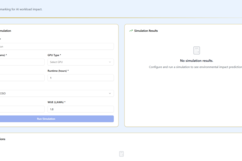
Simulation & benchmarking for AI workload impact with predictive environmental modeling.
-
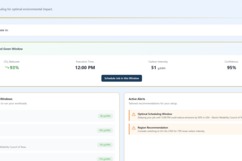
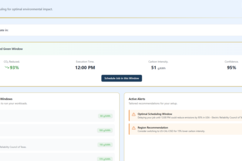
Carbon-aware scheduling for optimal environmental impact with intelligent green window recommendations.
-
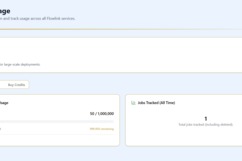
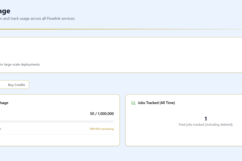
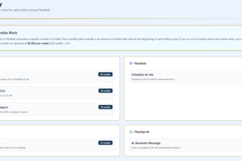
Manage your subscription, track credit usage, and view billing history seamlessly.
-
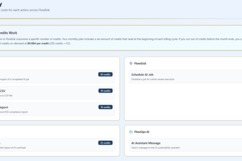
Credits Key Understanding credit costs for each action across Flowlink.
-
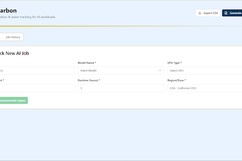
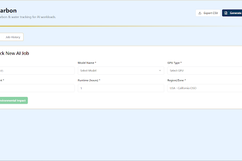
Real-time carbon & water tracking for AI workloads with automated ESG report generation.
Inspiration
We collectively picked this idea to work on because we noticed an unaddressed problem that was hurting the Earth. Specifically, we noticed AI’s contribution to environmental degradation and financial impact. Through extensive research and deep analysis into multiple sources, such as Deloitte and Oracle research papers and articles, we have gathered the necessary information to create our formulas and launch a running prototype of the software, highlighting our domain expertise in AI. Additionally, the demand for our software is exceptional; data centers and AI service providers fail in two potholes when they run their AI workloads: sustainability/ESG goals and minimizing costs. With Flowlink, they can track and reduce both of these factors - meeting sustainability standards and lowering expenses. Moreover, our current lead of an AI data center specialist from Oracle further conveys the attention and demand brought by our software and how it can help.
What it does
The purpose of Flowlink was to track and reduce the impact of AI workloads, including carbon footprint, water wastage, energy usage, and to cut data centers’ operational costs. Through extensive research into how AI contributes to environmental degradation and companies incur billions of dollars in losses, we incorporated mathematical formulas and APIs from third-party services to extract real-time financial and environmental data from AI workloads. Specifically, Flowlink has users input information, including model size, GPU type, GPU count, runtime hours, and the workload region to calculate its data and ensure that these AI workloads don’t run blindly. Users can compare data across regions and models and get recommendations for their workloads. We ran two tests side-by-side with different AI models in the same region (US-CAL-CISO) to determine the environmental and financial differences. In our first test, we ran a workload with a model size of 18, a GPU type of AMD-MI250X, a GPU count of 99, and a runtime of 17 hours, which produced 757.4 kWh, 302.9 kilograms of CO₂, 1363 liters of water, and a cost of $90.88. In our second test, we ran another workload with a model size of 27, a GPU type of AMD-MI300X, a GPU count of 45, a runtime of 12 hours, and it produced 365.4 kWh, 145.8 kilograms of CO₂, 656 liters of water, and cost $43.74. Flowlink is the complete sustainability suite that transforms AI operations. It prompts AI to continue its growth while simultaneously reducing its environmental impact.
How we built it
To develop and test Flowlink, we utilized various sources, both AI and institutional, to fully understand AI’s environmental and financial impact. Deloitte Data Center Sustainability, “Green AI Energy Report – Green AI: Cutting Carbon Intake While Enabling Growth,” and “Data Center Sustainability Metrics – IEEE Spectrum” allowed us to understand the exact statistics regarding the environmental impact, including AI’s contribution of electricity (300 TWh annually), carbon dioxide emissions (30M metric tons of CO₂), and billions of dollars lost to operational costs, such as utility bills, grid strain, and cloud service expenses. Additionally, we learned about data analytics on CO2 emissions, water, and energy-specific usage, optimal green windows for system execution, predictive environmental modeling, sustainability recommendations, and ORG sustainability scores for each job.
Furthermore, for extra questions and information not found through those websites, we utilized ChatGPT and input the following prompts:
● “Explain how to estimate energy consumption for GPU workloads based on runtime, hardware type, and utilization.”
● “List formulas to calculate CO₂ emissions usage from kWh across regions.”
● “How can I structure a Python function that converts compute usage into environmental impact metrics?”
● “List factors that affect water usage in data centers and how to approximate them mathematically.”
● “Suggest an algorithm to compare multiple workloads and recommend the most efficient configuration.”
● “How can I design a system architecture for a platform that analyzes AI workloads and outputs optimization suggestions?”
● “What are common inefficiencies in AI workloads and how can software detect them automatically?”
● “Explain how carbon-aware scheduling works and how to model optimal execution windows.”
● “Help me debug this logic for calculating workload cost based on GPU count, runtime, and region pricing.”
As for our means of hosting the website and software, we utilized Base44 and Grammarly for punctuation.
Challenges we ran into
In creating this software, we stumbled upon a variety of challenges, including coding and extracting real data rather than simulated. To elaborate, upon coding, we encountered a multitude of technical difficulties and runtime errors that we eventually fixed, although they were time-consuming and strenuous.
Accomplishments that we're proud of
Blue Ocean Student Competition Global Finalist (Top 100) - Pitched Flowlink Delaware Valley Science Fair — Honorable Mention (Team) - Pitched Flowlink Mott Million Dollar Challenge — National Winner (Top 28%) - Pitched Flowlink Coriell Institute Science Fair — 1st Place - Pitched Flowlink Diamond Challenge Pitch Round Semifinalist (Top 20) - Pitched Flowlink
What we learned
While working on Flowlink, we were able to acquire a significant amount of knowledge concerning AI sustainability challenges, including the difficulties that exist when estimating the true impact of AI on the environment and the factors that affect such calculations, including GPU efficiency, the source of energy used to power computing hardware, and proper workload optimization. Moreover, creating a product gave us hands-on experience with various problems that could arise during development and implementation.
First of all, we faced a number of obstacles, ranging from runtime errors to issues with calculating and comparing workloads. To overcome these challenges, we gained significant problem-solving experience and improved our coding and algorithmic thinking.
Additionally, while working on our project, we learned what it takes to start up a business and implement an innovative idea in a company. Namely, we realized that a truly innovative idea must have clear advantages, which can be translated in terms of benefits for the client. This experience taught us to emphasize cost savings along with sustainability and helped us find the right balance between them.
In general, we believe that combining research work with the help of a data center expert and our own practical experience is the key to successful product implementation.
What's next for Flowlink
- Job-level dataset improved recommendations
- API Keys and deeper integrations to extract real data rather than simulated across different regions
- The optimization engine gets better over time
- Expands across GPUs and areas
- Reduce AI’s contribution of electricity (300 TWh annually), carbon dioxide emissions (30M metric tons of CO2), and billions of dollars lost to operational costs, such as utility bills, grid strain, and cloud service expenses
Built With
- base44
- chatgpt
- claude
- electricitygrid
- gemini
- google-cloud
- grok
- supabase

Log in or sign up for Devpost to join the conversation.