-
-
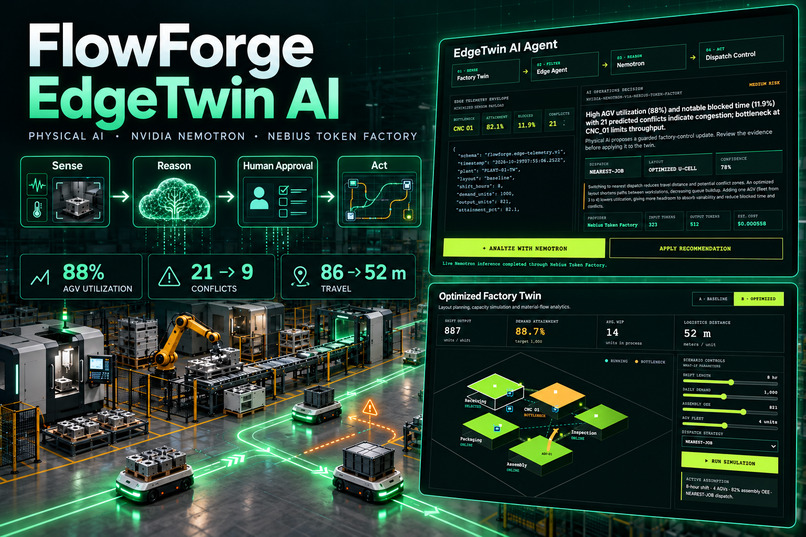
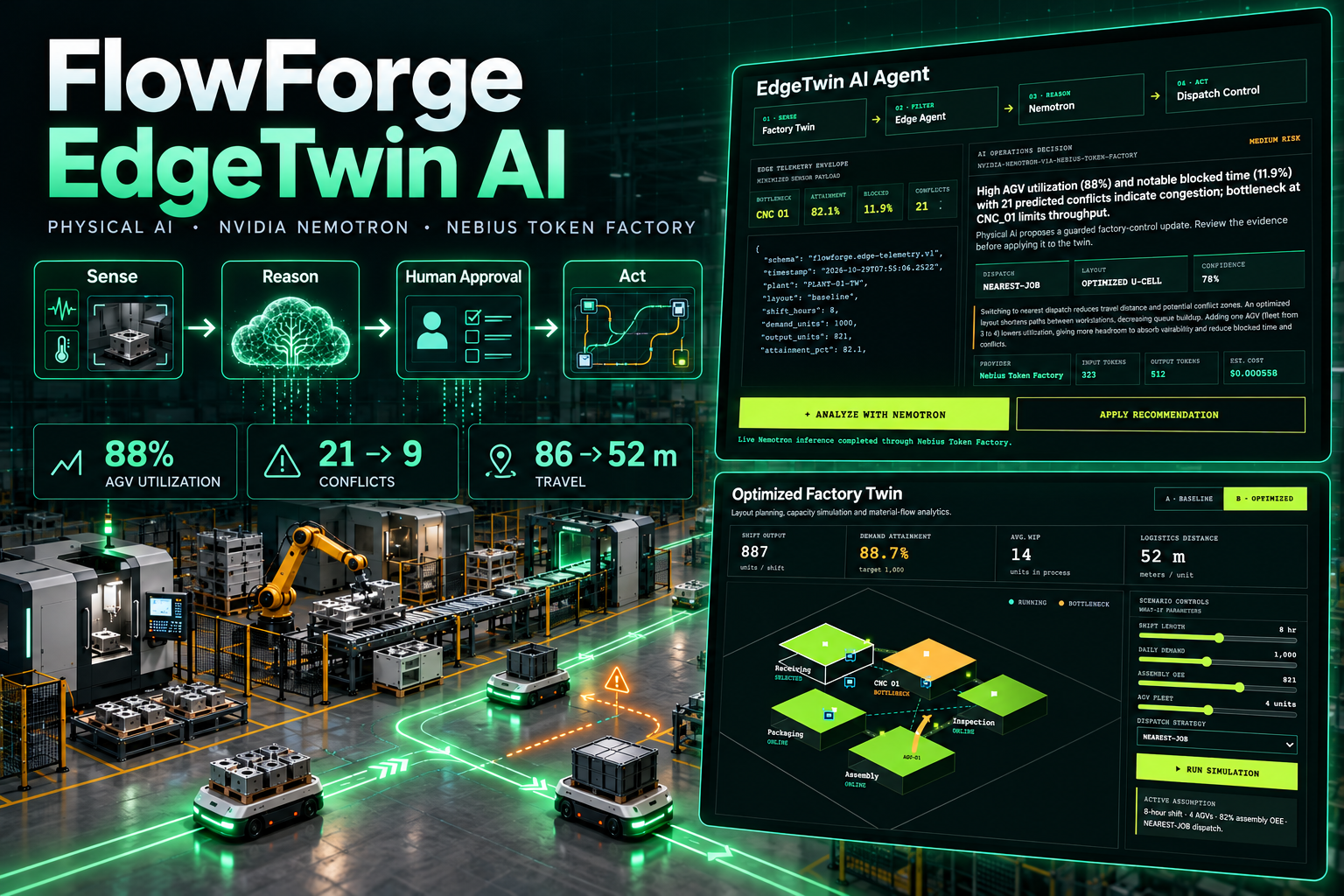
FlowForge EdgeTwin AI uses Nemotron on Nebius to optimize factory layouts, AGV conflicts from 21 to 9, travel distance from 86m to 52m
Inspiration
What it does
How we built it
Challenges we ran into
Accomplishments that we're proud of
What we learned
What's next for FlowForge EdgeTwin AI
Inspiration
Factory teams often review layout, production capacity, and mobile-robot traffic in separate tools. FlowForge EdgeTwin AI closes that gap with a visible sense → filter → reason → act loop: the digital twin produces a minimized sensor envelope, NVIDIA Nemotron reasons over it through Nebius Token Factory, and a human operator approves the proposed change before it reaches the simulated control layer.
What it does
FlowForge simulates receiving, CNC, inspection, assembly, packaging, WIP, and an AGV fleet. It calculates shift output, attainment, OEE effects, queues, blocked travel time, utilization, predicted conflicts, and the active bottleneck.
The EdgeTwin AI Agent sends only operational telemetry to a server-side proxy. NVIDIA Nemotron 3 Super returns a bounded JSON recommendation for the factory layout, AGV dispatch policy, fleet size, risk, rationale, and confidence. The browser validates the action against an allowlist and requires explicit human approval before applying it.
Every live decision shows the provider, model, input/output tokens, and estimated cost. If cloud inference is unavailable, a clearly labeled deterministic edge fallback keeps the demo operational without pretending the result came from Nemotron.
How we built it
The factory twin uses accessible HTML, CSS, JavaScript, and Canvas. A small Python server hosts the app and proxies OpenAI-compatible chat-completion requests to Nebius Token Factory. The API key stays server-side in a Git-ignored environment file.
- Sense: measure OEE, WIP, bottleneck, AGV utilization, blocked time, queues, and conflicts.
- Filter: emit the minimized
flowforge.edge-telemetry.v1contract. - Reason: call
nvidia/nemotron-3-super-120b-a12bthrough Token Factory. - Guard: reject unsupported actions and clamp the fleet to a safe simulated range.
- Act: require the operator to apply the accepted recommendation.
- Measure: rerun the twin to compare output and traffic impact.
The project also includes an OpenUSD-ready factory package with layout variants, component references, payloads, and MES-style metadata for a future NVIDIA Omniverse or Isaac Sim workflow.
Live result
For the baseline scenario — eight-hour shift, demand 1,000, assembly OEE 82%, three AGVs, FIFO — the twin reported 821 units, CNC 01 as the bottleneck, 88% AGV utilization, 11.9% blocked time, and 21 predicted conflicts.
A verified Token Factory call used 323 input and 526 output tokens. Nemotron recommended an optimized layout, nearest-job dispatch, and five AGVs with 78% confidence. Estimated inference cost: US$0.000570.
Challenges we ran into
- Keeping the Token Factory key out of browser code while preserving a one-command demo.
- Constraining a generative model to a small, auditable control action space.
- Separating live cloud provenance from deterministic fallback behavior.
- Turning a pre-existing digital-twin portfolio into a genuine closed-loop Physical AI system during the submission period.
Accomplishments that we're proud of
- A working Nemotron-powered control loop rather than a static AI mockup.
- Human approval and browser-side validation before simulated actuation.
- Per-decision token and cost transparency.
- Resilient, explicitly labeled edge fallback.
- A portable OpenUSD-ready representation of the same factory.
What we learned
A compact telemetry contract and bounded action schema make an AI operations system easier to audit, cheaper to run, and safer to demonstrate. Token Factory made it possible to use an NVIDIA open model through a familiar API while retaining model and usage visibility.
Significant hackathon updates
FlowForge existed before the submission period as a digital-factory and OpenUSD portfolio demo. During the hackathon it gained the complete EdgeTwin AI Agent, minimized telemetry contract, live NVIDIA Nemotron inference on Nebius Token Factory, server-side secret proxy, human-approved bounded actions, deterministic fallback, token/cost reporting, and automated decision tests.
Token Factory and NVIDIA feedback
The OpenAI-compatible endpoint made integration fast, while Nemotron produced useful structured reasoning from a compact payload. Model-card examples combining structured output, regional endpoints, rate limits, and edge-to-cloud reference architectures would make Physical AI production planning even easier.
What's next
Connect the contract to MQTT or OPC UA on NVIDIA Jetson, evaluate synthetic congestion scenarios with Nebius Serverless Jobs, and validate the OpenUSD stage in NVIDIA Isaac Sim or Omniverse.
Built With
- digital-twin
- edge-ai
- javascript
- nebius-token-factory
- nvidia-nemotron
- openusd
- physical-ai
- python
