-
-
FlowDebt
Inspiration
I tried to compare productivity debt with financial debt. It is stressful to manage productivity debt, especially when time is constrained. The idea is to create a focussed web app that helps people see their situation and clear productivity debt to progress.
Expanding on this concept, productivity debt refers to the accumulation of unfinished tasks, delayed projects, or neglected responsibilities that weigh down a person much like unpaid financial debt. Just as mounting bills can lead to anxiety and hinder one's financial stability, outstanding work commitments can create mental stress and obstruct personal or professional development. The pressure intensifies when deadlines are looming or resources are limited, making it increasingly challenging to catch up and regain control.
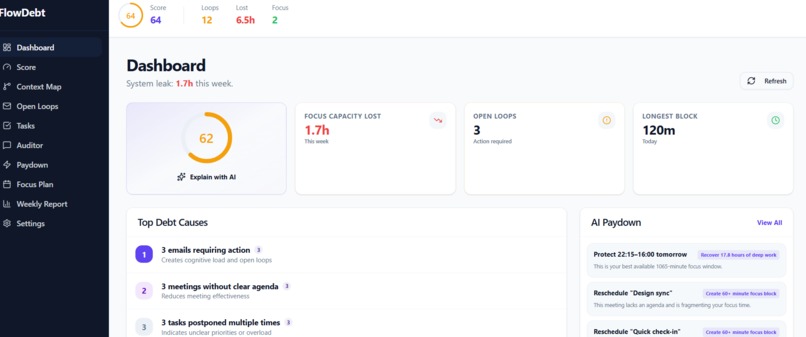
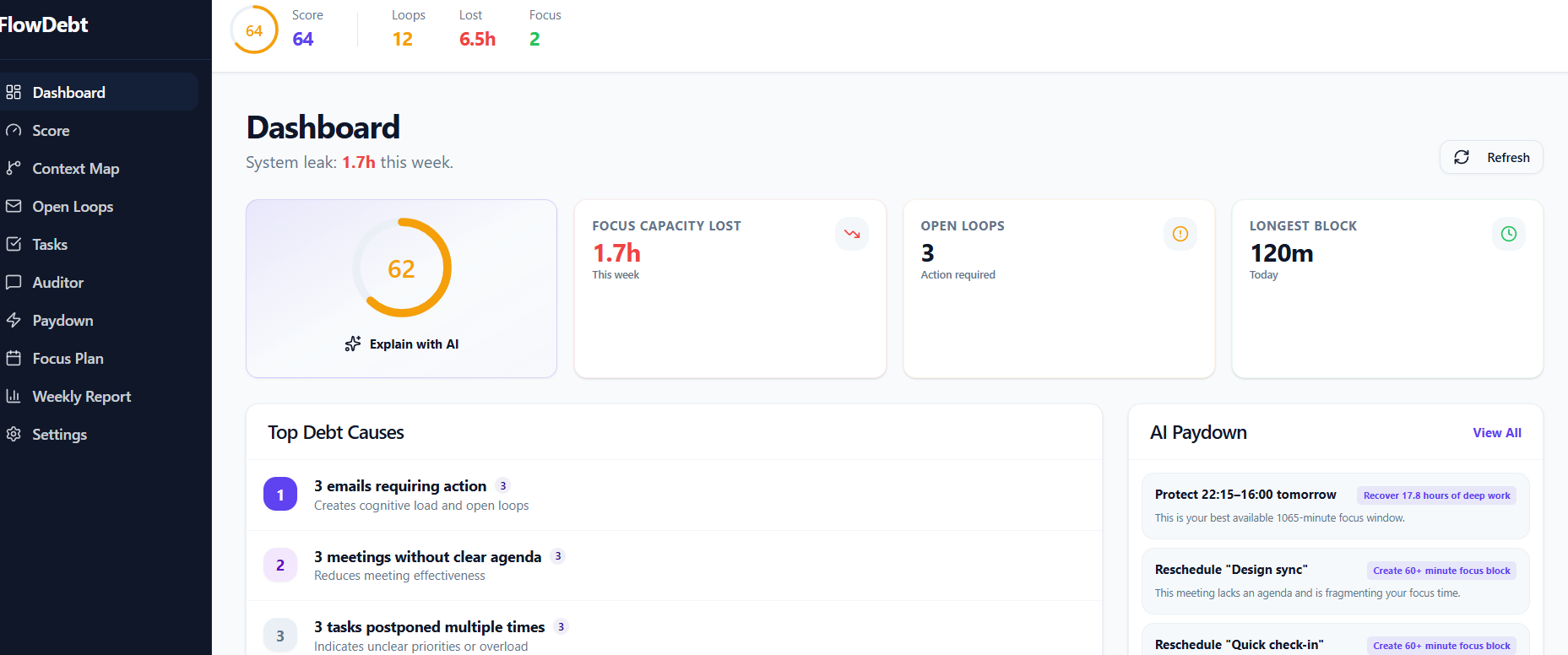
The proposed web app would serve as a practical tool for users to visualise their productivity debt in a structured and transparent way. By providing a clear overview of pending tasks and tracking progress, the app aims to empower individuals to take effective action towards reducing their backlog. Features might include a dashboard showing 'debt score', personalised recommendations to tackle the most pressing items, and simple interface controls to add, prioritise, and complete tasks. The goal is to help users stay focussed, alleviate stress, and move forward efficiently, turning what might feel like an overwhelming burden into manageable steps towards progress.
By streamlining the process and focusing on clarity and ease of use, the app could support anyone struggling with productivity debt, whether students, professionals, or teams, enabling them to achieve their goals with greater confidence and less stress. This project taught me that a useful productivity app does not need to be complicated; it needs to be clear, trustworthy, and easy to use.
I have learned two major lessons: User experience Productivity debt can already feel overwhelming, so the interface had to be simple, readable, and action oriented. Prototyping I used an AI-assisted no-code/full-stack app-building workflow through the AppMedo/MeDo ecosystem. MeDo describes itself as a platform for building full-stack apps and websites quickly, including frontend, backend, and database support.
How web app project was built? I started with a simple problem statement: “Know your productivity debt, pay it down automatically. “ I formulated a debt scoring system based on the factors: • Meeting Fragmentation (25% weight) • Open Loops (25% weight) • Task Rollover (20% weight) • After-Hours Work (15% weight) • Focus Recovery (15% weight)
The project was structured around several anticipated user activities, including: • Reviewing an analysis dashboard • Analysing customer feedback • Finalizing the product roadmap • Researching new tools
Languages: Prompt instructions were provided in clear, accessible natural language.
Frameworks / App-Building Platform
MeDo / AppMedo: The application is hosted on an appmedo.com subdomain. MeDo characterizes its platform as a no-code AI system designed for constructing production-grade full-stack applications and websites.
AI-assisted app generation: The project utilized a generated-app workflow, as opposed to a completely manual traditional coding approach.
Hosting / Deployment
AppMedo cloud hosting : the application is publicly accessible via the AppMedo deployment service.
Backend / Database
According to MeDo documentation, more advanced generated applications may require backend storage solutions and potentially integrate with Supabase.
A concise technical summary is as follows:
• Confirmed: Web application hosted by AppMedo.
Integrations include Gmail, Google Calendar, Slack, RescueTime, JIRA, and Make.com, indicating API usage.
Challenges Encountered
• Simplifying Concepts
A primary challenge was transforming a complex, often stressful subject into a streamlined interface. Productivity applications can become cluttered with statistics, alerts, graphs, and specialized terminology. The focus remained on presenting essential information first.
• Managing Automation Versus User Autonomy
While the AI Auditor can suggest productivity patterns, maintaining user control over decisions was critical. Deliberation was required to determine where automation could assist and where user judgment should prevail.
• Designing Transparent Calculations
Complexity in formulas can lead to confusion if the processes are hidden. It became evident that productivity applications must make calculations clear to foster user confidence.
• Navigating a Generated-App Platform
Utilizing an AI/no-code platform accelerated development but necessitated adaptation to the platform’s structural constraints, deployment protocols, and integration capabilities. The efficiency gained was counterbalanced by the need to ensure the project was purposeful and refined.
• Planning for Data Persistence
A debt tracking tool is significantly enhanced when users can save, update, and revisit their records. Addressing data persistence, authentication, privacy, and security introduced greater complexity than designing the visible interface alone.
Final Reflection FlowDebt offered valuable insights into how technology can transform productivity-related stress into clarity. The project originated from an identified real-world problem: individuals require straightforward tools to help them prioritize their focus and discern what can be deprioritized.
Built With
- medo

Log in or sign up for Devpost to join the conversation.