-
-
1
-
2
Inspiration
Modern daily routines are saturated with an overwhelming influx of micro-responsibilities, digital clutter, and endless checklists. Traditional productivity tools often exacerbate this issue by confronting users with dense, intimidating walls of static tasks, directly causing cognitive overload and choice paralysis. The true hurdle in personal productivity is not simply listing down tasks; it is overcoming the friction required to take the first step. FlowCompass was inspired by the need for a mindful, transition-driven interface that filters out the noise and gracefully guides users from an anxious planning state into an isolated state of actionable deep focus.
What it does
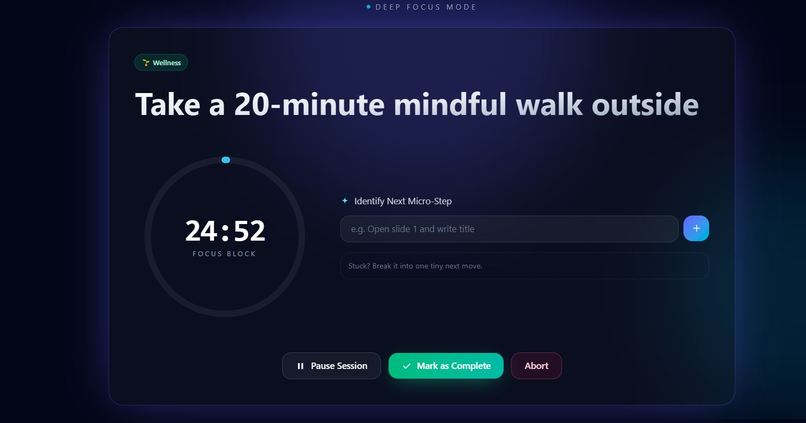
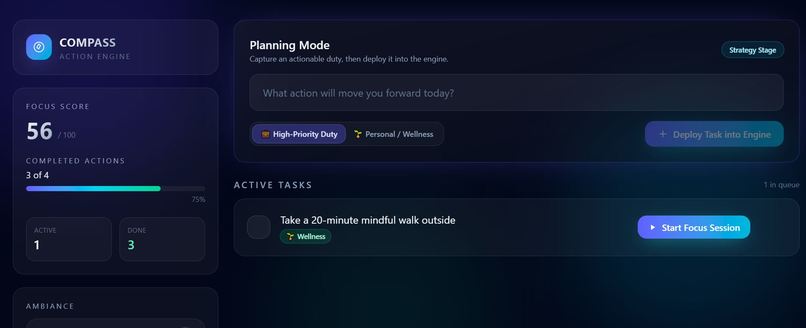
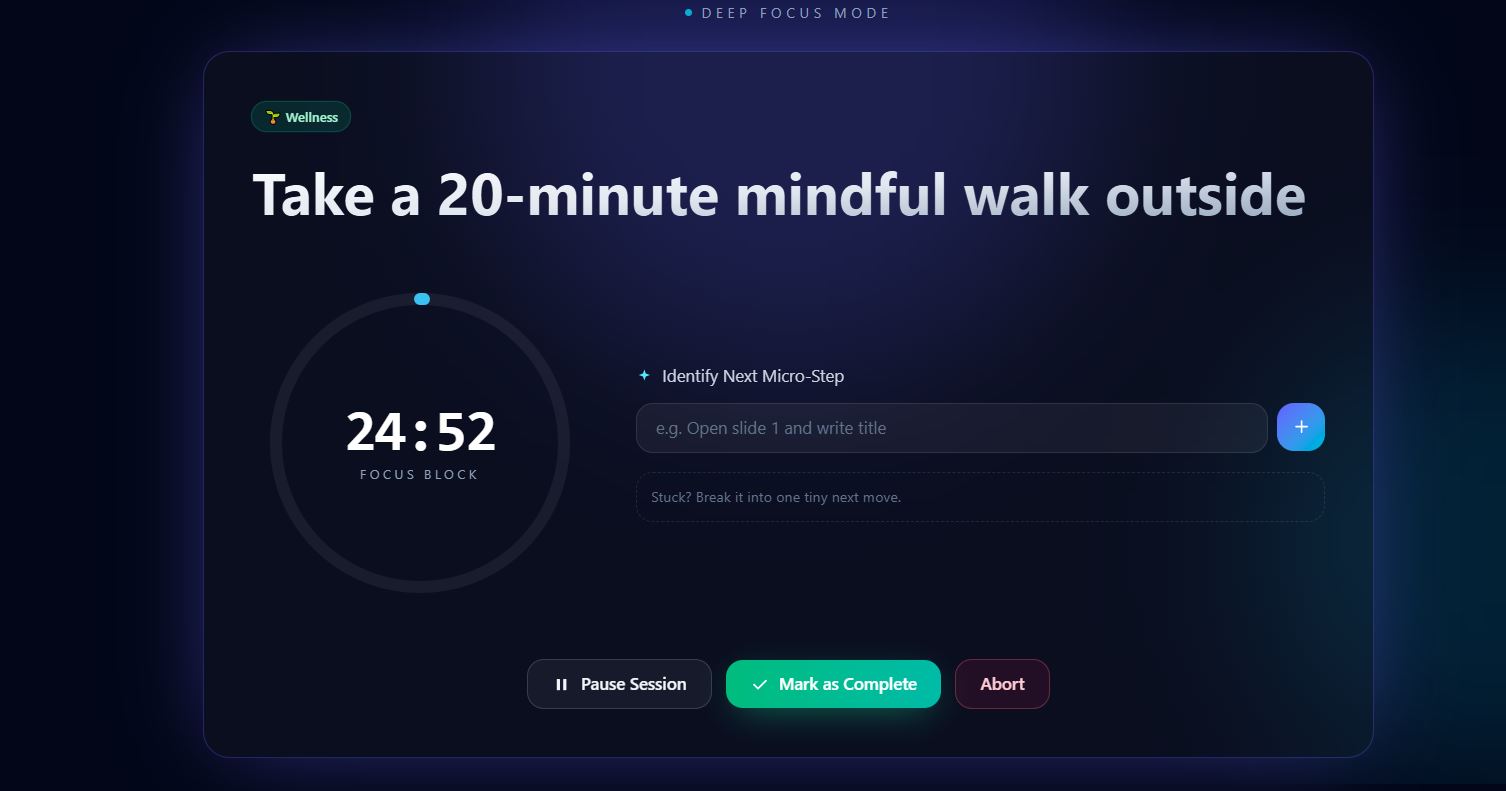
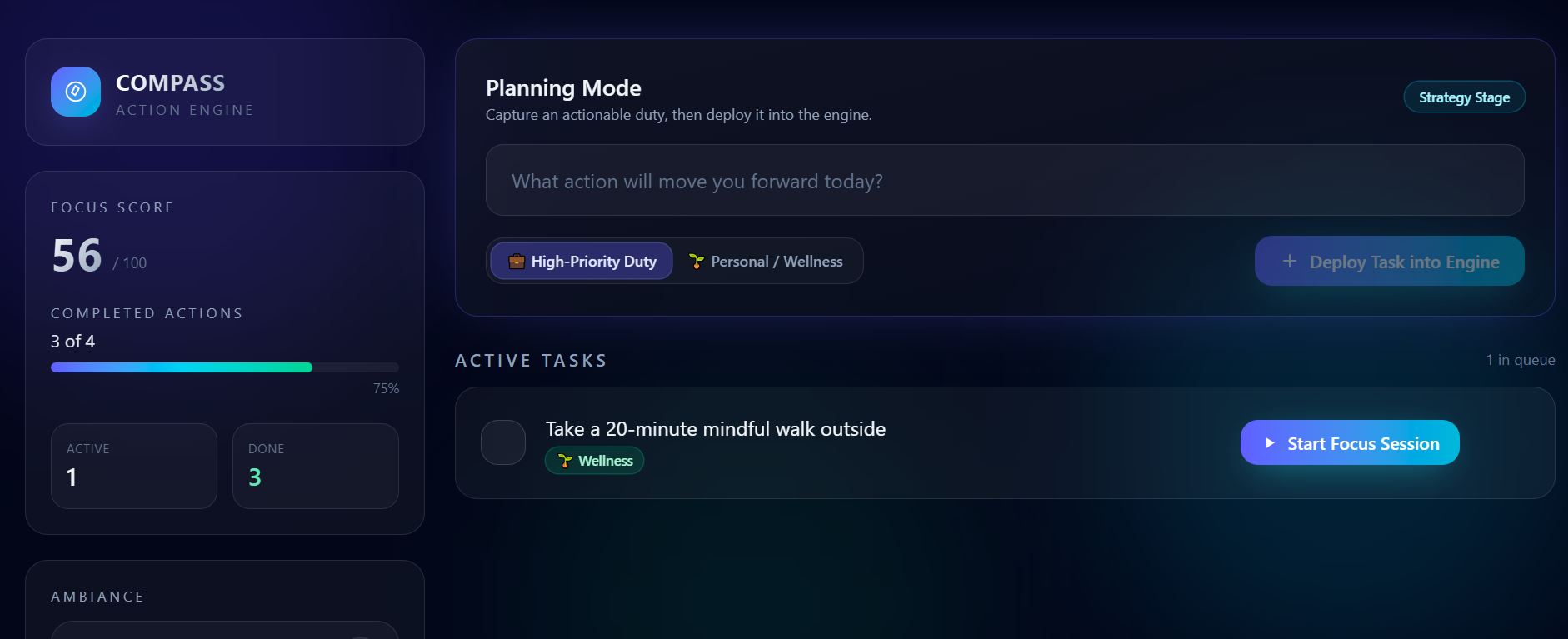
FlowCompass is an immersive, state-driven daily action engine designed to systematically eliminate decision fatigue. Operating completely without the friction of account creation, it utilizes local browser persistence to capture user tasks under distinct tracks: core professional duties and personal wellness indicators. The core innovation lies in its dynamic, dual-mode structural architecture. Instead of displaying a persistent checklist, users select a single task to initiate a deep focus session. The application instantly shifts its layout into a full-screen, minimalist execution canvas that isolates the selected task, initiates a visual countdown timer, provides an interface to map immediate micro-steps if the user feels stuck, and delivers integrated ambient soundscapes to keep the user anchored on track.
How we built it
The application was engineered utilizing a high-performance single-page architecture built with React and styled completely using custom Tailwind CSS utility layers.
- State & Persistence: State transitions and metrics are managed entirely using structural React hooks, linked directly to the native browser LocalStorage API for seamless client-side data persistence.
- Interface Mechanics: The premium dark-mode, glassmorphic layout relies heavily on smooth Tailwind transition layers and layout-shifting conditional components to safely swap views without layout layout fragmentation.
- Acoustics: The ambient focus soundscapes were implemented directly into the Document Object Model (DOM) using the native HTML5 Audio API managed through decoupled React mutable references to prevent state-re-render interruption.
Challenges we ran into
One of the primary technical hurdles involved building the layout transition mechanics between the multi-column Planning Phase and the full-screen Deep Focus Canvas. Ensuring that states, active audio parameters, and active countdown loops remained completely intact without re-triggering browser security flags or resetting components required meticulous lifecycle management and structural scoping. Additionally, tracking user progression without a complex external database backend forced us to maximize the efficiency and schema design of local storage boundaries, safely initializing default states so that the workspace never displays completely empty upon the first view.
Accomplishments that we're proud of
We are immensely proud of designing a highly interactive workspace that actively solves the psychology behind procrastination rather than just acting as a digital notepad. Successfully implementing a clean, zero-friction setup that functions instantly without a tedious authentication wall ensures absolute accessibility. Furthermore, crafting the entire application shell with such precise high-fidelity aesthetic layers, fluid UI animations, and immersive soundscapes within a highly constrained development timeline stands out as a major achievement.
What we learned
This development cycle provided deep insights into user experience psychology and the mechanics of behavioral conditioning within software. We learned that isolating a single task and hiding surrounding environmental data drastically reduces user anxiety and accelerates deep work entry rates. From a technical standpoint, we deepened our familiarity with state management synchronization, DOM audio handling constraints, and structural layout optimization techniques using Tailwind CSS configurations.
What's next for FlowCompass — Smart Productivity Dashboard
The immediate roadmap for FlowCompass involves evolving the layout into a decentralized stack. Future iterations will integrate a serverless backend using Supabase to introduce cross-device secure synchronization and automated analytics pipelines. We also intend to embed client-side natural language processing models to allow users to input unstructured paragraphs of text and automatically parse them into actionable micro-steps, turning FlowCompass into a highly predictive, intelligent life-management engine.


Log in or sign up for Devpost to join the conversation.