
Inspiration
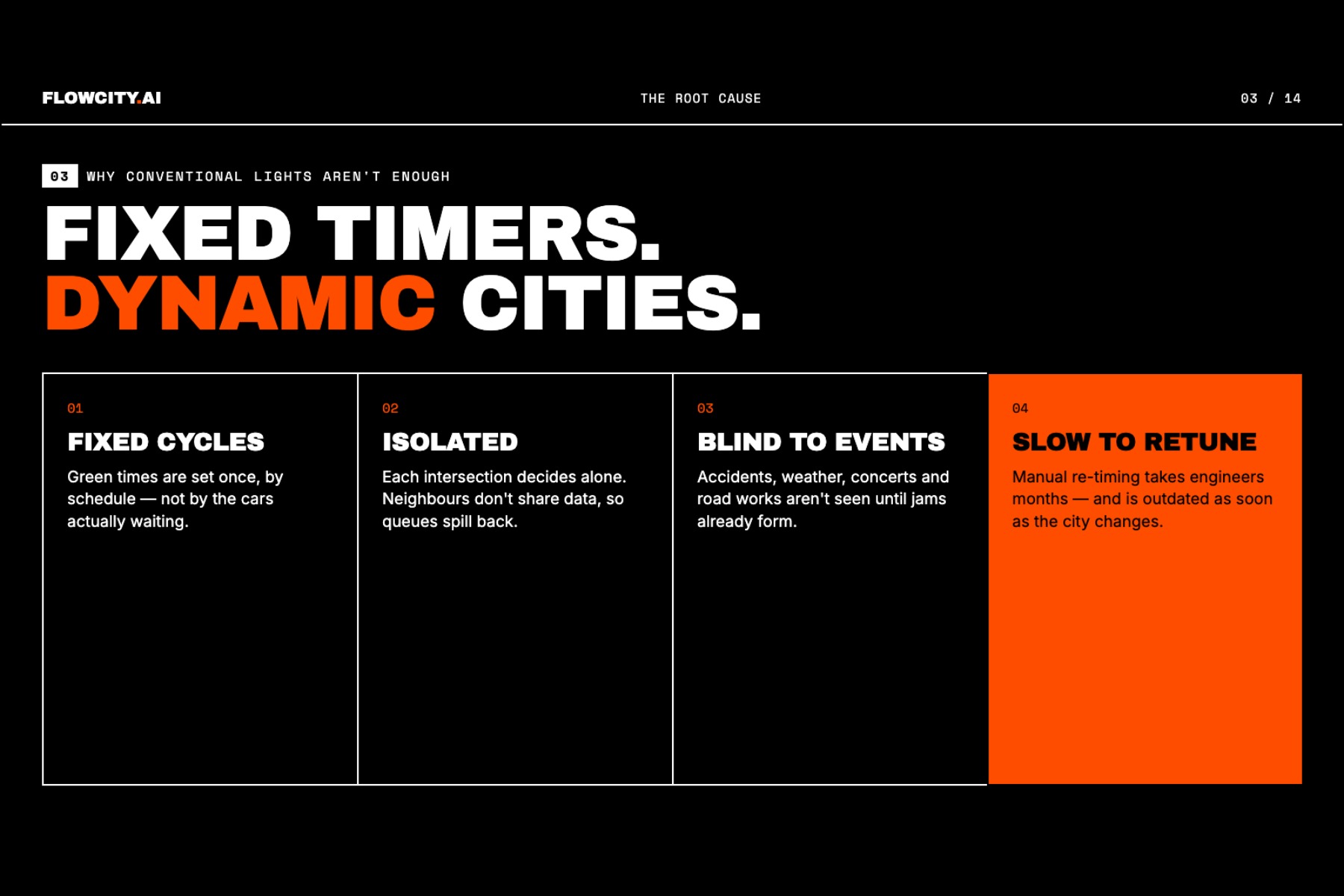
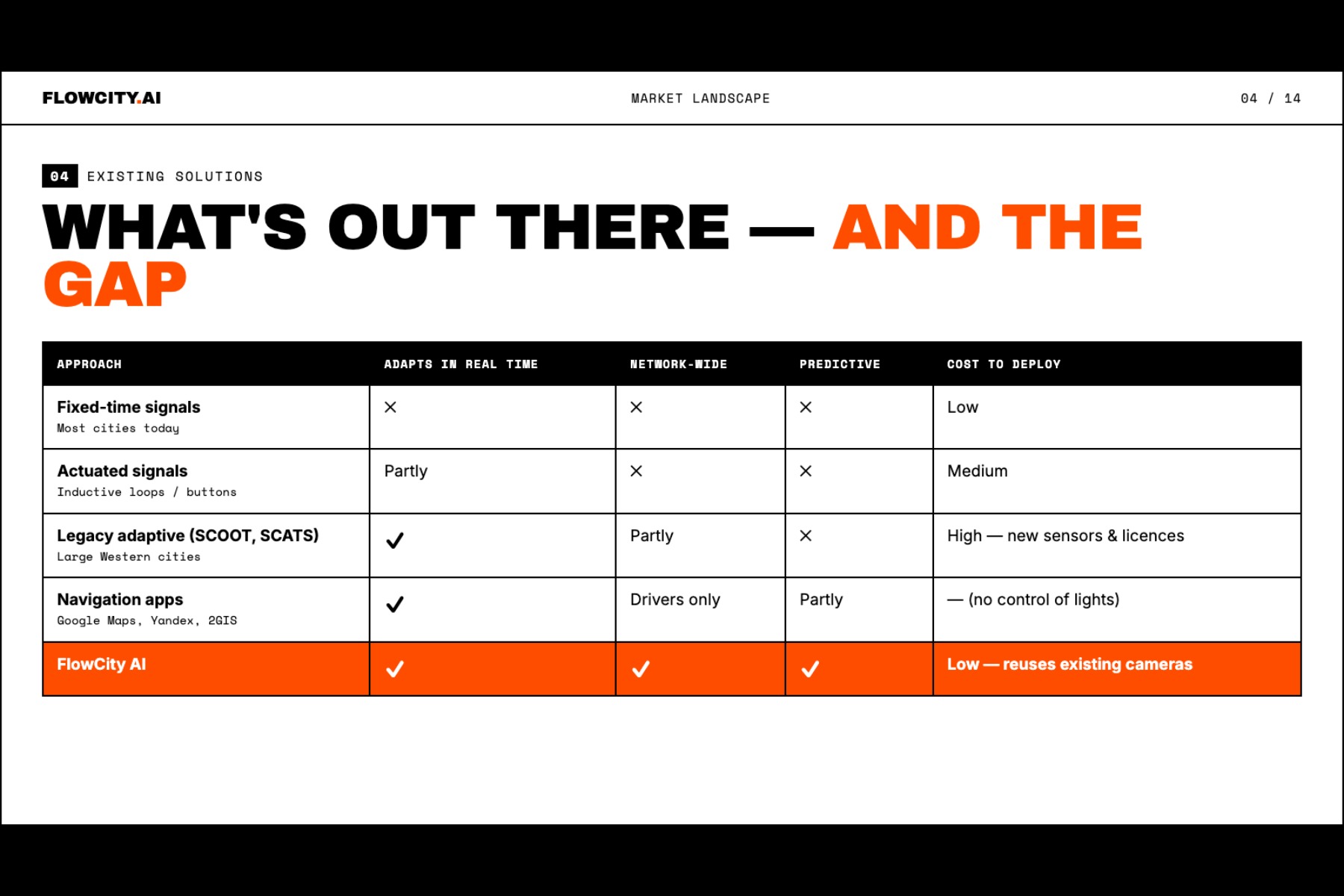
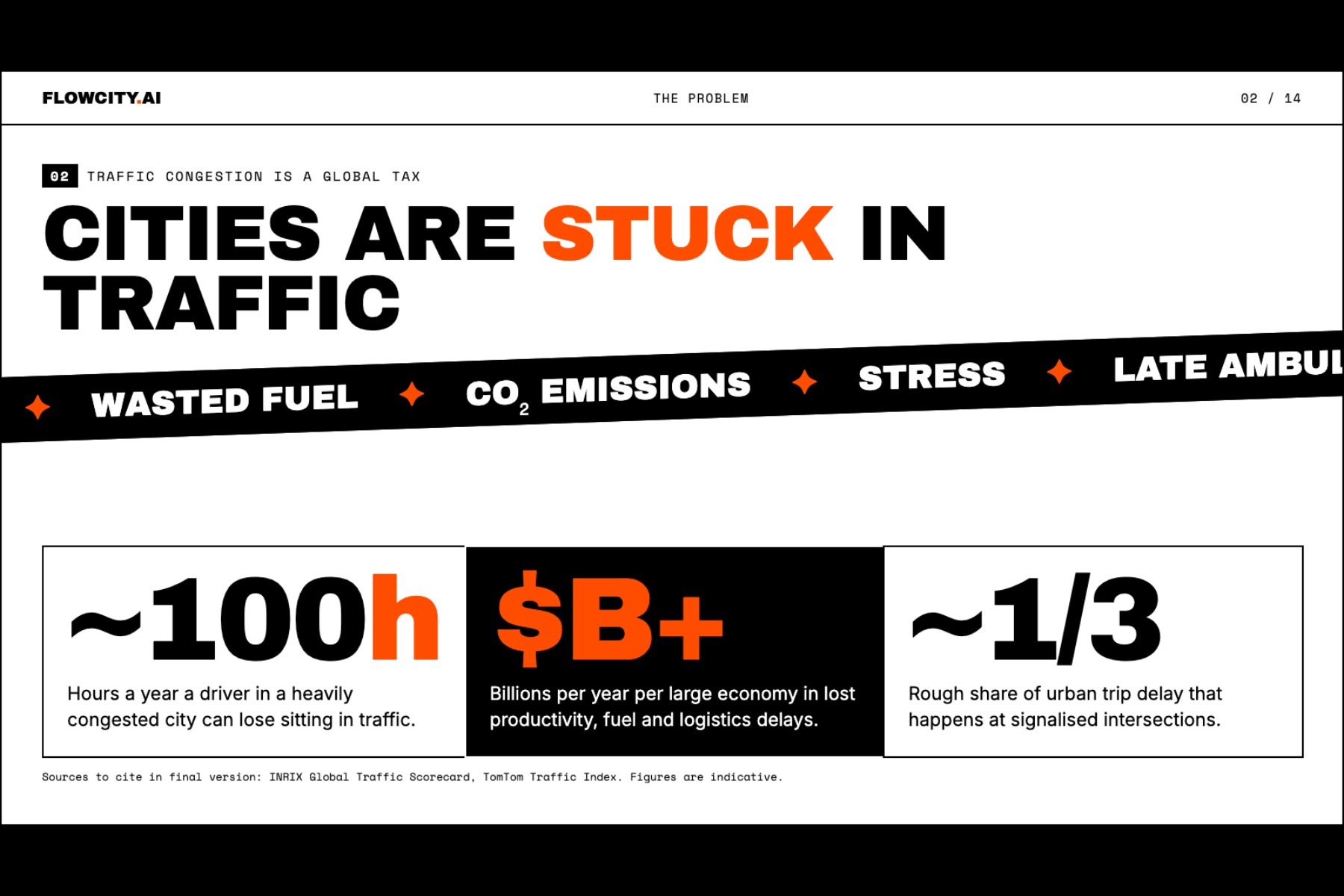
Traffic lights in most cities still rely on fixed schedules or isolated local logic, even though traffic conditions can change every few minutes. Congestion, accidents, weather, road works and rush-hour demand make static timing inefficient.
We wanted to explore a system where traffic lights do not work independently, but instead act as one coordinated network that reacts to the real situation on the road.
What it does
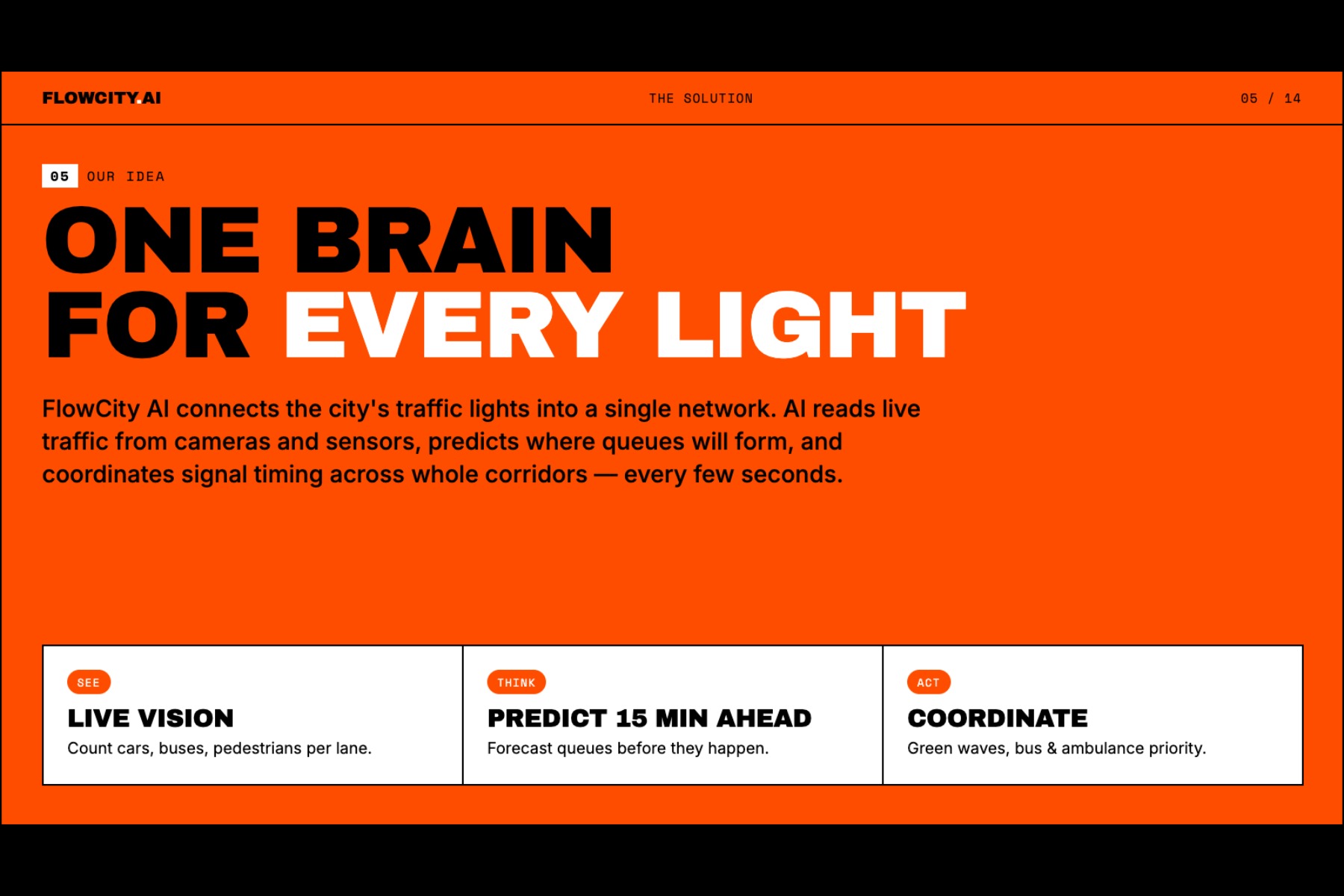
FlowCity AI is an AI-powered traffic-light coordination system.
It uses existing cameras and traffic sensors to estimate how many cars, buses and pedestrians are approaching each intersection. The system then analyzes traffic across multiple intersections, predicts where queues may form, and adjusts signal timing to reduce congestion.
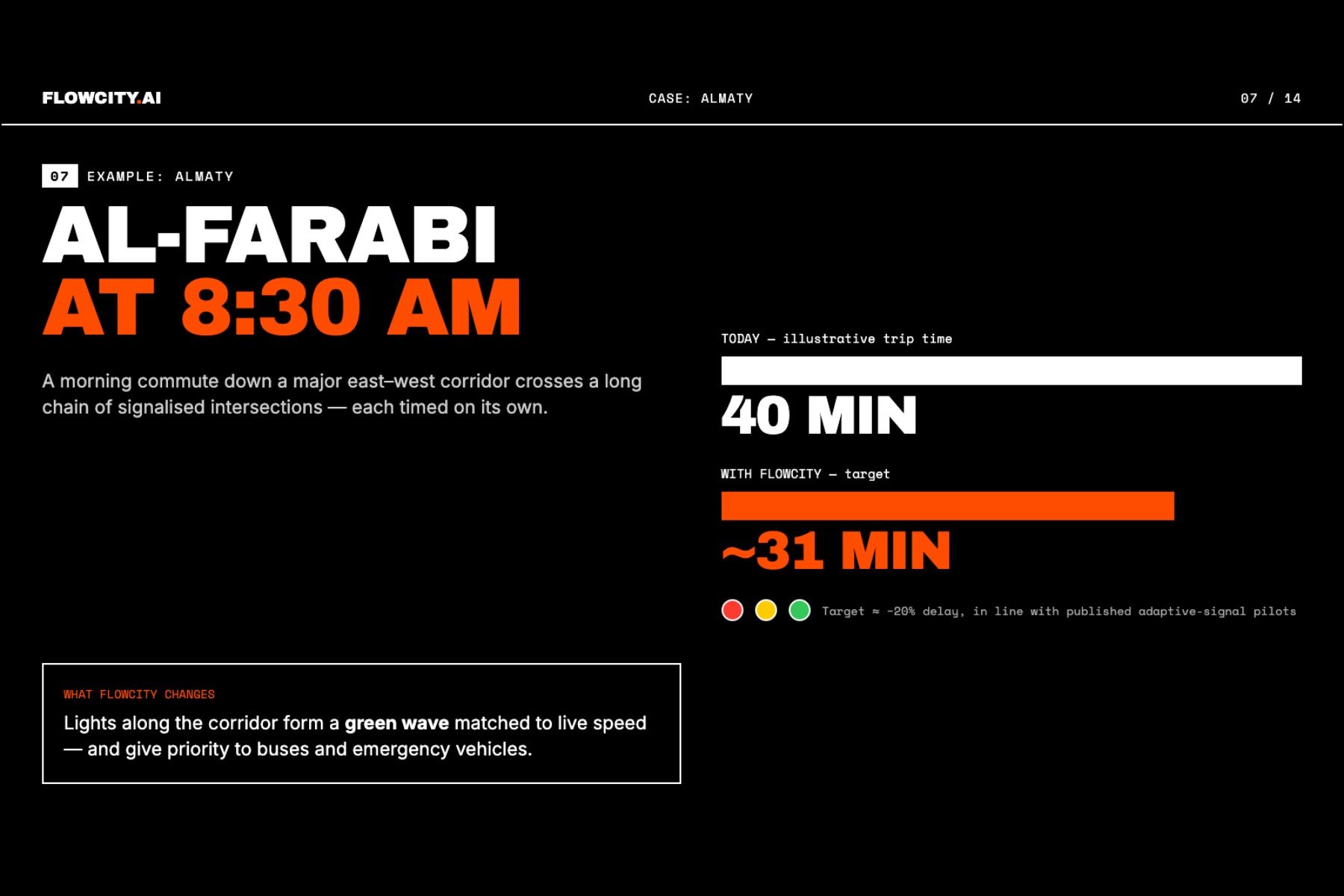
Instead of optimizing one traffic light at a time, FlowCity AI coordinates entire corridors to create dynamic green waves and can also prioritize buses and emergency vehicles.
The main pipeline is:
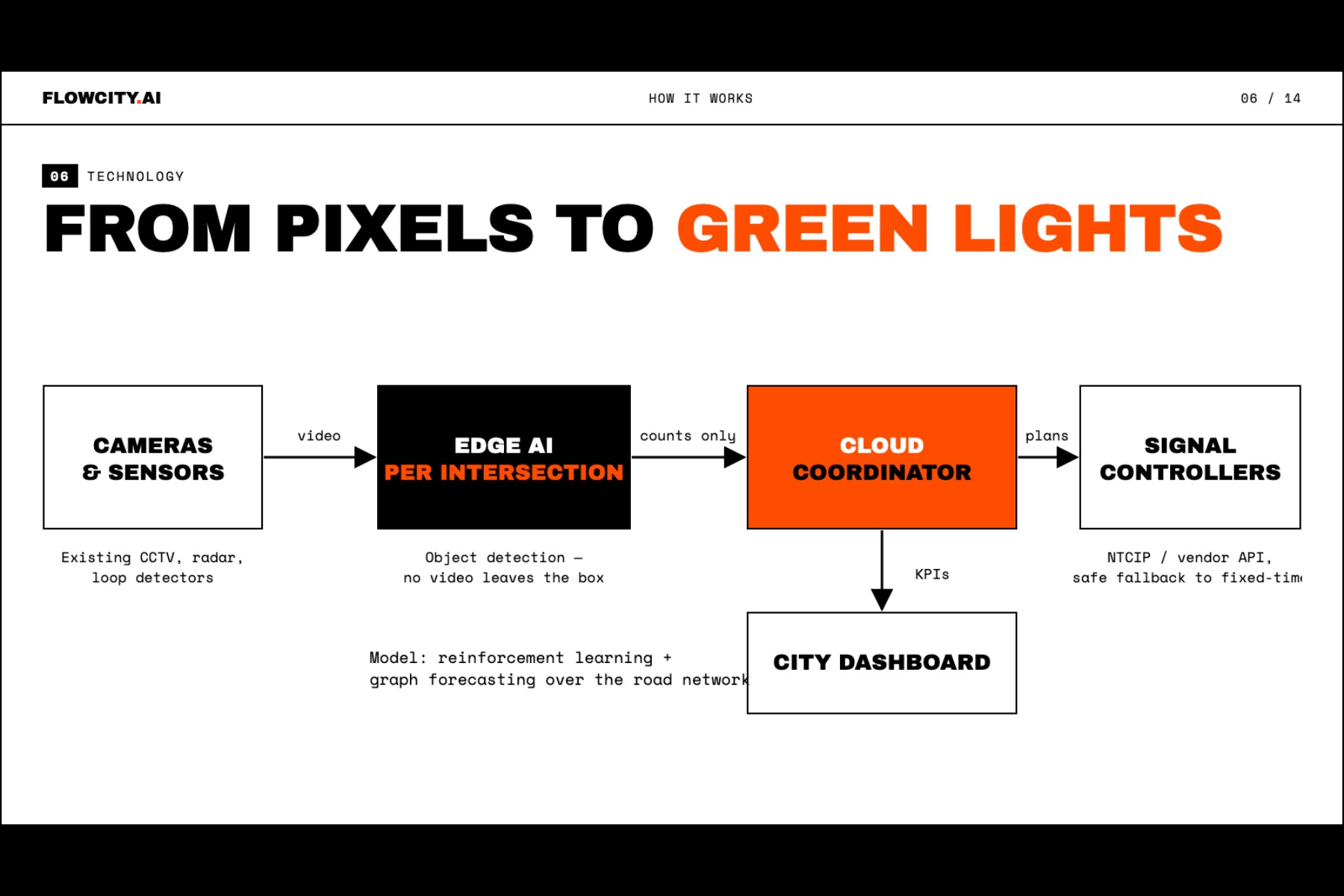
Cameras & sensors → Edge AI → Network coordinator → Traffic signal controllers
Video can be processed locally at the intersection, so only traffic data such as vehicle counts needs to be sent to the central system.
How we built it
For the hackathon, we designed the architecture and workflow of the system around four main components:
- Traffic perception — cameras and sensors detect vehicles and estimate traffic density for each lane.
- Edge processing — computer vision processes traffic locally instead of sending raw video to the cloud.
- Network optimization — traffic information from multiple intersections is combined to calculate better signal timing across a corridor.
- Signal control and monitoring — optimized timing plans are sent back to traffic-light controllers, while a dashboard displays system performance.
Our proposed AI layer combines traffic prediction with adaptive signal optimization. The long-term goal is to use reinforcement learning and graph-based traffic forecasting to coordinate intersections as a connected network.
Challenges we ran into
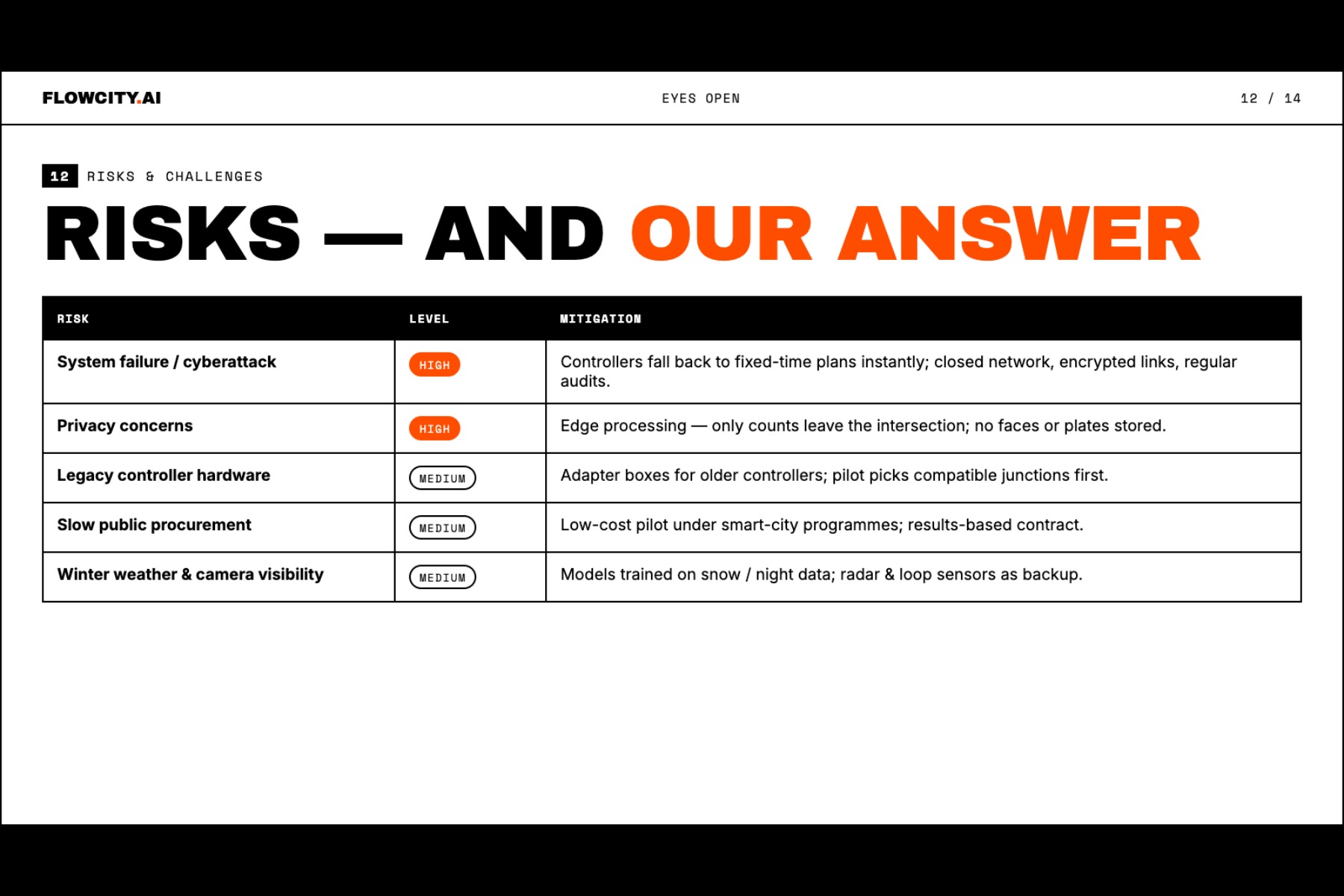
The biggest challenge is that a real-world traffic-light system cannot be fully tested without access to city infrastructure.
A production deployment would require real traffic-camera feeds, signal-controller APIs, detailed road-network data, safety certification and cooperation with local transport authorities.
Another major challenge is safety. An AI model cannot be allowed to directly control critical infrastructure without safeguards, so our architecture includes a fallback to existing fixed-time signal plans if the AI system fails.
Privacy is also important. Our design processes video at the edge and avoids storing faces or licence plates.
Accomplishments that we're proud of
We developed a complete concept for how an AI traffic-control system could work from data collection to real-world signal control.
Instead of focusing only on a single intersection, we designed FlowCity AI around network-wide coordination, where neighboring intersections share information and optimize traffic together.
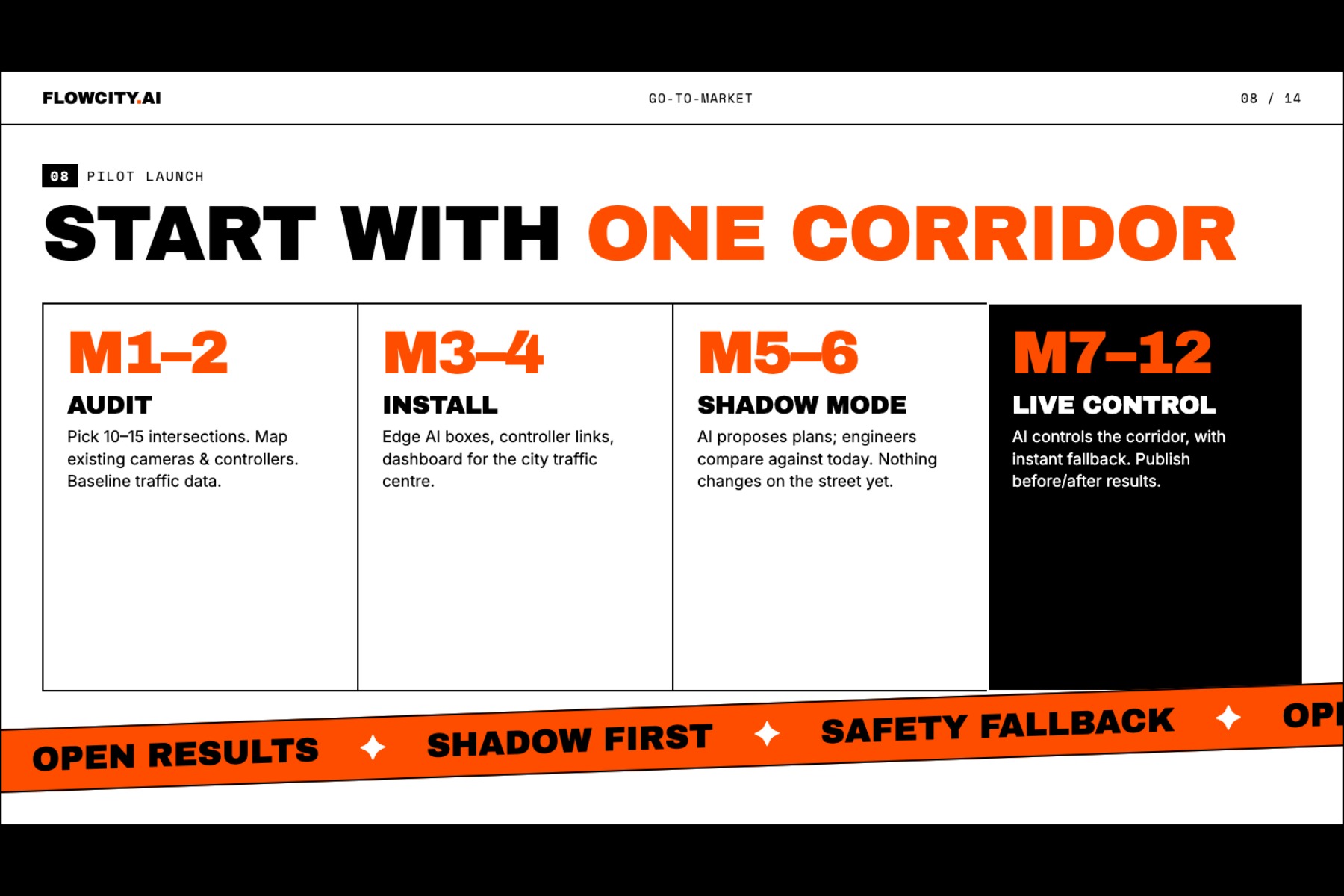
We also designed the system with real deployment constraints in mind, including compatibility with existing cameras, privacy, safe fallback modes and gradual rollout through a small pilot corridor.
What we learned
We learned that traffic optimization is much more than simply giving a longer green light to the road with more cars.
Changing one intersection can move congestion to the next intersection, so the real problem is a network optimization problem.
We also learned that computer vision is only one part of the system. A practical solution needs traffic prediction, optimization, communication with signal controllers, safety mechanisms and reliable real-time data.
Most importantly, we learned that a realistic smart-city solution needs to work with existing infrastructure rather than requiring a city to replace everything.
What's next for FlowCity AI
The next step is to build a simulation-based MVP using a traffic simulator and real or open traffic datasets.
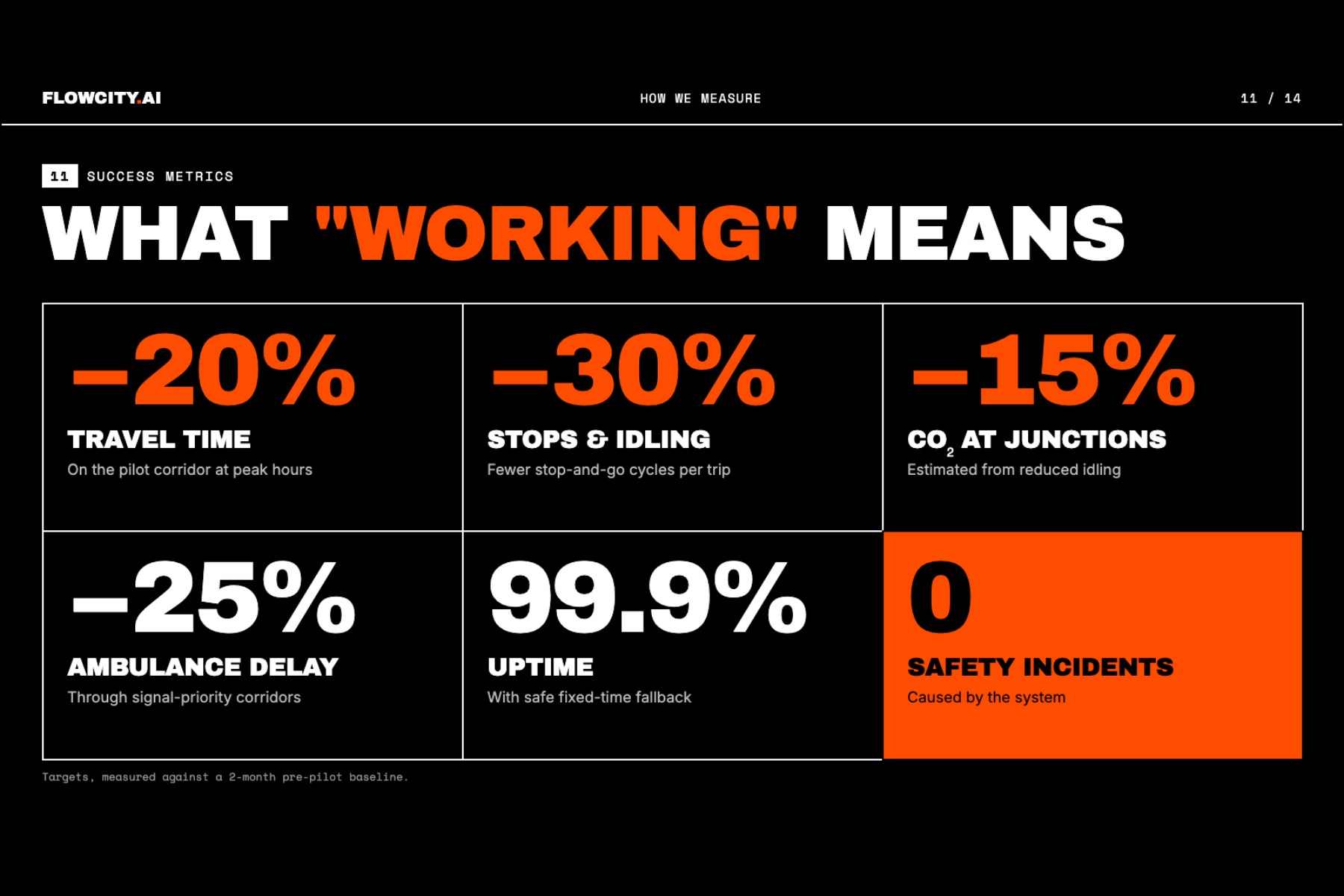
We want to compare FlowCity AI against traditional fixed-time traffic lights using metrics such as:
- average travel time
- average waiting time
- queue length
- number of vehicle stops
- intersection throughput
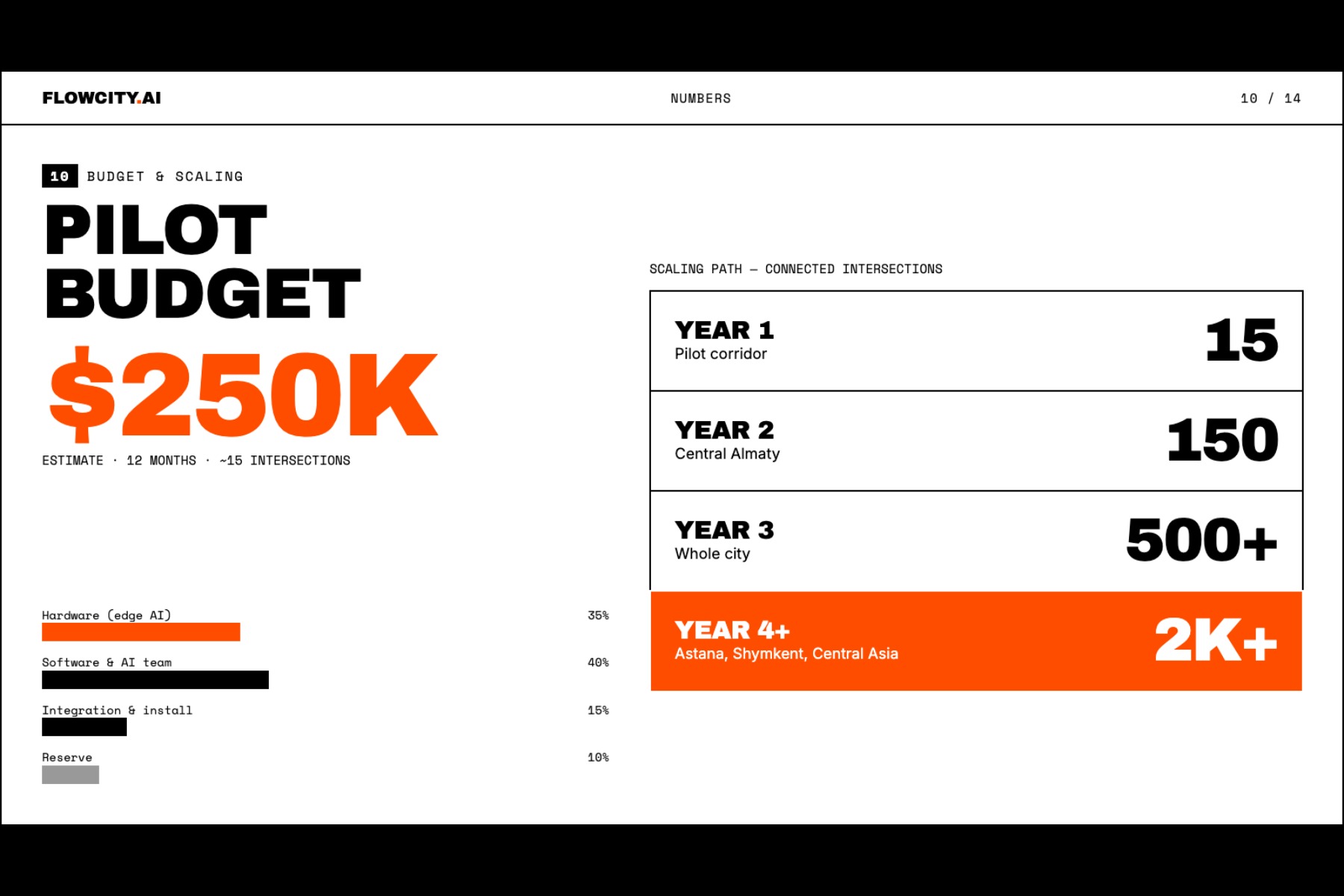
After validating the algorithm in simulation, the next stage would be a small pilot on a corridor of approximately 10–15 intersections.
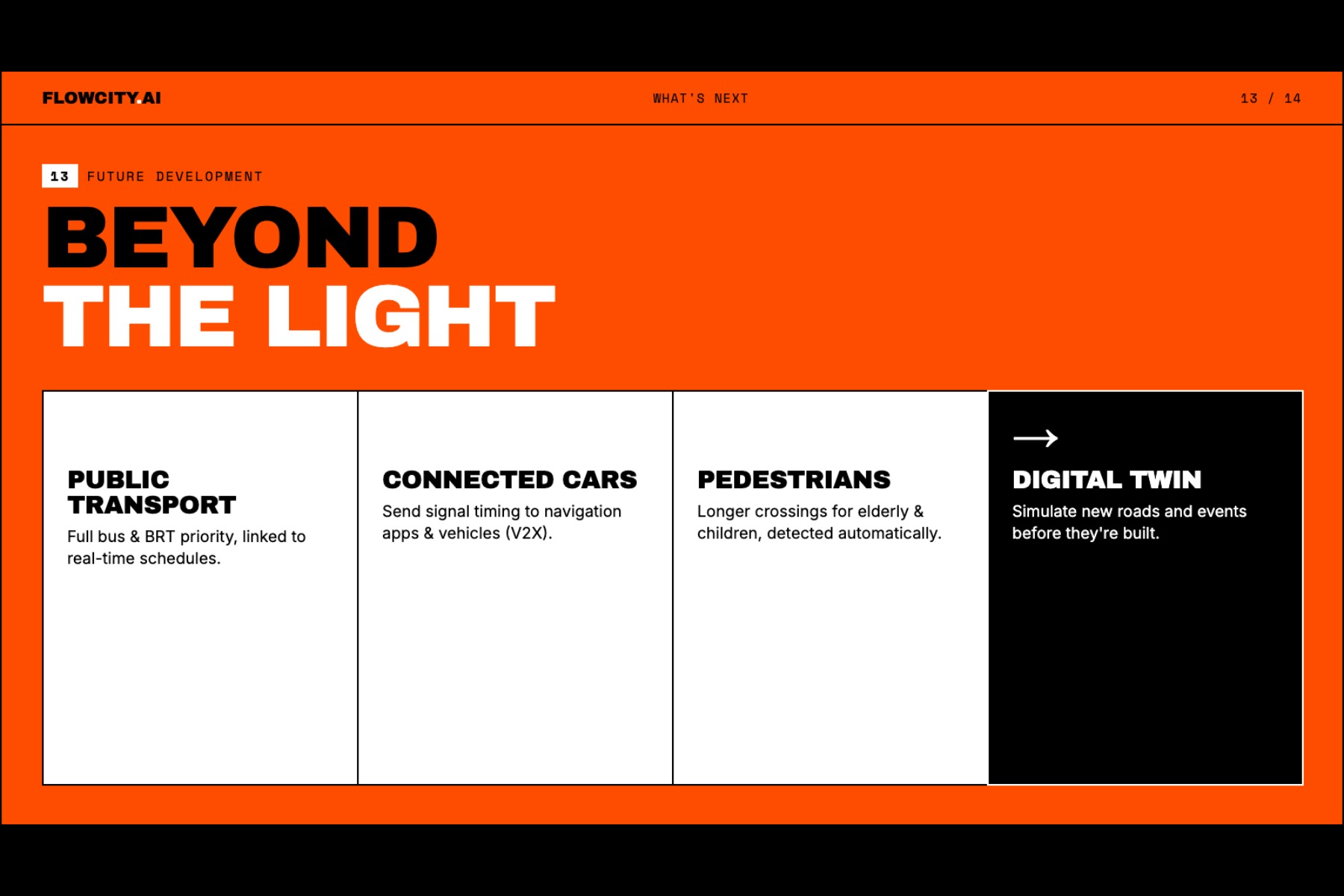
Future versions could also support public-transport priority, emergency-vehicle priority, connected vehicles and city-scale digital twins.
