Inspiration
My wife works in mainframes, and over the years I’ve seen how talented mainframe engineers are forced to work with tools that feel decades out of sync with the rest of the tech world. Every conversation about JCL, 3270 screens, assembler debugging, or job reruns made me wonder: Why do we have modern automation everywhere except on the mainframe?
That idea stuck with me. I wanted to build something that didn’t “replace” mainframes, but brought modern automation tooling to them. That became the starting point for FlowASM.
What it does
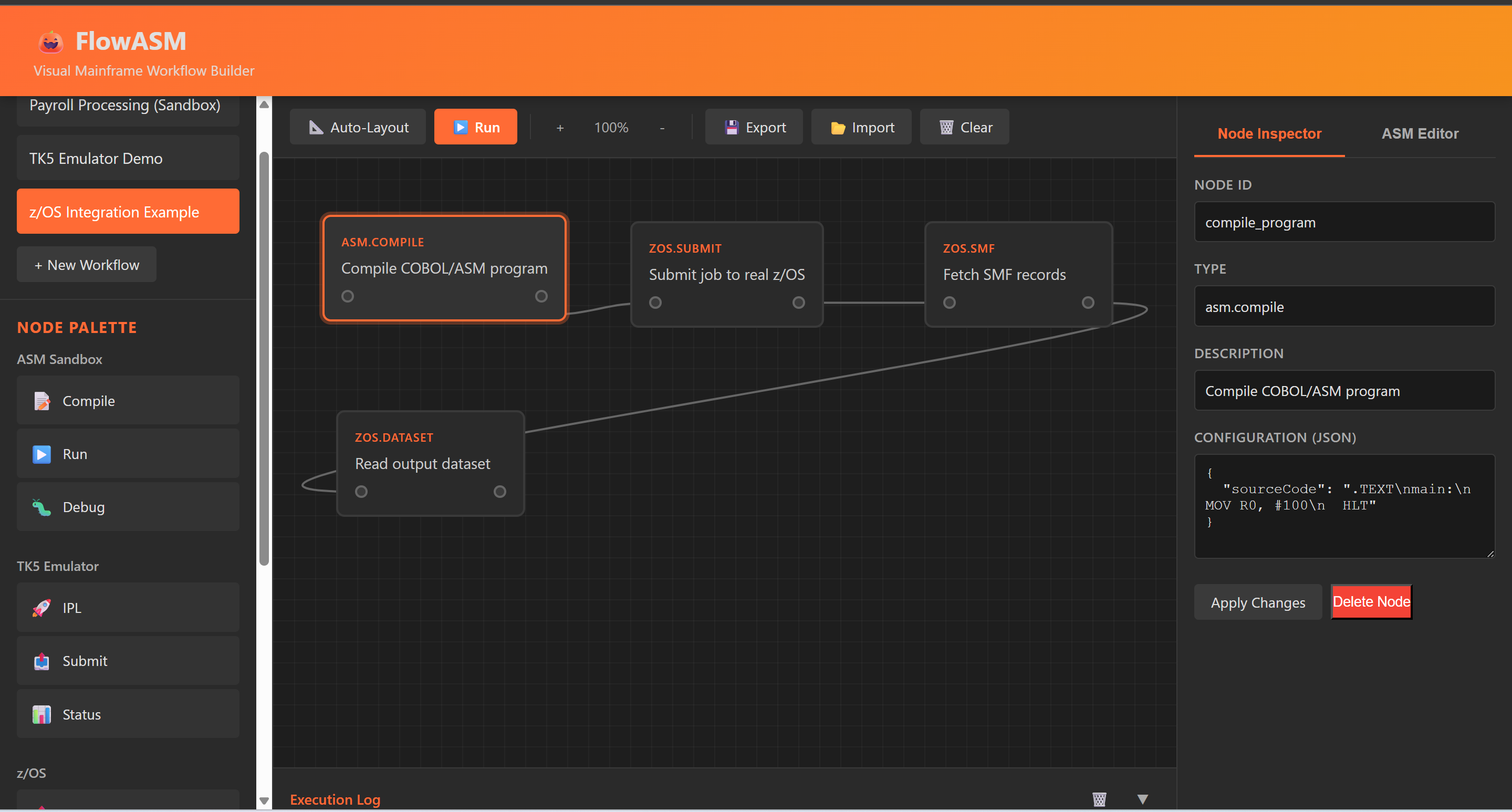
FlowASM is a visual workflow automation platform for mainframes, inspired by n8n.
It lets you:
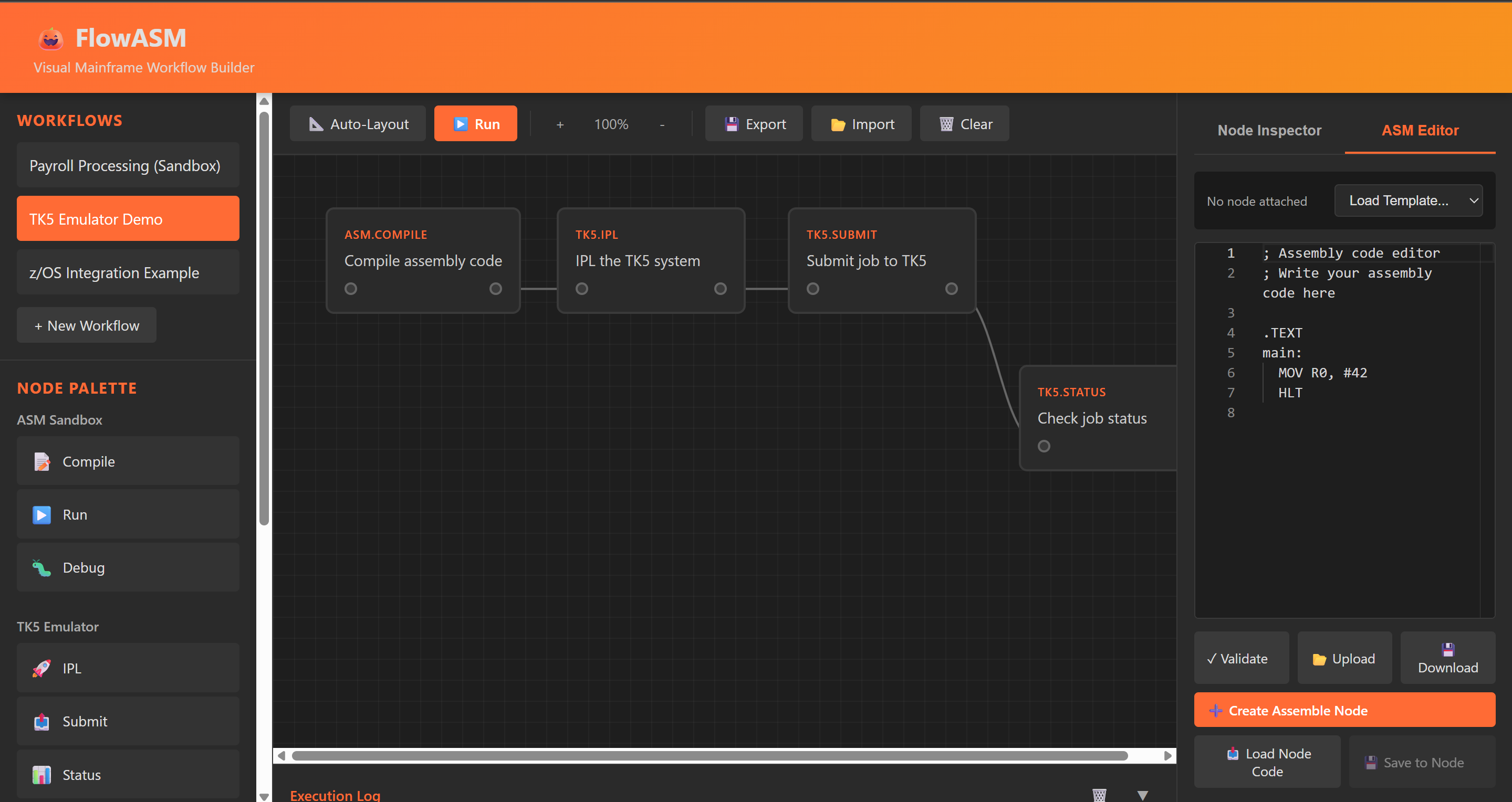
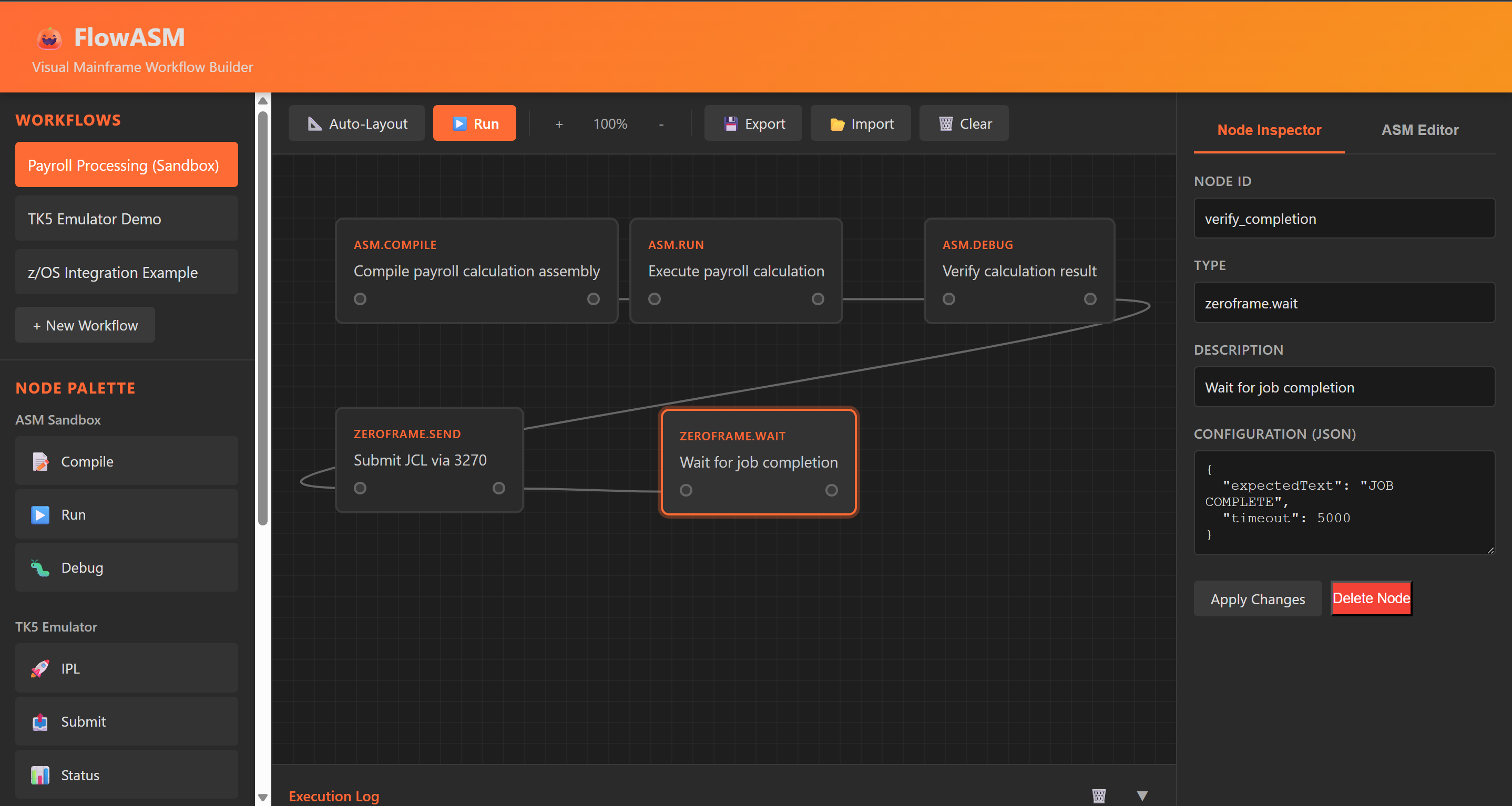
Create drag-and-drop workflows using a flowchart UI
Write or paste assembler code directly in the built-in editor
Compile, execute, and debug ASM programs using the included sandbox
Submit JCL, trigger 3270 terminal actions, and query job status
Connect to a local TK5/Hercules instance or a real z/OS through a connector
Mix sandbox steps with live mainframe steps in the same flow
Export, import, and run workflows exactly like modern automation platforms
In short: FlowASM turns old-school mainframe operations into modern, visual, configurable workflows.
How we built it
FlowASM is entirely built in Node.js:
A lightweight workflow engine modeled after n8n/Node-RED
A modular node system for ASM, JCL, 3270, TK5, and z/OS connectors
A full drag-and-drop UI built with modern JS libraries
A built-in Assembly Sandbox Engine (based on adapted IPLLab logic) so the demo is always runnable
Connectors for TK5 and real z/OS (using secure env-based configuration)
A visual editor that lets users design, connect, reorder, and run workflows
A backend that executes nodes sequentially with variable templating ({{node.A.output}})
Everything is packaged cleanly so judges can clone, run, and immediately see the workflow engine in action.
Challenges we ran into
Bringing mainframe concepts into a visual workflow tool ASM, JCL, and 3270 interactions are stateful and strict; modern workflow engines are dynamic. Making them coexist took several iterations.
Designing a polished drag-and-drop UI Getting node ports, connection points, and auto-layout to feel smooth required more effort than expected.
Sandbox + real connectors It was important that FlowASM both work offline AND connect to a real mainframe/TK5. Balancing the two without breaking UX was tricky.
Time constraints This is a big idea. Fitting it into a hackathon required cutting features, simplifying flows, and focusing on the strongest demo.
Keeping everything Node.js only Avoiding Python and heavy dependencies meant rethinking how to expose some lower-level assembler and 3270 logic.
Accomplishments that we're proud of
Building a full drag-and-drop workflow builder that feels genuinely modern
Embedding a working assembler editor + compiler + executor
Creating a system that can work both as a sandbox AND as a live mainframe automation tool
Getting a complex idea running cleanly in a polished UI within hackathon time
Designing a framework flexible enough to support dozens of future mainframe nodes
FlowASM feels like something the mainframe community would actually use — and that’s the biggest win.
What we learned
Mainframe workflows can be reimagined with modern UX without losing their reliability
Visual automation dramatically lowers the barrier for newer engineers entering the mainframe space
There's a huge opportunity in making legacy tech more accessible
Designing connectors that are secure, modular, and easy to extend is essential
Balancing demo realism and hackathon constraints is an art
And on a personal note: I learned to see the mainframe world not just from the outside, but through the daily challenges my wife experiences in her job
What's next for FlowASM
FlowASM is just getting started. Next steps include:
Full plugin system so anyone can build custom mainframe nodes
Real-time 3270 screen streaming in the UI
Parallel execution and conditional branches (like true n8n flows)
AI-assisted Abend explanation + JCL fix suggestions
Deeper z/OS integration with SMF, CICS, DB2, and MQ nodes
Team collaboration mode for workflow sharing
Secure enterprise connectors that large organizations can plug directly into their mainframes
The long-term vision is simple: FlowASM becomes the modern automation layer the mainframe ecosystem has been missing.

Log in or sign up for Devpost to join the conversation.