-
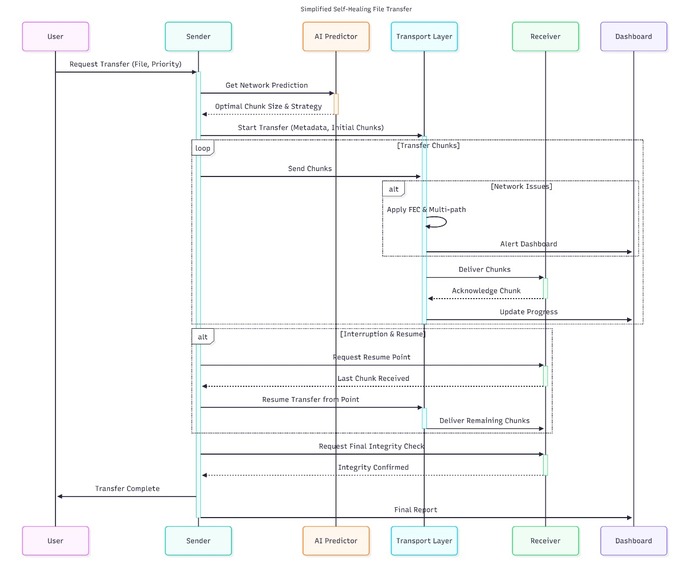
Proposed Flow Diagram

Inspiration
In many corners of India, the internet is fragile. A doctor in Assam tries to send crucial test results during a storm, but the network breaks halfway. A flood-relief volunteer in Odisha captures drone images of submerged villages, only to watch the upload freeze before it reaches the control team. A young girl in Ladakh, studying from home, waits over 40 minutes for her learning video to send—before the signal fades again.
Each of these moments shows the same truth: it’s not people who fail, it’s the connection.
FlowAI was created to make sure that every vital transfer—whether a medical scan, emergency map, or classroom file—never has to stop just because the network does.
The Idea
FlowAI is an AI-assisted smart file transfer system that keeps files moving when networks falter. It doesn’t simply retry after failure or compress blindly—it understands the network, predicts its behavior, and adapts intelligently.
It’s built to think before it sends, adjust while it transfers, and recover when things break. In essence, FlowAI applies machine learning not for trends or chat, but to fix something deeply human—reliability, even in chaos.
How FlowAI Works
AI-Powered Network Intelligence
FlowAI’s core intelligence lies in its predictive learning engine. Before and during every transfer, AI models trained on fluctuating network behavior analyze factors such as signal strength, historical latency, and packet loss patterns.
The system predicts when the connection is likely to dip or drop and pre-emptively adjusts—either by switching strategies, resizing chunks, or prioritizing stable links. It learns over time: the more it transfers, the smarter it becomes at reading your network environment.
So while most file senders react after failure, FlowAI prevents it in the first place.
Adaptive Chunking and Scheduling
Rather than splitting every file into fixed pieces, FlowAI uses AI to determine chunk size per network snapshot.
On strong connections, it sends larger segments to save time. On volatile bandwidth or mobile data, it switches to micro-chunks to preserve progress and avoid waste. The model continually evaluates success feedback, predicting the sweet spot between efficiency and stability.
Intelligent Priority Control
FlowAI’s neural priority model understands file context—critical documents (like disaster data or patient records) automatically move ahead of less time-sensitive files. It also recognizes repeat behavior—if a user consistently sends similar files at specific times, it optimizes that path proactively.
Think of it as a transfer system with judgment.
Smart Recovery and Real-Time Awareness
When a drop happens, FlowAI’s AI layer confirms exactly which chunks were safely received, verifies them via checksums, and instantly resumes at the byte level—no restarting, no resending entire parts.
On the interface, a live dashboard powered by WebSockets shows network health, predicted drop likelihood, throughput, and trust percentage for every file in motion—offering both control and confidence.
Why This AI Implementation is Unique
Most systems claim “AI” through automation. FlowAI’s use is different—it gives decision-making to the system, not dependence on the user.
- Predictive AI over Reactive Systems: It anticipates failures instead of fixing them afterward.
- Continuous Learning: The network model gets better with every transfer, adapting to local signal fluctuations, geography, and ISP quirks.
- Energy Efficiency Focus: By predicting downtime, it prevents endless upload loops—a critical advantage for field devices and mobile systems in off-grid areas.
- No Black Box AI: The predictions are explainable—users see visible reasoning through “network confidence” indicators before a transfer starts.
Unlike “AI wrappers,” FlowAI’s intelligence sits at the core network layer, changing how data moves, not just how users interact.
Technical Deep Dive
Core Stack
Node.js + Go for high-performance transfer orchestration.
QUIC protocol for connection resiliency (0-RTT handshake, multiplexing, and built-in encryption).
TensorFlow Lite models for edge AI inference on network adaptability.
Redis queues for prioritized, asynchronous task flow.
MongoDB for bookkeeping, file tracking, and real-time progress data.
React + WebSockets for dynamic visual feedback.
Learning Layers
The AI engine uses unsupervised and regression-based training from testbed data collected under simulated low-connectivity scenarios (50-300ms latency, 15–20% packet loss). The prediction system constantly refines chunk size logic, connection risk models, and recovery path selection based on download/upload history.
Deployment Capability
Dockerized microservices, scalable from cloud to local edge machines like Raspberry Pi or field laptops used by teams in remote zones.
Why It Matters
FlowAI’s AI layer brings judgment where it never existed before—in networks, which usually treat data blindly. With FlowAI, the transfer knows whether to rush, pause, split, or wait. That simple intelligence makes every second of connectivity count.
Whether it’s a rural hospital, a live engineering site, or a news crew at a race track, FlowAI promises one thing—your file will get there, because now your file knows how.
In One Line
FlowAI — when every byte matters, the network finally thinks before it breaks.
Built With
- docker
- express.js
- go
- nextjs
- quic
- redis
- tensorflow
- udp
- websockets

