Inspiration
I practice non-consumption: swapping instead of buying, creating instead of consuming, and looking for surplus resources and value already around us. My events, consultations, and stays have often moved through direct exchange — but mostly between two people. When there is no immediate reciprocal match, an exchange can remain unresolved, even when both people are willing.
I wanted the exchange relationships already around me to become visible as a network: people connected through me should be able to find, trust, and support one another too. This is also a “Don’t Do It Yourself” experiment: a request can be a wish and an invitation to co-create, not a purchase order.
Flow Circle also makes space to notice invisible labor and small acts of care. It must not turn them into piecework, a ranking, or a claim on anyone’s time. Care badges are recognition, not payment; mutual credit records how contribution and receipt move through a circle, not a personal debt. The test is simple: can it make asking easier without making anyone harder to refuse, compare, or consume?
What it does
1. Circles
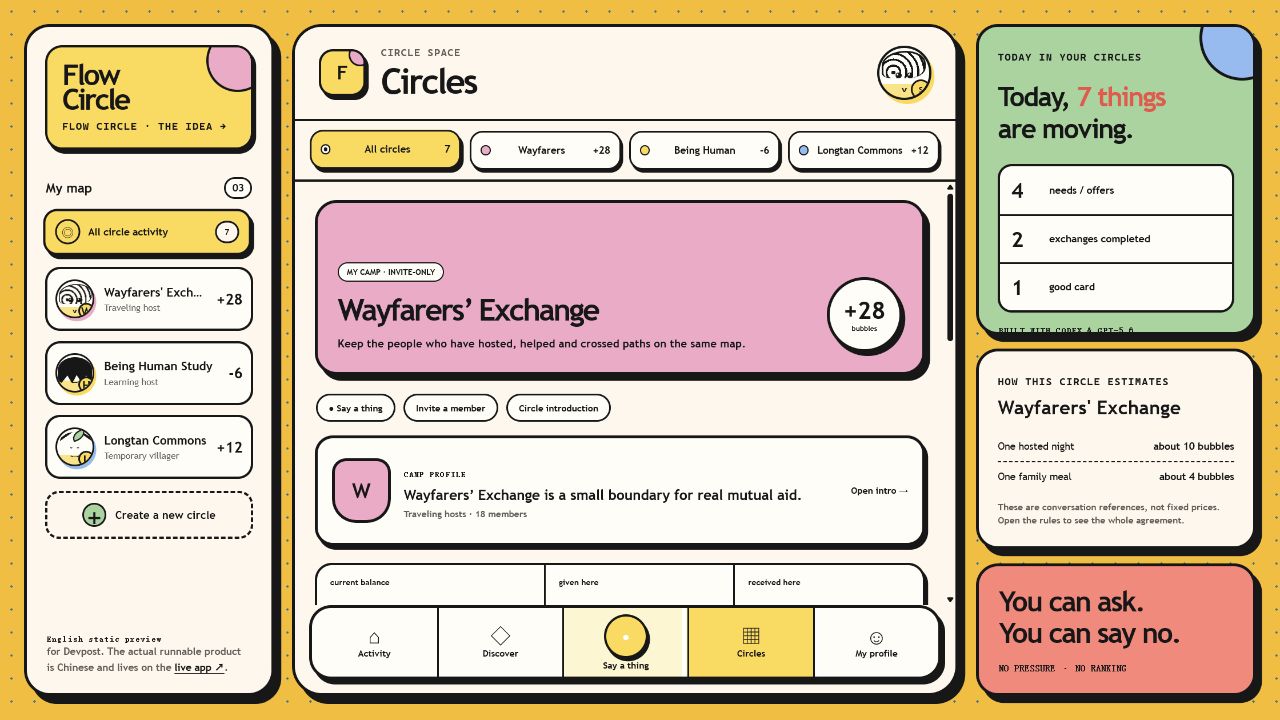
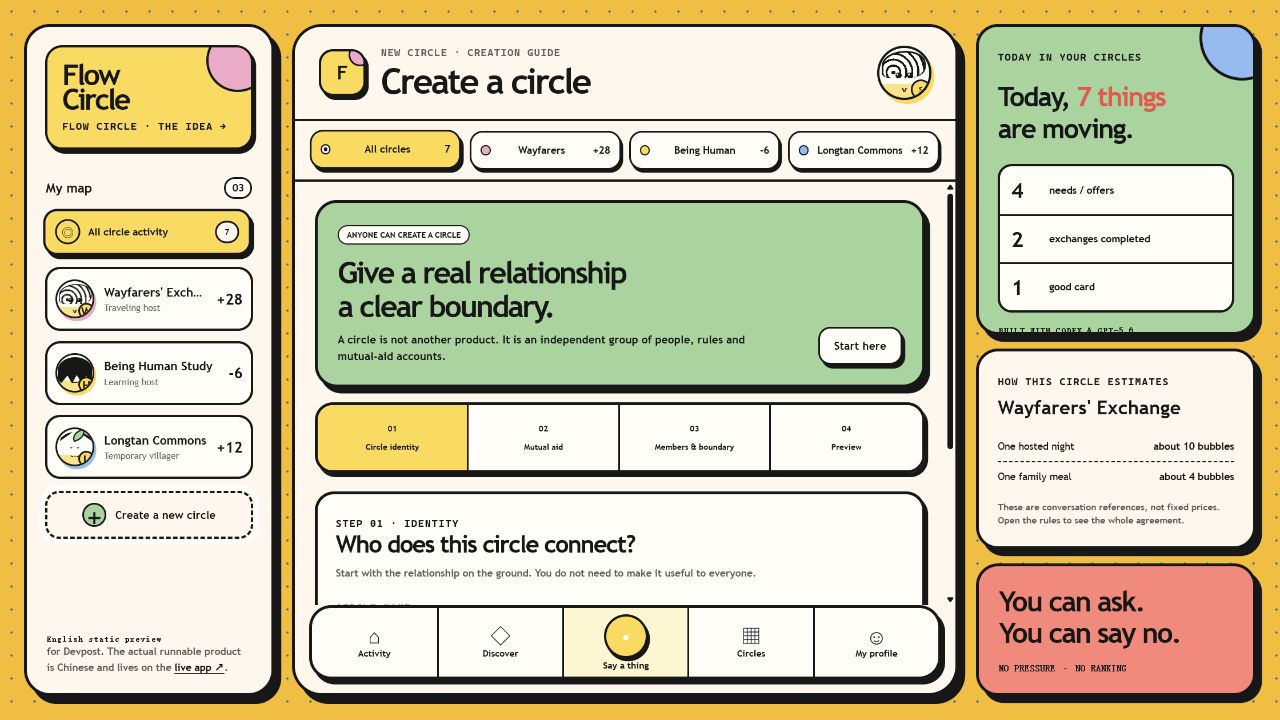
A circle is a small social boundary where people, context and shared rules are known. Different groups can define their own references and rituals:
- a traveling exchange circle for hosting, cooking and local knowledge;
- a study circle for feedback, co-learning and listening practice;
- a living-together circle for meals, tools, rides and shared work. There is no single universal currency or rulebook.
2. Needs and offers
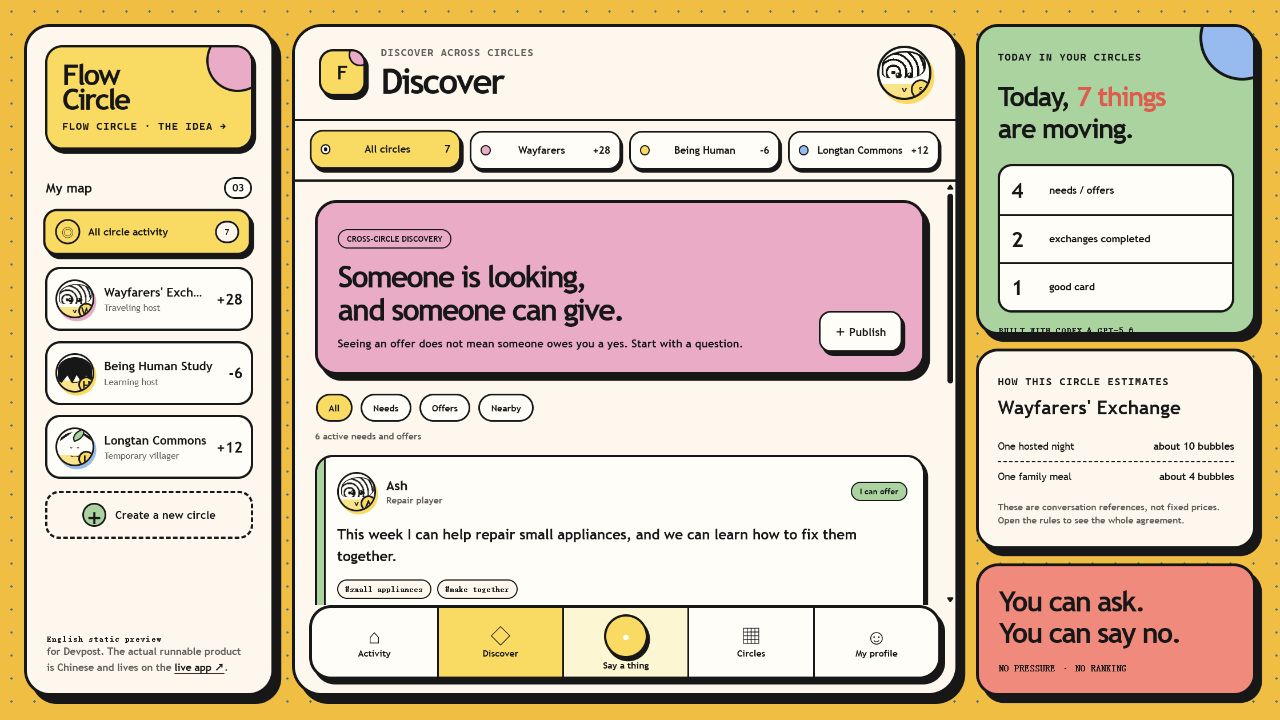
Members can say what they need or what they can offer in one sentence. An offer is not a contract, and posting an offer does not mean agreeing to help everyone. It is simply an invitation to start a conversation.
3. Mutual credit
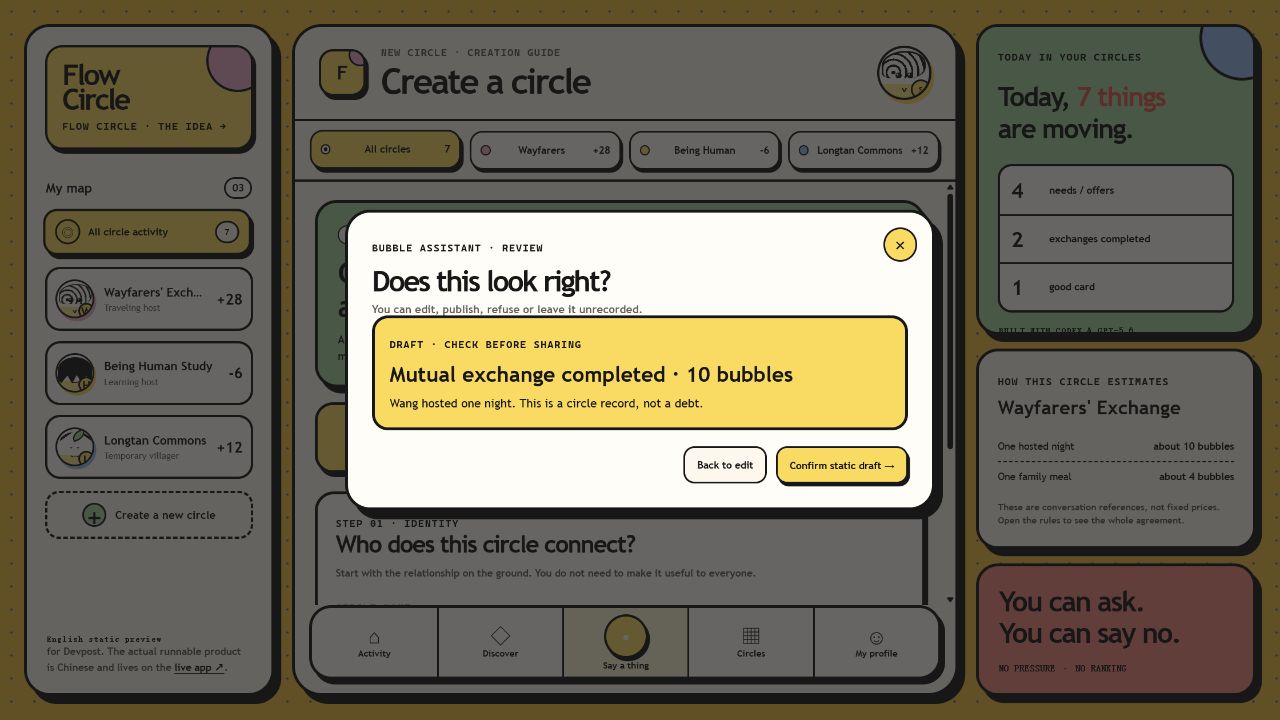
When a real exchange has already happened, the people involved can add it to their circle's shared record. Mutual credit makes one movement visible: what someone has contributed to the community, and what they have received from it. It is not a debt between two people, a bank loan, a score, or a measure of personal worth. A balance simply describes how care and contribution have flowed through the circle over time. Unfinished plans do not change the record.
4. Care badges
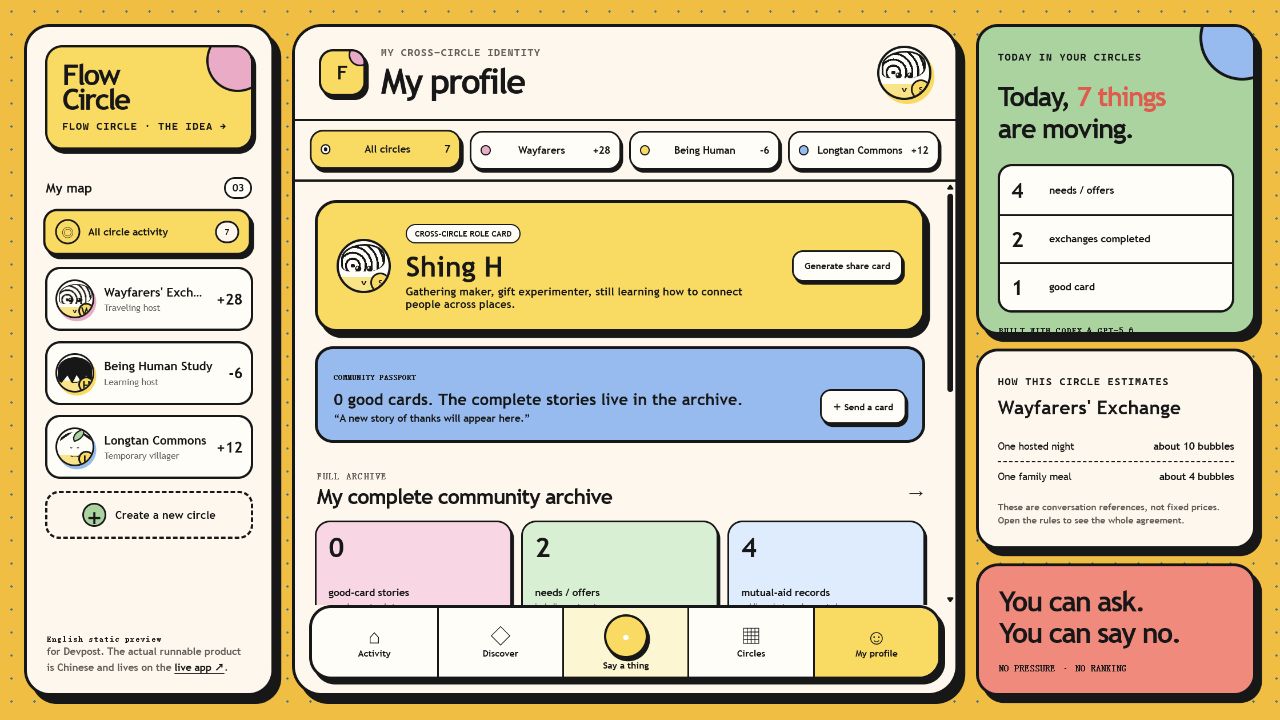
A care badge is a small commemorative badge of appreciation, carrying a short story from the person who received help. It does not create credit, payment, a ranking, or an obligation to repay. It gives visible language to care that would otherwise disappear, and it can travel with a person across circles.
How one moment flows
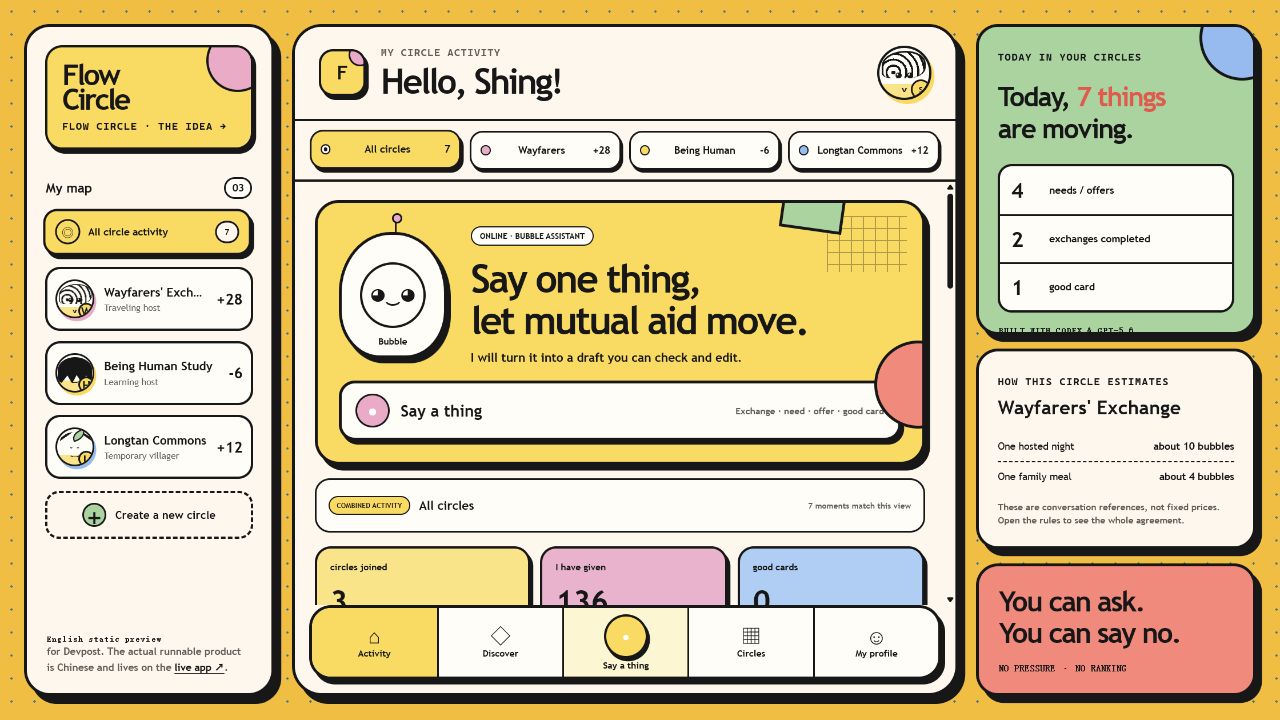
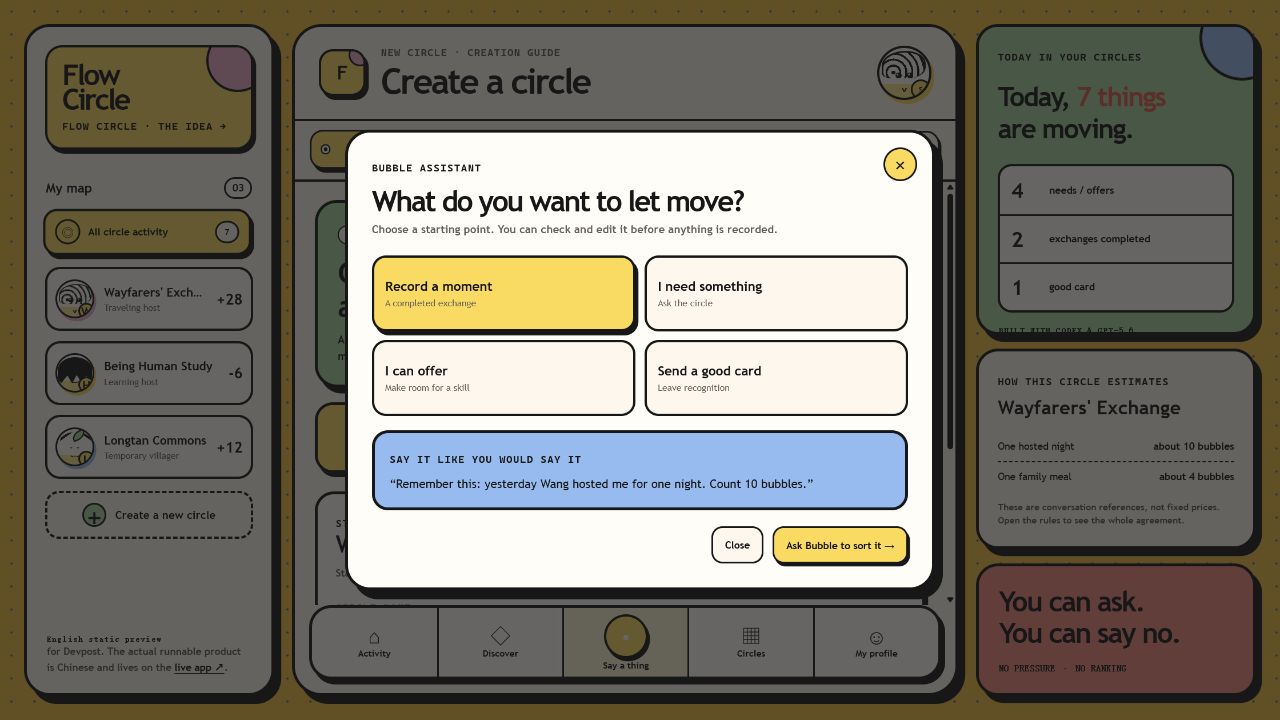
- Ask or offer. Someone says one sentence in the language they already use with people they know.
- Help happens in real life. The conversation continues in person or in an existing chat; Flow Circle does not replace the relationship.
- Remember it, if useful. The people involved can record a completed exchange, or leave it unrecorded. Both are valid.
- Let trust travel. Circle credit can circulate inside a circle. A care badge can help a person be recognized in another circle.
How we built it
I researched existing community-currency models and interviewed stakeholders in the kinds of communities this project is meant to serve. I then organized the findings into product, operations, design-principles, and case-study documents with GPT-5.6 in Codex. This helped clarify an important boundary: sharing can stay free; completed, costly mutual aid can create flexible circle-based credit; and appreciation can be remembered through Good Cards without becoming debt. With that foundation, I developed the visual language and interaction prototype, then deployed a static English demo for testing and storytelling.
What's next for Flow Circle
I am recruiting an initial group of people to test whether Flow Circle can work in real life. The first experiments will run in three contexts:
- The circles that already exist around me.
- A co-learning and co-creation community I am building.
- The offline community where I live long-term. The main question is not whether the interface can work, but whether people will actually use it: whether there are real needs, real offers, enough trust, and a flow that feels natural rather than burdensome. Those questions cannot be answered by a hackathon demo alone. They need patient iteration with real people, real situations, and permission to change the system when it does not fit.
Built With
- codex
- gpt

Log in or sign up for Devpost to join the conversation.