Inspiration
Most workflow platforms already provide exports containing assignments, statuses, due dates, and review information. The challenge is not collecting data—it is understanding it.
While working on this project, I kept coming back to the same observation: workflow exports contain useful evidence, but they rarely tell a clear story on their own. A due date can be overdue, an assignee can appear frequently, or several tickets can look similar, but none of those facts alone explain what is happening inside a team.
I wanted to build a tool that respects this distinction instead of replacing it with AI-generated assumptions.
That idea became Flow Audit.
What it does
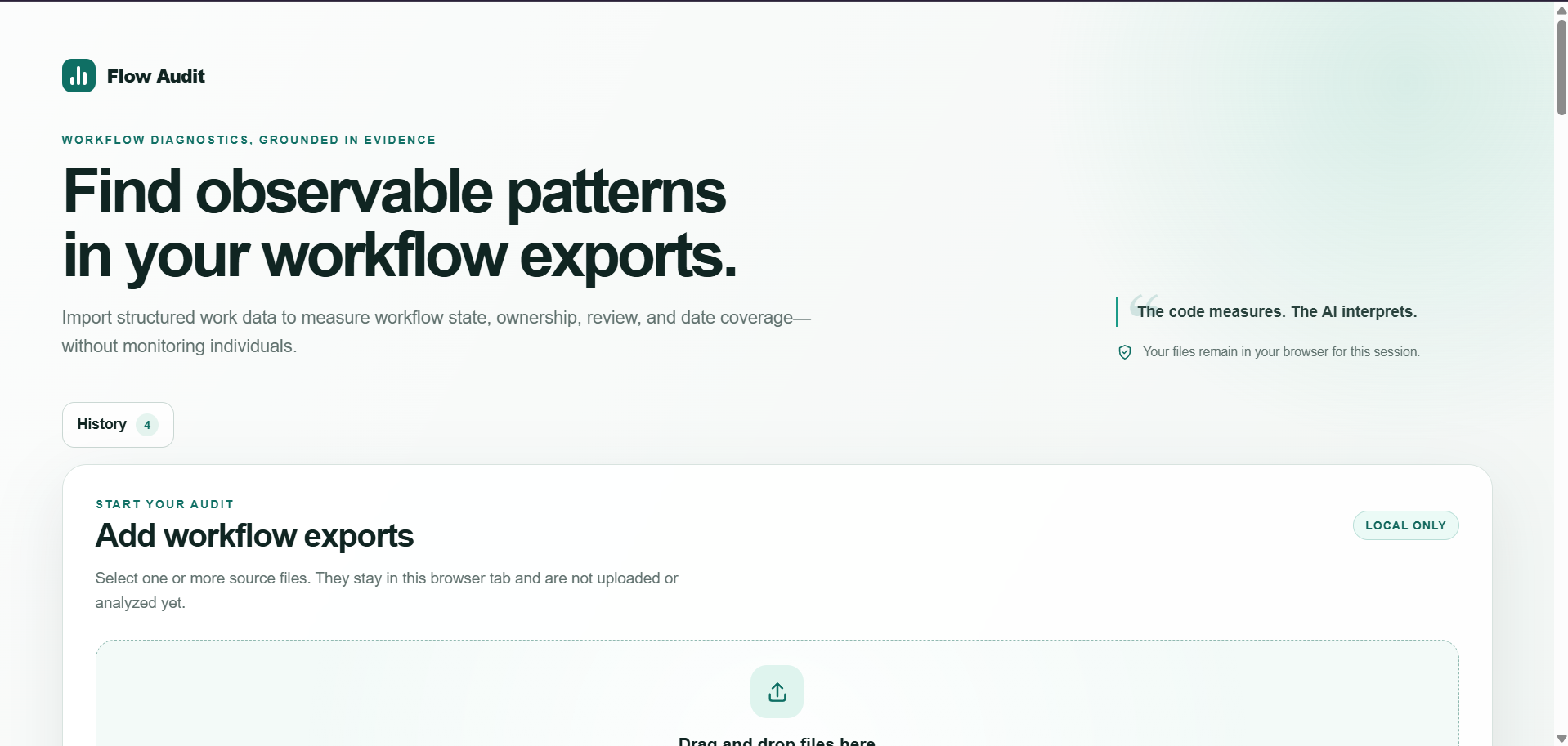
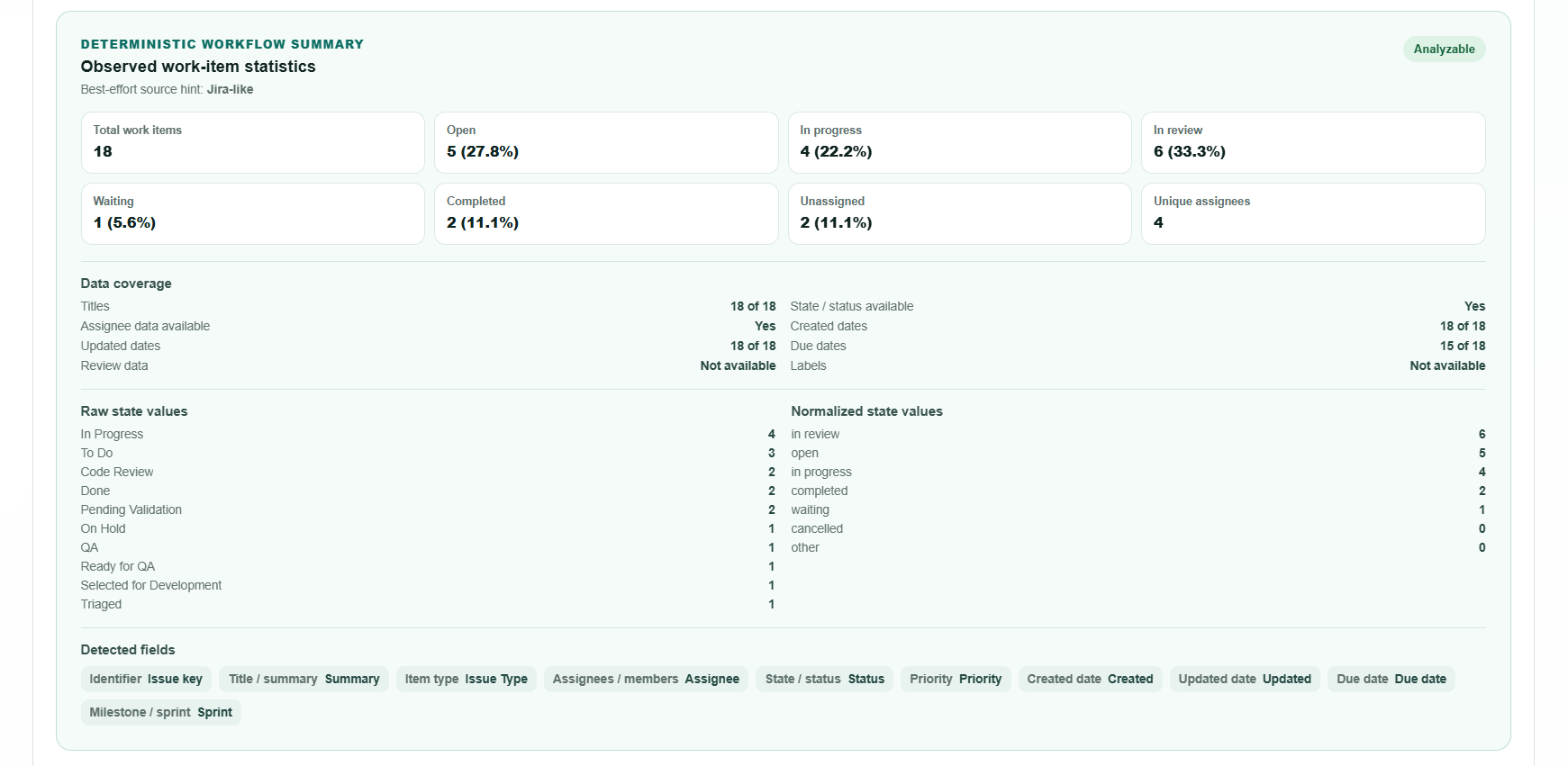
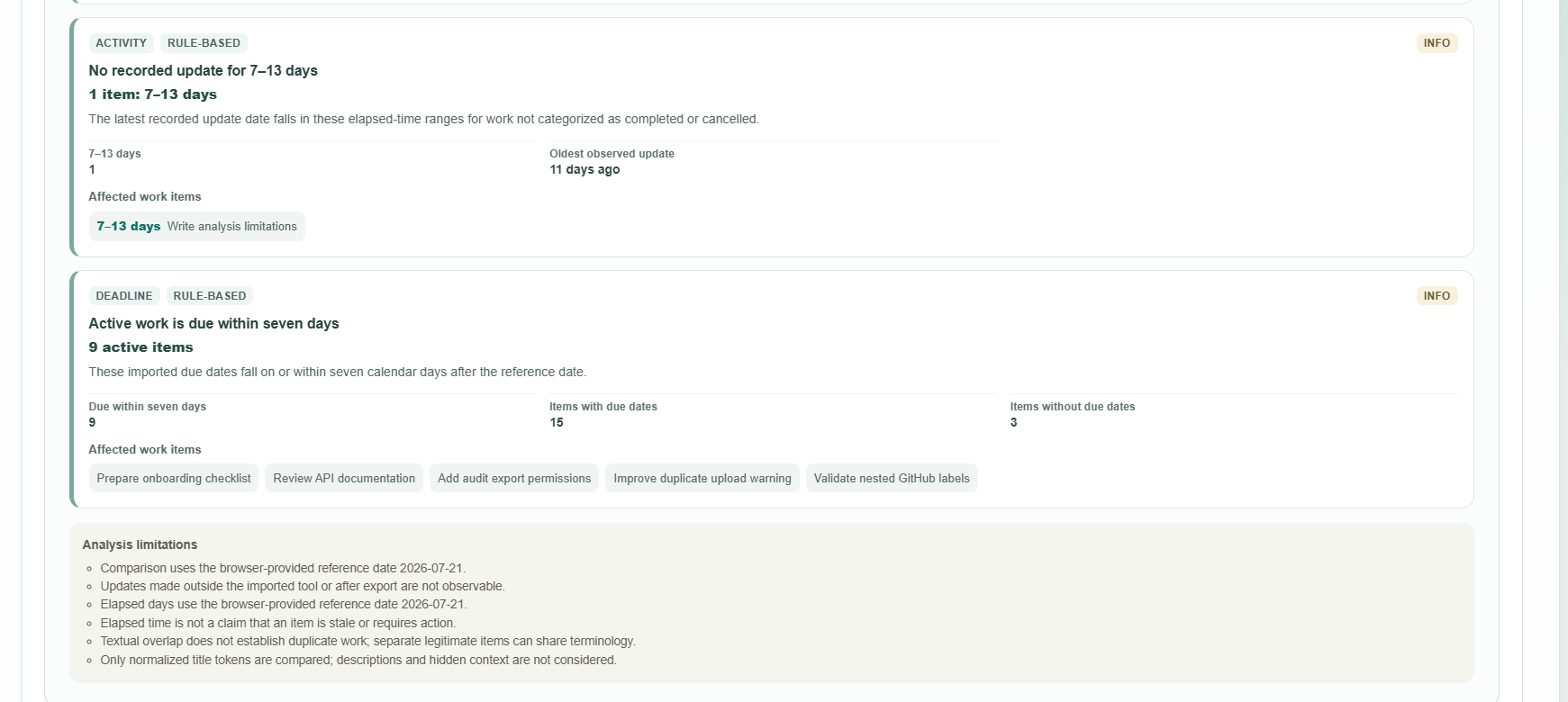
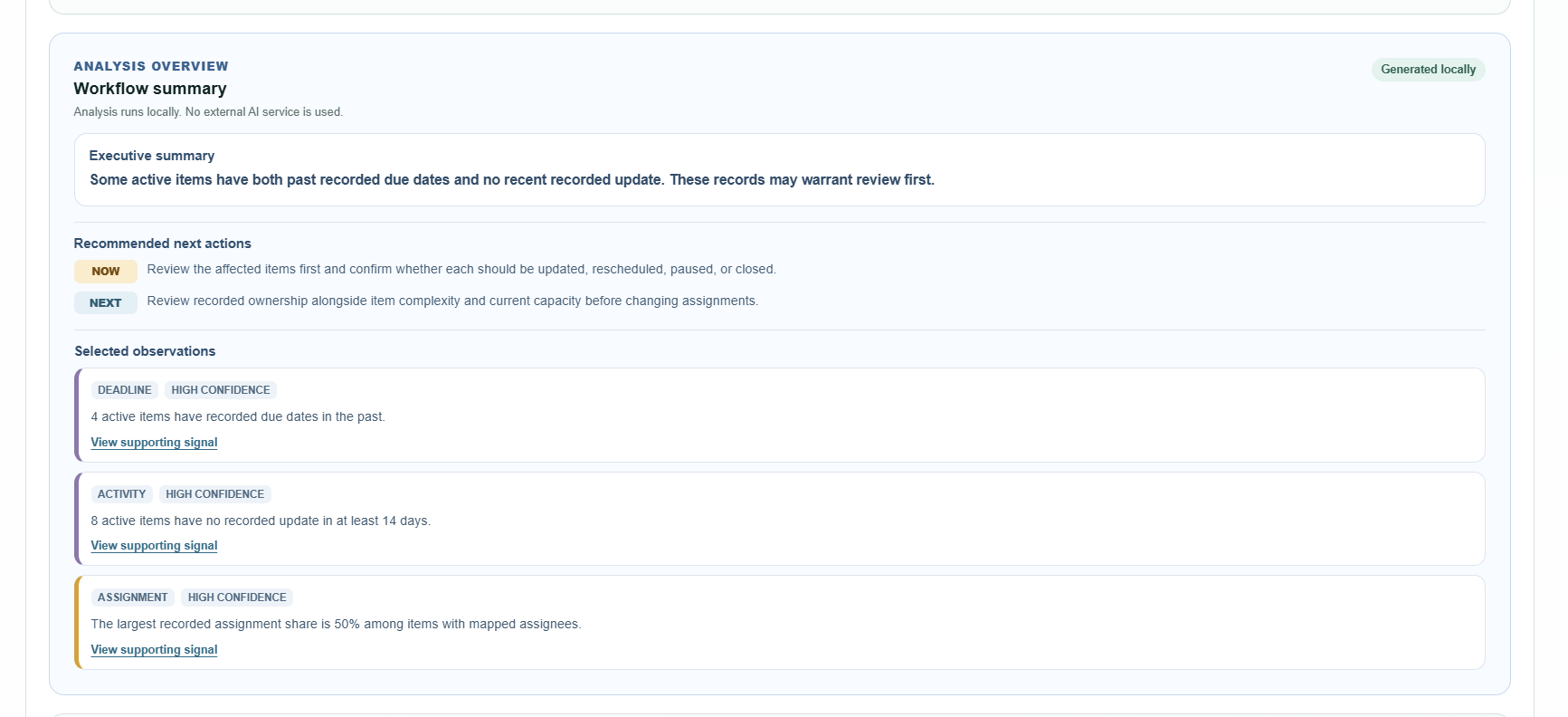
Flow Audit analyzes exported workflow data locally using deterministic rules.
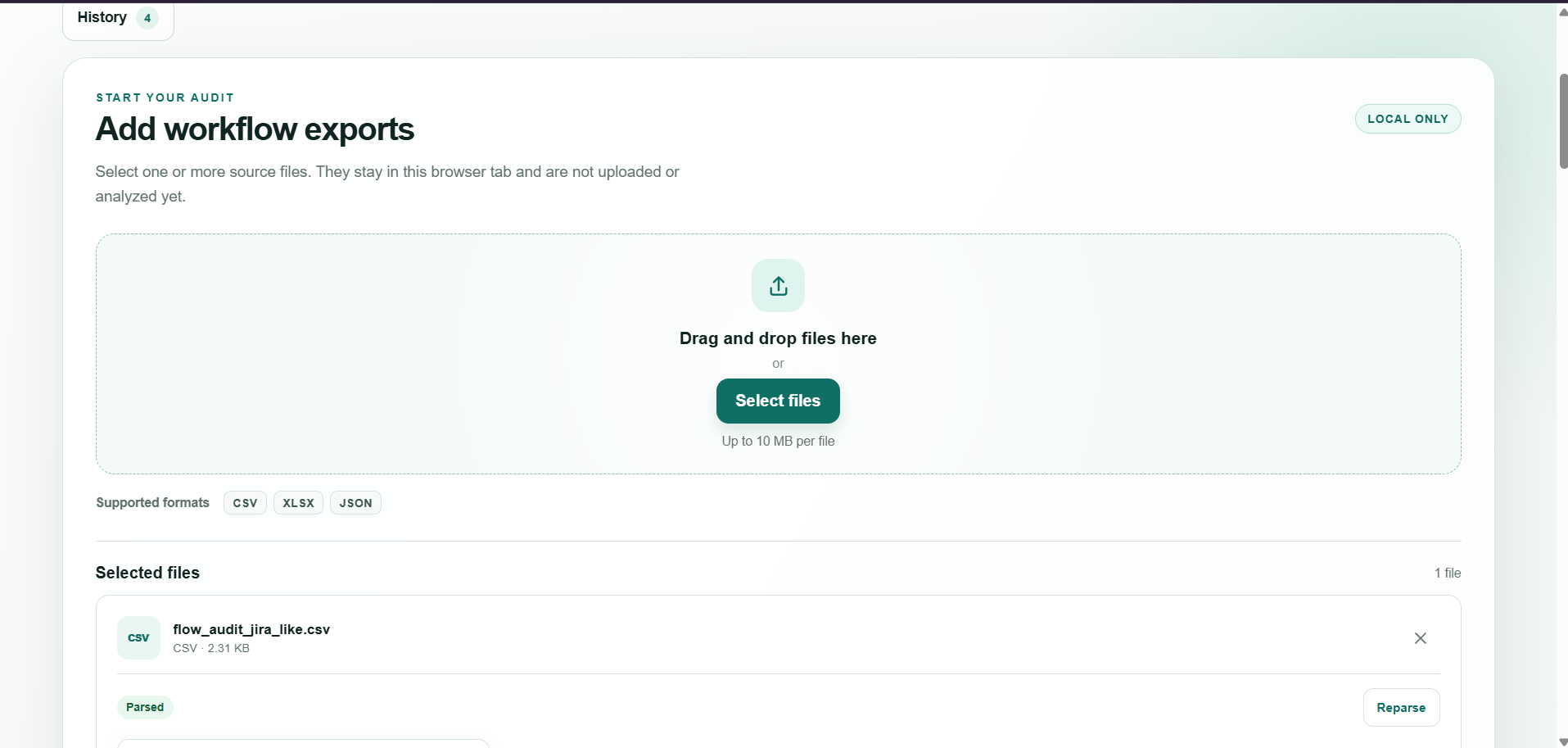
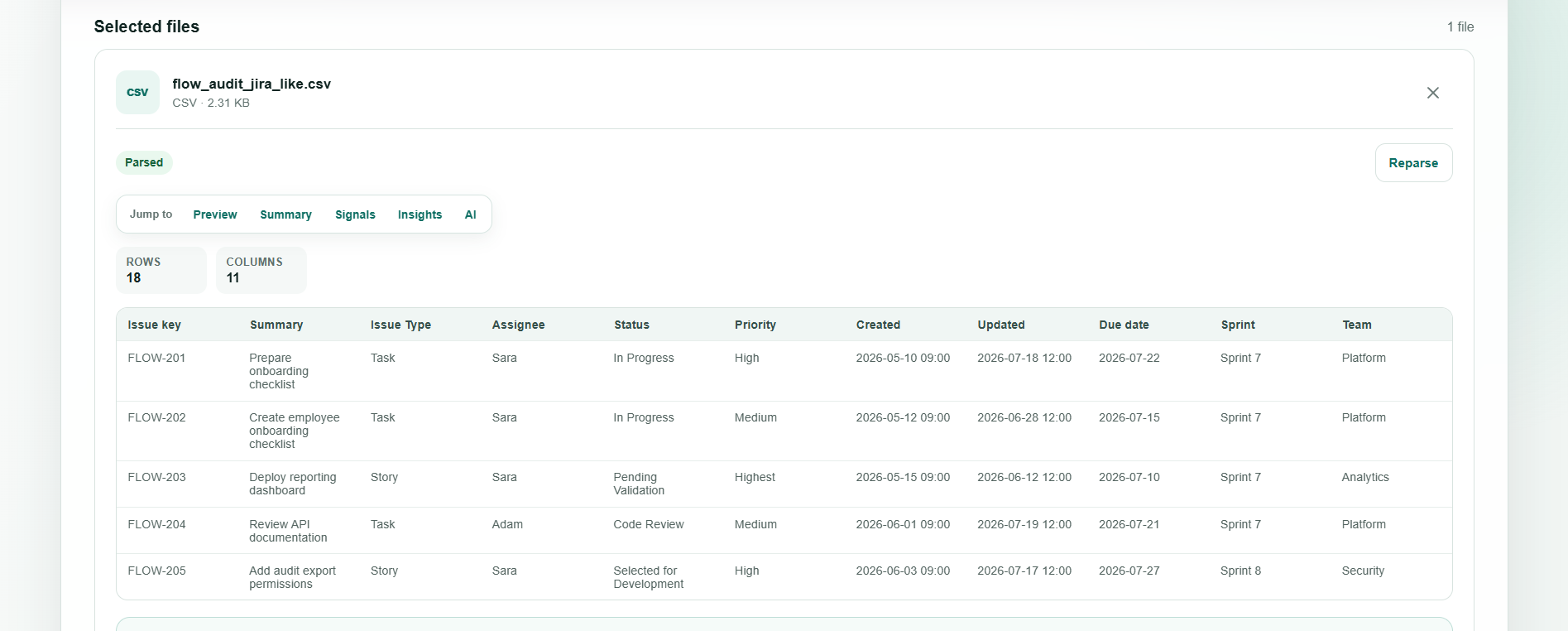
It supports CSV, XLSX, and JSON exports, normalizes them into a common structure, and computes reproducible workflow metrics covering assignment coverage, workflow states, review distribution, activity dates, due dates, data quality, and lexical title similarity.
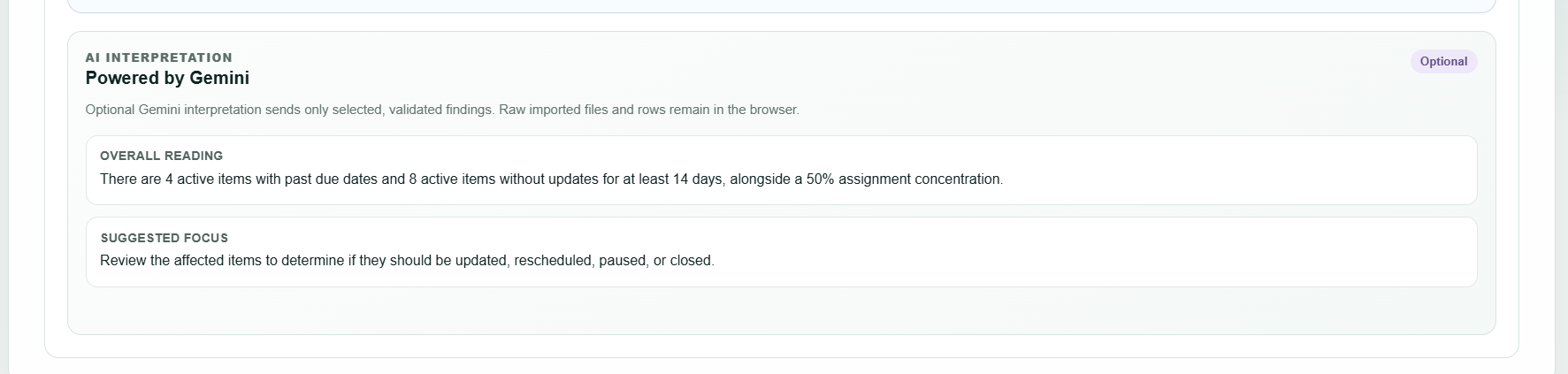
Once the deterministic audit is complete, users can optionally request a Gemini interpretation. Instead of sending imported files or raw rows, the application sends only a small set of validated findings through a Cloudflare Worker, allowing Gemini to produce a concise human-readable interpretation while preserving privacy.
The philosophy behind the project is simple:
The code measures. The AI interprets.
How we built it
Flow Audit was built with Next.js, TypeScript, Cloudflare Workers, and the Google Gemini API.
The application is intentionally divided into two independent layers.
The first layer performs local parsing, normalization, deterministic analysis, interpretation, and browser-based history management. Every metric is produced through explicit deterministic rules, making the results reproducible for the same input.
The second layer is completely optional. A Cloudflare Worker securely stores the Gemini API key, validates requests and responses, applies rate limiting, and sends only bounded validated findings to Gemini.
During development, I used Codex and GPT-5.6 as development collaborators for architecture discussions, implementation, debugging, testing, documentation, and edge-case analysis. They were development tools only and are not part of the deployed application.
Challenges we ran into
The biggest challenge was deciding where AI should stop.
It would have been easy to send the entire dataset to a language model and let it generate conclusions. Instead, I wanted every observation to be explainable, reproducible, and backed by deterministic evidence.
Another challenge was designing a strict privacy boundary so imported workflow data never leaves the browser. Only validated findings can be sent to Gemini after explicit user action.
Finally, deploying the application required configuring Cloudflare Workers, CORS policies, Vercel, and the communication between the frontend and the Worker to ensure the production environment behaved exactly like local development.
Accomplishments that we're proud of
I'm particularly proud of the project's architecture.
Rather than making AI responsible for the analysis itself, Flow Audit separates deterministic measurement from AI interpretation. This makes the results reproducible, easier to trust, and more respectful of user privacy.
I'm also proud that the complete deterministic audit works entirely in the browser. Even if Gemini is unavailable, the application remains fully functional.
Finally, bringing the entire system—from local parsing to Cloudflare Workers, secure deployment, and production testing—to a working MVP during OpenAI Build Week was an achievement in itself.
What we learned
This project reinforced an important lesson: AI is often more valuable when it explains reliable measurements instead of generating them.
I also gained hands-on experience with deterministic data analysis, browser-based file processing, Cloudflare Workers, secure API design, structured AI outputs, deployment with Vercel, production debugging, and building privacy-conscious AI applications.
What's next for Flow Audit
The current version focuses on a reliable MVP.
The next steps include supporting additional workflow platforms, generating downloadable PDF reports, improving comparison across multiple exports, expanding deterministic workflow signals, and making the application easier to integrate into existing engineering workflows.
Throughout these improvements, the same principle will remain unchanged:
Deterministic measurement first. AI interpretation second.
Built With
- cloudflare-workers
- csv
- google-gemini-api
- gpt-5.6
- indexeddb
- json
- next.js
- openai-codex
- papa-parse
- react
- sheetjs
- typescript
- vercel
- xlsx

Log in or sign up for Devpost to join the conversation.