-
-
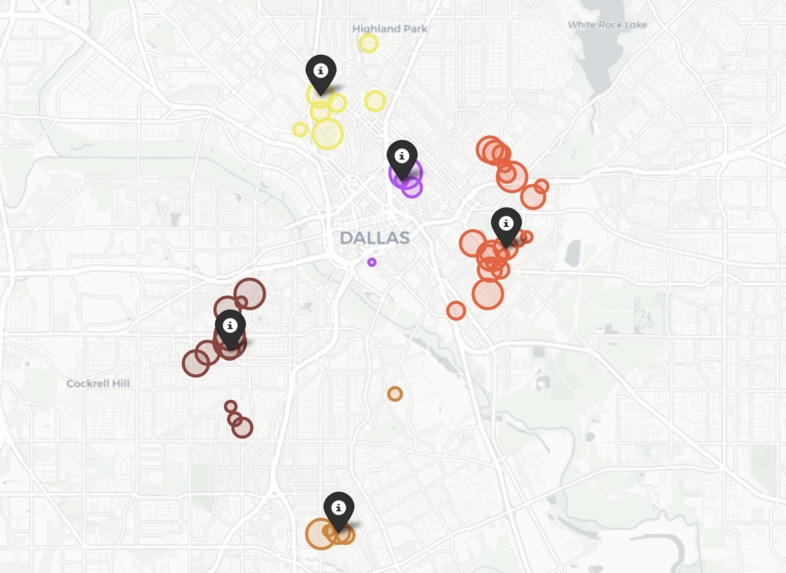
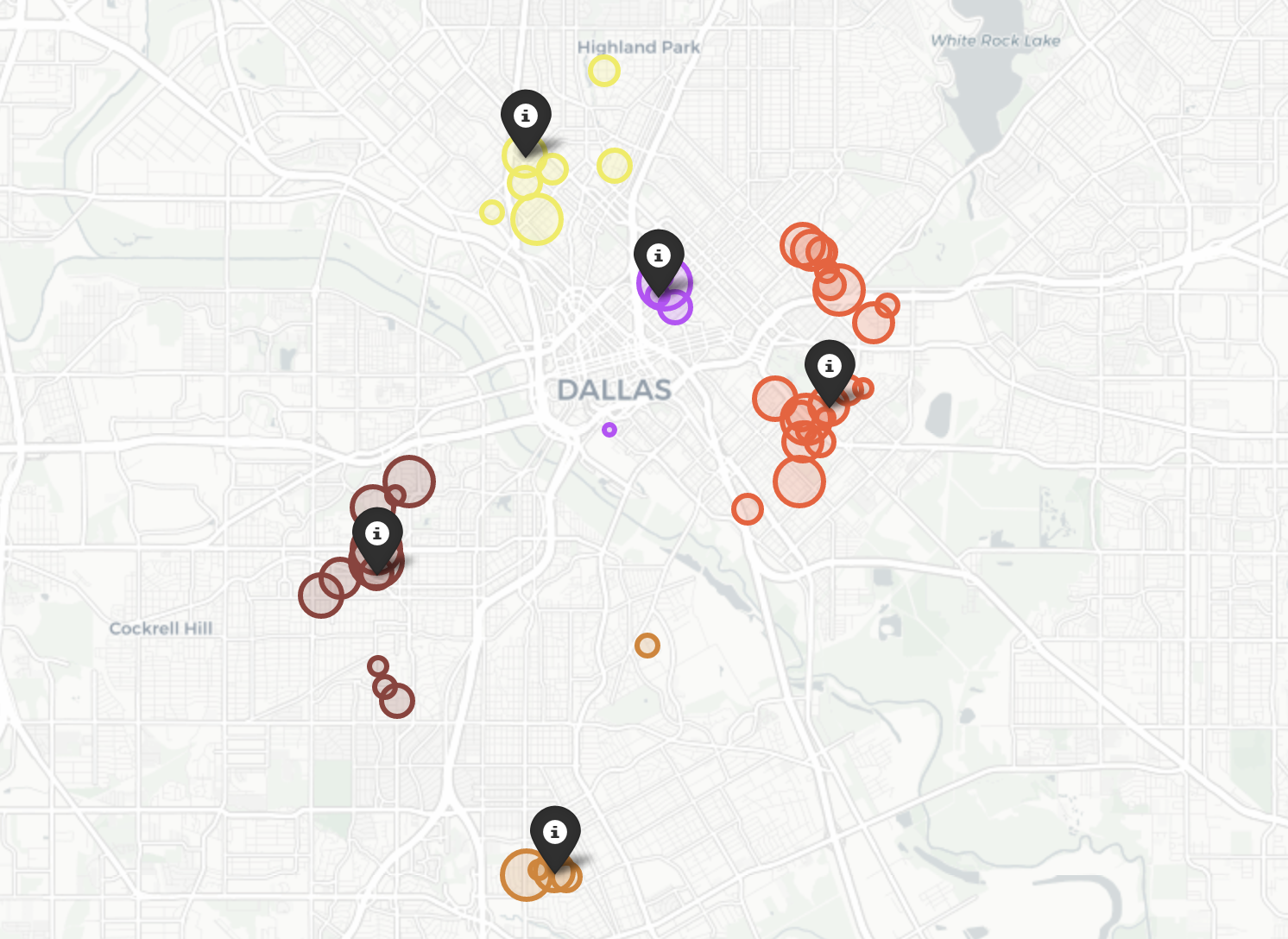
Cluster Map of Sample Data with AI generated suggestions for optimal drop off locations
Inspiration
Swathi’s inspiration comes from hearing stories from her mom about the hardship of experiencing menstruation back in India. Her mom regularly reminds her of the privilege that pads and tampons are, having spent many years relying on going out into the woods at night to avoid both stigma and lack of access to products. Even in the United States, period products are taxed unfairly despite being necessary healthcare for half the population, contributing to an epidemic of period poverty that disproportionately affects minorities. Maya’s inspiration came from a belief in the power of mutual aid to meet the critical needs of intersectionality marginalized people. Further, she was motivated by research derived from a Dallas-based initiative to provide free period products and found that 43% of the people who took part in this pilot program had reported missing school or work because they didn’t have access to menstrual products. Clearly, here is a huge need in our community. As well, a difficult task in meeting community needs is building trust with the most marginalized, so we wanted to create a product that balanced anonymity with reliability and usability. Lastly, volunteers have limited time, and mobilizing the power of AI to help create efficient supply chains would help maximize the power of our initiative.
What it does
Our product is a web app that allows users to submit a request for period products while providing minimal personal info. They only need to provide an email and a physical address they feel comfortable sharing. This address could be a public location of the users choice and is only used to maximize accessibility. User-submitted data is added to a database and used to create a map of an optimized amount of clusters. In addition, our web app has a volunteer experience that gives them access to a real-time version of clusters of need. This allows the volunteer to organize more quickly and enables them to provide aid more efficiently.
How we built it
Initially, we began by tossing around ideas around important problems. Maya suggested we create a web app submission portal for mutual aid organizations, and Swathi suggested we focus on fighting period poverty due to it being a relevant issue in public healthcare access. After deciding on a vision of what we wanted to build, we utilized a divide-and-conquer approach. Fortunately, our team had a diverse array of skills with each member providing a uniquely valuable contribution. Luka utilized MongoDB and her experience with development to support the database backbone of the project. Maya’s data science and AI abilities worked well with her passion for mutual aid. She designed a data pipeline that created location-based clusters of need using affinity propagation, a form of unsupervised learning that doesn’t require a set number of clusters and is well-suited for geospatial data. Ultimately, Geopy helped with converting addresses to coordinates, Sklearn was crucial for clustering algorithms, and Folium was great for displaying results on a detailed map of DFW. Bridget’s combination of design and engineering skills proved to be a powerful resource for the UX process, as she was the primary contributor to our product's aesthetic. Swathi’s vision can be seen most clearly in her work on the presentation and description of the project, where her expertise in public health proved to be crucial to our product's function.
Challenges we ran into
Developer dropout: On the morning of the presentation, our developer did not show up, crippling our ability to deliver a fully usable product. This frustrating moment did not hold us back, as we had full confidence in the value of our idea and our ability to demonstrate it with our UX mockups and fully functional data processing pipeline.
Technical issues: Technical feasibility was a huge limit in the idea stage, determining in large part the possible projects we could execute. We ran into a variety of issues in the development stage, ranging from bugs in the code, compatibility issues, or problems with the user interface such as designing a symbol for the app itself. Maya was challenged in implementing the data pipeline, running into multiple errors that took upwards of an hour each to resolve.
User testing: To ensure that the app is effective and user-friendly, it is important to conduct user testing with a diverse group of users. This can be a challenge at the end of a hackathon, as there may not be enough time or resources to conduct comprehensive testing.
Funding and sustainability: Developing an app is just the first step in tackling period poverty. To have a lasting impact, the app needs to be sustainable, which requires ongoing funding and support. At the end of a hackathon, the team may need to consider how they will secure funding and resources to maintain and update the app over time.
Accomplishments that we're proud of
We are proud to be a diverse team of women in STEM, ranging from computer science, to software engineering, to cognitive science and literature. We are also proud to create an app that can connect users with nearby volunteers and make their menstrual cycle a positive experience. The app is designed to address period poverty which is often overlooked in society as an issue that needs to be solved immediately. Moreover, our team made a tangible contribution to society by providing resources and support for those in need. By using technology to increase access to menstrual products and education, the team has demonstrated creativity and ingenuity. Our team is proud of our ability to put ourselves in the shoes of those experiencing period poverty and design an app to meet their needs.
What we learned
We learned the power of collaborating with people who have different skill sets but common goals and values.
Understanding the problem of period poverty: Developing this app that addresses period poverty required a deep understanding of the problem itself, including its causes, effects, and potential solutions. This involved conducting research, talking to other women, and analyzing data. Design thinking: Developing this app required careful planning and design, which involved taking a user-centered approach to identify the needs and preferences of the target audience. We learned to use these skills in a more time-efficient manner. Teamwork and collaboration: Developing this app was a team effort, requiring collaboration between a variety of skill sets. Working on this project taught us skills such as effective communication, collaboration, project management, and delegation of tasks.
What's next for Flow Aid: An Emergent Strategy to Fighting Period Poverty
Self-organized scheduling: The next step for Flow Aid is implementing scheduling, where users can submit preferred times for meeting with volunteers. The data for all users is then aggregated into a self-organizing calendar that finds optimal times for distribution for each cluster. These appointments are then emailed to members of the community for confirmation. Information and education: The app could provide users with information about menstrual hygiene and provide educational resources on periods, menstruation, and menstrual products. This could include information about reusable menstrual products, such as menstrual cups, which can be a cost-effective solution for period poverty. Expanding Exploratory Data Analysis: Identifying clusters of need based on location is only the first step, future iterations will ask about barriers to accessing period products, individual healthcare concerns, and experiences with stigma. This data can be mined to better understand the reasons for period poverty and to help develop novel solutions. Period tracking: The app could include a period tracking feature, allowing users to track their menstrual cycle and receive notifications when their period is due. This could help users plan and make sure they have the necessary supplies. Donation options: The app could provide users with the option to donate menstrual products or money to organizations that support people in need. This would allow users to contribute to the cause and help those who may not have access to menstrual products. Discounts and coupons: The app could partner with menstrual product manufacturers or retailers to offer discounts and coupons to users who are experiencing period poverty. This could help make these products more affordable for those who may be struggling financially. Community support: The app could provide a platform for users to connect with others who are experiencing period poverty. This could include forums, chat rooms, or social media features that allow users to share their experiences and support one another. Facilitating discussions at the local level can contribute to overall change. Language translation: Providing the app in multiple languages such as Spanish would help the app reach a wider audience and make it accessible to non-English speaking communities. Confidentiality and privacy: Ensuring that user's personal information and data are kept confidential and secure, especially for those who may be hesitant to use the app due to stigma or shame around menstruation. Period poverty resources: Providing information about organizations and resources that address period poverty, including local food banks, community organizations, and government programs that provide free or subsidized menstrual products.
Built With
- adobe
- xd

Log in or sign up for Devpost to join the conversation.