-
-
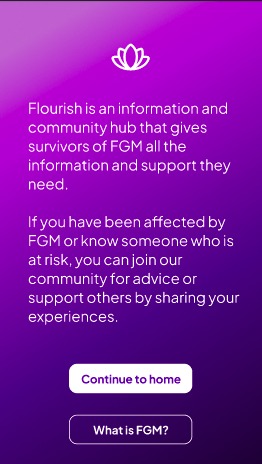
Information for first time users
-
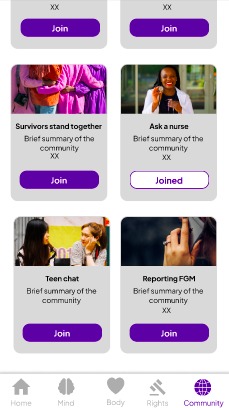
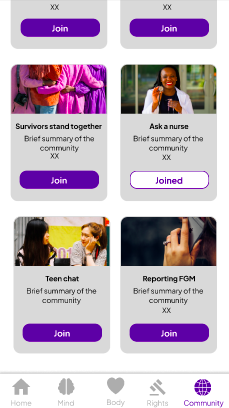
Create and join communities
-
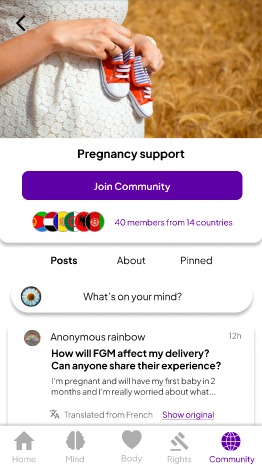
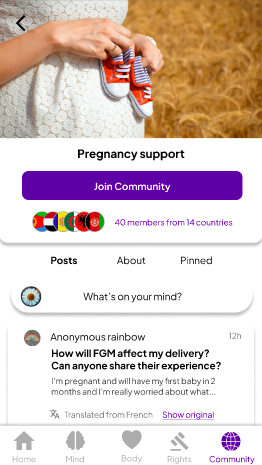
Users can speak about what's on their minds in their native languages
Inspiration
Our inspiration for creating an app to help survivors of Female Genital Mutilation (FGM) came from learning about the prevalence and devastating impact of this harmful practice on women and girls around the world. In the UK alone, an estimated 137,000 girls and women are survivors of Female Genital Mutilation living with the severe physical and psychological consequences of the practice, with a further 60,000 girls under the age of 15 at risk of mutilation.
Through our research, we realised that there was a gap in access to information and resources for survivors of FGM. We saw an opportunity to use our skills to create an app prototype that would provide survivors with the information and support they need to heal and recover. Our hope is that this app would help raise awareness about FGM and contribute to the global efforts to end this harmful practice.
What it does
Flourish offers a safe and anonymous platform for women to learn about FGM and get the support they need. It is divided into four main sections: my body, my mind, my rights, and my community.
In my mind, my body and my rights, users can access educational resources about FGM and bookmark them for later use. Additionally, the app provides links to seek professional help, legal advice, and therapy.
In the my community section, users can join different communities and participate in safe and moderated forums. Users will be able to see comments in their original language and a translated version. This section is designed to help women connect with others who have had similar experiences and build supportive networks.
We understand that female refugees may face unique challenges and barriers, and that's why we have created this app prototype. Our goal is to provide women with the information and resources they need to make informed decisions about their health and wellbeing.
In conclusion, our app is a powerful tool for educating and supporting female refugees affected by FGM. We hope that this app would make a real difference in the lives of women around the world.
How we built it
The Figma prototype of our educational app was built using a design thinking process, which involved the following technical steps:
Research and planning: We conducted research to identify the needs and preferences of our target users and developed a plan for the app's design and functionality.
Wireframing: We created wireframes to establish the basic layout and functionality of the app, along with a framework for the information architecture.
Prototyping: Using Figma's prototyping tools, we created a clickable prototype that allowed us to test the app's functionality and user experience.
Internal testing: We conducted internal testing to identify any issues with the app's design and functionality. This involved sharing the prototype and soliciting feedback.
Iteration: Based on the feedback we shared during internal testing, we made changes to the app's design and functionality, and tested it again until we were satisfied with the results.
Although we were unable to conduct user testing due to limited time and no users available, we still followed the design thinking process and conducted internal testing to ensure the app's functionality and user experience were effective. This allowed us to create a prototype that we believe would meet the needs of our target users. We recognise that user testing is important for validating the app's effectiveness, and we would plan to conduct user testing in the future when possible.
Challenges we ran into
The main challenges that we faced centred around making sure that the product we designed would be accessible. FGM is a global issue that affects many different cultures and languages, and building an app that can effectively communicate the dangers of FGM and support survivors across different languages and cultures may require additional resources and expertise.
In order to ensure that users are able to reach out to others in the community, our app would include integrated translation. However, translating from one language to another is not always smooth, so another option we considered was allowing users to create their own communities by language. These would have to be moderated as we want to avoid the spread of misinformation at all costs.
Accomplishments that we're proud of
We are really pleased that in a short period of time we have designed a product with multiple features that would affect real meaningful change for a cause that is often overlooked.
What we learned
In our initial brainstorming session we chose to create an FGM app. We envisioned it being a really impactful product, but there were large knowledge gaps on the chosen topic. As such, we took it upon ourselves to delve into the issue of FGM and conduct significant second hand research in order to better understand the specific problems faced by women and girls who have been victims of FGM practices, particularly among already vulnerable groups such as refugees. We consulted resources including The World Health Organisation, ActionAid, NHS, gov.uk, ForwardUK and Unicef.
Our findings included:
Refugee women and girls typically lack or have difficulty in obtaining basic information and resources relating to mental and physical health services.
Survivors of FGM may feel ashamed or stigmatised, which can make it challenging to seek help or speak out about their experiences. They may also fear retribution from their families or communities if they seek asylum or citizenship based on their experience of FGM.
According to the World Health Organization (WHO), FGM is most prevalent in 30 countries across Africa, the Middle East and Asia. In these countries, a range of languages are spoken, including Arabic, French, English, Somali, Amharic, Swahili, and many others. Therefore, it is essential that we provide support with the aid of multilingual translation.
We also researched a number of educational and community based apps (for example, Euki and Fishbowl among others) and took inspiration from their privacy features, such as the use of a mock error screen and forum anonymity.
What's next for Flourish
Given that collaboration with government run healthcare providers and local charities is not a quick process, initially the plan would be to roll out the app in the UK, and then to gradually diversify globally as collaboration widens.
We would also like to focus on further developing the app itself. In order to improve privacy we would like to set up a pin code. Given that users can use the forums to discuss sensitive information which they may not want friends and family seeing them accessing (i.e. how to report FGM) we would also incorporate a false screen. This way, if someone asks a user to open the app and you they don’t want them to see their data, they can enter "0000" when they open the app and the app will display a false screen.
Built With
- figma


Log in or sign up for Devpost to join the conversation.