-
-

FloRider AI
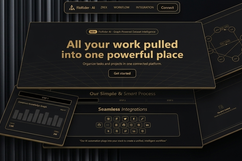
FloRider AI: Project Story
Inspiration
FloRider AI started from a simple frustration:
Data is everywhere, but intelligence is fragmented.
Most tools treat datasets, workflows, and tasks as isolated units, whereas real-world systems are deeply interconnected. This led to a central idea:
What if all workflows, datasets, and logic could exist inside a unified graph structure?
MVP Orientation Video
Setup Note
To unlock full functionality, configure your API key via the BYOK (Bring Your Own Key) section in the interface.
This enables secure, personalized access to AI-powered features.
For issues: @SakaethRam
Problem, Solution, and Impact
1. The Problem
Modern systems suffer from data fragmentation.
Datasets, workflows, and tasks are treated as isolated components, making it difficult to understand relationships between them.
Key Challenges
- No visibility into how datasets influence outcomes
- Difficulty tracing dependencies between tasks
- Limited understanding of insight origins
- Inefficient handling of interconnected workflows
Core Issue: Relationships are not treated as first-class elements, limiting deeper reasoning and intelligence.
2. The Solution
FloRider AI is a graph-powered dataset intelligence platform that unifies datasets, workflows, and tasks into a single connected system.
Core Model
$$ G = (V, E) $$
- V (Nodes): Datasets, tasks, agents
- E (Edges): Relationships, dependencies, transformations
System Architecture
1. Graph Abstraction Layer
Models all entities and their relationships as nodes and edges
2. Intelligence Layer
Enables traversal, dependency tracking, and contextual reasoning
3. Interface Layer
Provides an interactive visualization for exploring and managing the graph
Capabilities
- Trace data flow across systems
- Understand workflow dependencies
- Retrieve context-aware insights
3. Impact & Use Cases
FloRider AI shifts systems from static data storage → dynamic system understanding.
Key Use Cases
- Data Lineage Tracking: Identify how datasets influence results
- Workflow Dependency Mapping: Understand task relationships
- Contextual Decision-Making: Generate smarter insights
- System Debugging: Trace issues across interconnected components
Broader Impact
- Relationships become core system primitives
- Increased transparency in complex workflows
- Scalable intelligence for growing systems
Engineering Approach
The system was designed to prioritize relationships over storage.
Instead of hierarchical organization, FloRider AI models everything as a connected graph, enabling:
- Contextual reasoning
- Dependency-aware computation
- System-wide traceability
Challenges
Modeling Real-World Complexity
Translating messy, real-world workflows into graph structures without losing meaning.
Balancing Simplicity and Power
Maintaining usability while supporting complex relationships.
Dynamic Dependency Handling
Ensuring updates propagate correctly across dependent nodes.
Scalability
As the graph grows:
$$ |E| \approx O(n^2) $$
Managing this growth efficiently was a key challenge.
Key Learnings
- Graph-based thinking naturally models complex systems
- Relationships are fundamental to intelligence
- Usability is critical in abstract systems
- Connected system design differs from traditional architectures
Closing Thought
Stop storing data. Start connecting it.


Log in or sign up for Devpost to join the conversation.