Inspiration
Finding elder care is often overwhelming, especially when a family is already dealing with a hospital discharge, a sudden decline in health, or a loved one who can no longer live independently. Families are expected to understand the difference between home health, personal care, skilled nursing, hospice, rehabilitation, assisted living, and other services—often while making urgent decisions with incomplete information. They may call multiple agencies, repeat the same story, leave voicemails, wait for callbacks, and still not know whether care has actually been arranged. We built Florence because the first point of contact in elder care should feel less like navigating a phone tree and more like speaking with a compassionate care guide. Florence is inspired by the idea that technology should not replace human care. It should remove the confusion, paperwork, and communication barriers that prevent human care from happening.
What it does
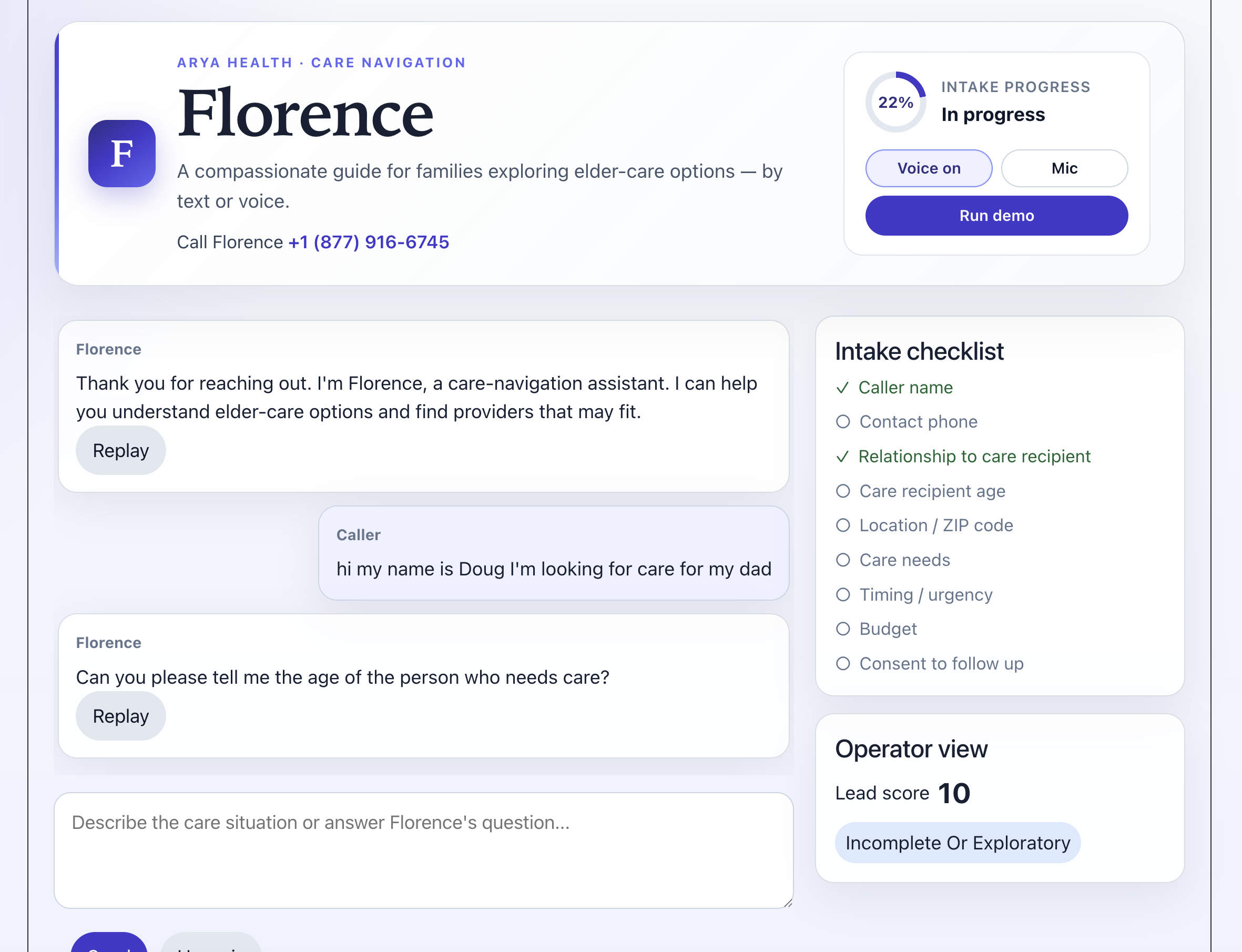
Florence is a humanistic elder-care voice AI and IVR navigation agent that guides families from their first call through referral submission. Florence can:
- Answer calls at any time
- Welcome the caller with a calm, compassionate voice
- Identify whether the caller is a patient, family member, hospital representative, or caregiver
- Screen for urgent situations and route emergencies appropriately
- Ask conversational intake questions
- Understand the elder’s location, care needs, mobility, daily-living limitations, language preferences, insurance, and desired start date
- Explain different care options in simple language
- Recommend an appropriate care category without making a medical diagnosis
- Match the family with providers based on geography, service type, availability, insurance, and specialized care requirements
- Create and submit a structured referral
- Send confirmation and status updates
- Escalate complex or sensitive cases to a human care coordinator Florence does not simply collect a message. It helps move the family toward a real care outcome. For example, a caller might say: “My father is coming home from the hospital tomorrow. He has trouble walking, needs help with medication, and I cannot stay with him during the day.” Florence can recognize that the family may need a combination of skilled home health and personal-care support, ask the necessary follow-up questions, summarize the request, and begin the referral process.
How we built it
We designed Florence as a voice-first care-navigation platform. The call begins through a programmable phone number and IVR layer. The caller’s speech is transcribed in real time and passed to an AI orchestration service. The language model interprets the caller’s needs, follows a structured intake workflow, and selects from approved actions. Our architecture includes:
- Twilio Programmable Voice for inbound and outbound calls
- Twilio ConversationRelay or Media Streams for real-time voice communication
- Speech-to-text and text-to-speech services for natural conversation
- A large language model for conversational understanding and response generation
- A deterministic workflow engine for emergency screening, intake requirements, consent, and referral state management
- A provider-matching engine that filters by location, care type, insurance, availability, language, and clinical capability
- A structured referral database for intake records, provider outreach, and referral status
- SMS notifications for confirmations and follow-up updates
- Human handoff tools for warm transfers to care coordinators We intentionally separated conversational intelligence from operational decision-making. The AI can understand natural language and guide the conversation, but critical actions—such as emergency routing, provider eligibility, referral submission, and status changes—are controlled by validated rules and structured tools. This helps make Florence more reliable, auditable, and appropriate for healthcare environments.
Challenges we ran into
One of our biggest challenges was balancing a natural conversation with the need for accurate, structured data. Families do not describe care needs using formal healthcare terminology. They say things such as:
- “My mother needs someone to stay with her.”
- “He cannot get out of bed by himself.”
- “The hospital says she needs therapy.”
- “We are not ready for a nursing home.”
- “I do not know what kind of help we need.”
Florence must translate these statements into useful care categories without overstepping into diagnosis or making unsupported clinical decisions. Another challenge was designing for emotionally difficult situations. A caller may be frightened, exhausted, impatient, or grieving. A traditional phone menu can make that experience worse. We had to make Florence patient, respectful, and able to ask one clear question at a time.
We also had to account for:
- Background noise and accents
- Callers interrupting the agent
- Incomplete or conflicting information
- Multiple family members speaking
- Emergency or high-risk language
- Privacy and consent
- Provider availability changing in real time
- The need for a seamless human handoff
- Preventing the AI from promising eligibility, coverage, or placement
The hardest challenge was recognizing that a referral is not complete when information is submitted. It is complete only when a provider accepts the case, a human coordinator takes responsibility, or the family receives a clear next step.
Accomplishments that we're proud of
We are proud that Florence is more than a voice chatbot. We designed an end-to-end care-navigation experience that connects conversation, intake, care education, provider matching, referral creation, and human escalation.
We are especially proud of:
- Creating a compassionate, elder-care-specific conversational experience
- Translating everyday family language into structured referral information
- Designing safety boundaries that keep clinical decisions with qualified humans
- Building a warm-transfer model so families do not have to repeat their story
- Focusing on closed-loop referrals instead of simply collecting leads
- Designing Florence to support both families and healthcare organizations
- Making the experience accessible through an ordinary telephone call, without requiring an app or technical knowledge Florence demonstrates that voice AI can be both operationally useful and deeply human-centered.
What we learned
We learned that the most important part of a healthcare AI agent is not how intelligent it sounds. It is whether it helps the right action happen. A polished conversation is valuable, but a family ultimately needs:
- The right type of care
- A provider that can actually serve them
- A clear explanation of what happens next
- Confidence that their request has not disappeared into a system We also learned that healthcare voice agents should not be built as fully autonomous, unrestricted systems. The strongest design combines:
- AI for language understanding
- Rules for safety and compliance
- Structured data for reliability
- Humans for judgment and complex decisions We learned that empathy can also be designed into workflow. Confirming what the caller said, avoiding repeated questions, providing status updates, and explaining delays are not just user-interface features. They are acts of respect. Most importantly, we learned that the first call can determine whether a family receives timely care or gives up during the process.
What's next for Florence: 2026
In Phase 2, we plan to expand Florence from a first-contact referral agent into a closed-loop elder-care coordination platform. Our next priorities include: Real-time provider capacity Florence will connect with provider systems to determine whether an agency has available nurses, aides, therapists, beds, or service capacity before submitting a referral. Automated provider outreach Florence will contact qualified providers through voice, SMS, secure messaging, or API integrations and continue outreach until the referral is accepted or escalated. Referral follow-through Florence will track each referral through key stages:
- Intake completed
- Documents requested
- Provider contacted
- Referral reviewed
- Referral accepted or declined
- Appointment scheduled
- Care started Multilingual navigation
We plan to support additional languages so families can explain care needs in the language they are most comfortable using. Hospital discharge integration Florence will support discharge planners by collecting referral information, identifying providers, tracking acceptance, and reducing delays in moving patients safely from hospitals to home or post-acute care. Family care dashboard Families will be able to see referral status, provider responses, appointments, required documents, and next steps without repeatedly calling different organizations. Human care-coordinator workspace Care coordinators will receive a structured summary of each call, risk flags, referral history, provider responses, and recommended next actions. EHR and healthcare-system integration We plan to integrate with electronic health records, scheduling systems, provider directories, and referral-management platforms using secure APIs and healthcare interoperability standards. Care continuity Florence will follow up after placement to confirm that the provider contacted the family, the appointment occurred, and care actually began. Broader elder-care services Phase 2 will expand matching to include:
- Home health
- Personal-care aides
- Skilled nursing
- Assisted living
- Hospice and palliative care
- Rehabilitation
- Adult day programs
- Transportation
- Meal support
- Durable medical equipment
- Caregiver respite
- Community and nonprofit resources Our long-term vision is for Florence to become a trusted front door for elder care—one compassionate voice that helps families understand their choices, navigate fragmented systems, and reach the right care without being lost along the way.
Acknowledgements: Icon created by onlyintheworlds from The Noun Project
Built With
- ollama
- pipecat
- react
- twilio
- typescript
- vite
- wisper


Log in or sign up for Devpost to join the conversation.