-
-
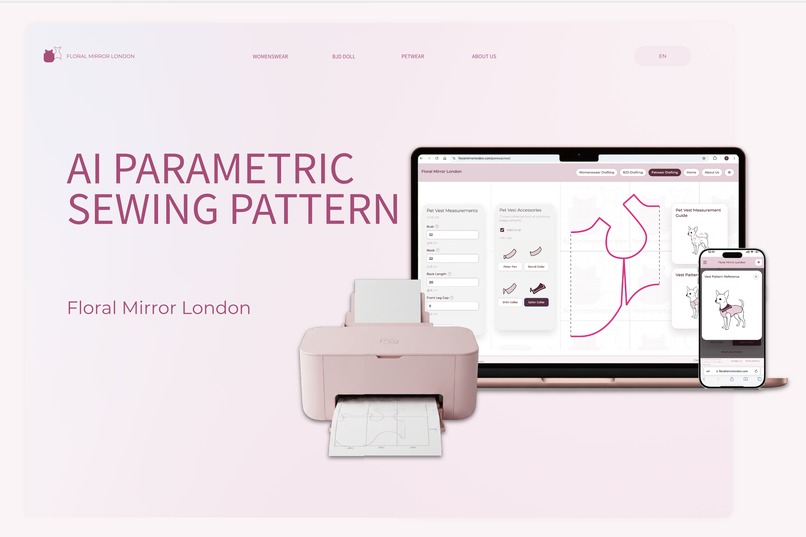
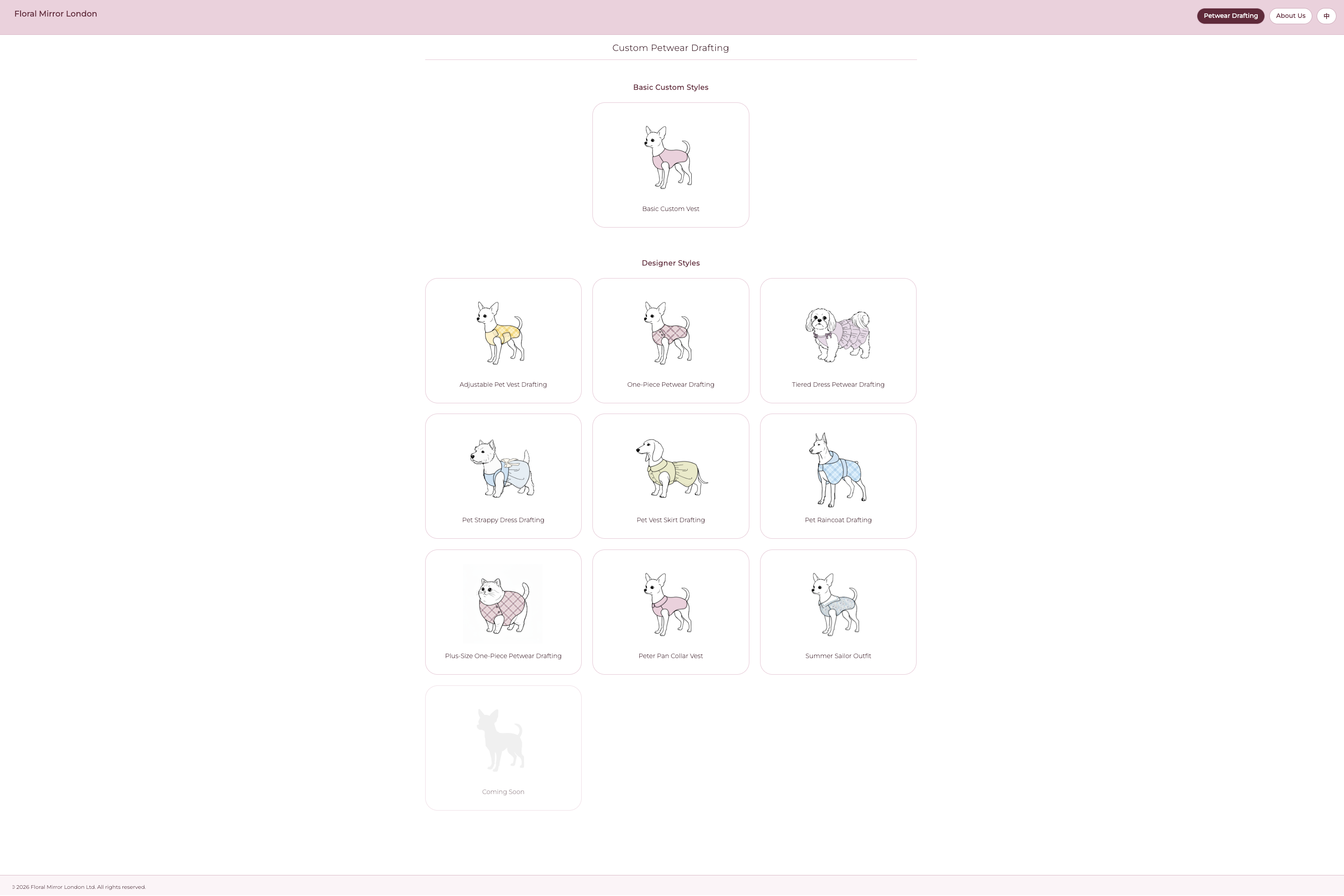
FLORAL MIRROR LONDON PET PATTERN SYSTEM COVER
-
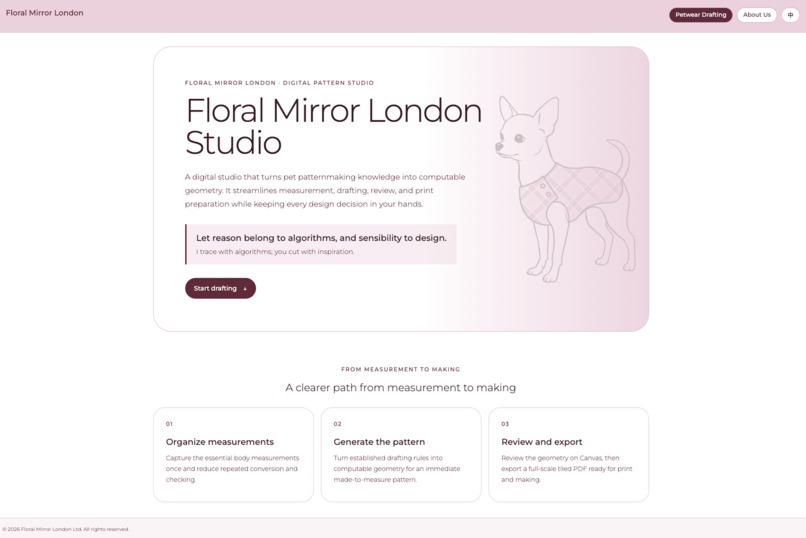
FLORAL MIRROR LONDON PET PATTERN SYSTEM HOMEPAGE
-
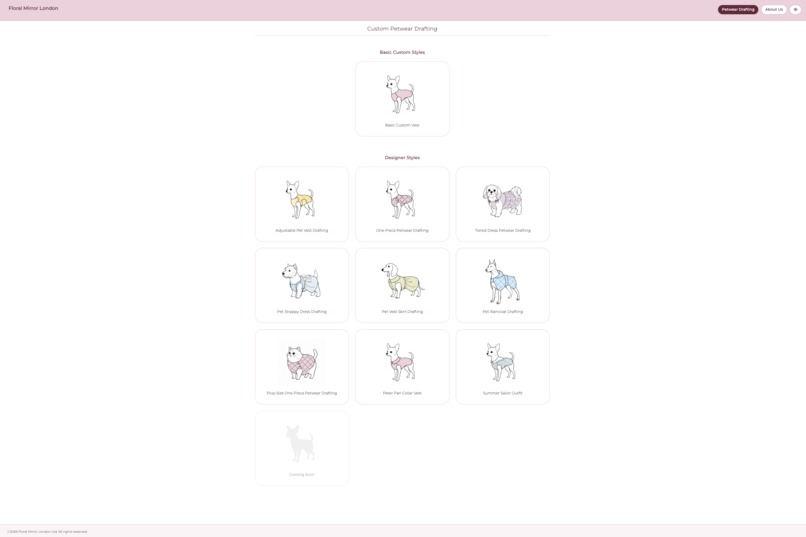
FLORAL MIRROR LONDON PET PATTERN SYSTEM CATEGORY PAGE
-
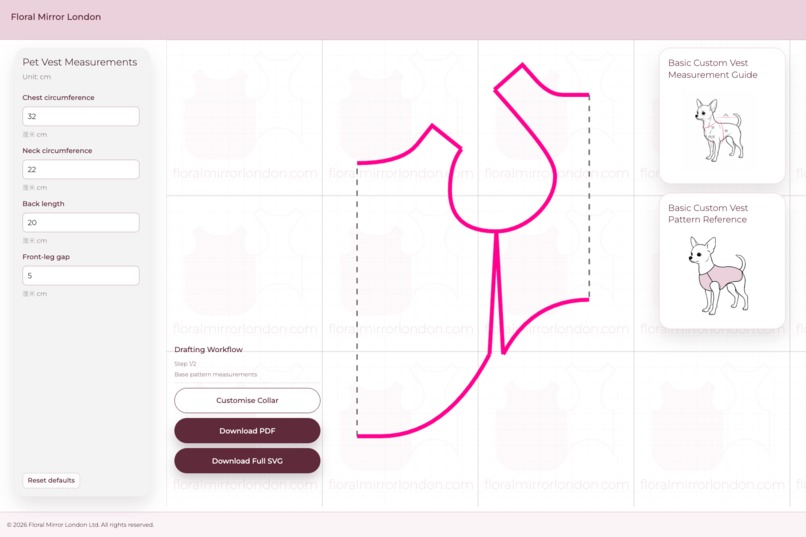
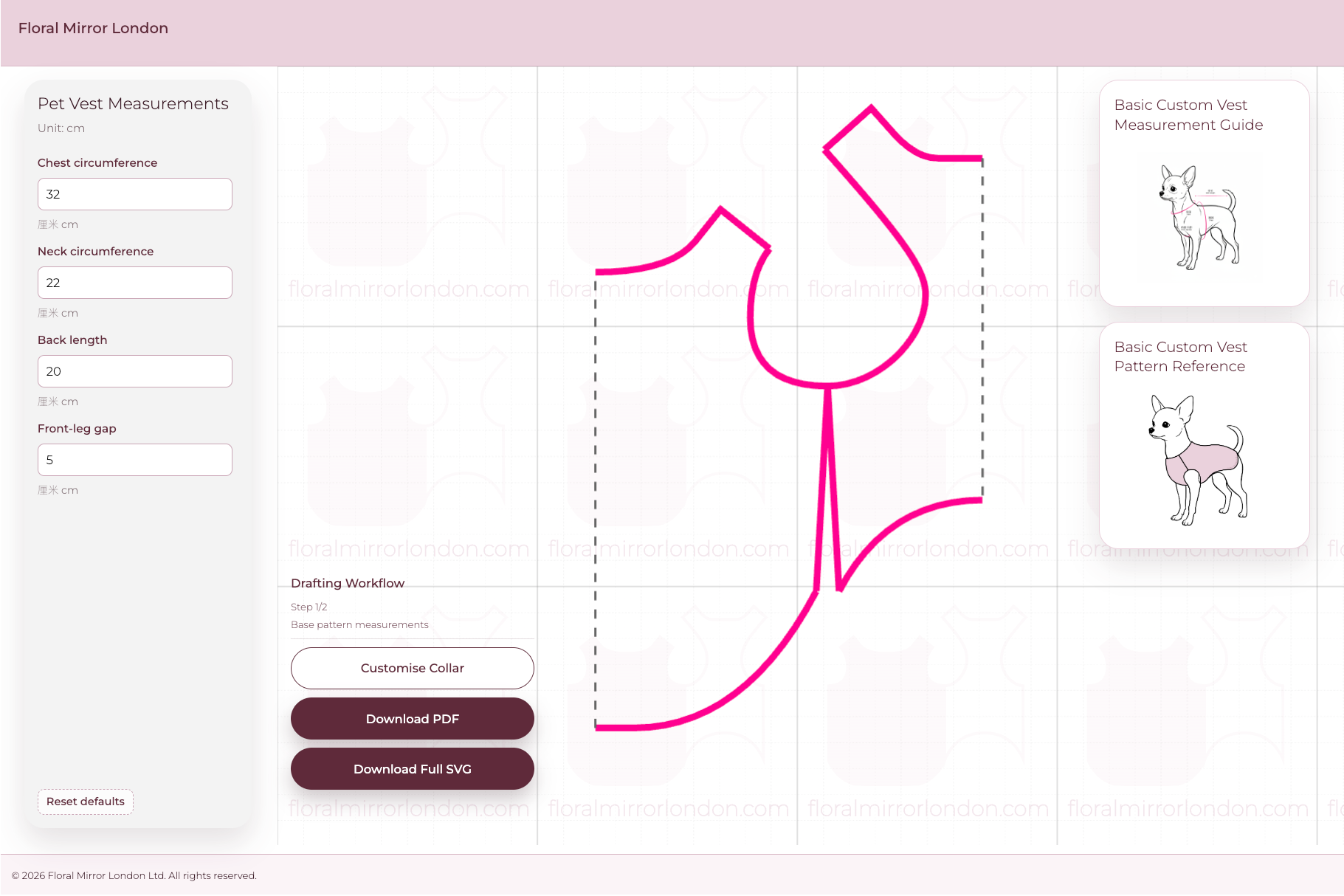
FLORAL MIRROR LONDON PET PATTERN SYSTEM CANVAS PAGE
-
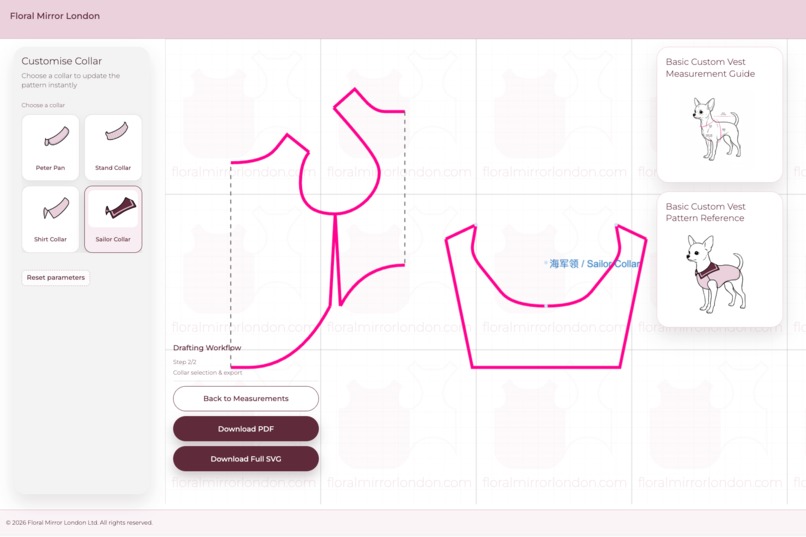
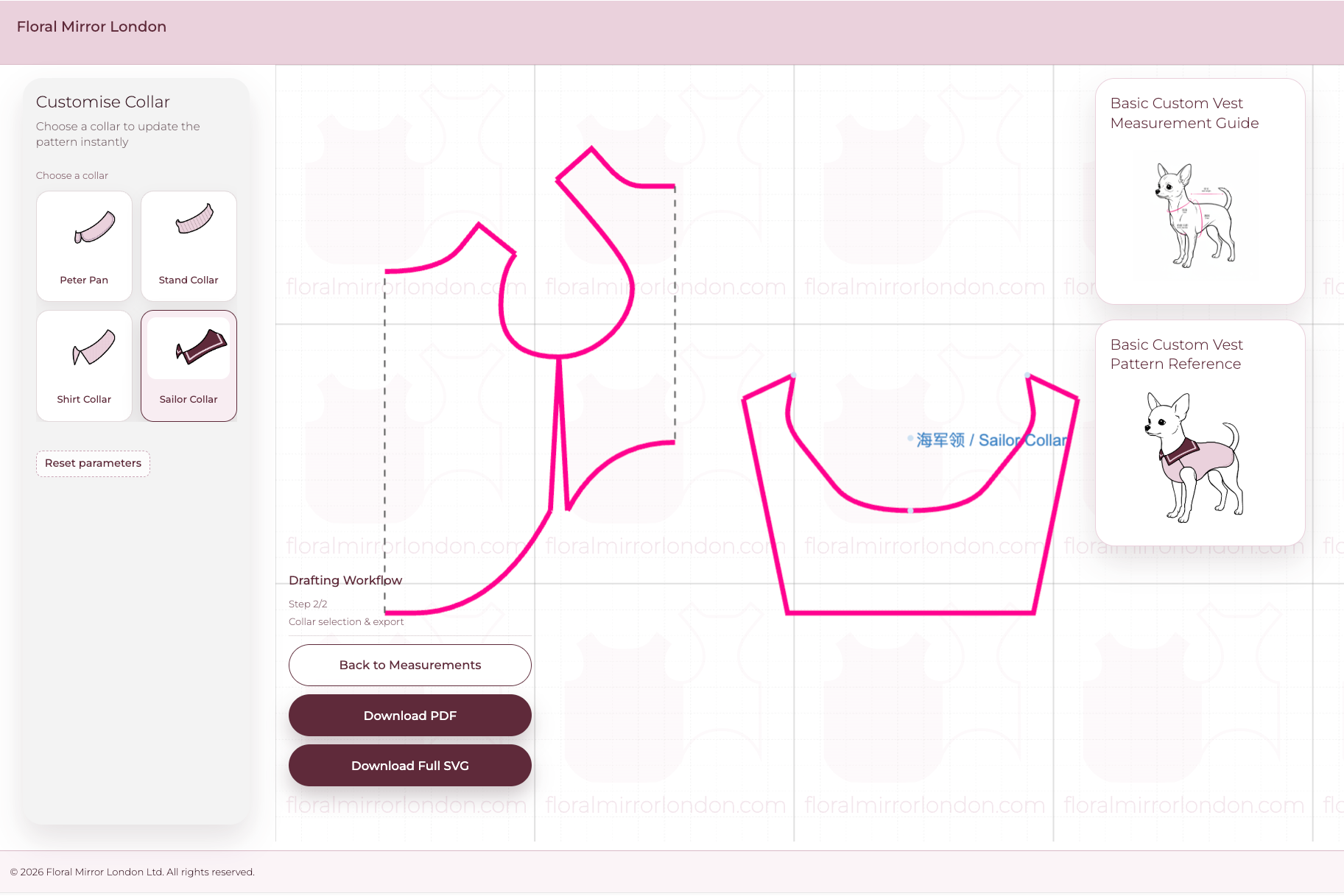
FLORAL MIRROR LONDON PET PATTERN SYSTEM COLLAR CUSTOMISATION PAGE
-
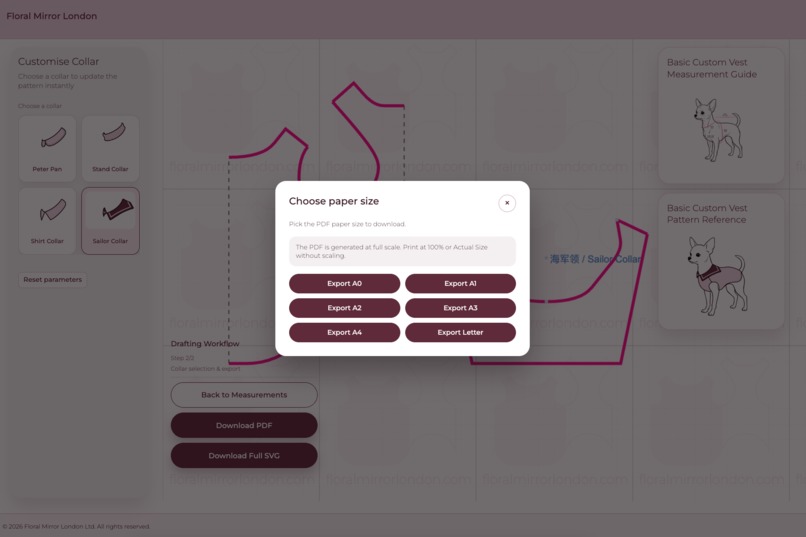
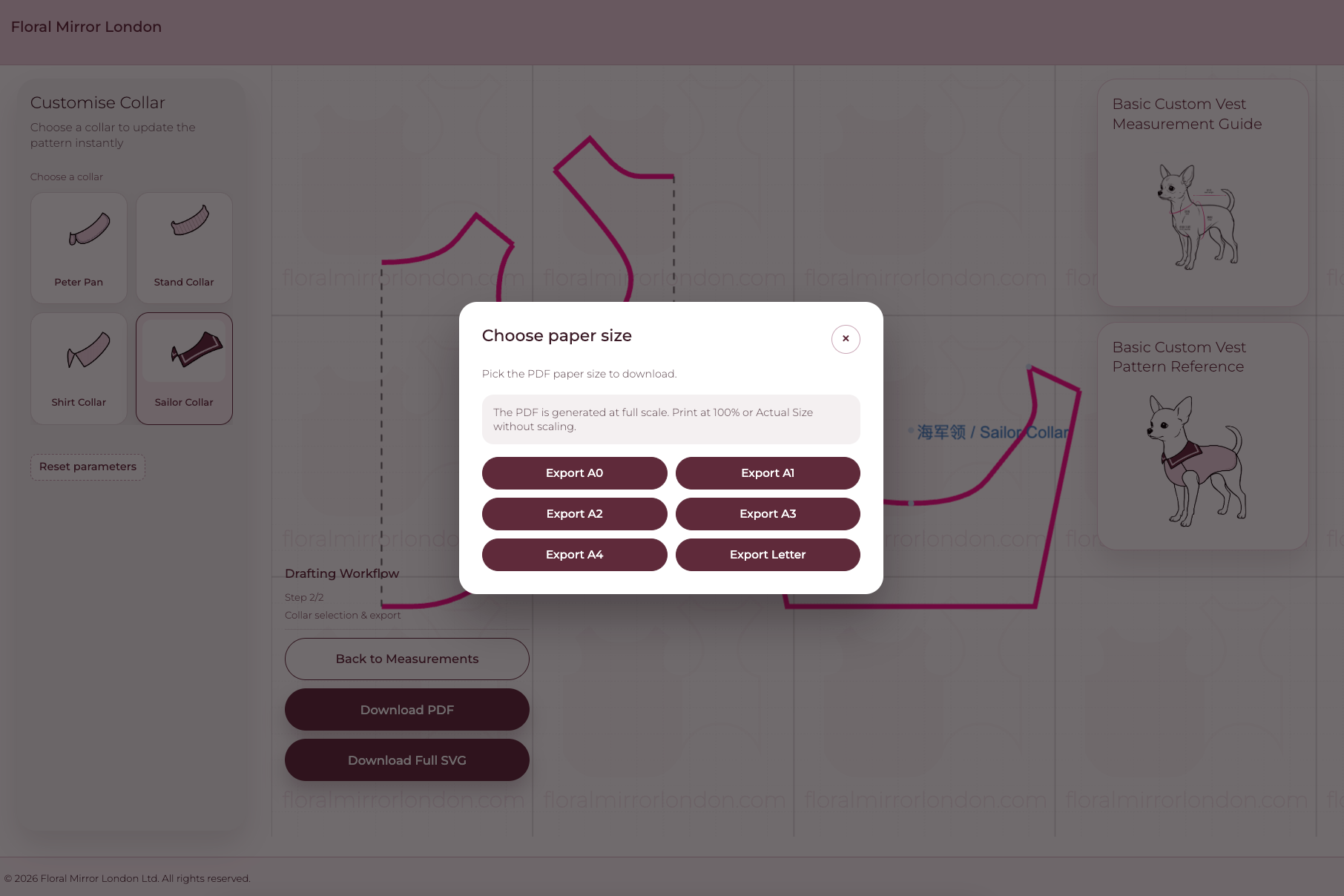
FLORAL MIRROR LONDON PET PATTERN SYSTEM PDF PAPER SIZE CHOOSE
-
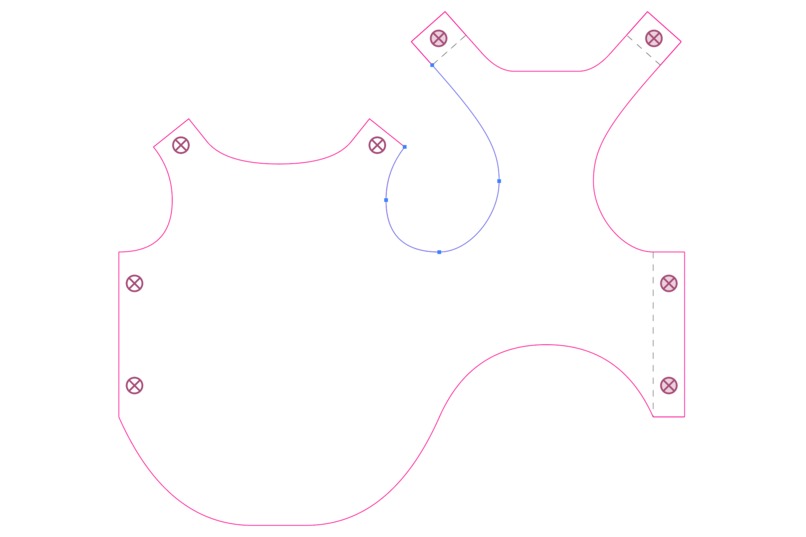
SVG OUTPUT FROM FLORAL MIRROR LONDON PET PATTERN SYSTEM
-
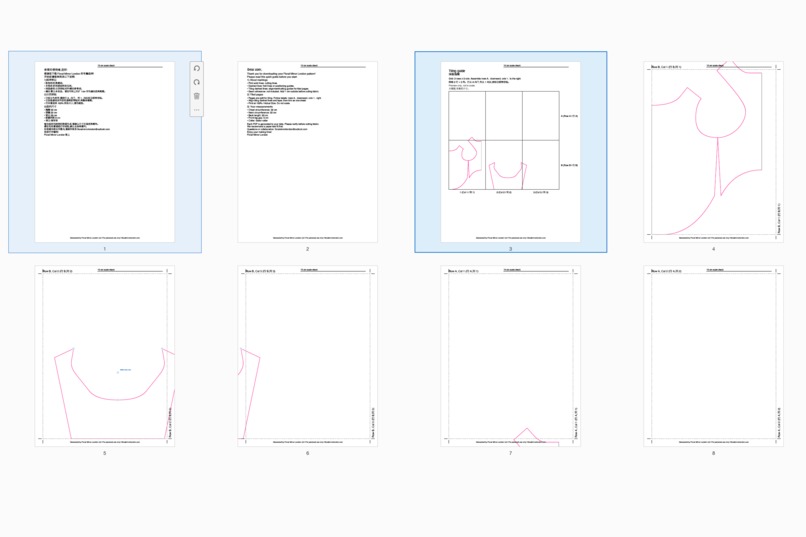
PDF OUTPUT FROM FLORAL MIRROR LONDON PET PATTERN SYSTEM
-
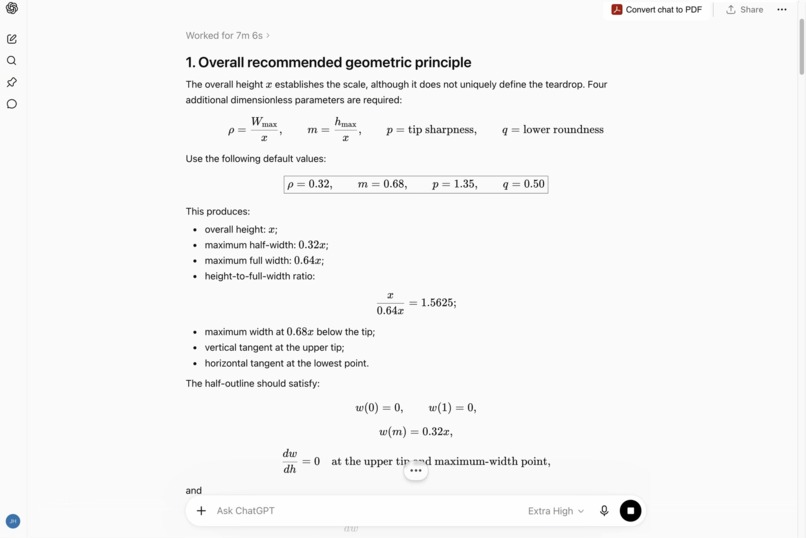
GPT5.6 USE FOR PARAMETERISATION
-
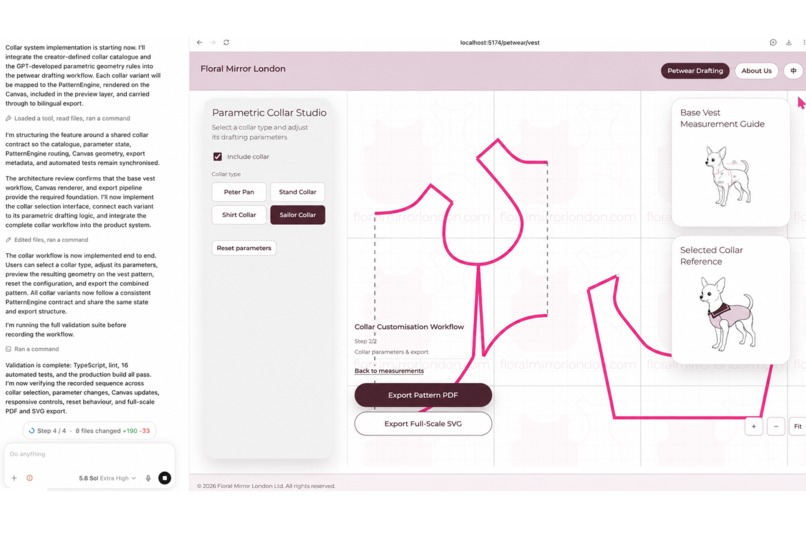
CODEX USE FOR SYSTEM ESTABLISHMENT
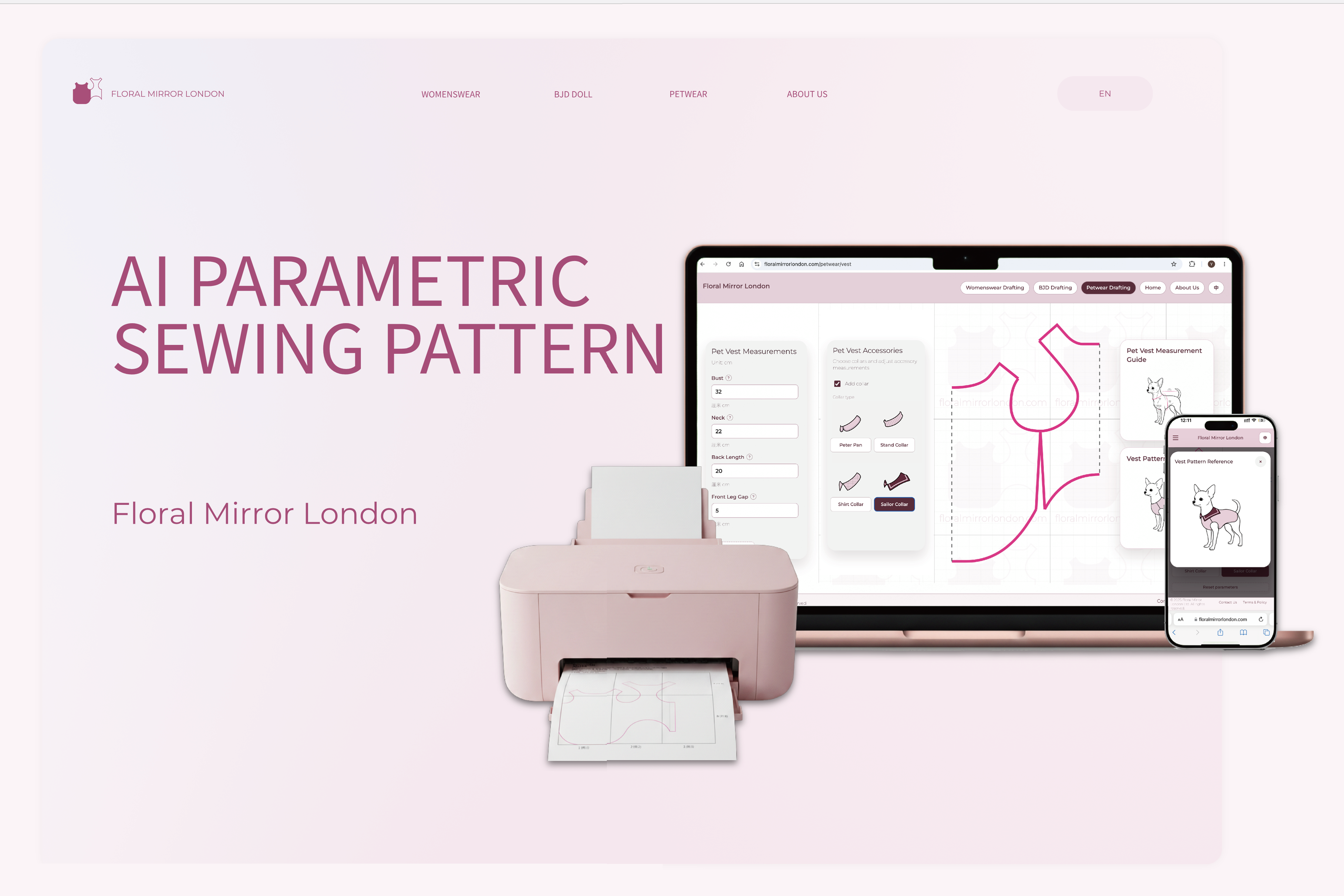
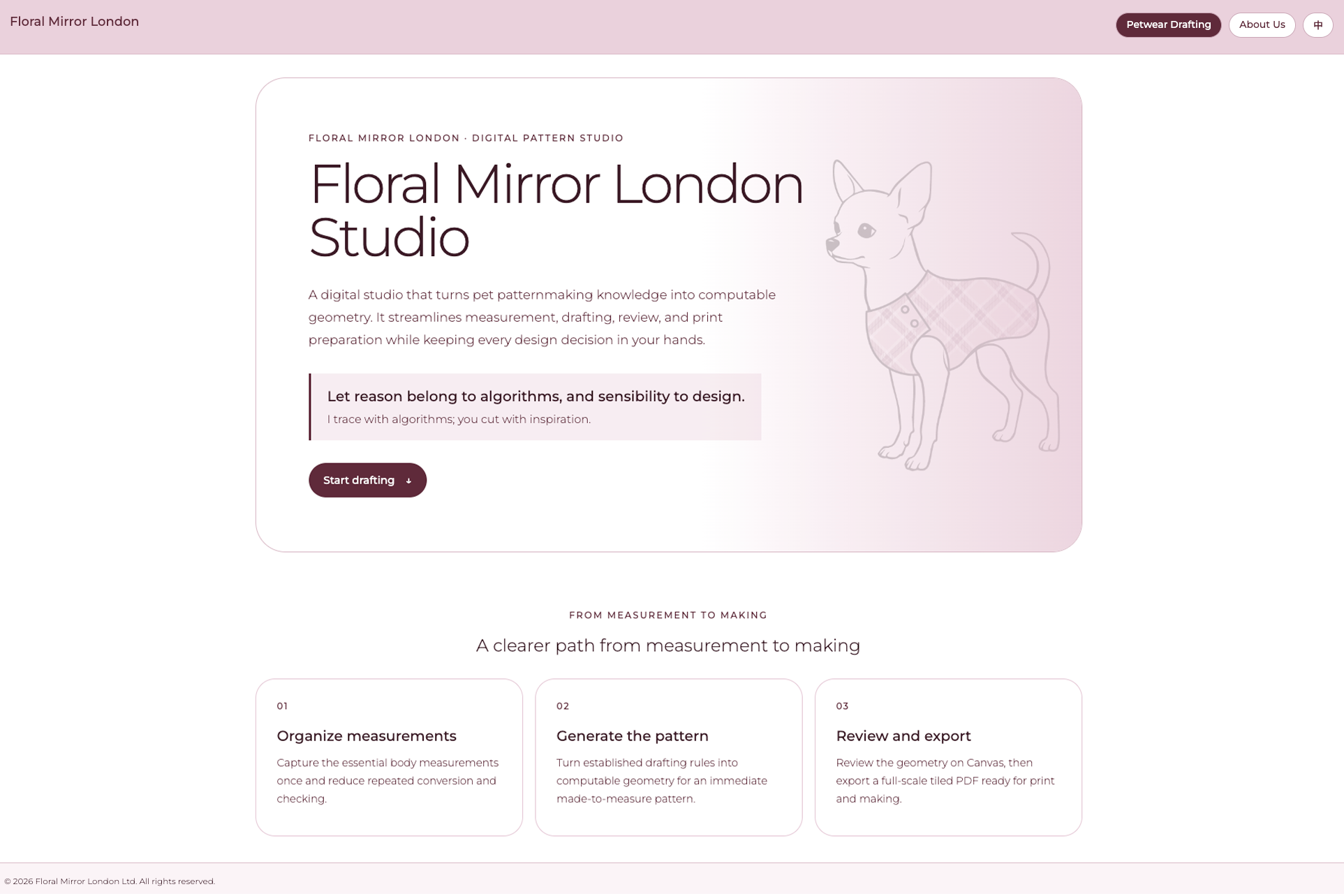
Floral Mirror London — Parametric Pattern Customisation
Inspiration
Every pet has a different body shape, proportion and posture. Standard pet clothing is usually based on a limited number of generic sizes, which can lead to poor fit around the neck, chest, legs and back.
Made-to-measure petwear offers a more appropriate solution, although producing an accurate sewing pattern normally requires specialist pattern-cutting knowledge. Traditional drafting methods also depend heavily on accumulated experience, visual diagrams and handwritten formulas. These methods are understandable to an experienced pattern cutter, yet difficult to translate into a digital system that remains adjustable, reliable and clear to the user.
Floral Mirror London was created to make personalised petwear more accessible.
Our aim is to automate repetitive drafting operations while keeping creative direction, fitting judgement and final design approval in human hands.
What It Does
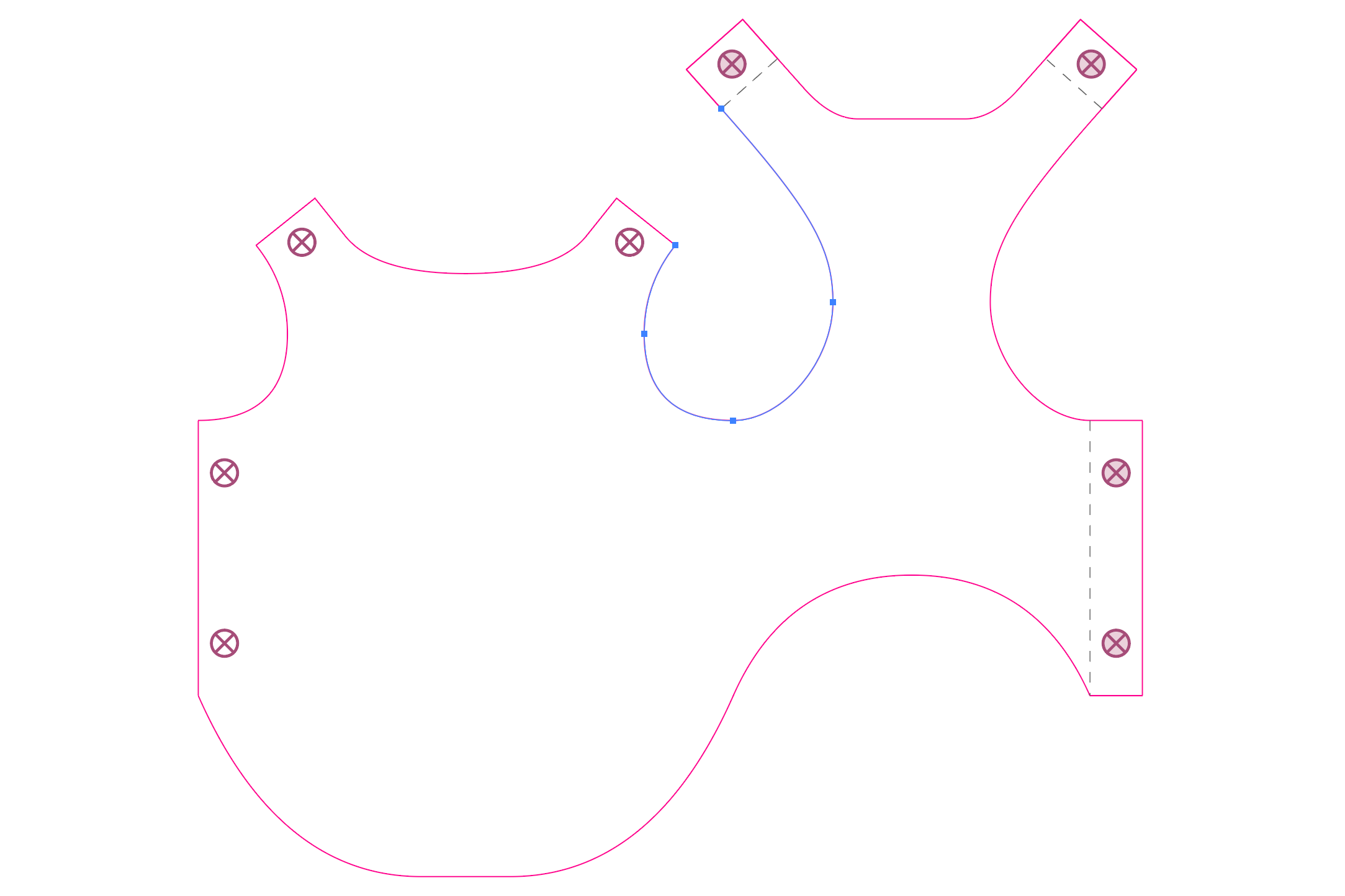
Floral Mirror London — Parametric Pattern Customisation helps users create an adjustable digital petwear pattern from a selected garment style and a set of body measurements.
Users can:
- enter the pet’s key measurements;
- select a base garment;
- choose available design options;
- replace supported garment components;
- switch between collar styles;
- adjust released fitting and design parameters;
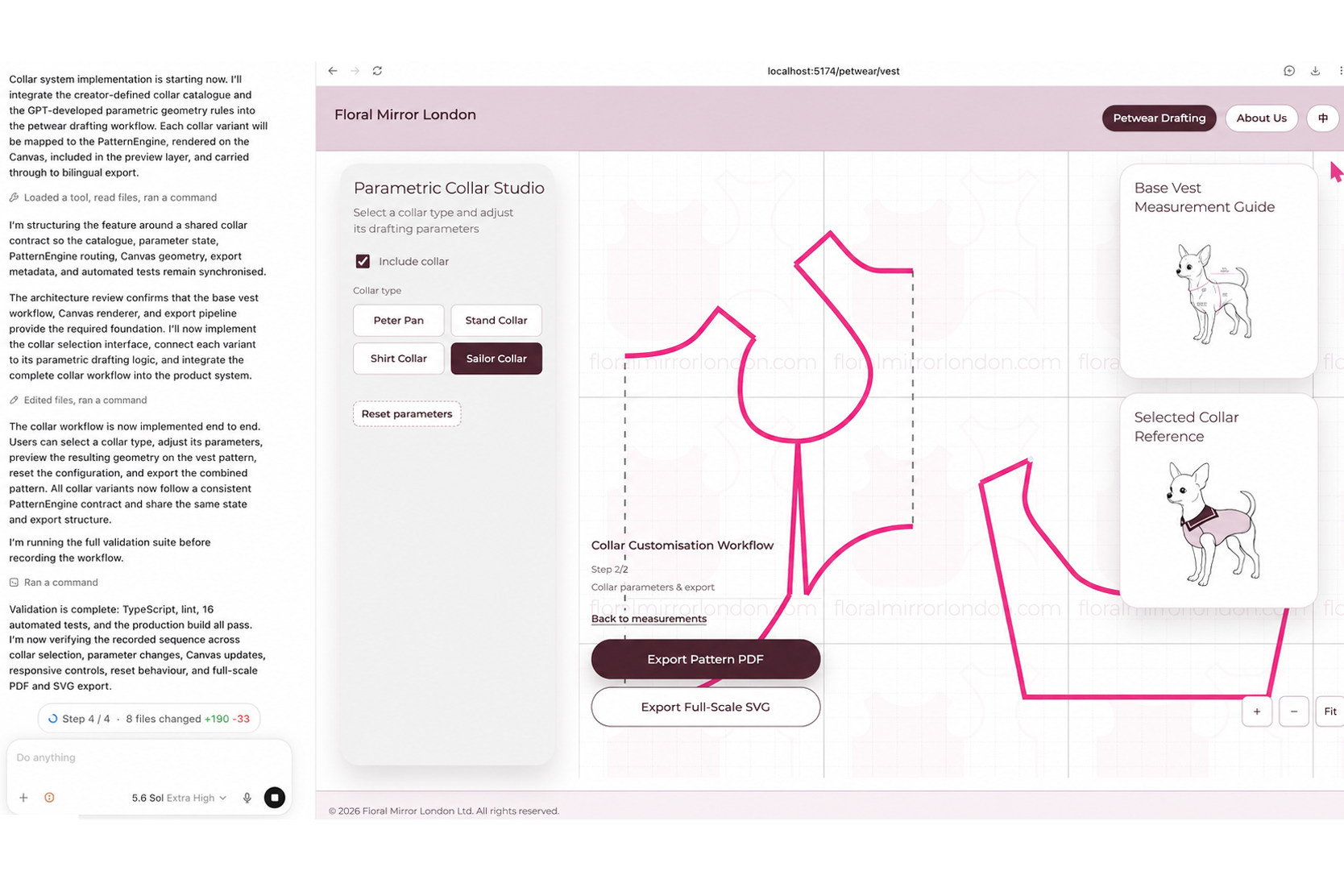
- review the generated pattern on an interactive Canvas;
- export the result for printing or further development.
The Build Week demonstration focuses on interchangeable collars.
A single base garment can be combined with several collar options, including:
- sailor collar;
- Peter Pan collar;
- stand collar;
- shirt collar.
When the user changes the measurements or selected design options, the related pattern geometry updates through the deterministic drafting system.
The prototype demonstrates how a made-to-measure garment can support meaningful customisation without requiring the user to redraw the complete pattern manually.
How GPT-5.6 Was Used
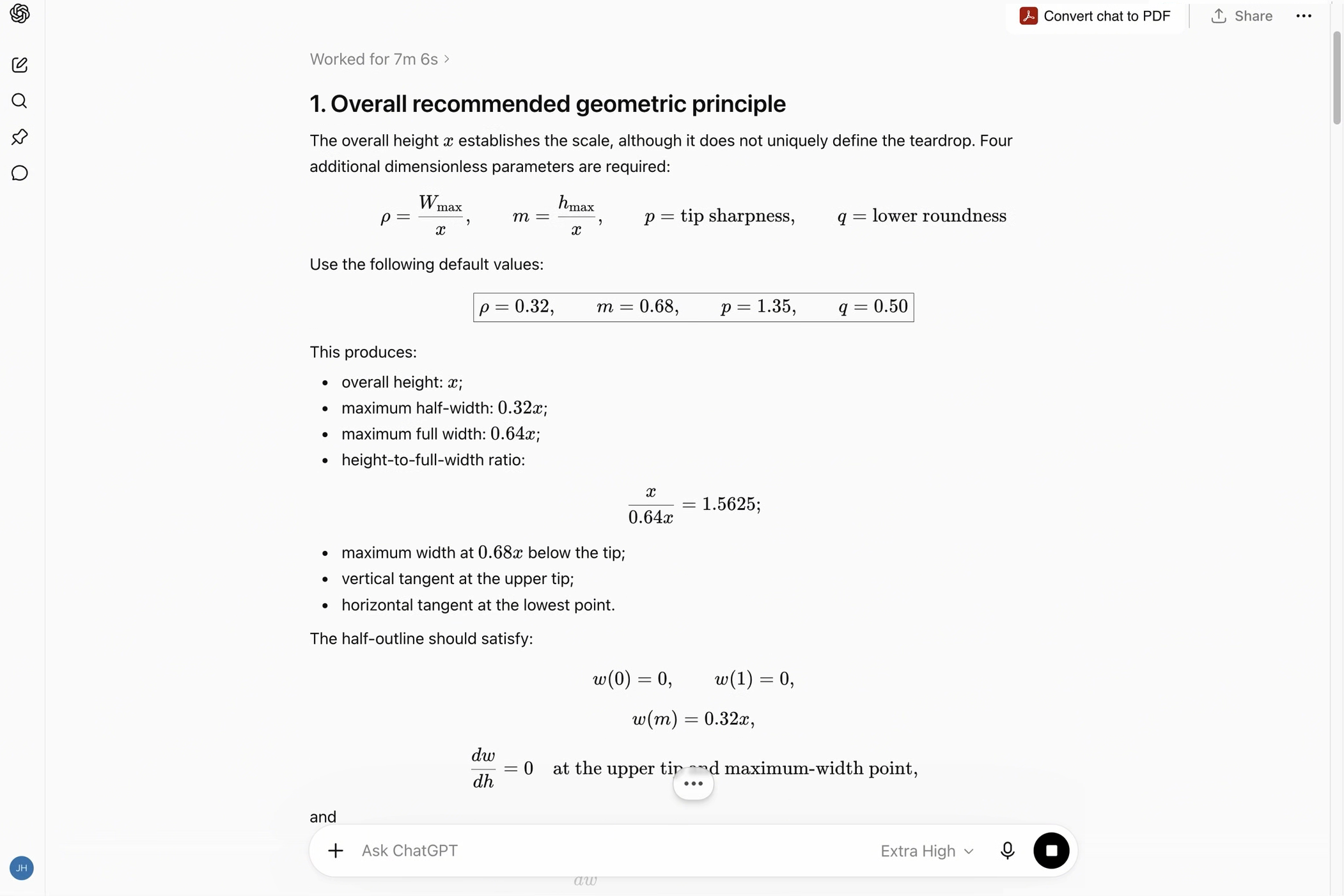
GPT-5.6 supported the project as a formalisation and reasoning layer during development.
Traditional pattern-cutting instructions often combine written formulas, reference diagrams, construction lines and experienced visual judgement. These sources may be clear to a professional pattern cutter while remaining incomplete as software specifications.
GPT-5.6 helped translate the creator’s patternmaking knowledge into clearer, structured requirements that Codex could implement.
Its contribution included:
- organising verbal and visual drafting instructions;
- clarifying measurement dependencies;
- distinguishing fixed measurements from adjustable design values;
- identifying geometric constraints and edge cases;
- structuring component relationships;
- supporting validation requirements;
- helping define consistent implementation and test expectations.
GPT-5.6 also helped analyse ambiguous drafting instructions. For example, a conventional diagram may show a curved edge without defining how that curve should behave computationally. GPT-5.6 helped the project creator describe the intended geometric result more precisely before implementation.
The underlying pattern-cutting methods, fitting criteria, construction decisions and acceptable results were defined and approved by the human designer.
GPT-5.6 did not independently invent the patternmaking system or determine whether a generated pattern fitted correctly.
The submitted prototype does not use GPT-5.6 at runtime. User measurements and generated patterns are processed through deterministic browser-based geometry.
How Codex Was Used
Codex supported the implementation of the Build Week feature within the Floral Mirror London application.
Working from specifications defined by the project creator and clarified through GPT-5.6-assisted formalisation, Codex helped build:
- the measurement and style-selection workflow;
- the interchangeable collar experience;
- the deterministic pattern-generation system;
- the bilingual interface;
- the interactive Canvas;
- pattern validation;
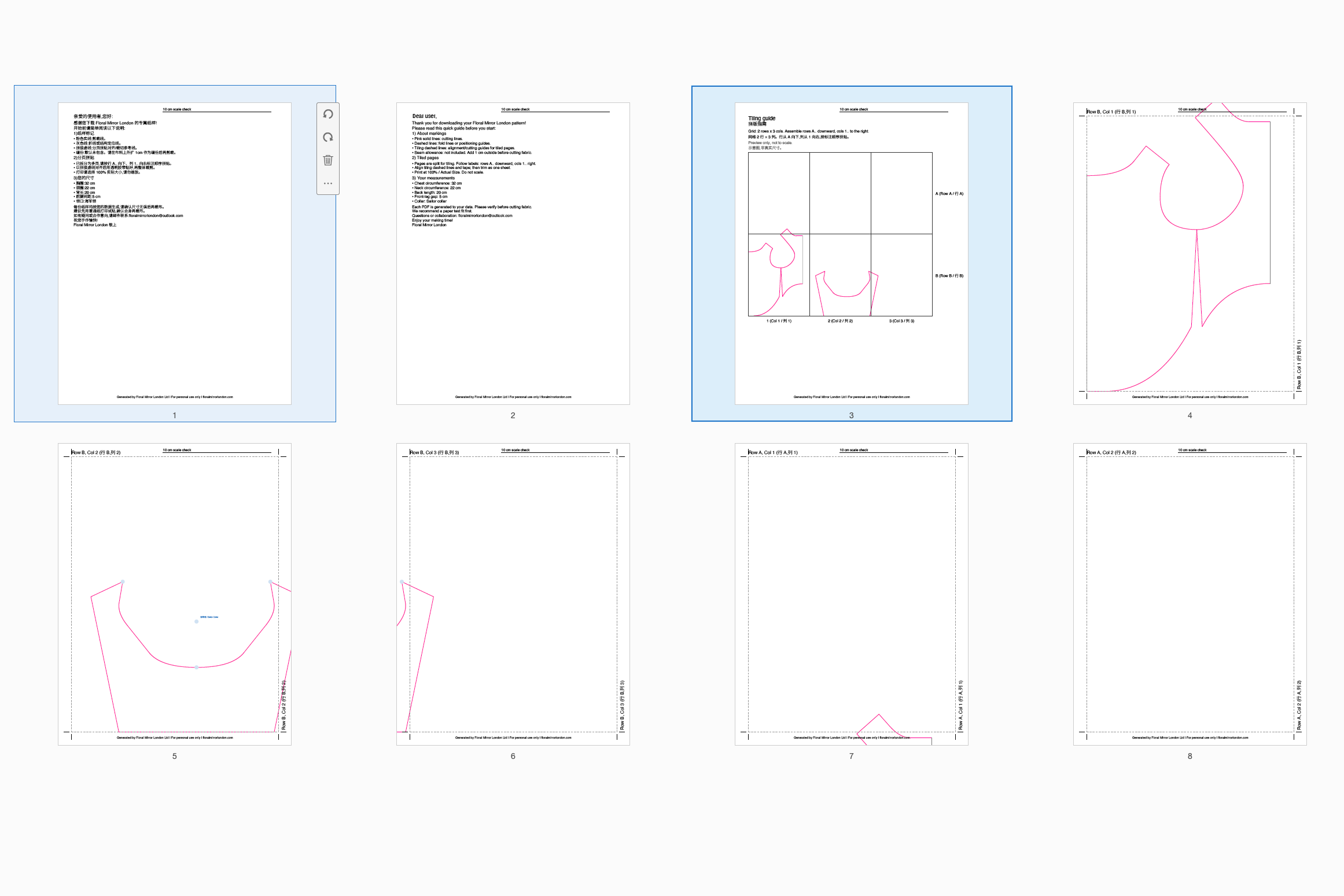
- PDF and vector export;
- automated testing;
- production build and deployment preparation.
Codex accelerated the translation of approved design and patternmaking requirements into a working React and TypeScript application.
It did not define the original drafting methods or independently approve the final shape, construction or fit of the patterns.
All generated results were reviewed against the requirements supplied by the project creator.
Human-Led, AI-Assisted Workflow
The project follows a clear division of responsibilities.
Project Creator and Pattern Designer
The human designer defined:
- the product direction;
- the pattern-cutting methods;
- the measurement system;
- fitting and ease assumptions;
- supported garments and collars;
- customisation rules;
- visual identity;
- interface workflow;
- final pattern acceptance criteria.
The designer also reviewed the generated pattern pieces, their proportions, labels, construction information and exported results.
GPT-5.6
GPT-5.6 helped convert the creator’s knowledge into structured and implementation-ready specifications.
Codex
Codex implemented and tested the approved specifications within the software application.
Final Pattern Generation
The application generates patterns through deterministic geometry. It does not ask a language model to improvise the final pattern.
The final workflow is:
- The creator defines the drafting knowledge and expected result.
- GPT-5.6 helps formalise the requirements.
- Codex implements the approved specifications.
- The application generates the geometry deterministically.
- The creator reviews and approves the result.
Build Week Scope
Floral Mirror London existed before OpenAI Build Week as a parametric petwear pattern platform.
This submission focuses on a new modular pattern-customisation workflow, demonstrated through interchangeable collar options.
The Build Week work includes:
- a clearer customisation journey;
- multiple collar options for a shared base garment;
- measurement-responsive pattern updates;
- adjustable collar controls;
- improved synchronisation between controls and Canvas output;
- strengthened pattern validation;
- a more structured workflow for translating professional drafting knowledge into software requirements;
- a dedicated demonstration experience for personalised pattern generation.
The existing platform provides the broader foundation. The submitted feature demonstrates how that foundation can support modular, AI-assisted product development while keeping the final drafting process deterministic.
Challenges We Ran Into
Translating Experience-Based Knowledge
Traditional pattern drafting often relies on visual interpretation and professional experience.
A diagram may contain a short formula and a curved line, while leaving much of the intended construction implicit. A human pattern cutter can interpret the intended result using experience. Software requires those assumptions to be made explicit.
The challenge was to translate this knowledge without removing the judgement and sensitivity that make professional patternmaking valuable.
GPT-5.6 helped question and organise the drafting information. Codex then implemented the agreed requirements. The human designer remained responsible for deciding whether the resulting geometry was technically and visually correct.
Turning Design Language into Controlled Adjustments
Design descriptions can be expressive and subjective.
A request such as “make the collar deeper and softer” needs to become a controlled set of adjustments that the pattern system can apply safely.
The project therefore needed a clear boundary between creative intention and the values that could be adjusted within the deterministic system.
Maintaining Compatibility Between Components
A customisable garment contains parts that may be generated separately, while still needing to connect correctly.
Changing a collar or measurement should update the relevant geometry without disrupting the rest of the pattern.
The challenge was to make component replacement flexible for the user while preserving the construction relationships required by the patternmaking method.
Accomplishments We Are Proud Of
We created a working relationship between three forms of intelligence:
- the user’s creative intention;
- GPT-5.6-assisted interpretation and formalisation;
- deterministic software implementation supported by Codex.
The project also creates a bridge between traditional pattern-cutting knowledge and computational design.
A user can change a meaningful garment component and immediately review the corresponding pattern update through controlled parameters.
This demonstrates a route towards petwear that is:
- more personal;
- more adaptable;
- easier to visualise;
- easier to reproduce;
- more accessible to users without professional drafting experience.
We are particularly proud that the system retains human authorship and judgement while using AI to reduce repetitive translation and implementation work.
What We Learned
AI is especially valuable when it helps translate between different forms of knowledge.
In this project, GPT-5.6 helped connect:
- everyday design language;
- visual pattern-cutting information;
- professional drafting judgement;
- structured software requirements.
Codex then helped convert the approved requirements into working software.
We also learned that a drafting formula alone is not enough to create a reliable parametric pattern. The software must understand the broader construction context in which that formula operates.
Modularity is equally important.
Treating collars and other garment features as adjustable components allows a design to evolve while preserving the underlying garment logic.
Most importantly, human expertise remains central. Pattern quality depends on how the system is defined, constrained, reviewed and tested.
What’s Next
Future development will expand the range of customisable garment components and strengthen the connection between design intention, pattern validation and deterministic drafting.
The next stages will focus on:
- broader component customisation;
- stronger fitting and geometric validation;
- improved professional export workflows;
- more physical prototype testing;
- clearer visual feedback for pattern adjustments;
- more complete made-to-measure garment journeys.
Future versions may also use GPT-based interpretation to translate confirmed design descriptions and reference information into controlled inputs for the deterministic pattern system.
The wider vision is to connect creative design intention with reliable computational drafting.
Repetitive geometric work can be handled by the system, while creativity, sensitivity and final design judgement remain with people.
Let reason belong to algorithms, and sensibility to design.
I trace the lines with algorithms; you cut with inspiration.
Built With
- codex
- dxf-writer
- express.js
- github
- konva
- node.js
- openai-api
- openai-gpt-5.6
- pdf-lib
- react
- react-konva
- svg
- typescript
- vercel
- vite
- zustand


Log in or sign up for Devpost to join the conversation.