-
-
FloraGate
Inspiration
Our inspiration came from standing in local open-air markets and watching food prices skyrocket in Nigeria, while knowing that just a few hours away in rural communities, smallholder farmers were watching their hard-earned harvests rot in the sun. The traditional supply chain was fragmented, inefficient, and heavily reliant on predatory middlemen. We realized that if we could build a digital bridge between these two disconnected worlds, we could simultaneously increase food security, lower urban retail prices, and lift rural families out of poverty.
What it does
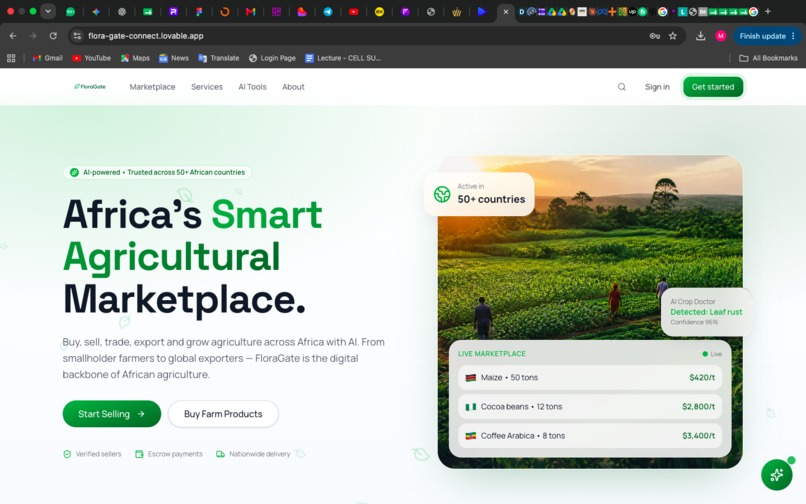
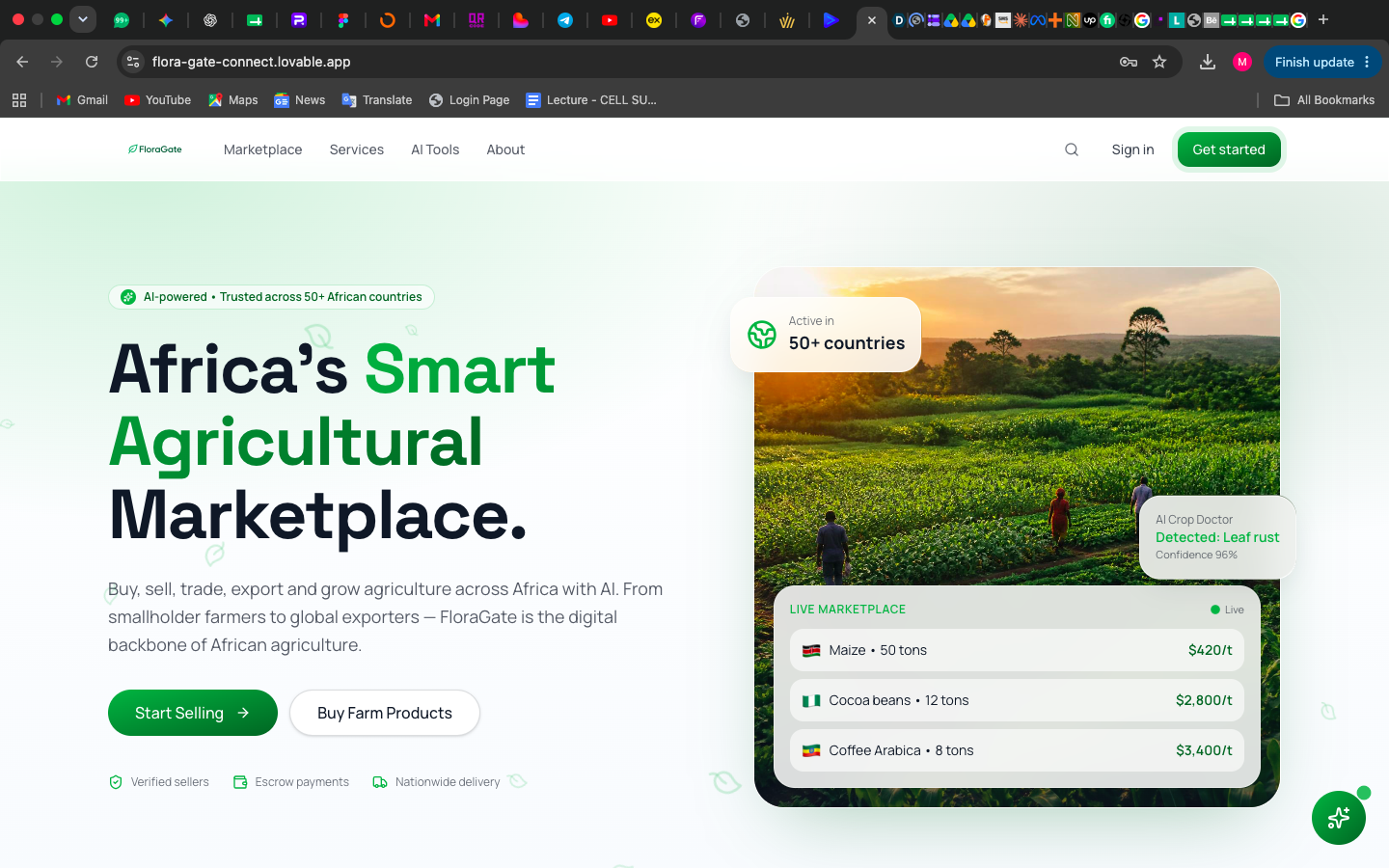
FloraGates is an asset-light, multi-channel B2B agricultural marketplace that connects rural smallholder farmers directly to urban retailers, restaurants, and food processors. By combining an inclusive digital ordering infrastructure with a smart, decentralized logistics network, FloraGates cuts post-harvest crop spoilage by matching supply with active demand before transit even begins. It also aggregates transaction and yield data to unlock financial history profiles, enabling banks to provide trade and input credit to previously unbanked farmers.
How we built it
We built FloraGates with an offline-first, multi-channel approach tailored to the infrastructural realities of the African agricultural landscape:
- The Farmer Interface: Built using lightweight telecom gateways via USSD and SMS menus, allowing rural farmers to list crops and accept buyers' offers using simple feature phones without needing an active internet data plan.
- The Field Agent App: Developed a mobile application using React Native and SQLite for offline data caching. Local field agents can map farm boundaries, weigh produce, and log quality metrics in remote areas, automatically syncing with the central database once a cellular network connection is detected.
- The Backend & Logistics Engine: Built on a Node.js and PostgreSQL architecture, integrated with localized mobile money networks (like MTN MoMo and regional payment APIs) to trigger automated escrow payouts to independent third-party truck drivers upon verified delivery milestones.
To optimize transport efficiency without owning an expensive fleet, the backend runs a modified routing algorithm. Let $C_i$ represent the volume of produce waiting at a rural collection spoke $i$, and $Q_{max}$ represent the maximum cargo capacity of an independent third-party truck. The system only triggers an automated dispatch alert when the total aggregated volume satisfies:
$$\sum_{i=1}^{n} C_i \ge 0.85 \times Q_{max}$$
This mathematical gate ensures that every vehicle leaves the rural zone at a minimum of 85% capacity, keeping transit costs per kilogram as low as possible.
Challenges we ran into
1. The Post-Harvest Spoilage Clock
We quickly learned that physical spoilage is unforgiving. In our early pilot, a 6-hour transit delay caused by an independent truck breaking down resulted in substantial crop loss. We overcame this by pivoting to a strict cross-docking strategy where goods are virtually matched to urban buyers before they ever leave the village collection center, minimizing warehouse storage time to less than 12 hours.
2. The Trust Deficit
Rural farmers were understandably highly skeptical of mobile applications promising them future payouts, as they were accustomed to immediate cash-in-hand transactions from traditional middlemen. We solved this by deploying a localized Field Agent Network hiring trusted youths directly from the local farming communities to handle the physical sorting, weighing, and digital logging, showing farmers instant mobile money transaction confirmations in person.
Accomplishments that we're proud of
- 184-Character Pitch Clarity: Distilling a highly complex logistics, fintech, and agricultural venture into a single powerful statement that immediately hooks partners and investors.
- An Asset-Light Architecture: Designing a scalable operational plan that completely avoids high upfront capital expenditures (such as purchasing delivery trucks or building mega-warehouses) by tapping into underutilized local infrastructure.
- Inclusive Technical Accessibility: Bridging the digital divide by creating a unified system where a farmer on a 15-year-old feature phone via USSD seamlessly transacts with an urban wholesaler using a high-end web dashboard.
What we learned
We learned that technology alone cannot solve physical infrastructure gaps. True innovation in emerging markets isn't about building the flashiest mobile application; it’s about deeply understanding the realities of the physical ground layout and designing software that adapts to human behavior, instead of forcing users to adapt to the software. We also realized that charging direct cash commissions to cash-constrained farmers stalls adoption; instead, monetization must be derived by capturing value at the endpoints of the chain through bulk supply spreads and fintech credit intermediation.
What's next for FloraGates
- Automating the 3PL Marketplace: Fully launching our automated independent driver matching app to let third-party truck drivers bid on shipping routes in real-time.
- Return-Journey Backhauling: Optimizing empty trucks returning from urban hubs by loading them with discounted commercial agricultural inputs (fertilizer, high-yield seeds) to sell back to rural agro-dealers.
- Embedded Agri-Fintech Credit: Partnering with commercial banking institutions to deploy alternative credit-scoring algorithms, converting historical transaction logs into input-financing loans for farmers ahead of the next planting season.
Built With
- africa's-talking
- amazon-web-services
- earth-engine
- flutterwave
- listing
- node.js
- offline-first-android-interface.-*-**web-portal:**-`next.js`-+-`tailwind-css`-for-fast-wholesale-buyer-dashboards.-###-2.-databases-&-storage-*-**primary-db:**-`postgresql`-for-structural-order
- postgresql
- react
- redis


Log in or sign up for Devpost to join the conversation.