Inspiration
After listening to the speech given by one of the Juniper Networks associates, our team wanted to build something unique that plays a special role in our hearts. Rather than build a generic LLM wrapper and call it, "Artificial Intelligence", we sought to take our childhood nostalgia and build a game centered on this aspect. A fun simple game that centers on a unique control system, Floppy Fish provides an exciting experience for all users.
What it does
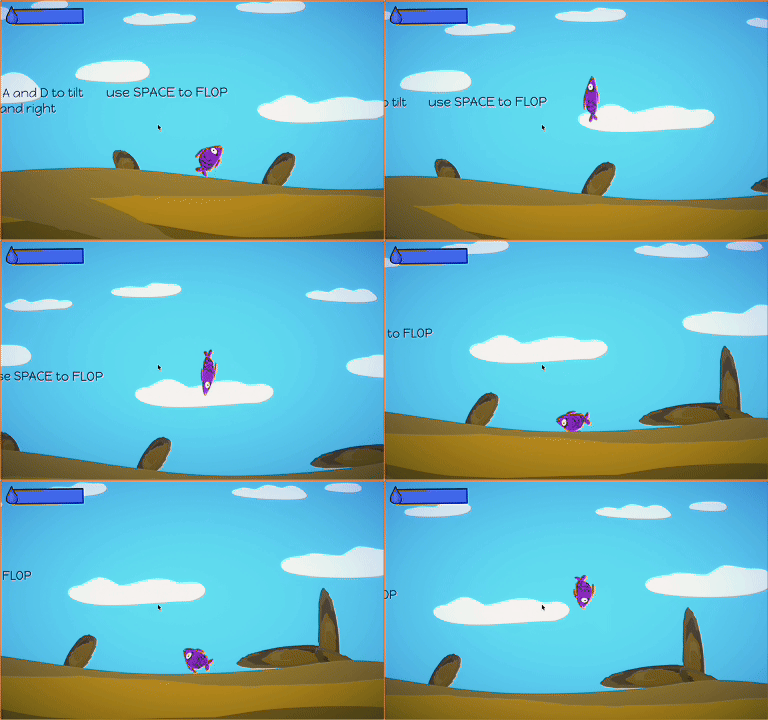
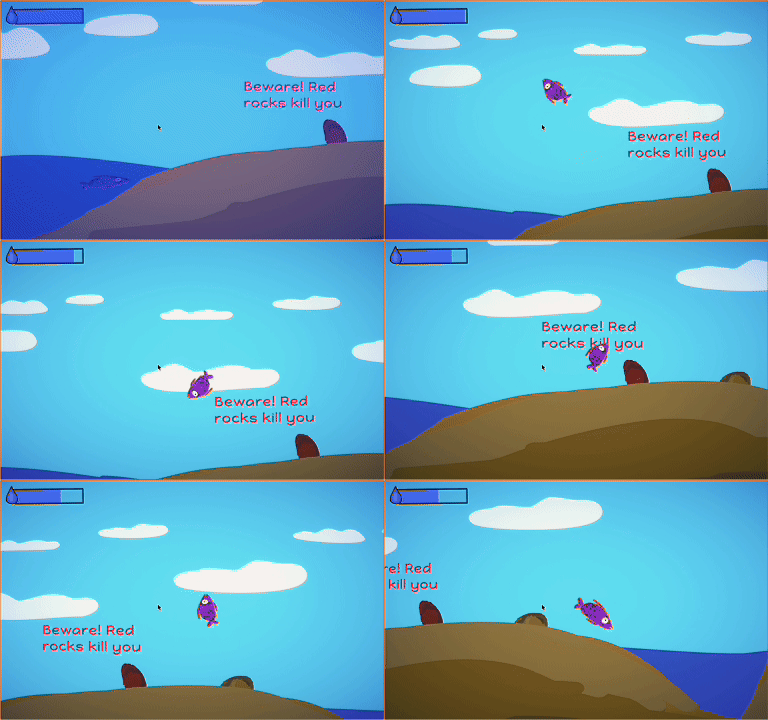
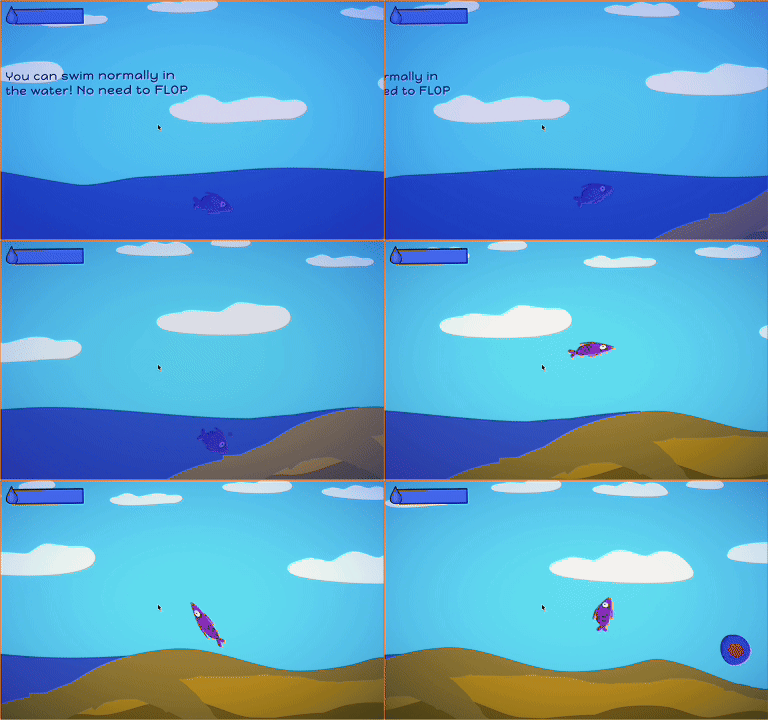
Floppy Fish is a game that recreates nostalgic feeling, combining a fun aspect with a funny and unique playthrough. In the game, the player is a fish who aims to complete several levels while battling obstacles such as dehydration and rocks.
How we built it
Built on the Unity Engine, we made custom physics framework with dynamically adjusted torque for its unique movement system. Instead of scaling delta time to each physics call, physics is calculated per frame and scaled using fixed update. For movement in air, we used relative quaternions for adjusting the anchor pints for in-air torque, and for water, we implemented spherical linear interpolation to dynamically adjust the local rotation quaternion based on the normalized linear velocity vector. Floppy fish has a custom post processing pipeline based on Universal Render Pipeline, and all animations were done procedurally using randomized torque and collision impact velocity. For example, if the fish falls really hard on the sand, the local scale will linearly interpolate to a higher magnitude. For the background, we used a dual-layered parallax effect for the clouds to create a sense of distance and depth. Lastly Floppy Fish has a custom particle effect system, and all assets were created during the competition. These custom components add up to the captivating effect that Floppy Fish has on all its users.
Challenges we ran into
When developing Floppy Fish, we ran into a glaring problem: our game had no assets to make it look aesthetic or visually pleasing. Using Krita, we had to undergo the grueling process of creating assets by hand, giving our game a homemade feel. The physics that powered the fish movement had to be tailored and took several hours to polish.
Accomplishments that we're proud of
The team that accomplished Floppy Fish feel incredibly proud for making a polished game in under 24 hours-- an undertaking that usually takes a week to come up with an idea and execute. We are proud of everything from the smallest particle to making our own custom physics system.
What we learned
How to design a physics-based character controller that feels dynamic and fun Fine-tuning movement between different environments (land vs. water) Using animation tricks (squash/stretch) to make gameplay feel more alive Managing transitions between scenes while preserving audio and player state Creating a modular system for character states like “Water” and “Land” Making quick polish passes like screen shake, particles, and sound to boost immersion
What's next for Floppy Fish
Floppy Fish is just the beginning of a much bigger splash. Moving forward, we plan to expand the game with new environments, like toxic sewers and deep-sea caves, each filled with unique hazards and obstacles. We're also adding power-ups, unlockable fish skins, and challenging enemy types to keep gameplay fresh and exciting. A global leaderboard, mobile support, and community-driven features are also on the horizon. Floppy Fish may start small, but it’s diving into a future full of fun, chaos, and creativity!

Log in or sign up for Devpost to join the conversation.