-
-
-
-
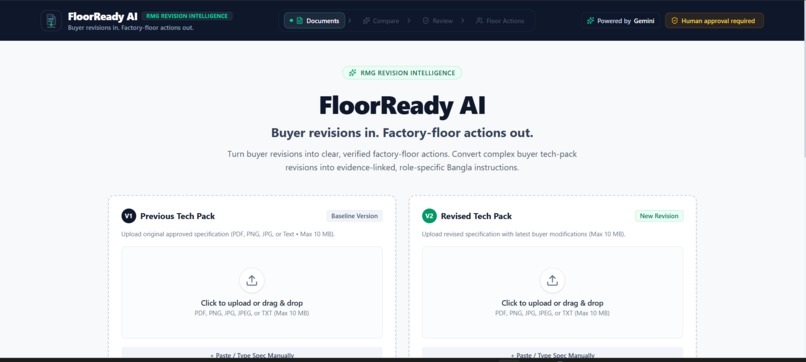
home UI
-
Home Splash
-
test
-
-
Inspiration
Bangladesh’s ready-made garment industry employs millions of people and connects factories, buyers, merchandisers, quality teams, and production workers. Yet one small buyer revision—such as a changed sleeve measurement, stitch density, care-label position, or carton quantity—can be buried inside a long technical document.
These revisions often move through email, spreadsheets, printed pages, and verbal instructions. A missed change can cause rejected samples, rework, material waste, shipment delays, and financial loss. The communication gap becomes even larger when buyer documents are written in technical English while many factory-floor workers are more comfortable receiving instructions in Bangla.
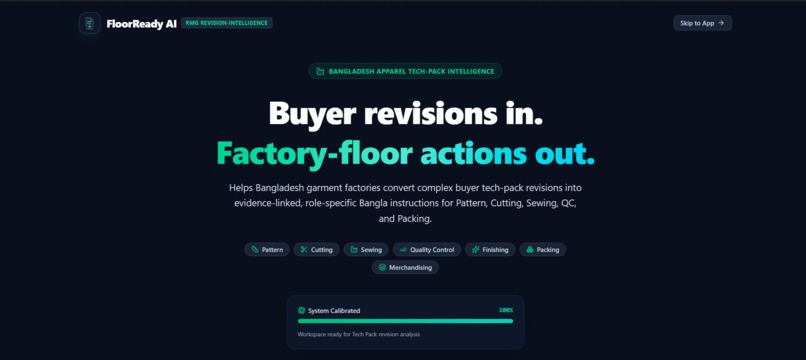
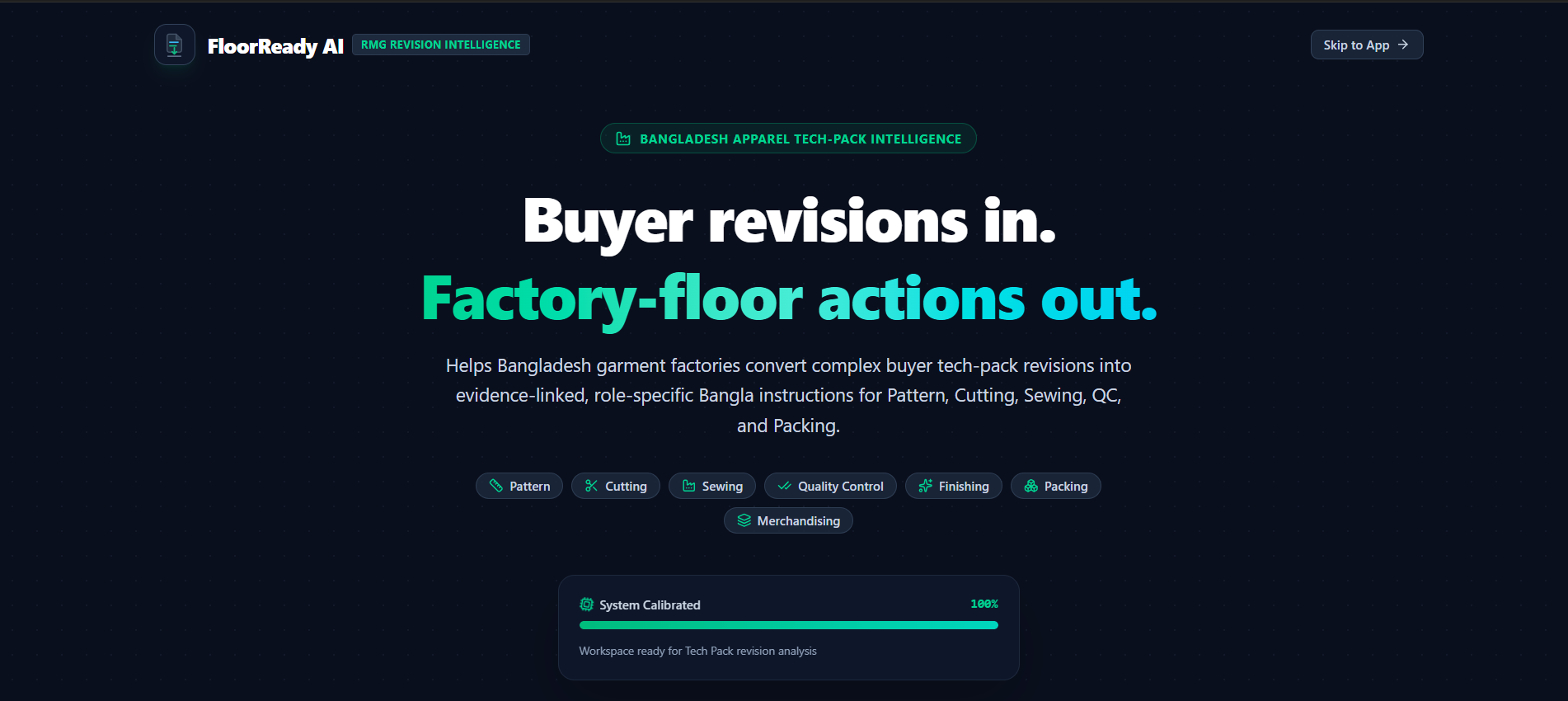
This inspired me to build FloorReady AI: a system that converts buyer document revisions into traceable, department-specific factory-floor actions.
What it does
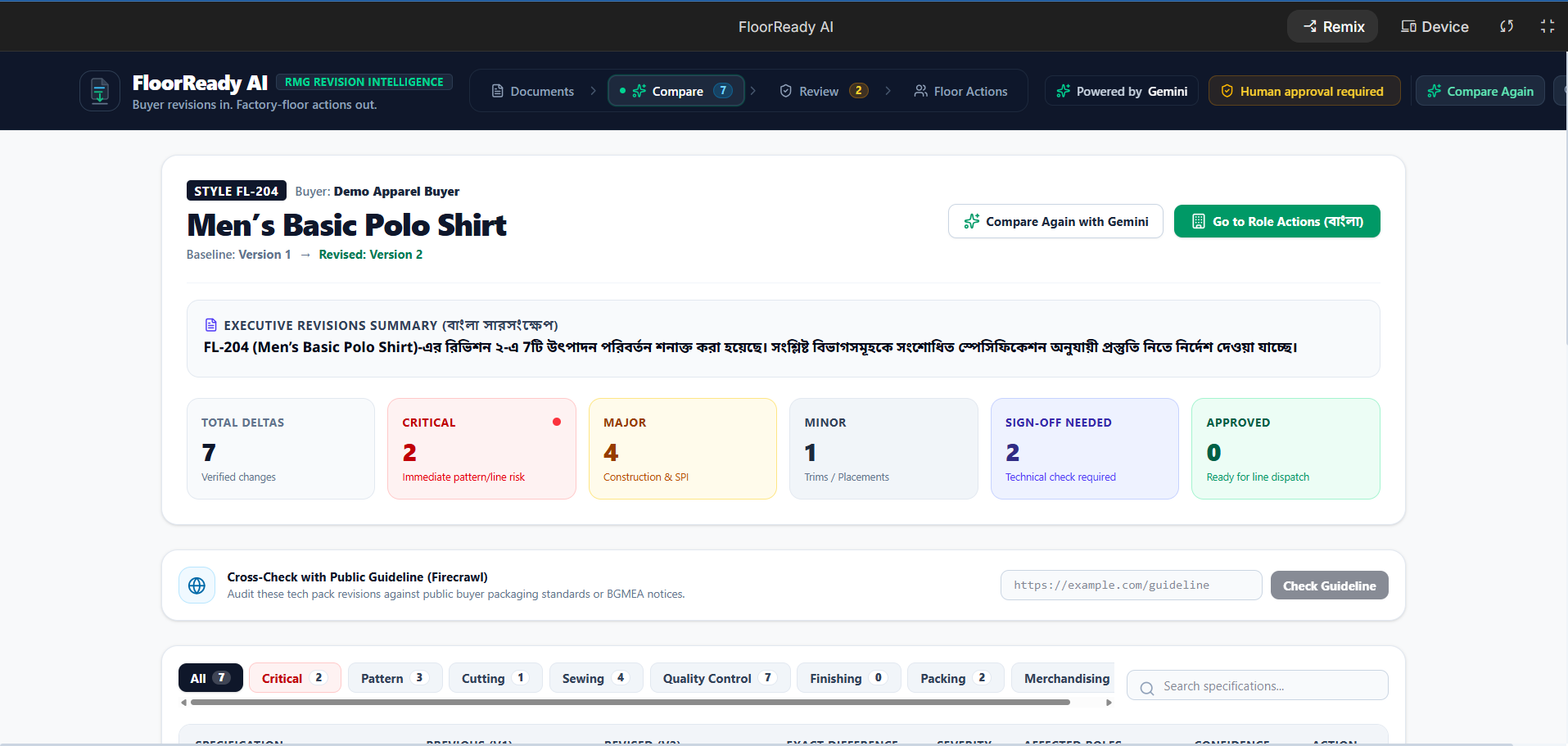
FloorReady AI compares two versions of a garment tech pack and identifies the operational changes between them.
Instead of producing a generic summary, it creates a structured workflow:
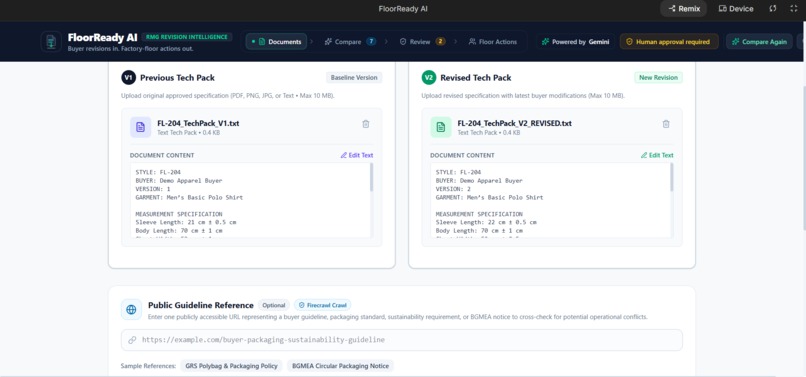
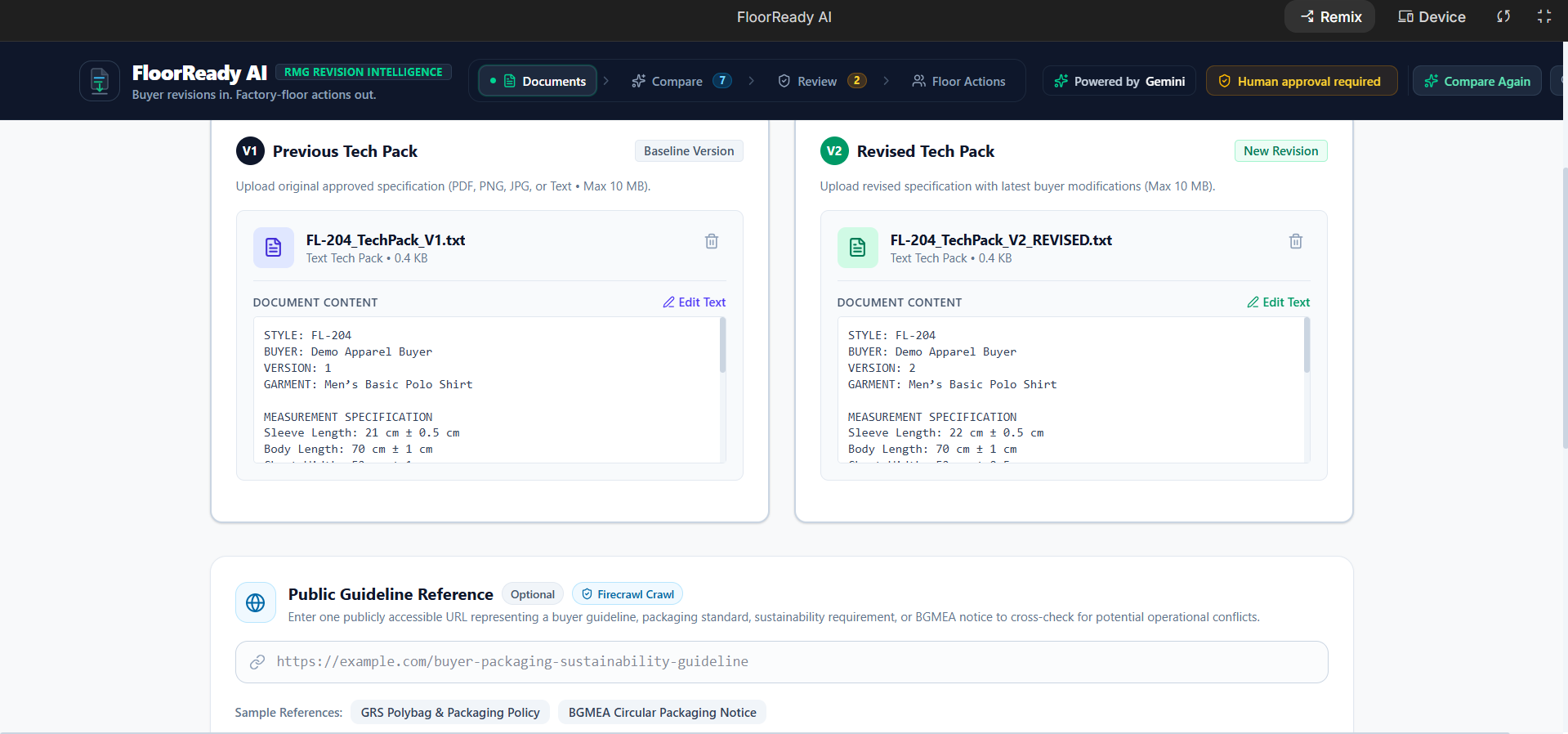
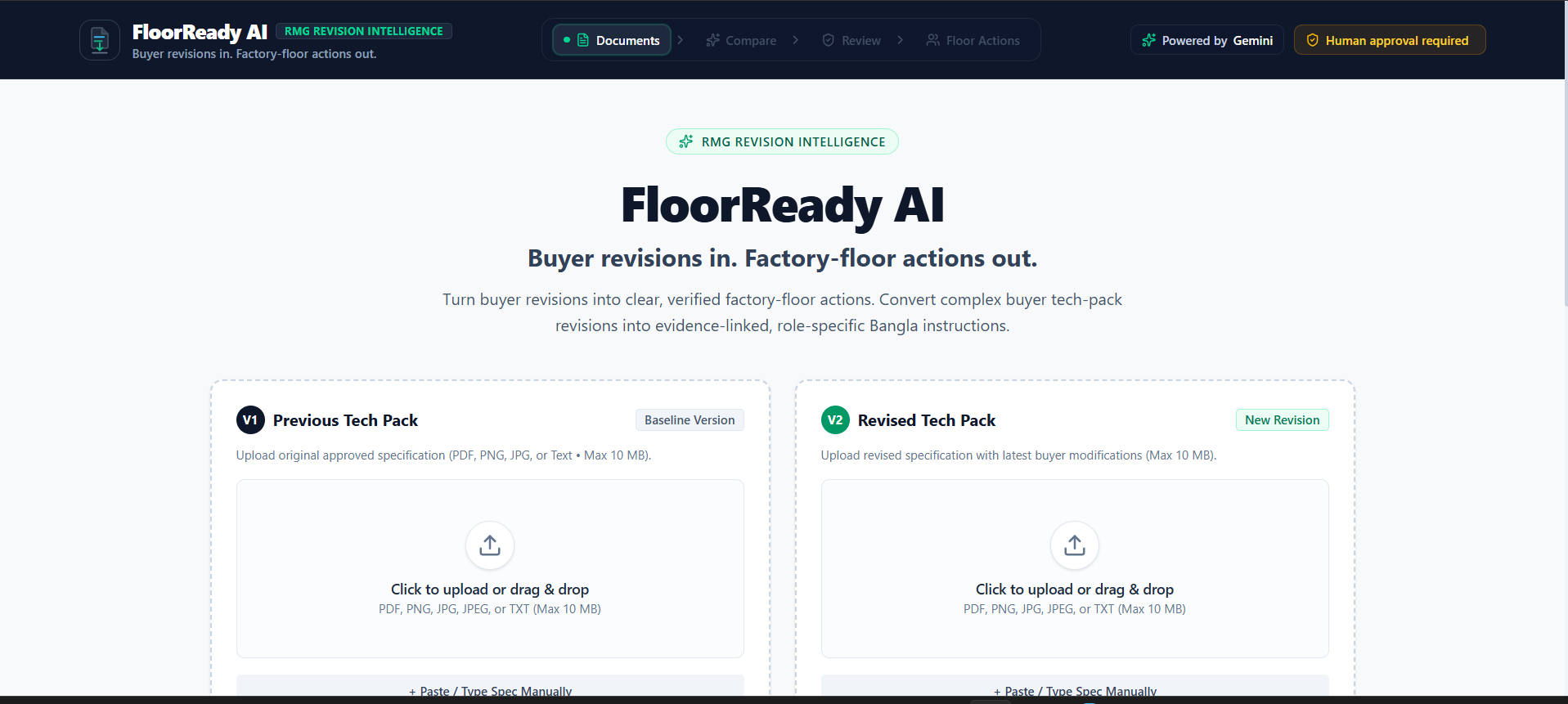
- Upload the previous and revised tech packs.
- Use the Gemini API to analyze both documents.
- Detect meaningful changes while ignoring formatting-only differences.
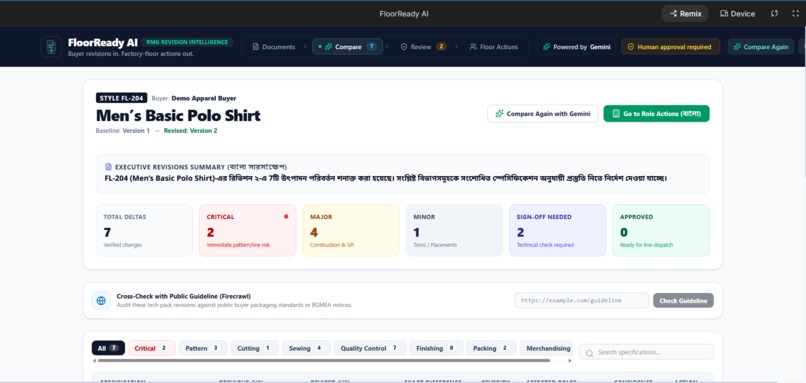
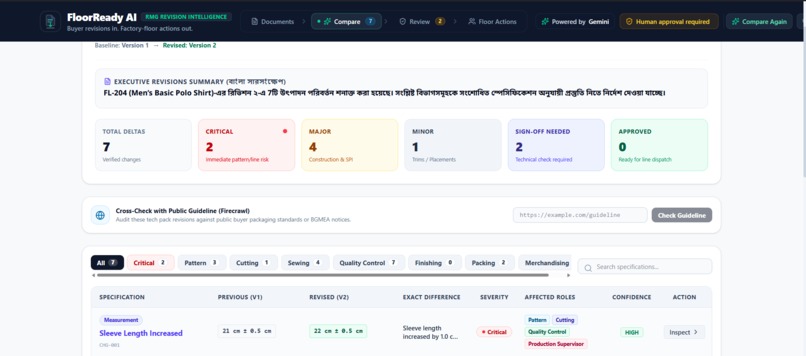
- Display the previous and revised text as evidence.
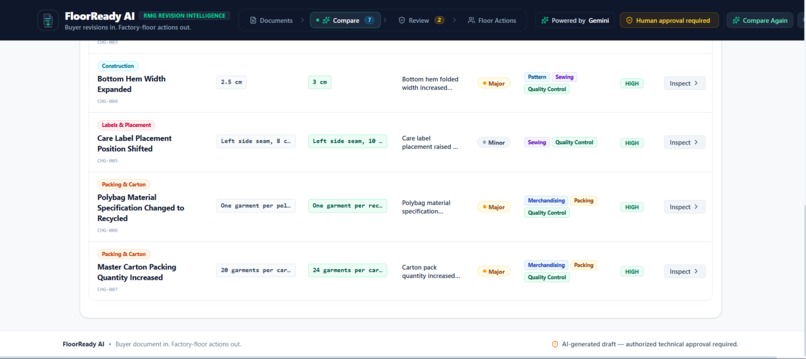
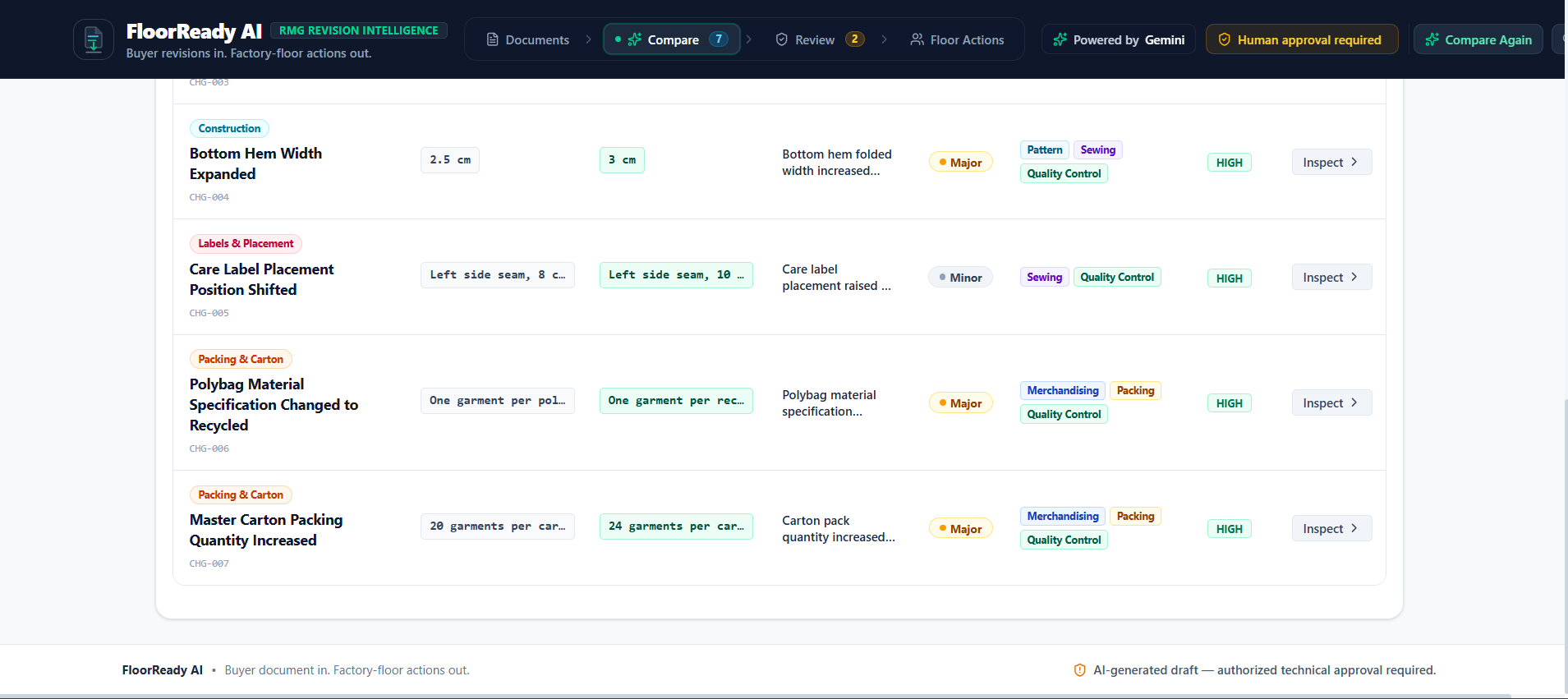
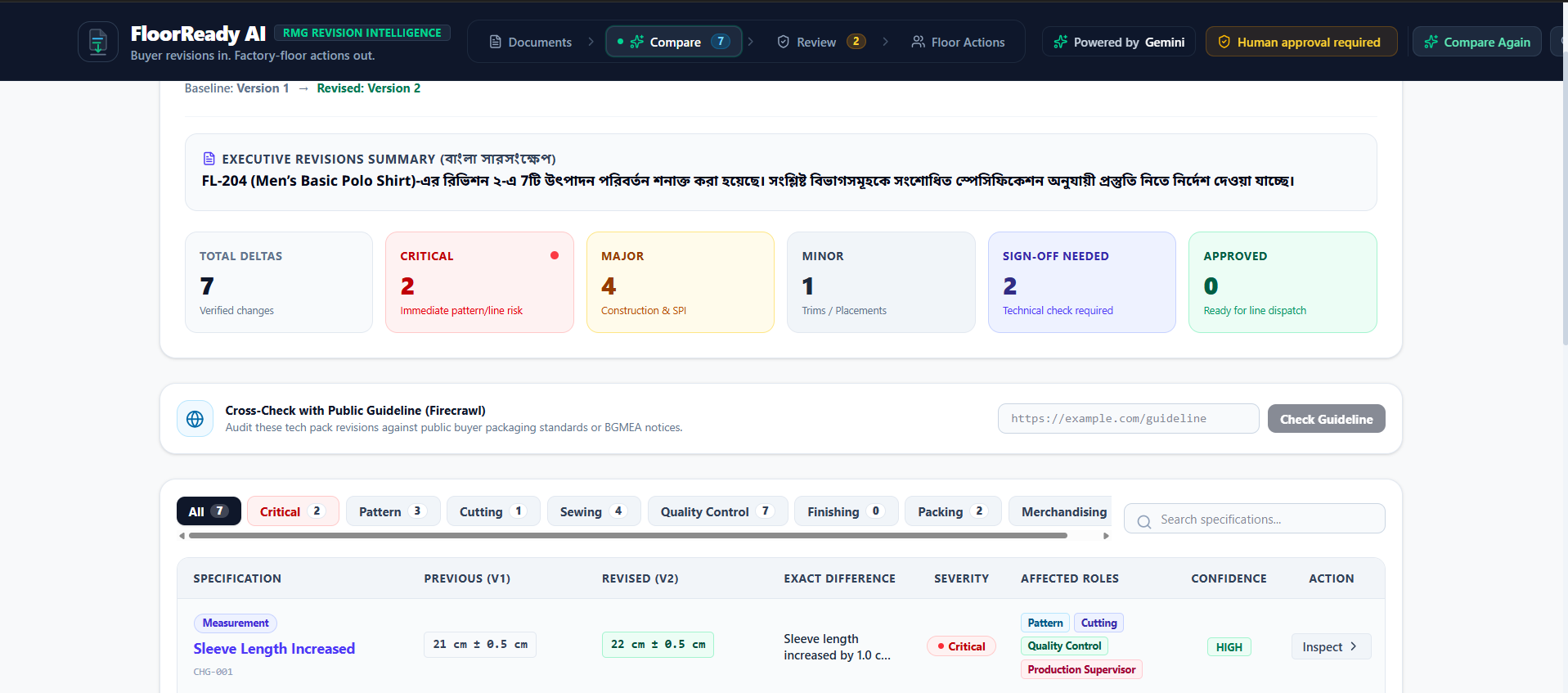
- Assess severity, confidence, and whether human confirmation is required.
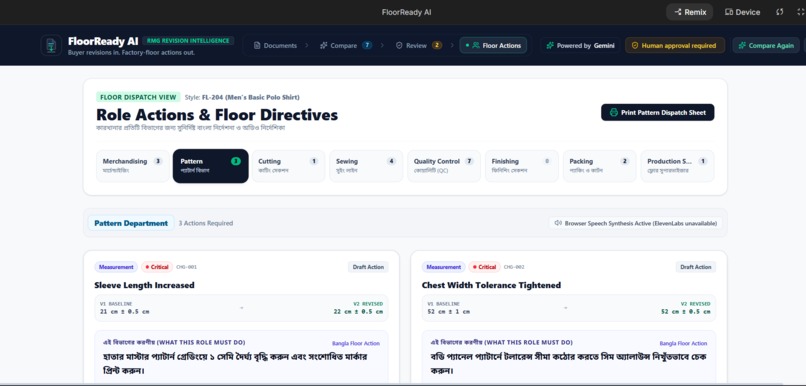
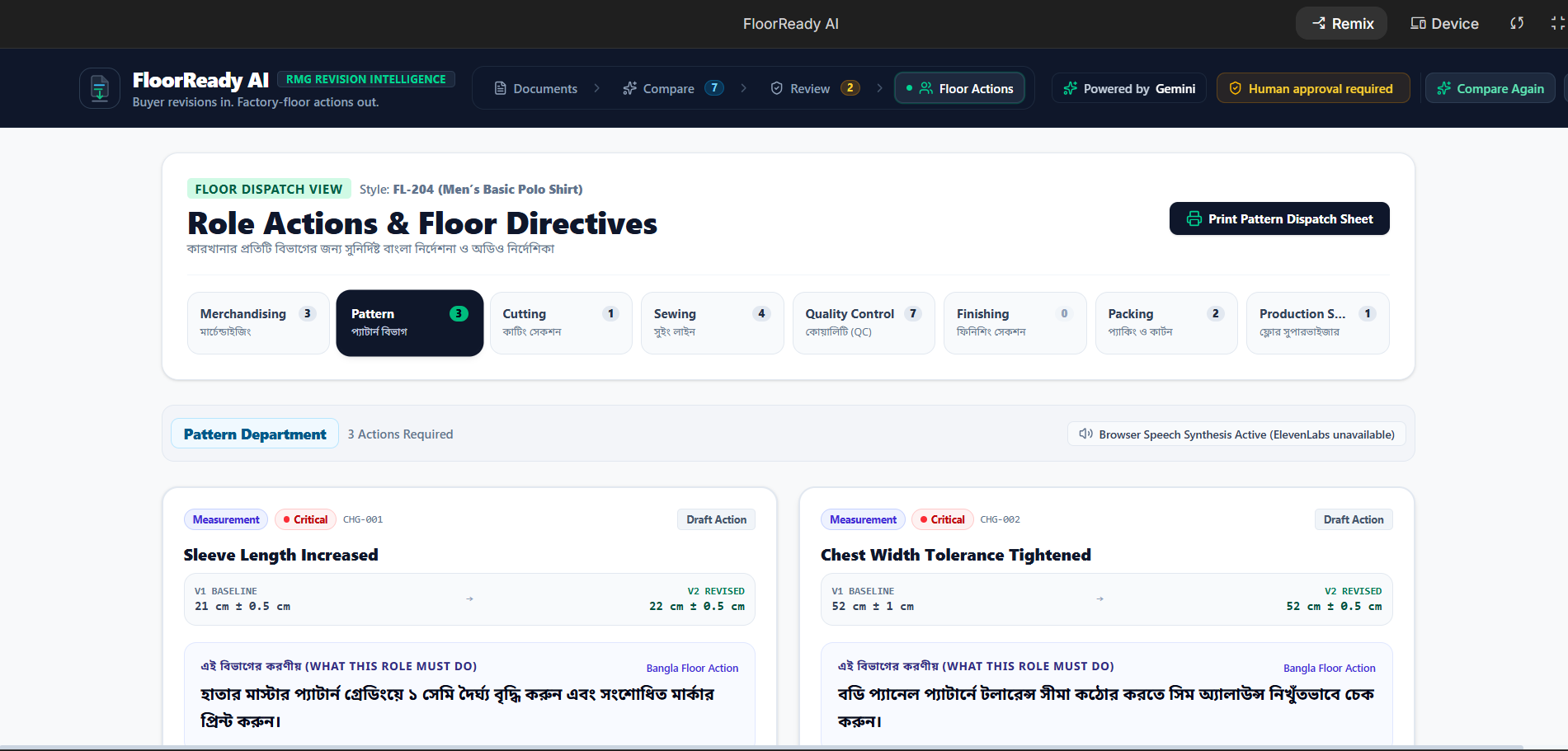
- Convert each change into role-specific instructions for departments such as Pattern, Cutting, Sewing, Quality Control, Finishing, Packing, and Merchandising.
- Translate the instructions into practical Bangla.
- Require a human technical review before approved instructions are dispatched.
- Use ElevenLabs to deliver the approved Bangla instructions as voice.
For example, if a buyer changes the sleeve length from 21 cm to 22 cm, FloorReady AI does more than highlight the numbers. It identifies which teams are affected, preserves the measurement tolerance, provides the source evidence, and produces an understandable Bangla action for the relevant workers.
How I built it
I built FloorReady AI as a responsive TypeScript and React application with a server-side API layer.
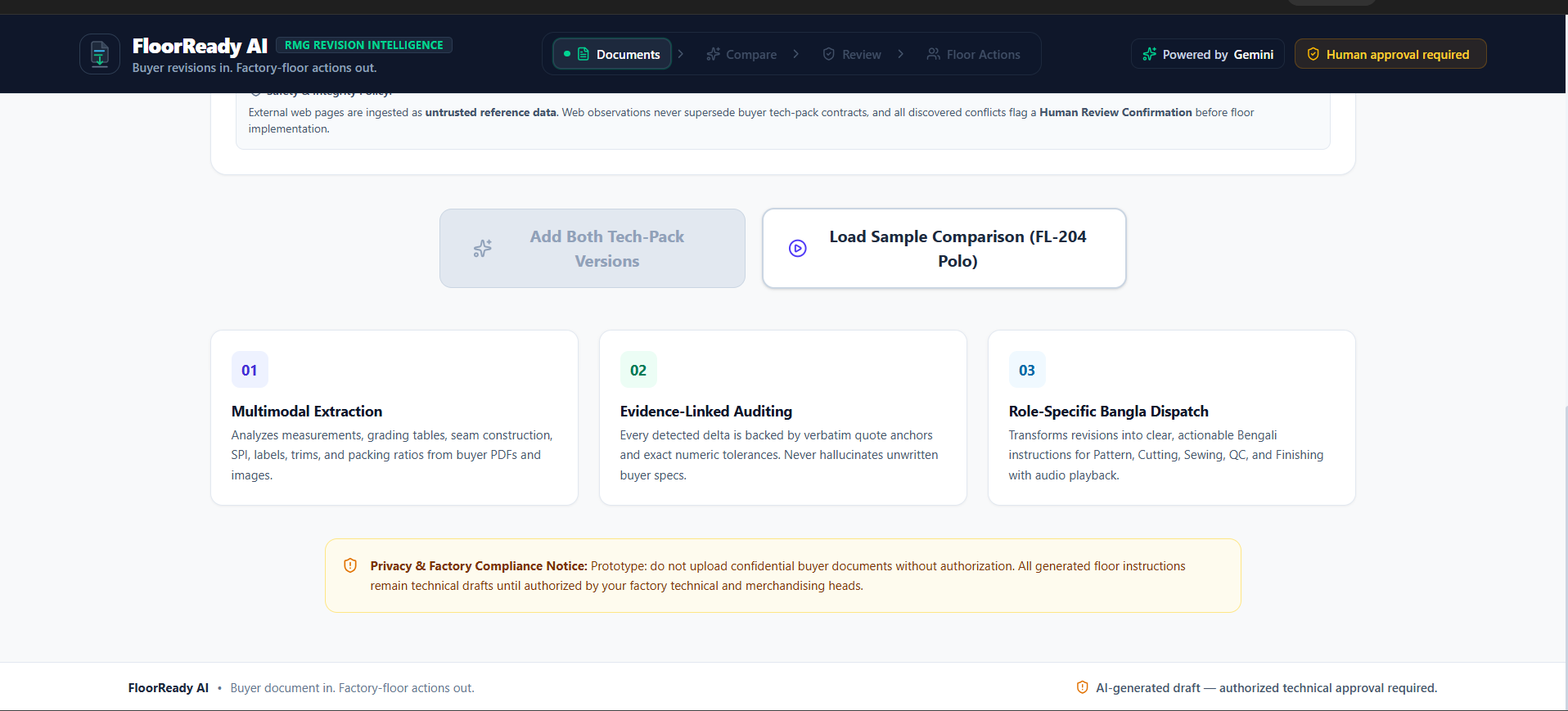
The Gemini API is the reasoning engine. Both document versions are sent to Gemini with a strict structured-output schema. Gemini returns a document summary, comparison status, evidence-linked changes, confidence levels, affected departments, and role-specific Bangla actions.
Gemini is not used as a basic chatbot. It orchestrates several connected tasks:
- Understanding semi-structured garment specifications
- Comparing two document versions
- Separating operational changes from formatting differences
- Extracting supporting evidence
- Assessing uncertainty and production impact
- Generating department-specific actions
- Translating technical instructions into clear Bangla
The application then presents the results through an operational dashboard. Users can inspect evidence, filter actions by department, and send uncertain findings to a human-review queue.
I integrated the ElevenLabs API through a server-side text-to-speech endpoint. Approved Bangla instructions can be played as multilingual neural speech, improving accessibility for workers who may prefer listening over reading. If the ElevenLabs service is unavailable, the interface clearly identifies and offers a browser speech fallback.
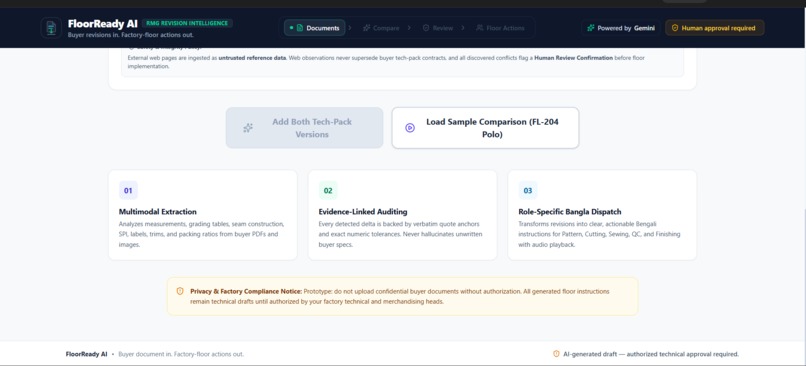
I also integrated Firecrawl to retrieve relevant public web guidance. This gives the workflow an optional external reference layer rather than treating AI-generated conclusions as unquestionable facts. Retrieved content is treated as untrusted reference data and does not override the uploaded documents or human approval.
API credentials remain on the server, and uploaded content is treated as data—not as executable instructions. The system also includes input validation, request limits, visible errors, retry handling, and protection against duplicate analysis requests.
Human-centered AI
Garment specifications can directly affect production quality and worker instructions, so FloorReady AI does not allow the model to act as the final authority.
Every detected revision includes:
- The previous value
- The revised value
- Verbatim document evidence
- The affected department
- A confidence level
- A human-confirmation flag
- An approval status
Low-confidence or ambiguous findings are automatically routed for human review. Voice instructions awaiting approval receive a clear draft disclaimer. This creates an accountable AI-assisted workflow, rather than an unsafe automated decision system.
Challenges I faced
The first challenge was distinguishing meaningful production changes from harmless differences in capitalization, spacing, or formatting. I addressed this through normalization and explicit comparison rules.
The second challenge was preventing plausible-looking AI output from becoming untraceable. I solved this by requiring evidence for every reported change and using a structured response schema instead of unrestricted text.
The third challenge was translating technical garment terminology into Bangla without losing values, units, tolerances, or department context. The system therefore preserves the original specification alongside the translated action.
Voice integration introduced additional challenges around API security, Bangla pronunciation, audio latency, caching, and service failure. I kept the ElevenLabs key server-side, added audio caching, displayed the active voice provider, and implemented a transparent fallback.
Finally, I had to design the product for very different users—from merchandisers reviewing technical evidence on desktop computers to floor supervisors using mobile devices in production environments. This led to role-based views, high-contrast status indicators, large touch targets, and short actionable instructions.
What I learned
I learned that the strongest use of generative AI is not simply generating text. It is building a reliable workflow around model reasoning, evidence, uncertainty, human judgment, and real-world delivery.
I also learned that localization is more than translation. A useful Bangla factory instruction must preserve technical accuracy while remaining direct, understandable, and appropriate for the worker’s role.
Most importantly, I learned that AI becomes more valuable when it helps people make safer and faster decisions without hiding its limitations.
Impact and future vision
FloorReady AI could help Bangladeshi garment factories reduce revision-related mistakes, rework, waste, and production delays while making critical information more accessible to floor teams.
Future versions could support complete PDF and image-based tech packs, OCR for scanned documents, WhatsApp or factory-speaker dispatch, approval audit exports, buyer-specific terminology, and analytics showing which revision types create the most production risk.
FloorReady AI transforms buyer changes into evidence-linked, human-approved, Bangla factory-floor action—both on screen and through voice.
Built With
- accessibility
- ai
- api
- bangla
- document
- elevenlabs
- express.js
- firecrawl
- gemini
- generative
- human-in-the-loop
- intelligence
- language
- natural
- node.js
- processing
- react
- studio
- text-to-speech
- typescript
- vite
- voice

Log in or sign up for Devpost to join the conversation.