-
-
Floor Rush: Hotel Manager
-
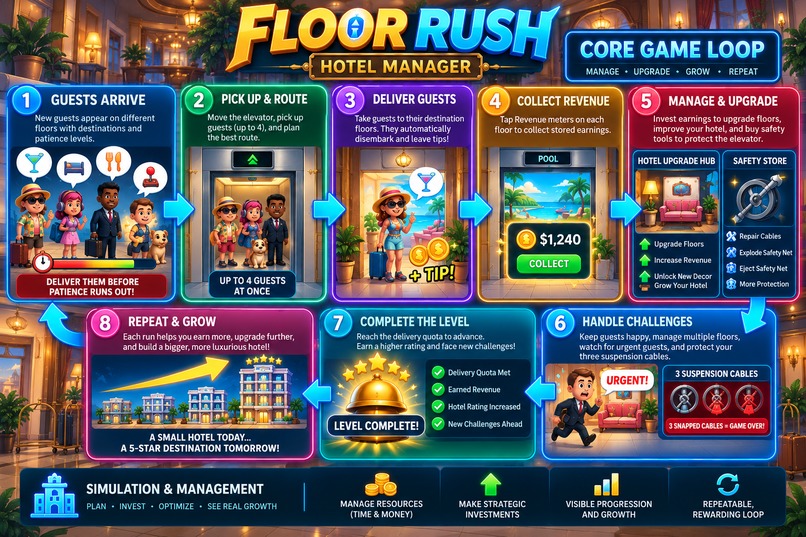
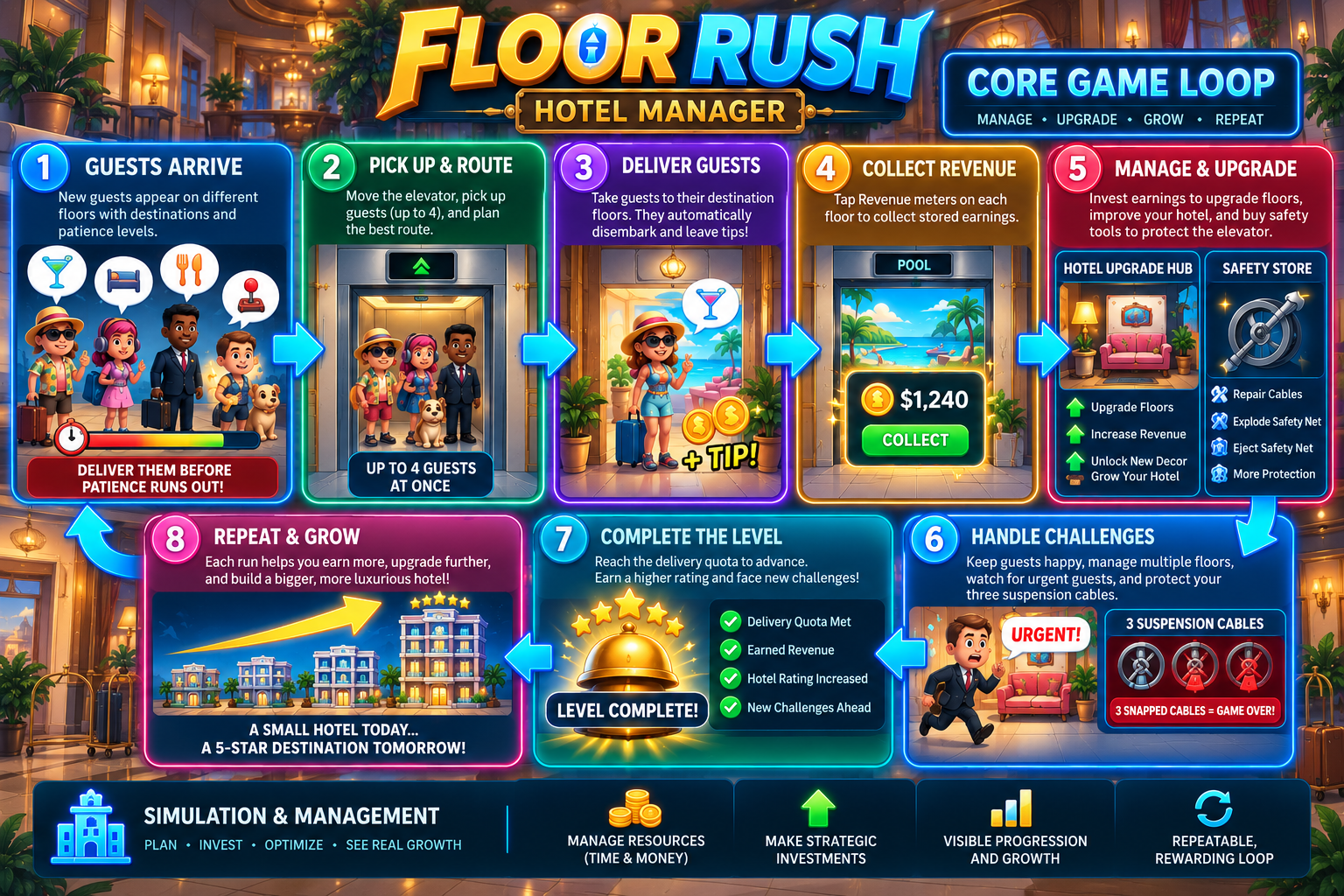
Core Game Loop
-
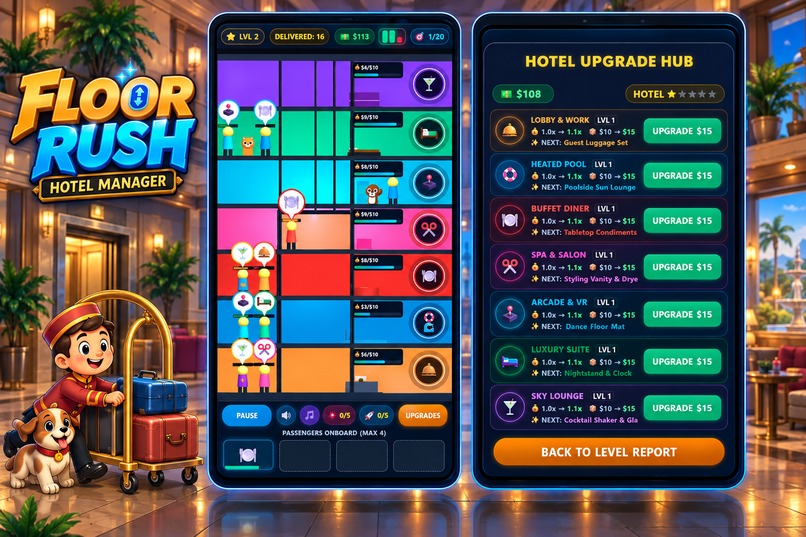
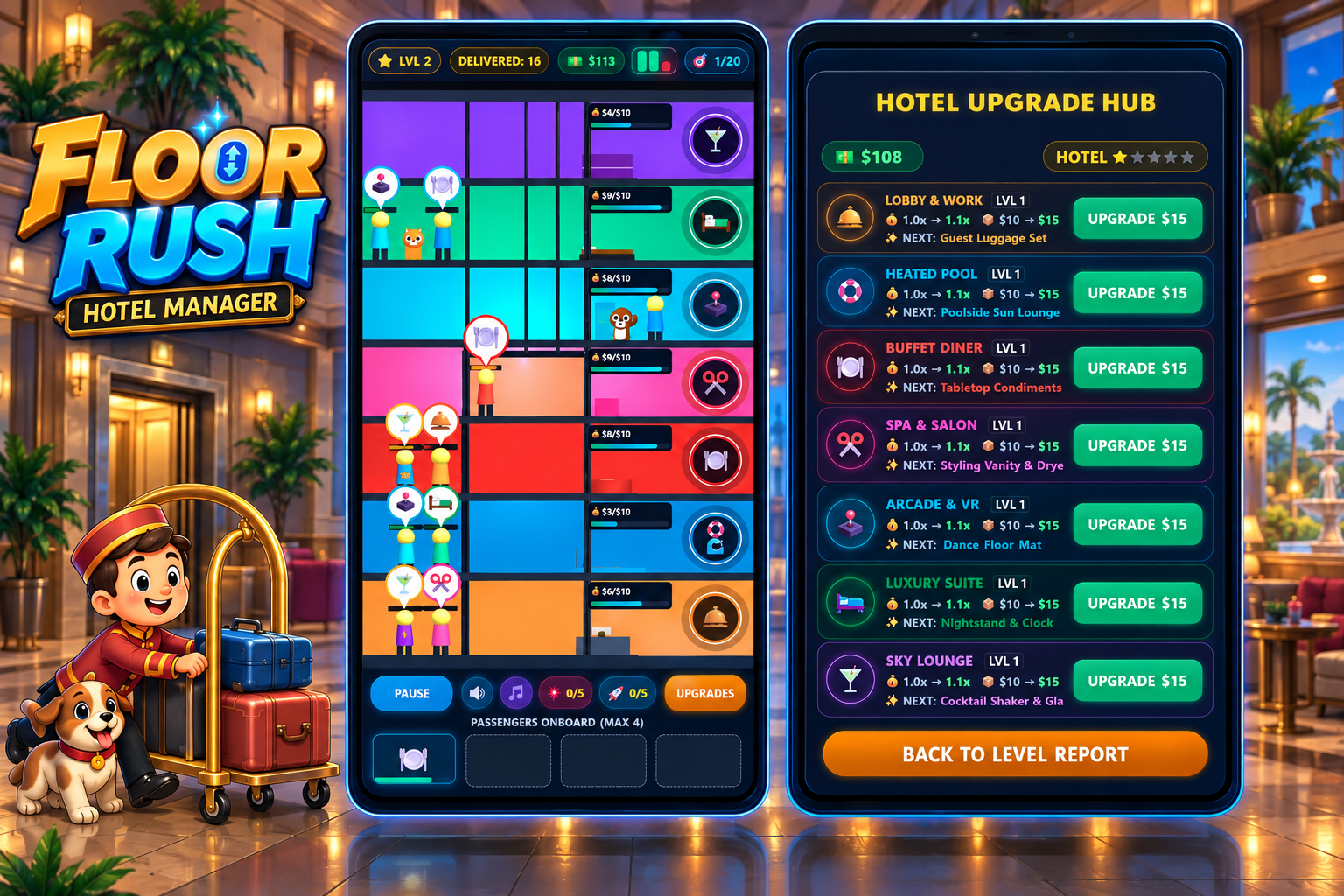
Gameplay Images
Inspiration
Floor Rush turns a simple elevator ride into controlled chaos. Guests are waiting, patience is running out, and you have to keep your hotel moving before everything comes crashing down.
I wanted to take something everyone instantly understands—an elevator—and turn it into a fast-paced management game where you’re constantly making little decisions. Which guest should I pick up first? Can I squeeze in one more delivery? Do I collect my revenue now or deal with the guest whose patience is disappearing? Should I spend my money on an upgrade or save it in case things go wrong?
From there, the hotel became more and more alive. Guests got personalities, floors became upgradeable, rooms physically changed as you invested in them, and the elevator cables became your three “lives.” The goal was to make a management game that was easy to understand almost immediately, but increasingly frantic and satisfying the longer you survived.
What it does
Floor Rush: Hotel Manager is a fast-paced 2D hotel management game where you operate a seven-floor hotel using one very busy elevator.
Guests appear throughout the hotel with different destinations and limited patience. You race between floors, pick up guests, and deliver them before their patience runs out. Successful deliveries earn tips and generate revenue for your hotel, which you can collect and reinvest into upgrading individual floors.
Those upgrades aren’t just numbers—the hotel visibly improves around you, adding furniture, decorations, and more luxurious spaces as it grows.
But there’s a catch: when a guest loses all their patience, one of your elevator’s three suspension cables snaps. Lose all three and your shift ends in a spectacular Crash & Inferno Game Over!
As the game progresses, Urgent guests and valuable VIP High-Rollers increase the pressure. You’ll even encounter guests traveling with pets, who take up two precious elevator spots and force you to think carefully about who you pick up next. Upgrades and safety equipment give you new ways to survive and build a better hotel.
How I built it
Floor Rush was built as a Three.js/HTML5 game designed specifically for a portrait phone screen.
The hotel, elevator, guests, rooms, upgrade props, effects, and interface were created to work together inside one compact vertical play space. A lot of attention went into making the entire seven-floor hotel readable at once so the player can constantly scan for guests, destinations, revenue, and danger.
The game was built iteratively with AI-assisted development. I would design a feature, implement it with AI, play it, find what wasn’t fun or clear, and then refine it. Many systems went through several versions before they felt right.
The game combines procedural audio created with the Web Audio API with locally bundled sound effects, allowing the entire experience to remain self-contained and playable offline without relying on externally hosted assets.
Challenges I ran into
The biggest challenge was balancing management with chaos.
Floor Rush can get hectic fast. Guests may be waiting across several floors while your elevator is already full, revenue is ready to collect, upgrades are competing for your money, and multiple patience bars are getting dangerously close to zero.
I wanted the player to feel that pressure without ever thinking, “I have no idea what's happening.”
That meant constantly refining the HUD, floor colors, guest indicators, tutorials, revenue system, upgrade screens, and visual feedback.
Scope was another challenge. It was incredibly tempting to keep adding things. I eventually started asking a much more important question: does this make the core loop more fun, or does it just make the game bigger?
There were plenty of technical challenges too—preventing duplicate rewards, managing tutorial states, keeping everything readable on a small portrait screen, maintaining reliable level progression and reset behavior, and making sure one new feature didn't accidentally break three existing ones.
Some ideas worked immediately. Plenty didn't. Learning when to simplify something—or just delete it—became an important part of building Floor Rush.
Accomplishments that I'm proud of
I’m especially proud of how much personality came out of such a simple starting idea.
The elevator feels fast. The hotel feels busy. VIP guests sparkle as they impatiently wait for service. Rooms become noticeably more impressive as you invest in them. Revenue piles up while you’re distracted with guests. And watching those three elevator cables disappear one by one creates an immediate “uh-oh” moment.
I’m also proud that the progression is something you can actually see. Upgrading a floor doesn’t just increase a hidden statistic. Furniture and decorations physically appear inside the hotel, so the building gradually transforms because of the decisions you made.
Most of all, I’m proud that the game developed a clear identity. Floor Rush is a little ridiculous, a little stressful, and intentionally playful. It turns running an elevator into something I genuinely want to keep playing one more time.
What I learned
The biggest lesson was that more features do not automatically make a better game.
Some of the best improvements came from simplifying things: shortening instructions, removing unnecessary information, making buttons clearer, and concentrating on the decisions that were actually fun.
I also learned how important immediate feedback is. A cash sound, an elevator chime, a room visibly upgrading, a patience bar flashing red, or a cable suddenly snapping can communicate more to the player than a paragraph of instructions ever could.
And playtesting changed the game constantly. Something that sounded great on paper could feel completely different once several guests were yelling for attention at the same time!
The project reinforced a design philosophy I want to carry forward: build the core interaction, play it, listen to what the game is telling you, and only then decide what it needs next.
What's next for Floor Rush - Hotel Manager
There is so much more I’d love to explore with Floor Rush.
The biggest opportunity is expanding the hotel’s long-term progression while keeping the frantic elevator gameplay at its heart. I’d love to take fully upgraded floors beyond their current state with increasingly luxurious transformations—Bronze, Silver, Gold, and eventually Platinum—until the entire hotel looks dramatically different from where the player started.
I’d also love to expand the cast of guests. New personalities, unusual VIPs, and different types of pets could each introduce their own behaviors and challenges, forcing players to rethink how they manage the elevator. I especially like the idea of occasionally throwing unexpected curveballs into a shift—special guests, hotel events, elevator problems, or other surprises that temporarily change the way the player has to manage the chaos.
As the hotel becomes more demanding, players could invest their earnings in additional upgrades, safety equipment, and purchasable tools that make those later levels more manageable. The goal would be to give players meaningful choices about what to invest in and let a well-managed, well-upgraded hotel feel noticeably more capable than the one they started with.
Most importantly, I’d want every addition to build on what makes Floor Rush fun: more decisions, more surprises, more visible progression, and just enough chaos to make every shift feel different.


Log in or sign up for Devpost to join the conversation.