-
-
Post-login Screen
-
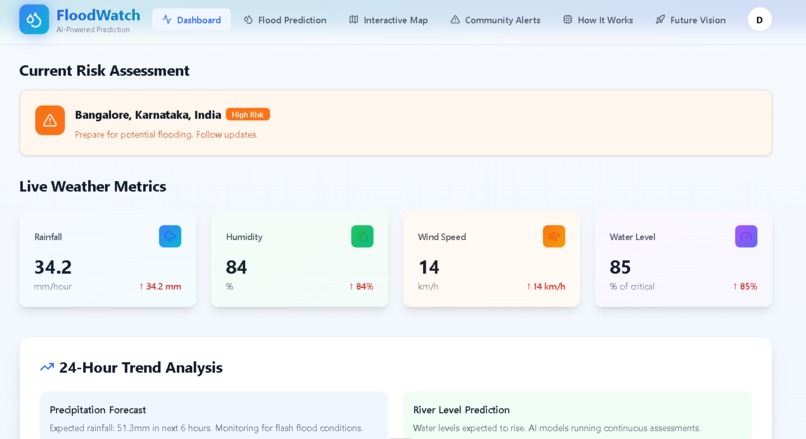
Dashboard
-
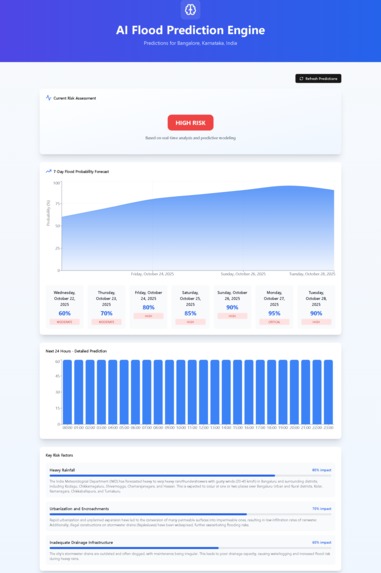
Flood Prediction
-
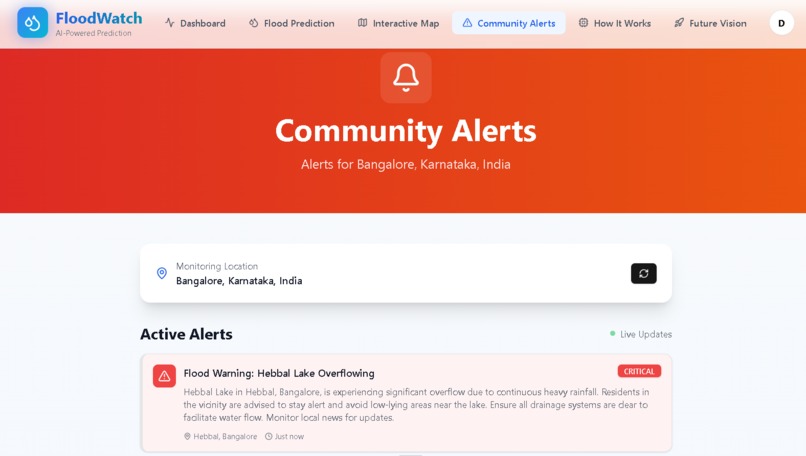
Community Alerts


Inspiration
As climate change accelerates, floods are becoming more unpredictable and destructive — overwhelming communities before they can react. The inspiration behind FloodWatch was to create an intelligent, accessible platform that predicts floods early and equips people, governments, and organizations to act before disaster strikes.
What it does
FloodWatch uses live weather APIs and simulated IoT data to forecast potential flood risks. It continuously monitors rainfall, river levels, humidity, and temperature to detect early signs of flooding. The AI model analyzes this data, generates risk maps, and issues early alerts through a clean, data-driven web interface — helping communities stay a step ahead of nature.
How we built it
FloodWatch is currently a working prototype powered by real-time APIs and an AI-based analytics engine. It aggregates live weather data, runs predictive models, and visualizes results in an intuitive dashboard. Future updates will integrate IoT sensors for ground validation — adding local accuracy through rainfall gauges, water level detectors, and soil moisture probes.
Challenges we ran into
Integrating multiple data streams, designing an AI model that handles noisy and incomplete data, and maintaining seamless visualization were complex challenges. Ensuring the system works reliably across regions and devices also required thoughtful data modeling and architecture planning.
Accomplishments that we're proud of
FloodWatch successfully demonstrates a scalable, AI-powered flood forecasting system — fully API-driven, modular, and ready for hardware expansion. It represents the foundation of a community-level climate resilience network.
What we learned
We learned how real-time environmental data, when combined with AI, can form a predictive ecosystem that saves lives. The process deepened our understanding of model accuracy, data fusion, and the power of simple visual interfaces for complex systems.
What’s next for FloodWatch
Next, FloodWatch will integrate physical IoT sensors, refine its machine learning models for hyperlocal accuracy, and expand into a mobile platform for instant alerts. The ultimate goal: make flood prediction accessible, intelligent, and automatic — everywhere.
Built With
- cv
- lstm
- openweathermap
- random-forest


Log in or sign up for Devpost to join the conversation.