-
-
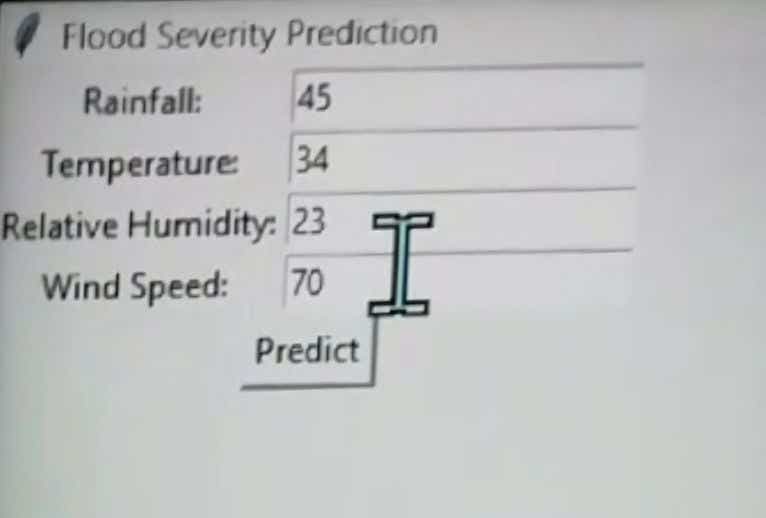
output of our project-"Flood Prediction"

Inspiration
Once upon a time, in our village, everything was about farming. My uncle Rahul was the backbone of our family and the village. He worked hard in his fields, nurturing the crops like they were his own children.
But then, one year, something terrible happened. Rain fell from the sky like it was angry, washing away our hopes along with the soil. Uncle Rahul's fields were flooded, and all his crops were destroyed. It wasn't just us; the whole village suffered.
With no crops to sell, Uncle Rahul couldn't make money. And when he couldn't earn, it affected our family and the village's economy. People had less money to buy things, and shops struggled to stay open.
Uncle Rahul didn't give up, though. He worked even harder, clearing the fields and planting new seeds. We all pitched in to help him, knowing that if he succeeded, it would benefit everyone.
Slowly but surely, the fields started to recover. Uncle Rahul's determination paid off, and soon, green shoots began to sprout from the once barren land. His hard work not only brought back our family's livelihood but also boosted the village's economy.
It wasn't easy, and we faced many challenges along the way. But through teamwork and perseverance, we turned the tide of destruction into a story of resilience and hope. And Uncle Rahul, with his unwavering spirit, taught us that no matter how hard the rain falls, the sun will always rise again.
How we built it
- Data Collection:
- Gather historical data on rainfall discharge, gage height, and flooding events from reliable sources like weather stations or government databases.
Data Preprocessing:
- Clean the data to remove any inconsistencies or errors.
- Transform the data into a format suitable for machine learning, ensuring all features are numerical.
Feature Engineering:
- Create additional features from the raw data, to capture important patterns.
Model Selection:
- Choose a machine learning model suitable for the task, we use Random Forest
- Train the model using historical data, with flooding severity as the target variable and rainfall discharge, gage height, and other engineered features as inputs.
Model Evaluation:
- Evaluate the trained model's performance using metrics like accuracy, precision, recall, and F1-score.
- Fine-tune the model parameters to improve its predictive capabilities. 6.Maintenance:
- Regularly update it with new data and improvements to keep it relevant and reliable.
- Stay informed about advancements in machine learning and incorporate new techniques to enhance it .
Challenges we ran into
- Data Quality: Ensuring accuracy and reliability of rainfall discharge and gage height data may be hindered by inconsistencies or missing values.
- Model Complexity: Selecting and optimizing machine learning models to accurately predict flooding severity is challenging due to the complex nature of flood dynamics.
- Feature Engineering: Identifying and engineering relevant features from the data requires domain expertise and experimentation to capture important patterns.
- User Interface Design: Designing an intuitive interface for users to input data and interpret flood predictions while maintaining simplicity poses a design challenge.
- Deployment Scalability: Deploying the app on a scalable infrastructure to handle varying loads and ensuring reliability under heavy usage presents technical hurdles.
- Ethical Considerations: Addressing ethical implications of predicting natural disasters and ensuring responsible use of the app's predictions is important yet challenging.
- Data Privacy: Safeguarding user data privacy while still allowing for accurate predictions requires robust security measures and compliance with regulations.
- Model Interpretability: Ensuring transparency and interpretability of machine learning models to build user trust and understanding presents a technical and communication challenge.
- Validation and Testing: Rigorous validation and testing procedures are needed to ensure the accuracy and reliability of flood predictions under different scenarios.
- Continuous Improvement: Continuously updating and improving the app based on user feedback, new data, and advancements in machine learning techniques requires ongoing dedication and resources.
Accomplishments that we're proud of
Accurate Flood Prediction Model We developed a highly accurate flood prediction model using advanced machine learning algorithms. This model can predict potential flood events with high precision, allowing for timely warnings and preventive measures.
Real-time Data Integration Our system integrates real-time data from various sources such as weather stations, river gauges, and satellite imagery. This ensures our model has the most current information, improving prediction accuracy.
User-friendly Interface We designed a user-friendly interface that allows users, including government agencies and local communities, to easily access flood predictions and related information. The interface includes interactive maps and visualizations to help users understand the data better.
Community Engagement and Education We have conducted workshops and seminars to educate local communities about flood risks and the importance of early warning systems. Our efforts have increased community awareness and preparedness.
Collaboration with Local Authorities We collaborated closely with local authorities and disaster management agencies to ensure our predictions are used effectively for emergency planning and response. This partnership has strengthened the overall flood management strategy in the region.
Scalability and Flexibility Our flood prediction system is designed to be scalable and adaptable to different regions and flood-prone areas. This flexibility allows for easy deployment in various geographic locations with minimal modifications.
Successful Pilot Testing We conducted successful pilot testing in flood-prone areas, demonstrating the model's effectiveness in real-world scenarios. The positive results from these tests have paved the way for broader implementation.
8.Integration with Emergency Response Systems Our flood prediction model is integrated with existing emergency response systems, ensuring that predictions trigger automatic alerts and response actions. This integration enhances the overall efficiency of disaster response efforts.
Publicly Accessible Data We have made our flood prediction data publicly accessible, promoting transparency and enabling researchers and developers to build upon our work. This open data approach fosters innovation and collaboration in the field of flood management.
Continuous Improvement and Updates We are committed to continuous improvement of our flood prediction system. Regular updates and incorporation of new data sources and technologies ensure that our model remains at the cutting edge of flood prediction science.
What we learned
1.we learned how to identify reliable sources for weather and water data, such as weather stations and government agencies.
- Gained knowledge about accessing data repositories and understanding data formats. 3. We developed skills in data processing, aggregating data points for analysis. We acquired knowledge about data storage solutions and the importance of organizing data for model training.
4.We understood the significance of updating data regularly to maintain accuracy in predictions. We familiarized myself with data usage policies and legal considerations when accessing and using data for projects.
5.We learned to use APIs where you can access historical data.
- Gained experience in Flask.
What's next for Flood prediction Model
Refinement: Continuously refine the machine learning algorithms and models to improve prediction accuracy based on new data and insights gained from user feedback.
Enhanced Features: Explore additional features or data sources that could further enhance the predictive capabilities of the model, such as soil moisture levels or terrain elevation.
Validation: Conduct thorough validation and testing of the model to ensure its reliability and effectiveness across different geographical regions and weather conditions.
User Interface:* Improve the user interface of the app to make it more intuitive and user-friendly, allowing users to easily input data and interpret flood predictions.
Scalability: Scale up the infrastructure and deployment of the app to accommodate increasing user demand and ensure responsiveness during peak periods.
Ethical Considerations: Continuously address ethical considerations surrounding the use of the model, such as privacy concerns and responsible communication of predictions.
Education and Outreach: Conduct educational outreach to raise awareness about flood risks and the capabilities of the prediction model, empowering communities to make informed decisions.
Collaboration: Collaborate with relevant stakeholders, such as government agencies and disaster management organizations, to integrate the model into decision-making processes and emergency response plans.
Adaptation: Stay informed about changes in environmental factors and climate patterns, and adapt the model accordingly to ensure its relevance and effectiveness over time.
Continuous Improvement: Maintain a culture of continuous improvement, incorporating feedback from users and stakeholders to iteratively enhance the Flood Prediction Model and its impact on mitigating flood risks.
Built With
- flask
- jupyter
- machine-learning
- numpy
- pandas
- preprocessing
- python
- python-package-index
- sklearn
- sqlite
- tensorflow
- vscode


Log in or sign up for Devpost to join the conversation.