Flood Escape: Last Exit
The water is rising. Every route has a cost.
About the Project
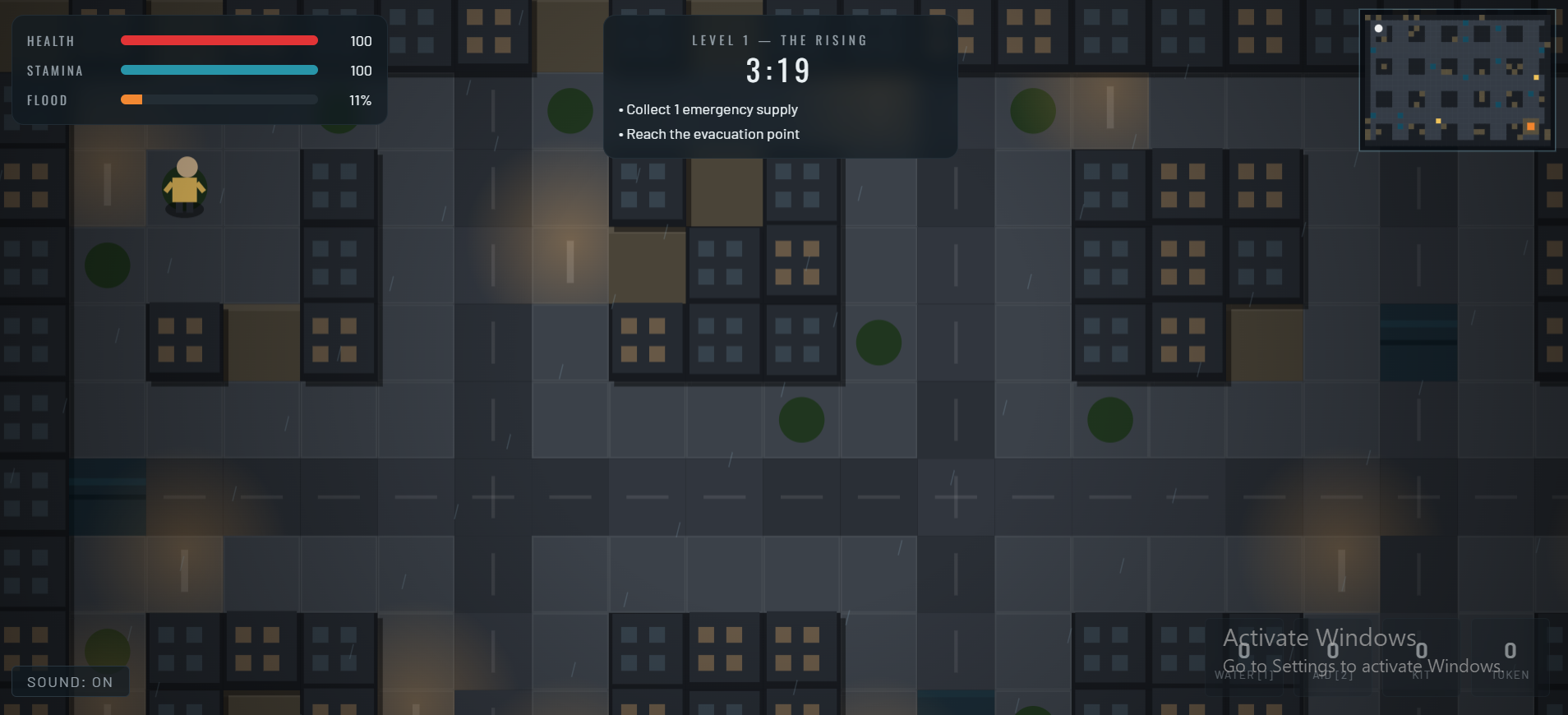
Flood Escape: Last Exit is a browser-based urban survival adventure where players must navigate a rapidly flooding city, make critical decisions, manage limited resources, and reach safety before the evacuation window closes.
The project was inspired by the real-world challenge of flooding and evacuation.
Flooding is often represented through maps, statistics, warnings, and vulnerability assessments. We wanted to approach the problem from a more personal perspective:
What would it feel like to actually make those decisions while the environment around you is changing?
That question became the foundation of Flood Escape.
The Core Idea
The central mechanic is simple:
The longer you stay, the more the city changes.
At the beginning of a level, the player has relatively safe routes and enough time to explore.
As the flood progresses, water levels increase, movement becomes more difficult, dangerous areas become more important, and the player has to continuously adapt.
The game is built around a simple gameplay loop:
Explore → Decide → Adapt → Survive → Escape
The objective isn't simply to reach the exit as quickly as possible.
The player must decide how to get there.
The Game
Flood Escape currently contains three playable levels, each representing a different stage of the disaster.
🌧️ The Rising
The introductory level.
The player learns the basic movement and survival mechanics while navigating a city where the flood has just begun.
The goal is to understand the environment, collect supplies, interact with survivors, and reach the emergency shelter.
🌊 Cut Off
The situation becomes more dangerous.
The rising water begins to affect the player's available routes, while stranded survivors and limited resources create additional decisions.
Players must balance helping others with conserving their time and reaching safety.
🚨 Last Exit
The final and most intense level.
The flood is advancing rapidly, and the player has a limited window to reach the final evacuation point.
At this stage, hesitation can mean getting trapped.
Key Features
Flood Escape includes:
- Three complete playable levels
- A progressive rising-water system
- Player movement and sprinting
- Health and stamina systems
- A countdown/timing system
- Collectible emergency supplies
- NPC interactions
- Help or Leave survivor decisions
- Dynamic objectives
- An in-game minimap
- Pause functionality
- Victory and failure states
- Score calculation
- S–D performance rankings
- Saved best scores for replayability
- Procedural audio
- Cinematic game introduction
The systems work together to create constant pressure as the flood progresses.
Decisions Matter
One of the game's central ideas is that survival isn't only about speed.
During the game, players encounter stranded survivors who can either be helped or left behind.
Helping someone may cost valuable time, while leaving them allows the player to continue toward safety more quickly.
These interactions are intentionally simple, but they reinforce the game's central question:
How much can you afford to care when every second matters?
The player's choices contribute to their final performance and encourage replayability.
Why Flooding?
The concept has a connection to real-world environmental challenges.
Flooding can transform familiar roads and neighborhoods into dangerous or inaccessible spaces very quickly. A route that appears safe at one moment may no longer be usable later.
We wanted to capture that feeling through gameplay.
Instead of creating a complex flood simulation, we focused on making the rising water directly affect the player's decisions.
The flood is therefore not just an environmental effect.
It is the game's main source of pressure.
How We Built It
Flood Escape was built with Lovable, using an AI-assisted development workflow.
Lovable was used to turn the game concept into a functional browser-based experience and assist with implementing the game's systems, interface, gameplay logic, debugging, and iteration.
The project was developed through an iterative process:
Concept → Build → Test → Identify Problems → Improve → Test Again
The creative direction remained human-led.
The game's concept, gameplay structure, mechanics, level progression, feature priorities, and overall direction were defined before and during development, while Lovable helped translate those ideas into the working application.
Challenges
One of the biggest challenges was balancing the rising-water mechanic.
If the flood progresses too slowly, the player doesn't feel enough urgency.
If it progresses too quickly, the game becomes frustrating rather than challenging.
Finding the right balance between pressure and playability was therefore an important part of development.
Another challenge was controlling the scope.
It would have been easy to keep adding features to the game, but the goal was to create a complete and playable experience within the time available rather than an oversized unfinished project.
We focused on making the core mechanic work first and then built the interface, progression, audio, scoring, and other features around it.
Testing
The game was tested through complete simulated runs of all three levels.
Each level was verified to be winnable, and the browser build was tested for console errors.
The final result is an end-to-end playable game rather than simply a visual prototype.
The game can be played from the opening cinematic through all three levels, including victory and failure states.
What We Learned
Building Flood Escape taught us that a game doesn't need an enormous number of mechanics to create an engaging experience.
A single strong mechanic can become the foundation of an entire game when it continuously affects the player's decisions.
The project also gave us practical experience with:
- Browser-based game development
- AI-assisted development
- Game-state management
- Gameplay balancing
- Level progression
- Interactive UI
- NPC interactions
- Resource management
- Audio implementation
- Debugging
- Browser testing
- Iterative game design
Most importantly, it showed how an idea inspired by a real-world problem can be transformed into something interactive and playable.
What's Next
Flood Escape could eventually expand with:
- More cities and environments
- Additional flood scenarios
- More survivor interactions
- New environmental hazards
- More levels
- Expanded progression
- More advanced flood behavior
- Additional replay challenges
For the BTT Web Game Jam, however, the goal was to keep the project focused and deliver a complete experience around one strong idea.
Final Thought
Flood Escape isn't about simply outrunning the water.
It's about making decisions while the world around you is changing.
Flood Escape: Last Exit
When the water rises, every decision matters.
Built With
- ai-assisted
- css
- html
- lovable
- react
- typescript
- vite
- web-game

