Inspiration
During floods, rescue teams need to make quick decisions based on constantly changing information. However, information about affected areas, damage, and rescue needs can be scattered, difficult to interpret, or communicated in different languages.
I was inspired to build Flood Damage Mapper, an AI-powered assistant that helps rescuers get quick answers to their questions and generate short situation reports in English and Nepali. My goal is to make flood-related information easier to understand and communicate when time is critical.
What it does
Flood Damage Mapper is designed to help rescue teams access and communicate flood-related information efficiently.
- Question answering: Answers rescuers' questions using available flood-related information.
- Bilingual situation reports: Generates concise reports in English and Nepali.
- Information summarization: Converts available information into short, readable updates.
- Rescue support: Helps rescuers understand reported conditions and communicate important information more efficiently.
The tool is intended to support human decision-making rather than replace verified information or professional judgment.
How I built it
I built Flood Damage Mapper around an AI-powered workflow for answering questions and generating situation reports. The system processes available flood-related information and uses it to produce clear, concise answers to users' questions. It can also generate short reports in English and Nepali, helping reduce language barriers during emergency response.
I focused on making the system straightforward to use and ensuring that its responses are concise enough to be useful in time-sensitive situations.
Challenges I ran into
One of the main challenges was balancing brevity with accuracy. Rescuers need information quickly, but overly short responses can leave out important details.
Another challenge was handling incomplete or changing information while maintaining the meaning of reports in both English and Nepali. In disaster response, unreliable information can have serious consequences, so accuracy, clarity, and verification are essential.
Accomplishments that I'm proud of
I'm proud to have built a project that addresses a real-world disaster-management challenge. Flood Damage Mapper combines AI-powered question answering with bilingual situation-report generation to make important information easier to access and share.
I'm especially proud of focusing on English and Nepali communication, because language accessibility can play an important role in helping rescue teams understand and communicate critical updates.
What I learned
Through this project, I learned how AI can be applied to practical disaster-management problems. I gained a better understanding of how question answering and summarization can help people process information efficiently.
I also learned that AI tools for emergencies must prioritize reliability, clarity, and responsible handling of uncertain information. Building a useful solution means considering not just what the technology can do, but also how people will depend on it in real situations.
What's next for Flood Damage Mapper
I plan to improve Flood Damage Mapper by incorporating updated and verified flood-related information, enhancing English–Nepali report generation, and supporting more location-specific questions.
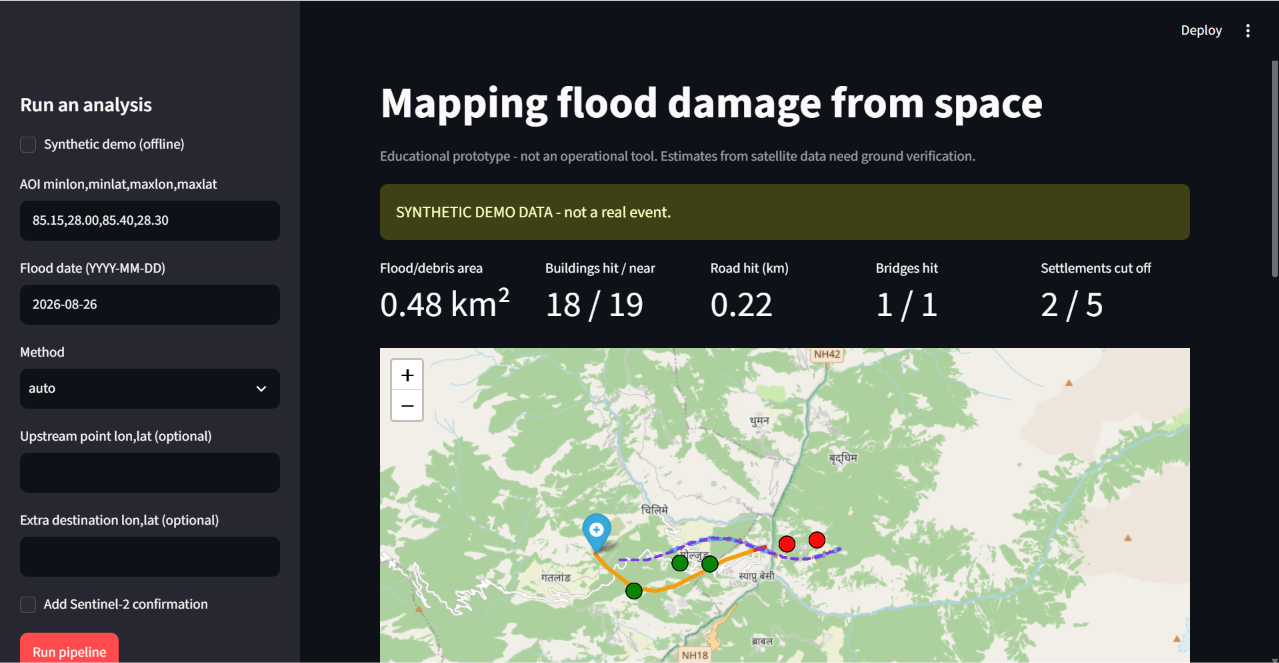
Future improvements could include integrating verified damage assessments, identifying affected areas and blocked routes, highlighting urgent rescue needs, and displaying relevant information on an interactive map. I also aim to improve source verification so that rescuers can distinguish confirmed information from reports that still require validation.
My long-term goal is to make Flood Damage Mapper a reliable decision-support tool that helps rescue teams access and communicate critical information more efficiently during flood emergencies.
