-
-
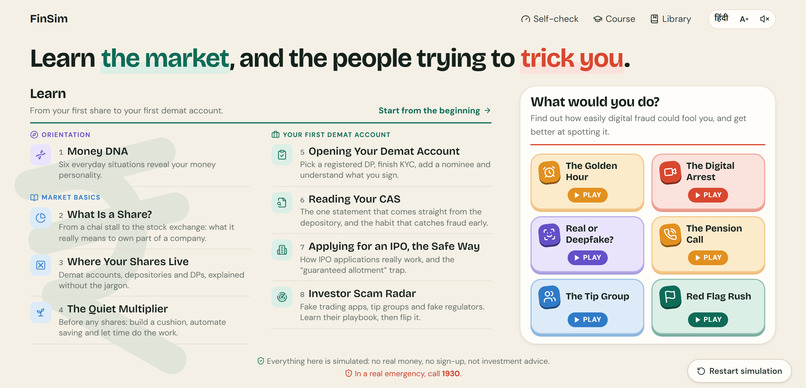
FinSim: get scammed here, so you never get scammed out there.
-
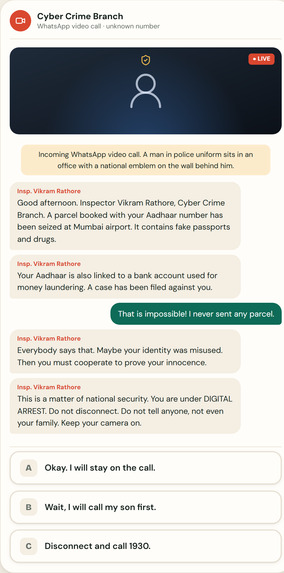
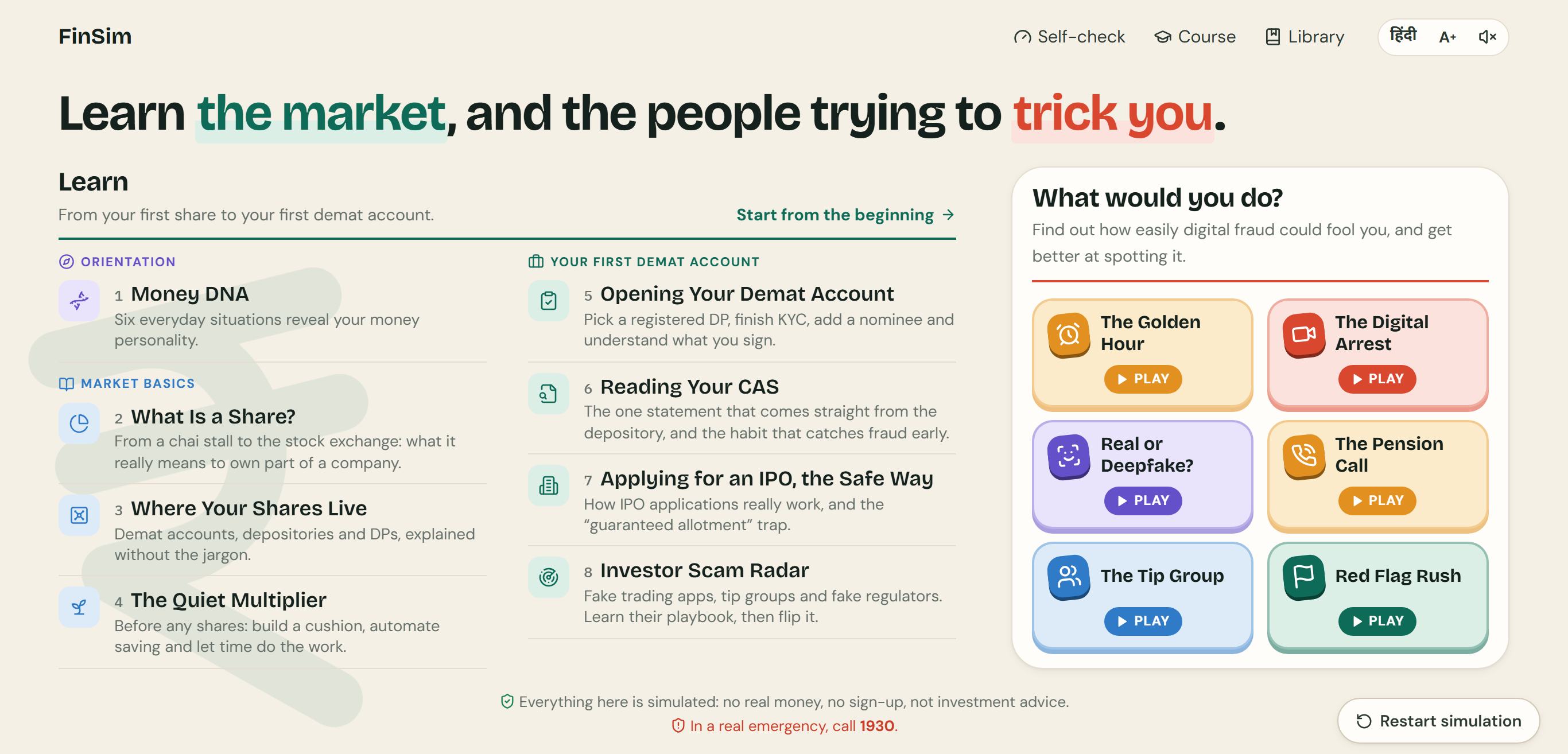
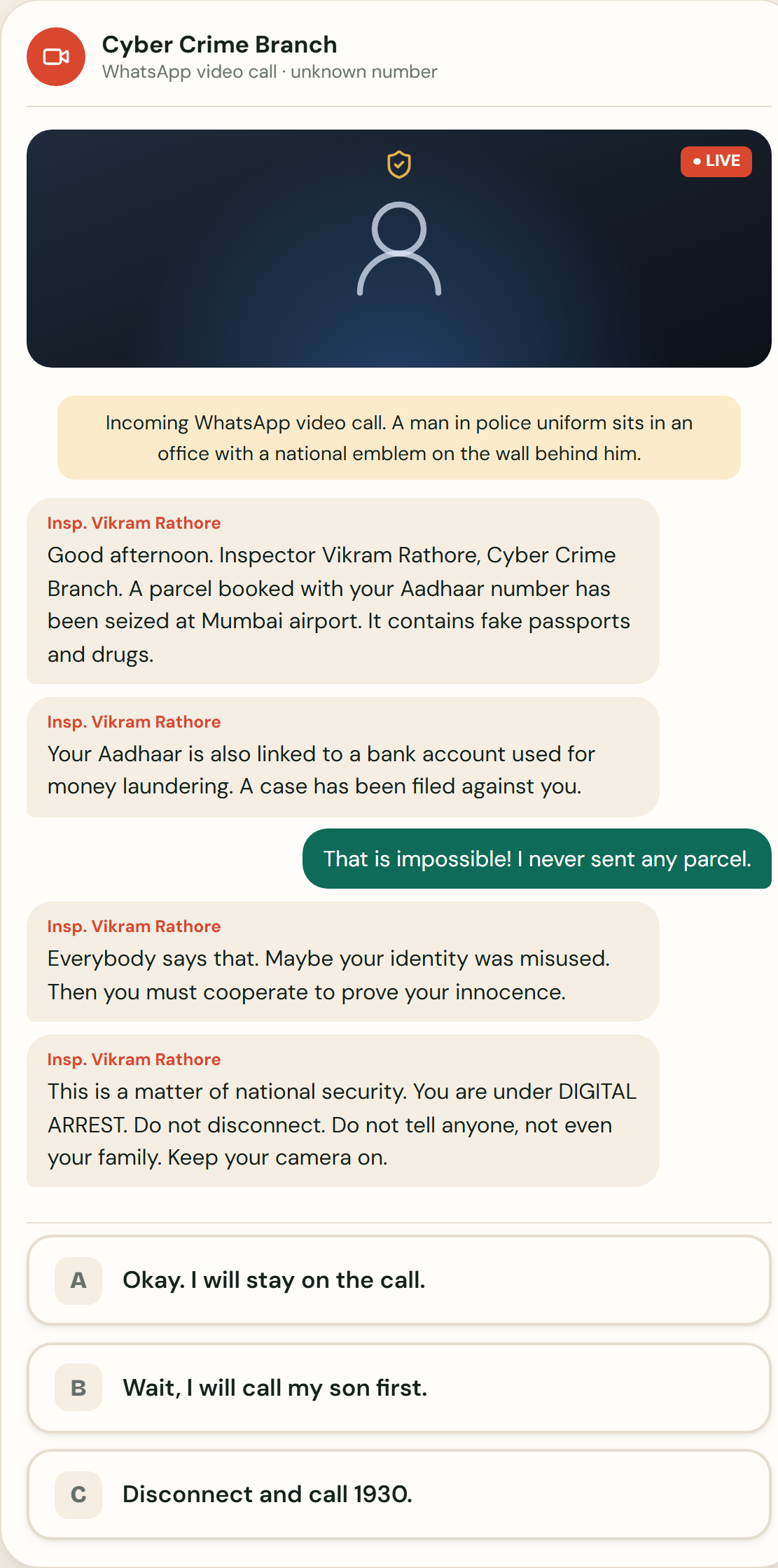
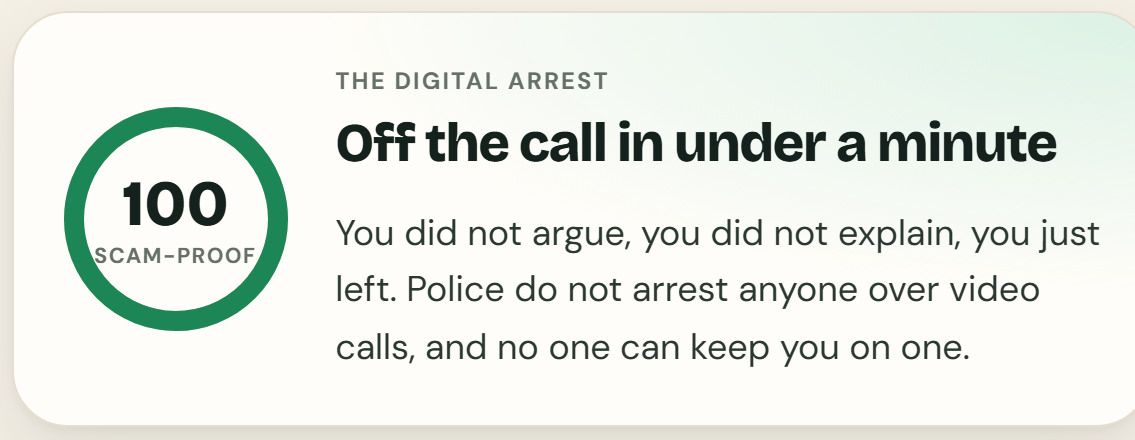
The Digital Arrest: a fake "Cyber Crime Branch" officer on a video call. Do you stay on, or hang up and call 1930?
-
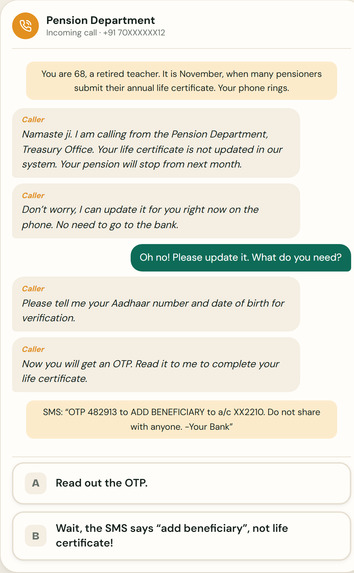
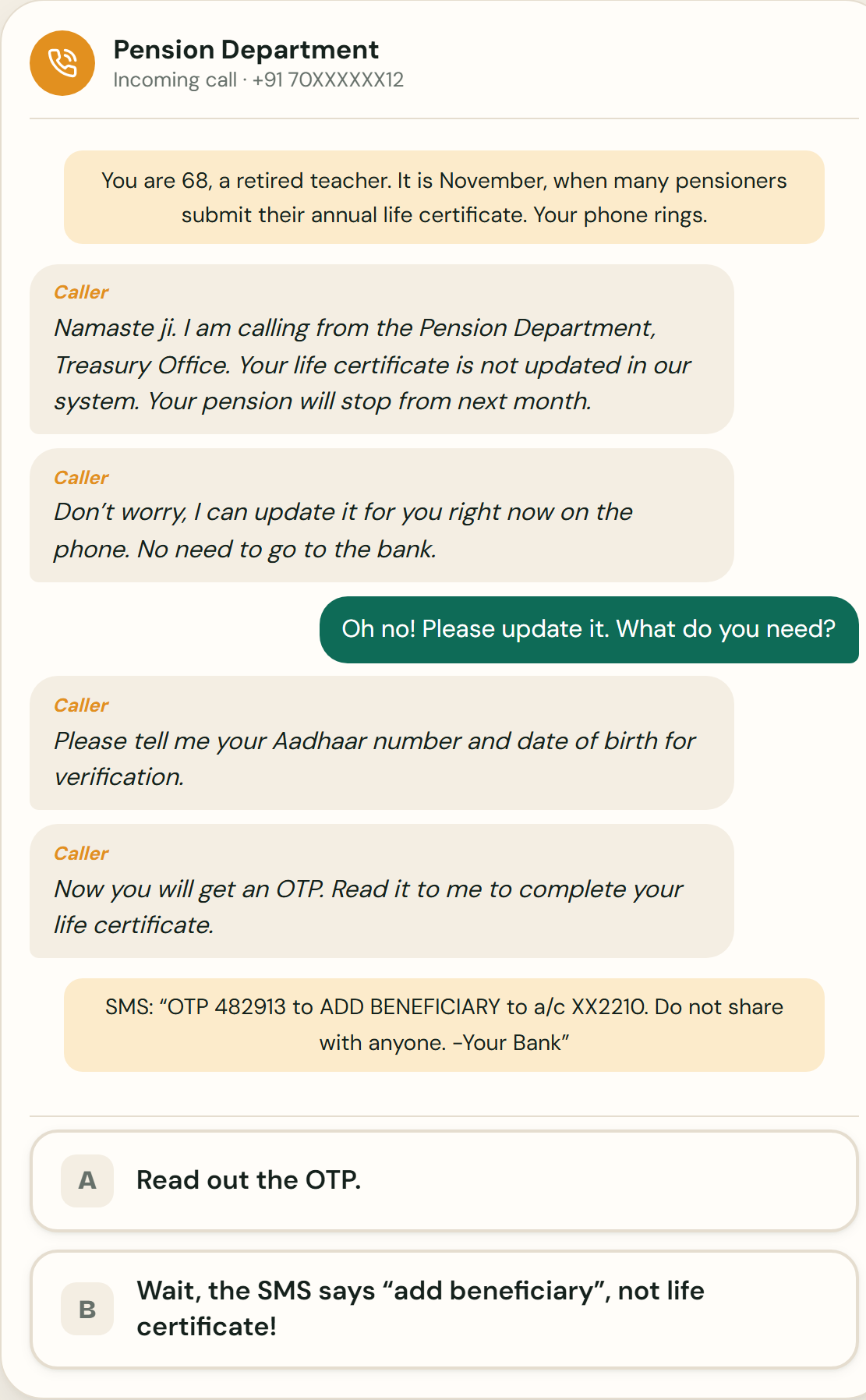
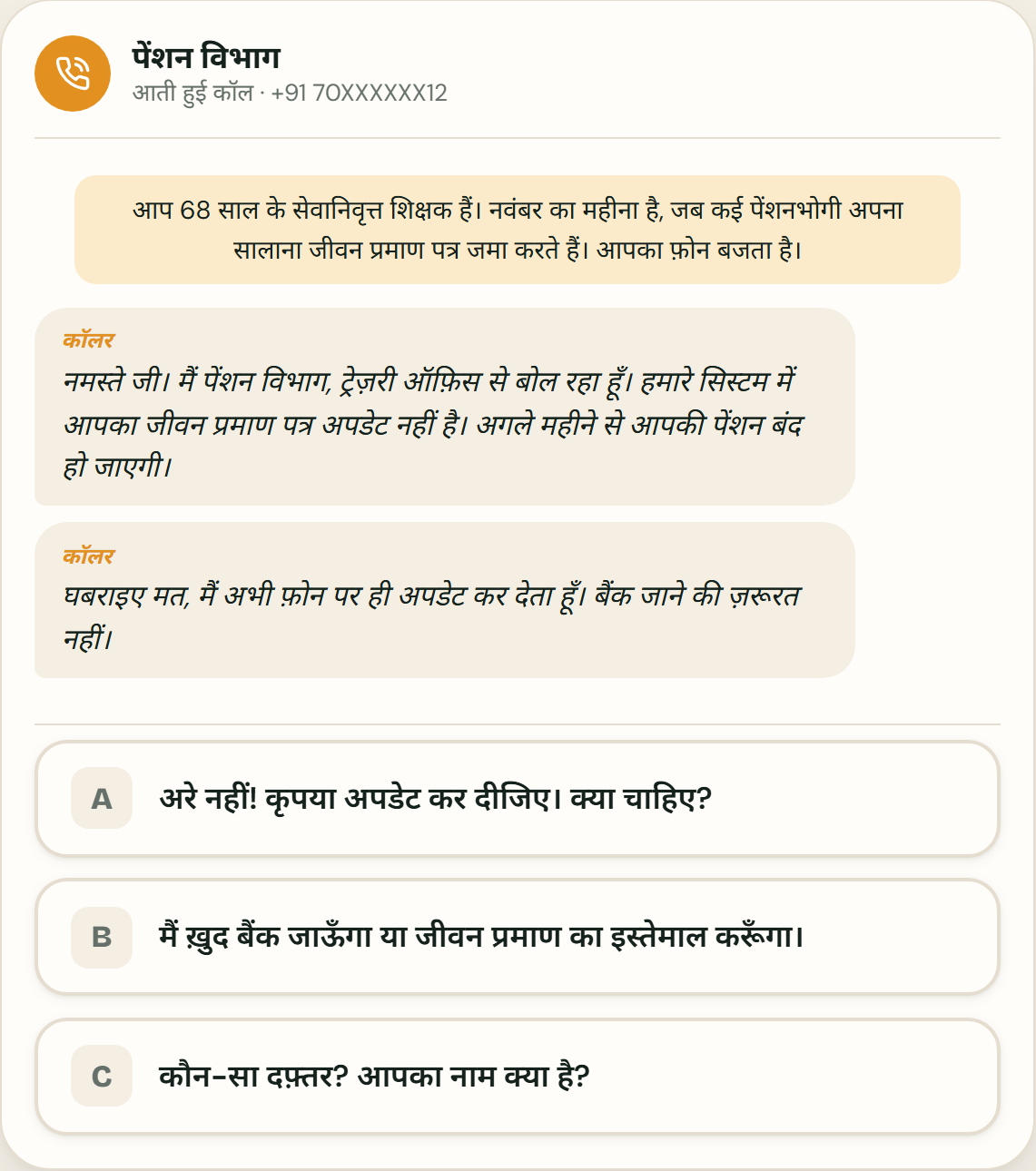
The Pension Call: the caller says "life certificate", but the OTP really says "add beneficiary".
-
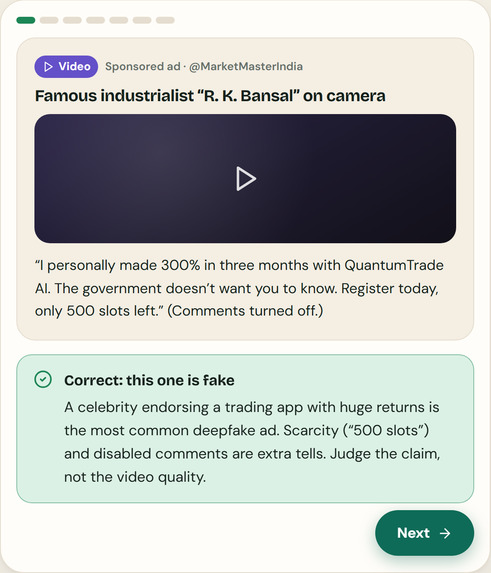
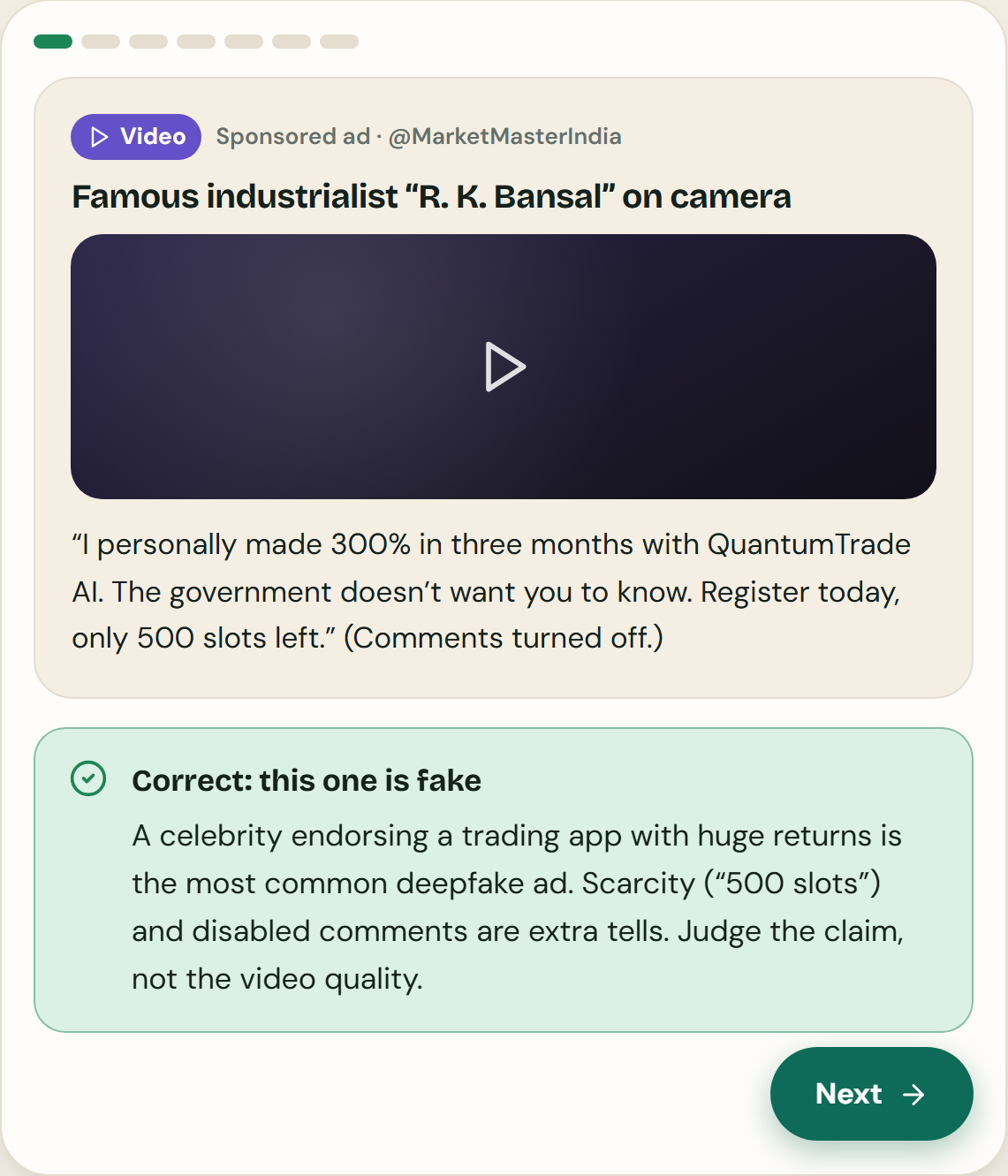
Real or Deepfake? Judge cloned voices, fake celebrity ads and fake SEBI notices, then learn the tell.
-
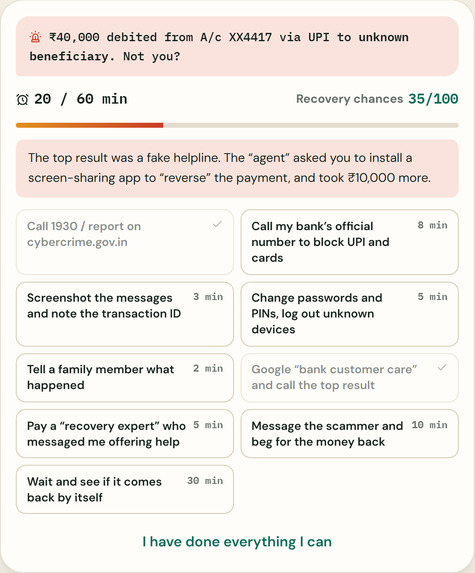
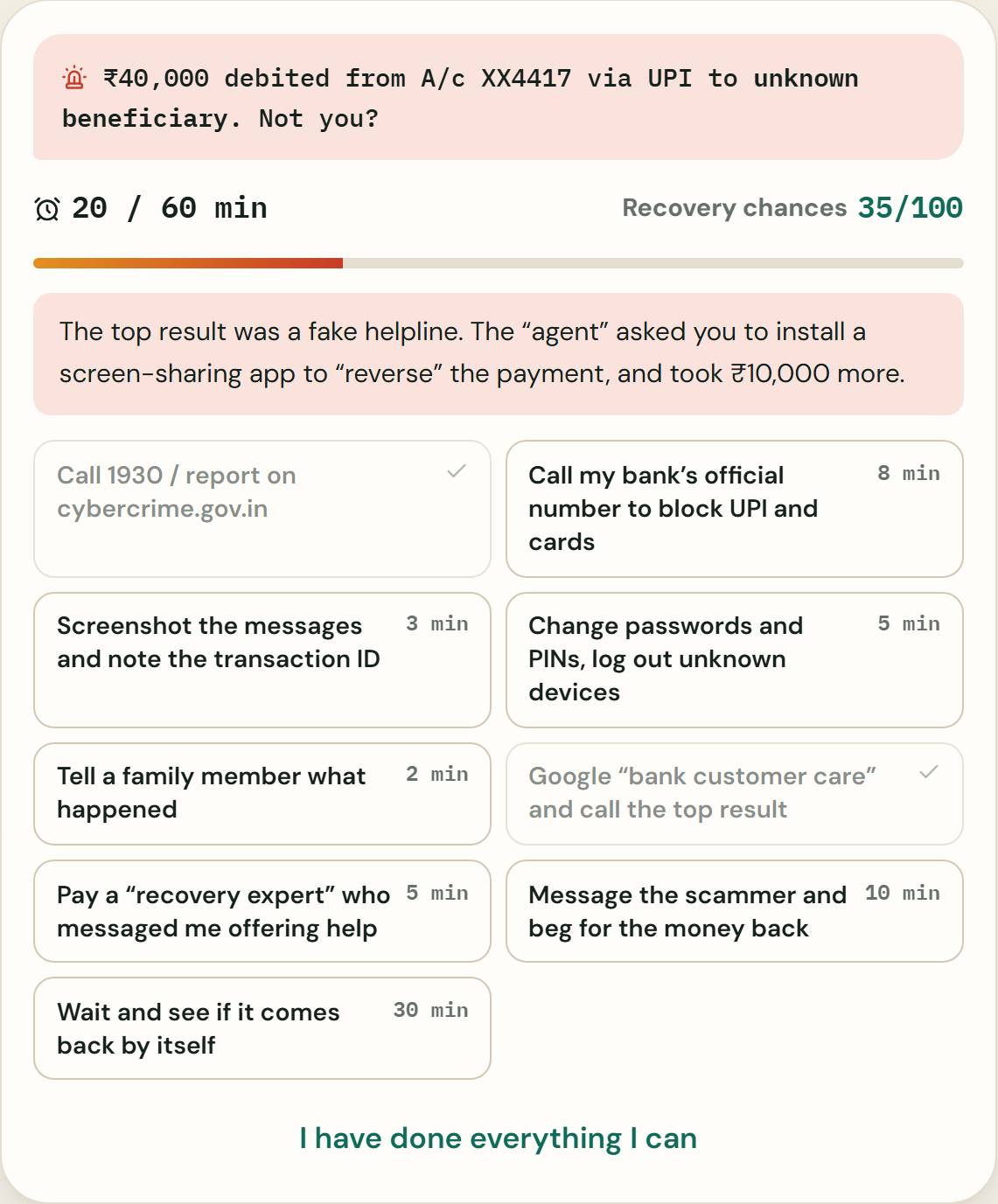
The Golden Hour: just been defrauded? Every action costs minutes, so spend them well.
-
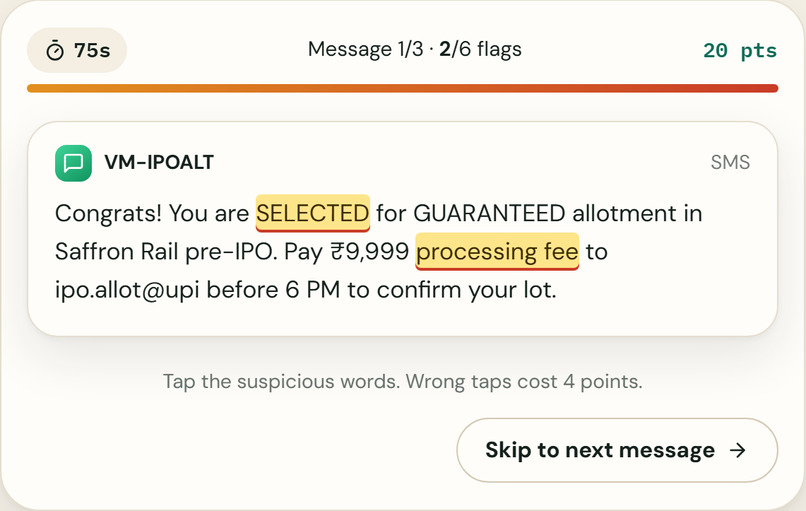
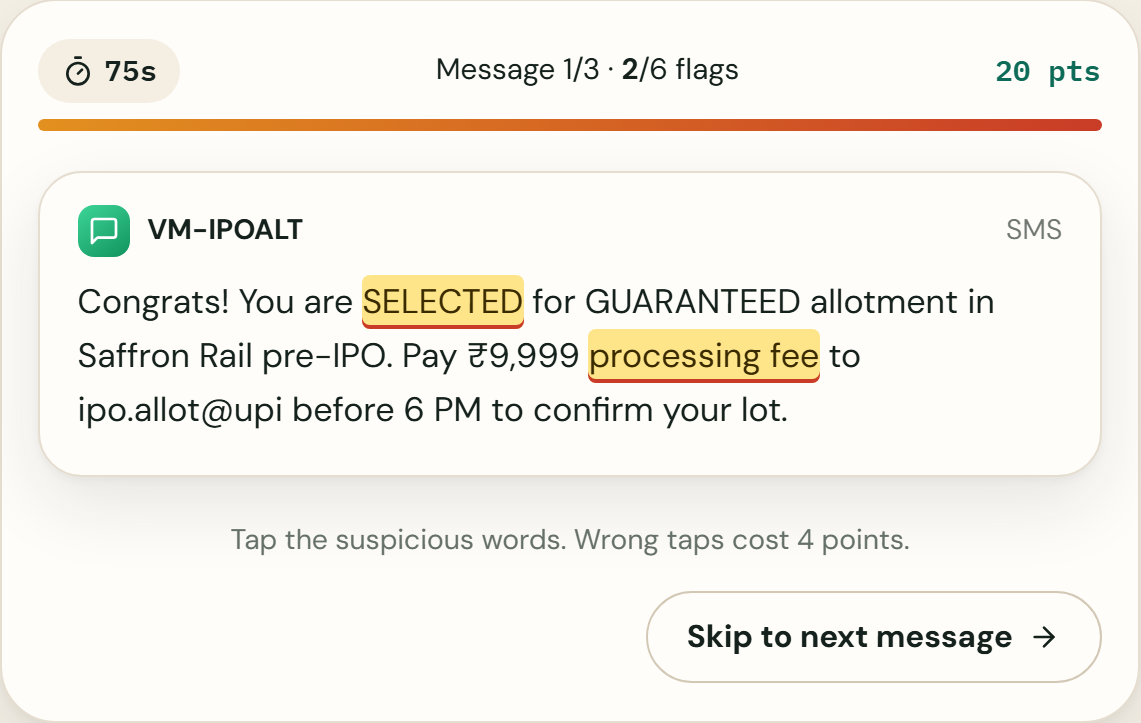
Red Flag Rush: tap every red flag in three investor scams against a 75-second clock.
-
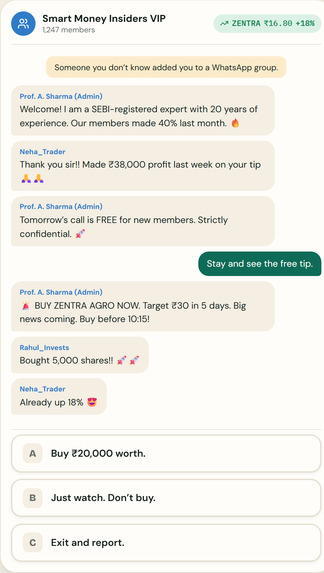
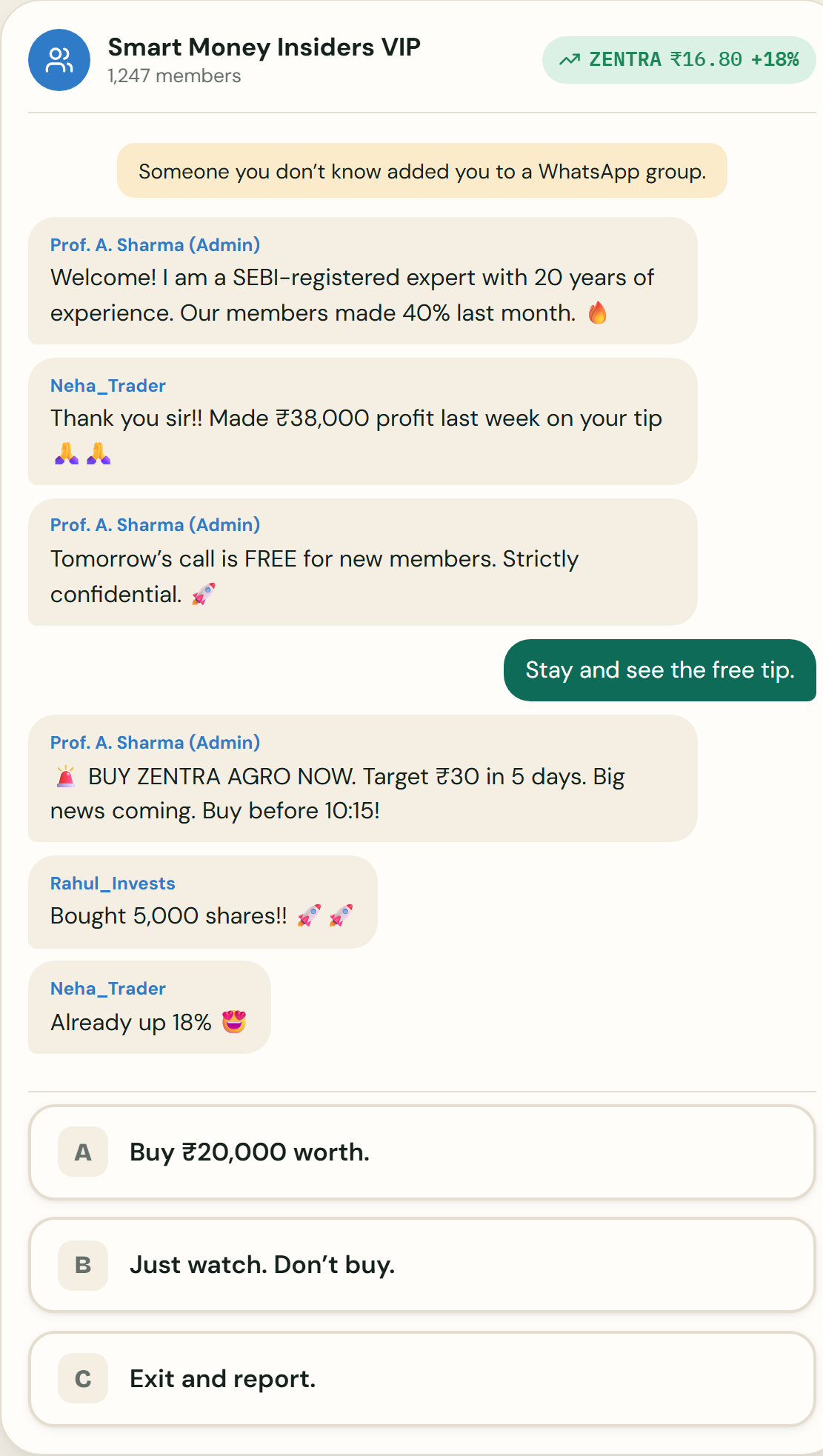
The Tip Group: a "VIP stock tips" chat pumps a share before the dump.
-
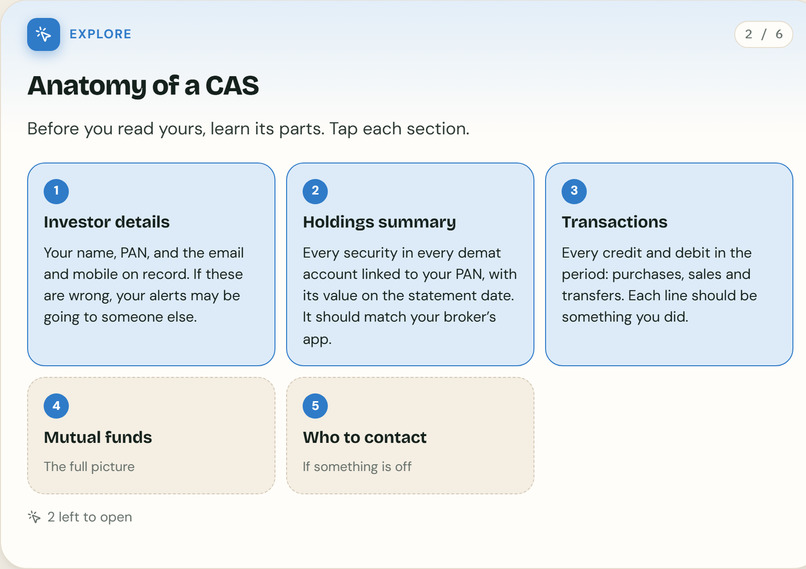
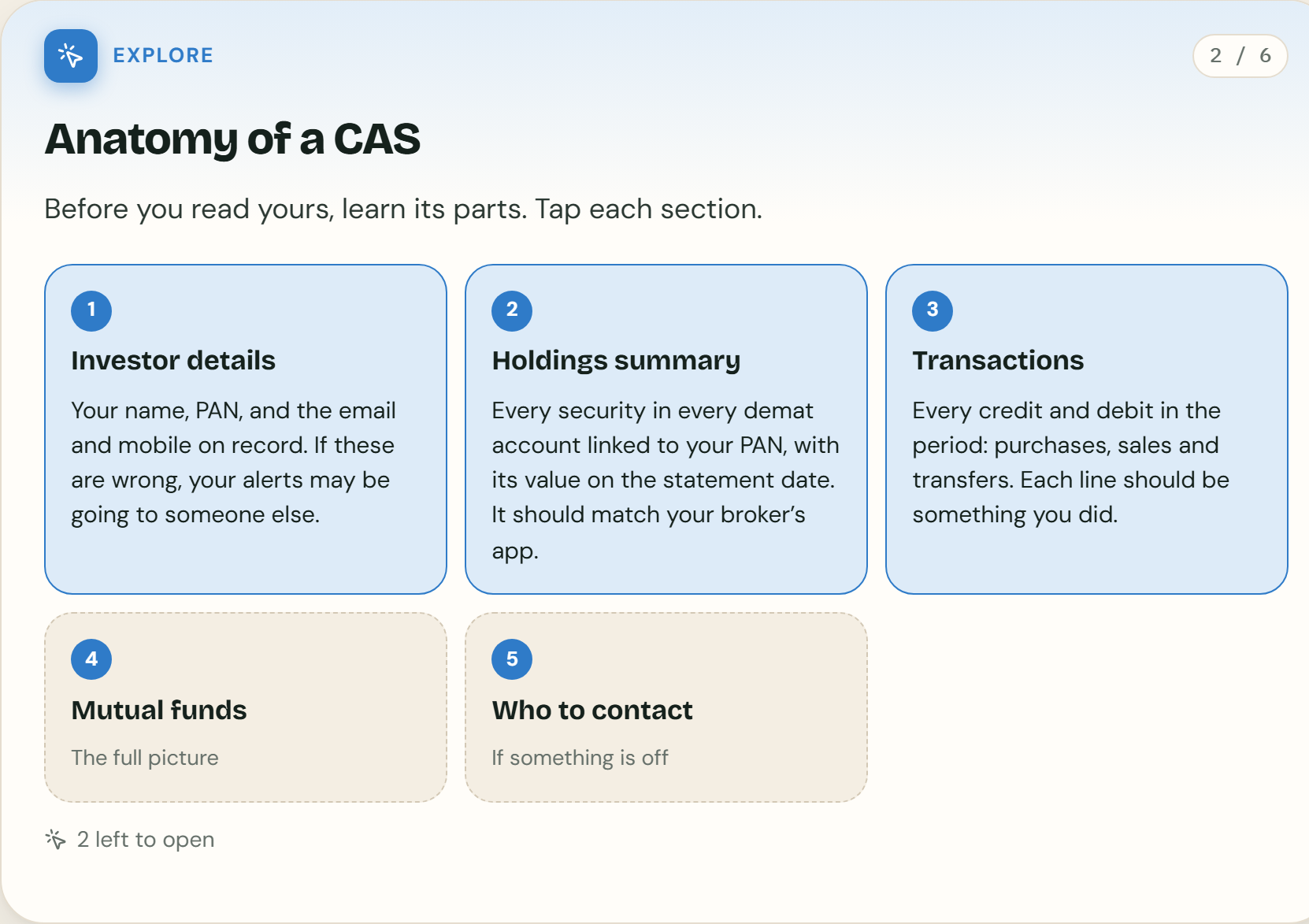
Teach before testing: tap each part of a real-looking account statement (CAS) to learn what it means.
-
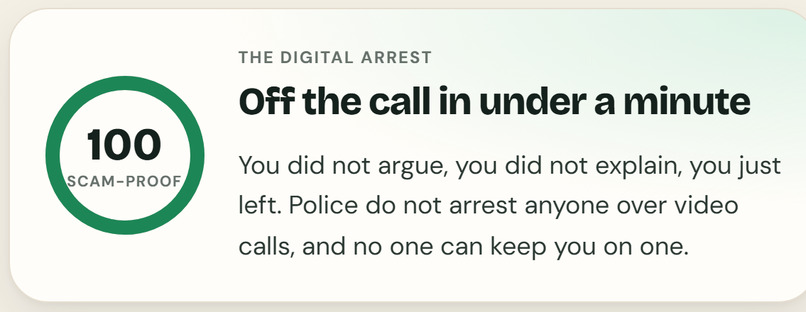
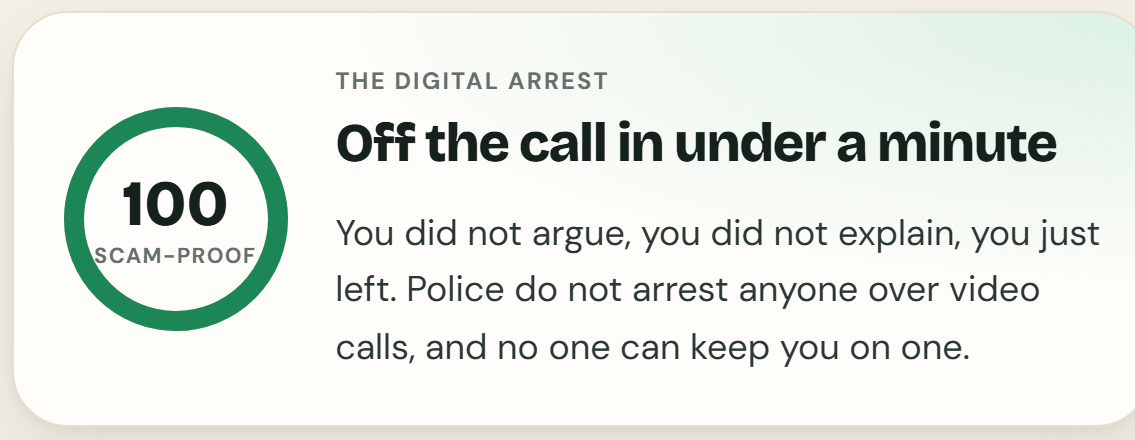
Every game ends with a debrief: a score from "Hooked" to "Scam-proof", the red flags and what to do for real.
-
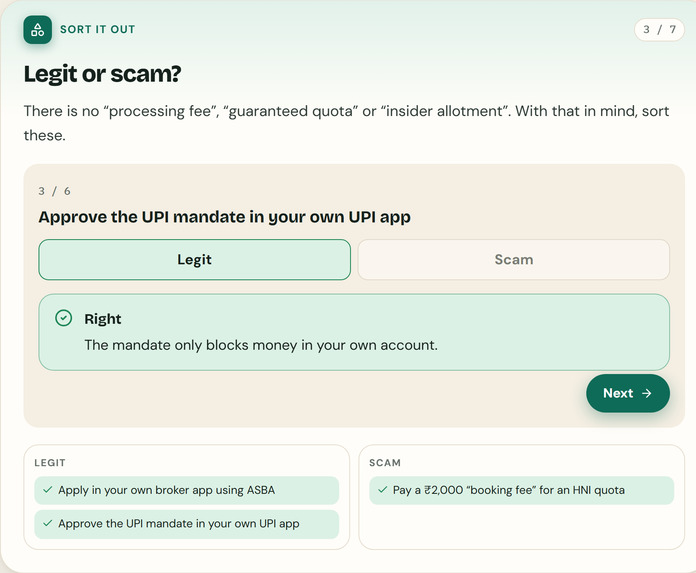
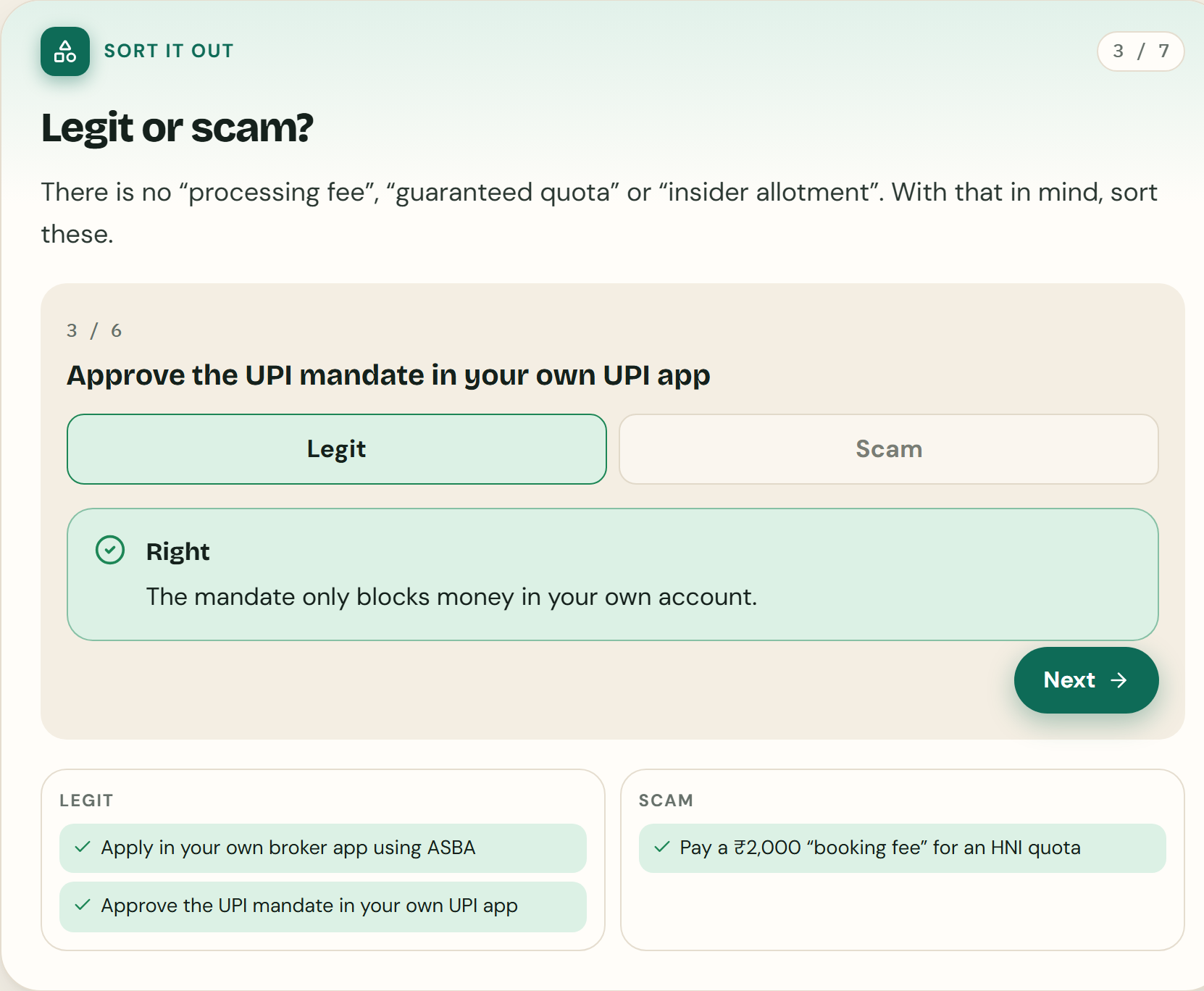
Legit or scam? Sort real-world offers into buckets with instant feedback.
-
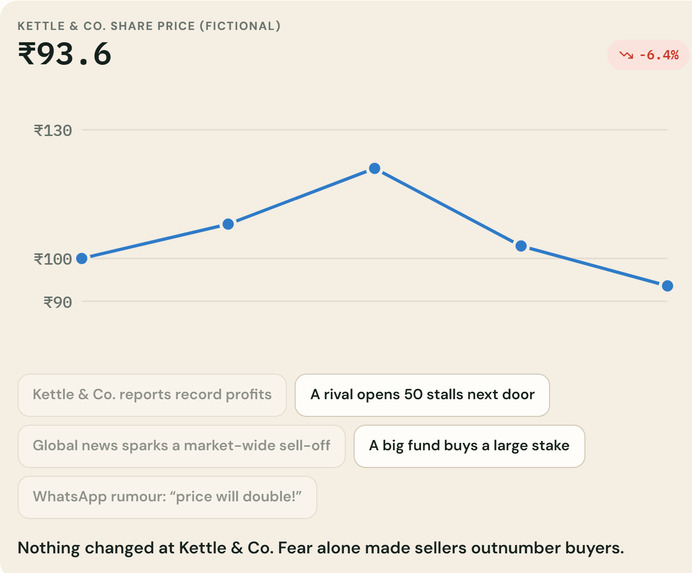
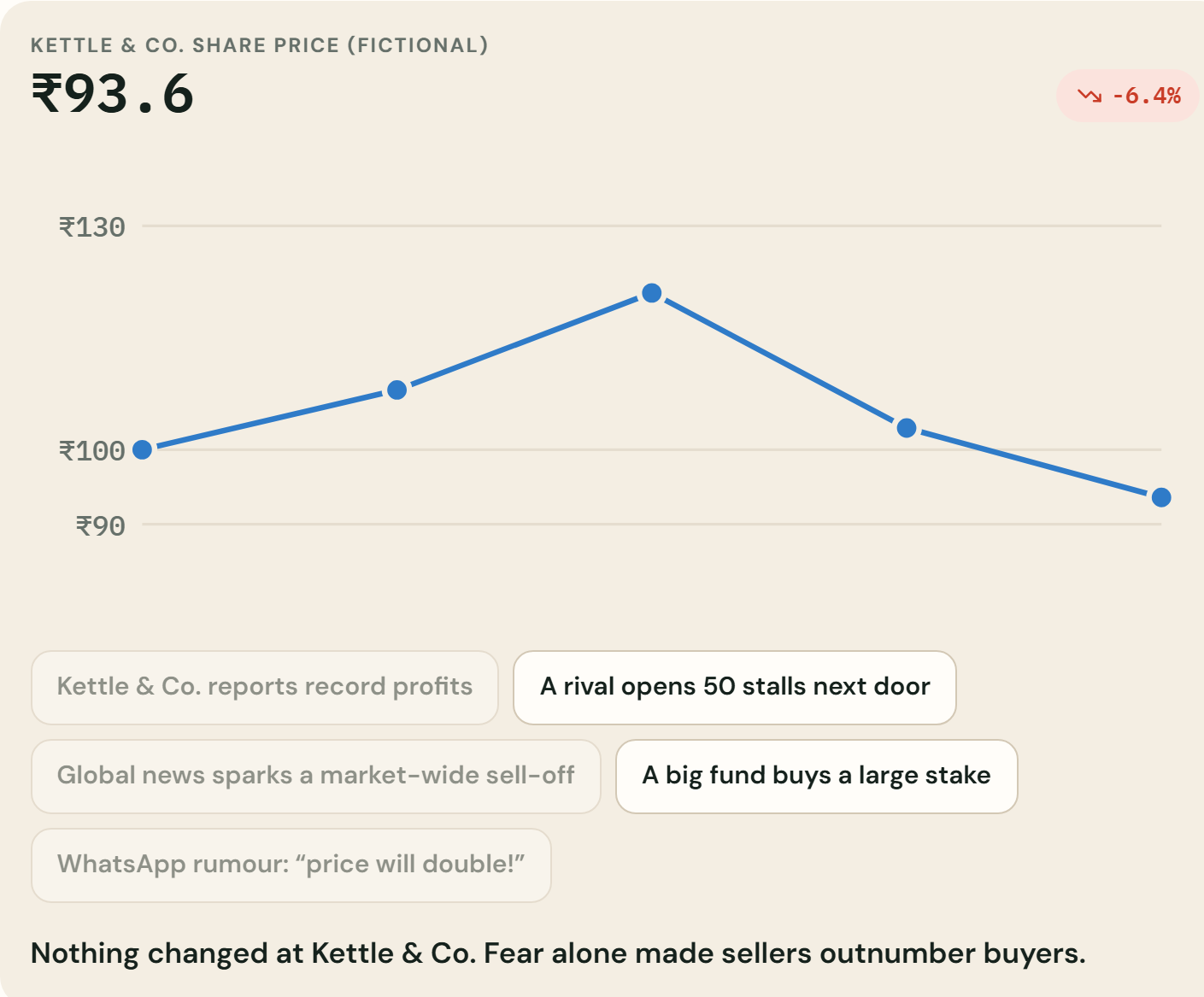
Price lab: watch how news moves buyers, sellers and a share's price.
-
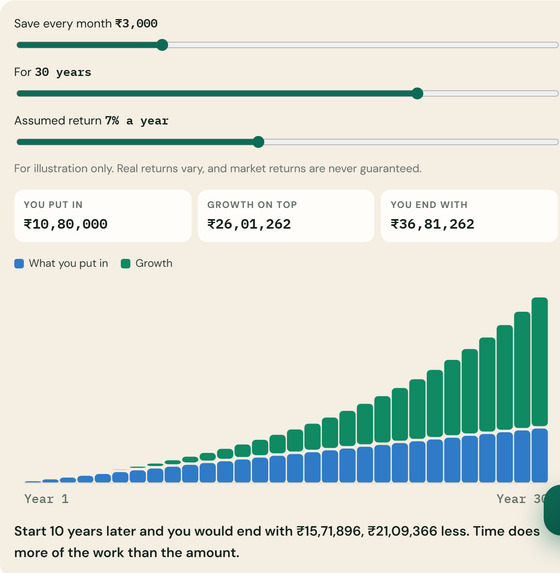
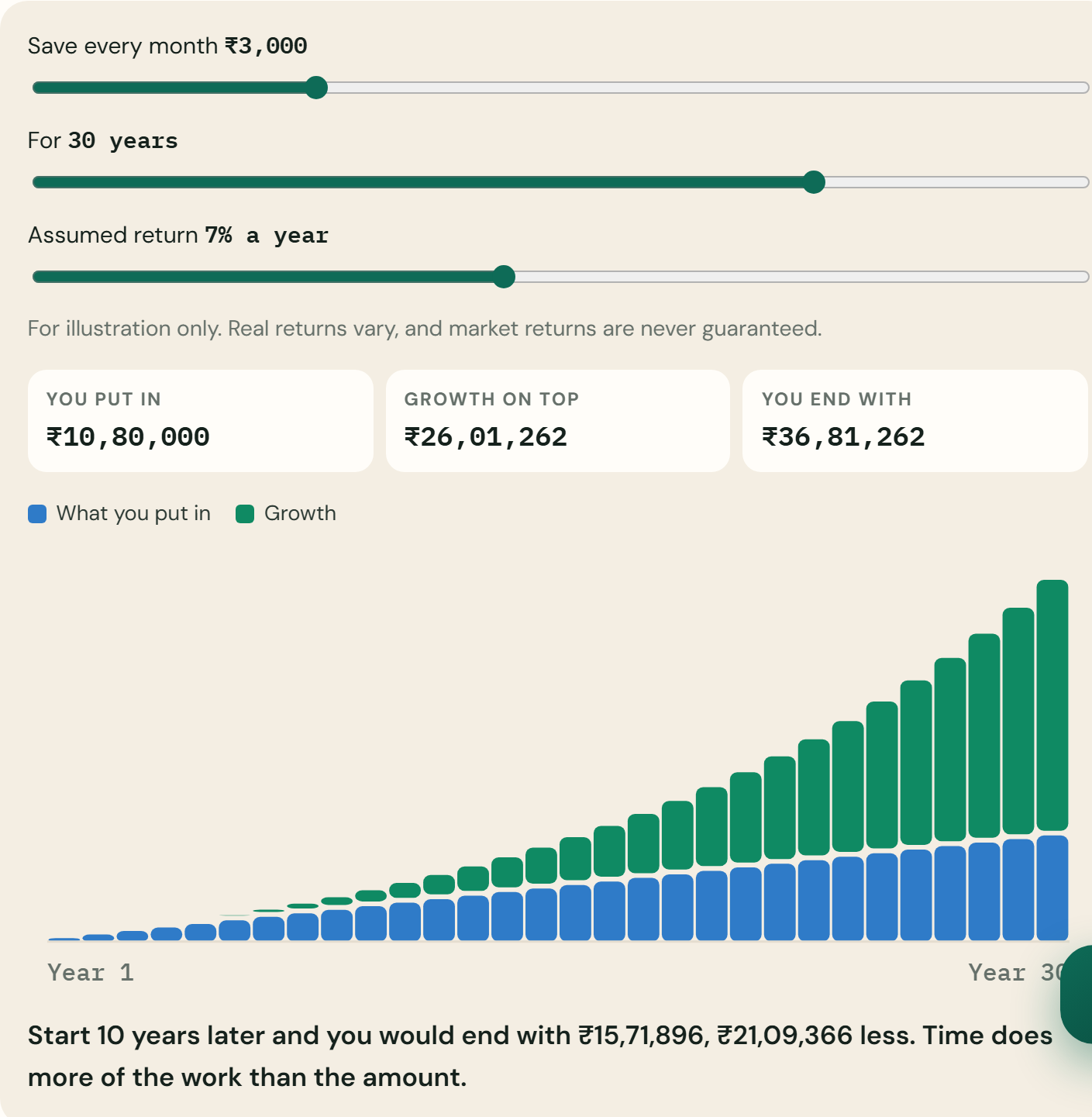
Compounding lab: drag the sliders and see why time beats amount.
-
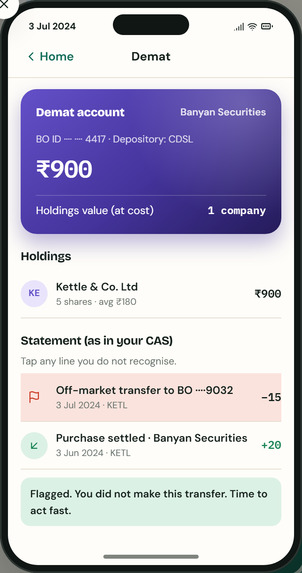
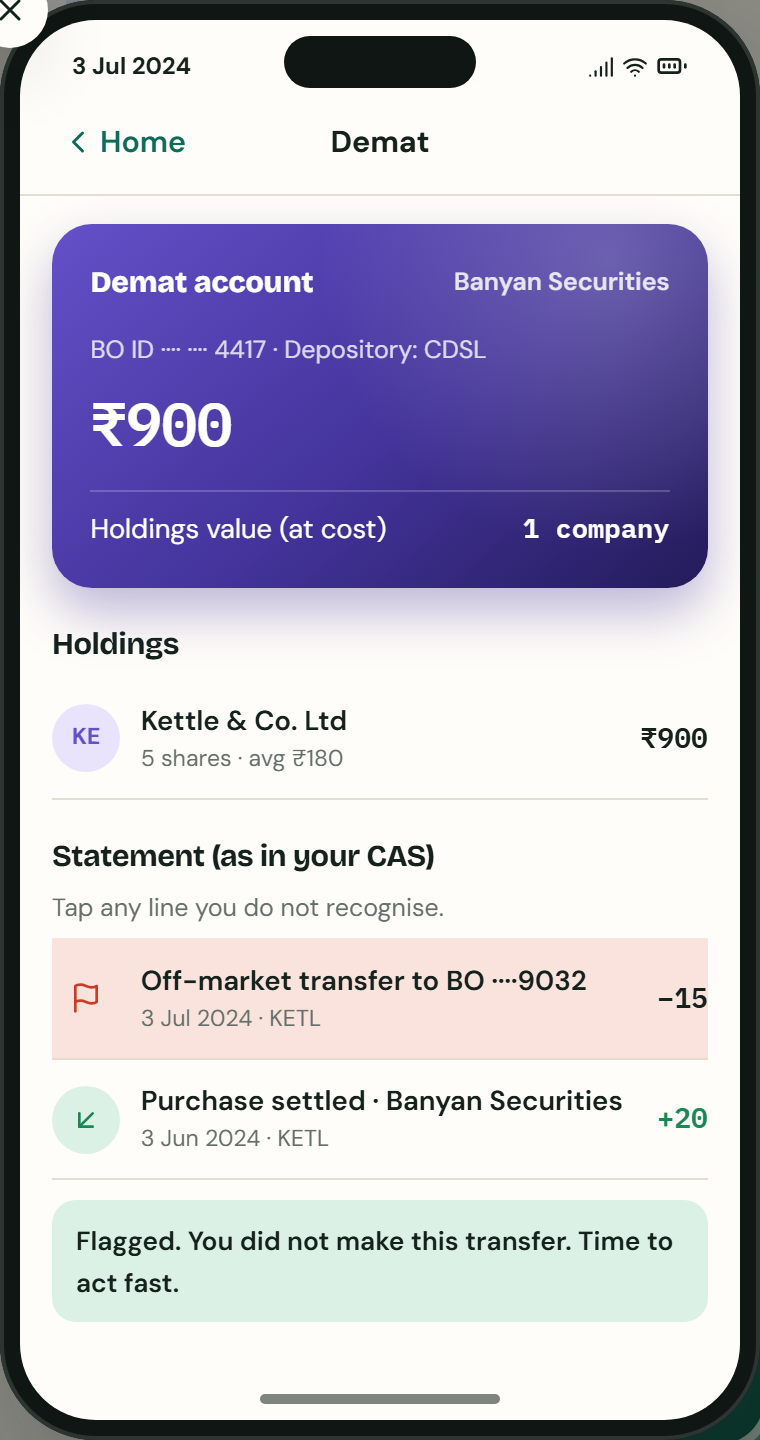
Spot the fraud in your own statement: an off-market transfer you never made, flagged.
-
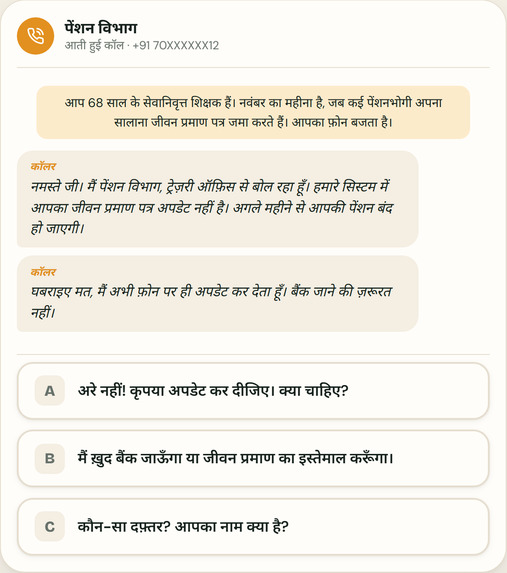
Made for everyone: The Pension Call fully in Hindi, with read-aloud and large text.
-
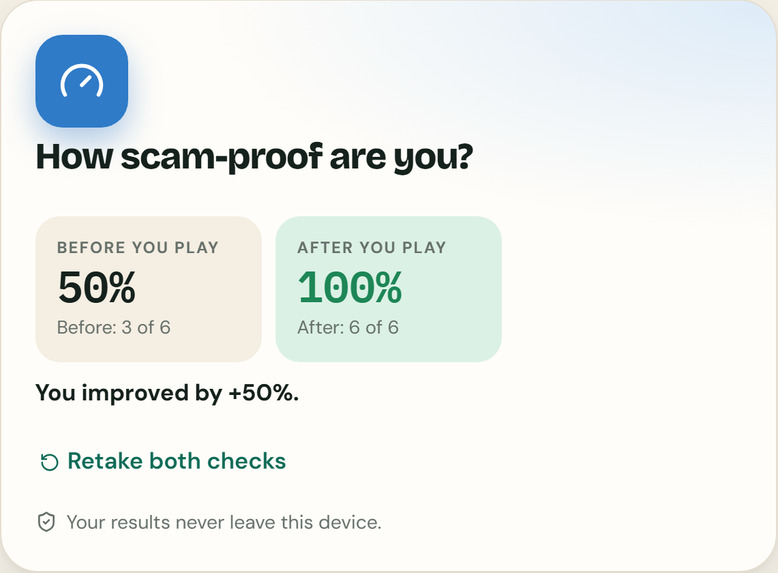
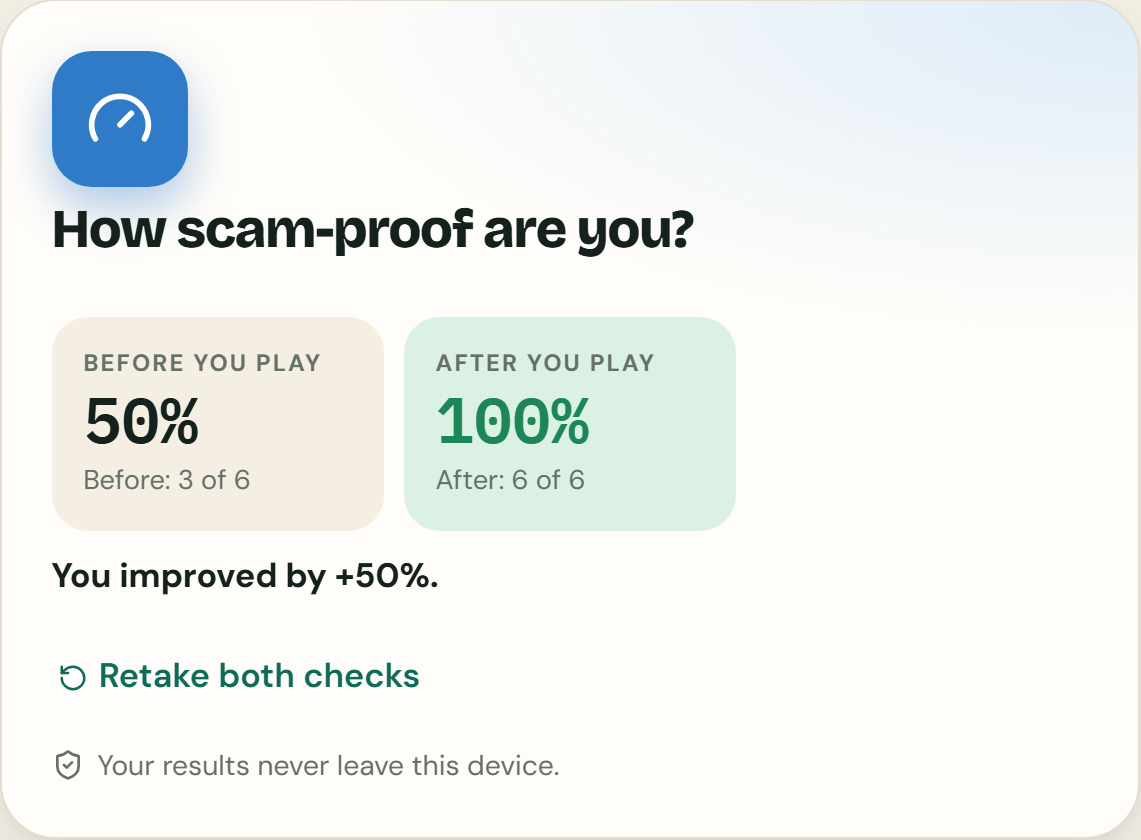
A built-in before/after self-check measures whether players actually got better at spotting scams.
-
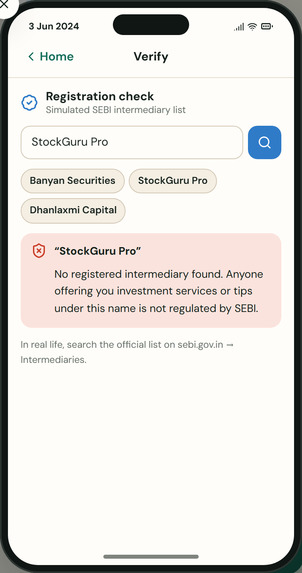
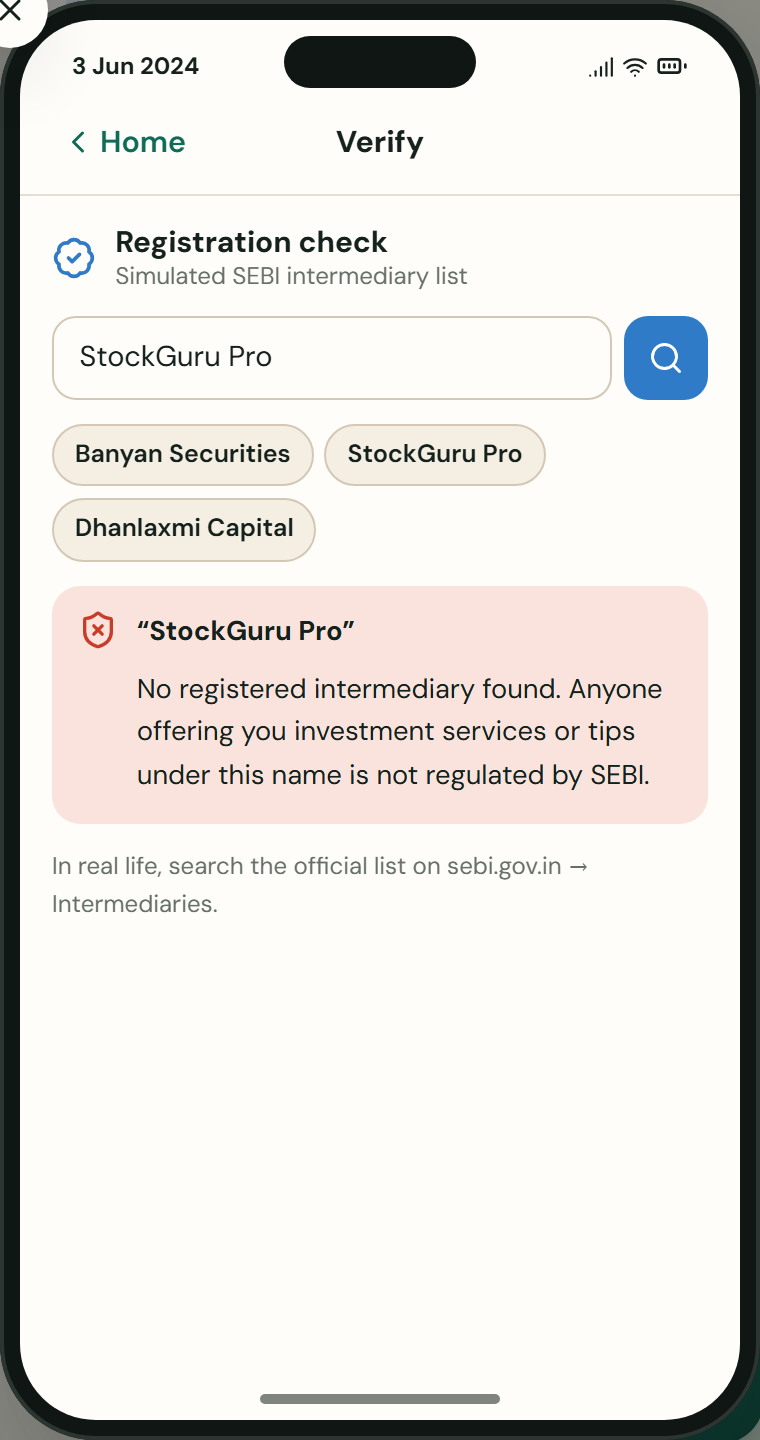
The virtual phone's Verify app: "StockGuru Pro" is not SEBI-registered. Check before you trust.
Inspiration
A "police officer" on a WhatsApp video call tells you a parcel in your name was seized with drugs inside, and that you're under digital arrest. A "pension officer" asks you to read out an OTP that, in small print, actually says add beneficiary. A stock-tip group promises a share that's about to fly.
Scams like these now reach people directly on their phones, and they hit hardest the people with the least practice spotting them: seniors, students and first-time investors. India's investor education works when people actually take it. In SEBI's Investor Survey 2025, 91% of people who attended a programme found it highly useful, but fewer than 1% had ever attended one. Only about 9.5% of households invest at all, and 51% of non-investors name trust as a barrier.
We realised the problem isn't information; it's rehearsal. Nobody reads a circular in the middle of a "police" video call. So we asked: what if you could get scammed safely, once, in a simulation, so the real thing feels familiar? Research on "inoculation" games such as Bad News (University of Cambridge) shows that playing through a manipulation builds resistance to it. We wanted to bring that idea to money and investing.
What it does
FinSim: get scammed here, so you never get scammed out there. It's a free, browser-based platform with two doors:
Six two-minute scam games, each a link you can forward on WhatsApp:
- The Digital Arrest: get off a fake "Cyber Crime Branch" video call
- The Pension Call: notice that the OTP really says add beneficiary
- Real or Deepfake?: judge cloned voices, fake celebrity ads and fake SEBI notices
- The Tip Group: resist a pump-and-dump "VIP tips" group
- Red Flag Rush: tap every red flag in three scams in 75 seconds
- The Golden Hour: spend the first 60 minutes after a fraud wisely
You make one choice at a time, and the story reacts. Every game ends with a debrief: a score, a review of each choice, the red flags explained, and the real-world steps if it ever happens for real (call 1930, report at cybercrime.gov.in, freeze your account). A share bar lets you challenge friends and family: "I scored 80, can you?"
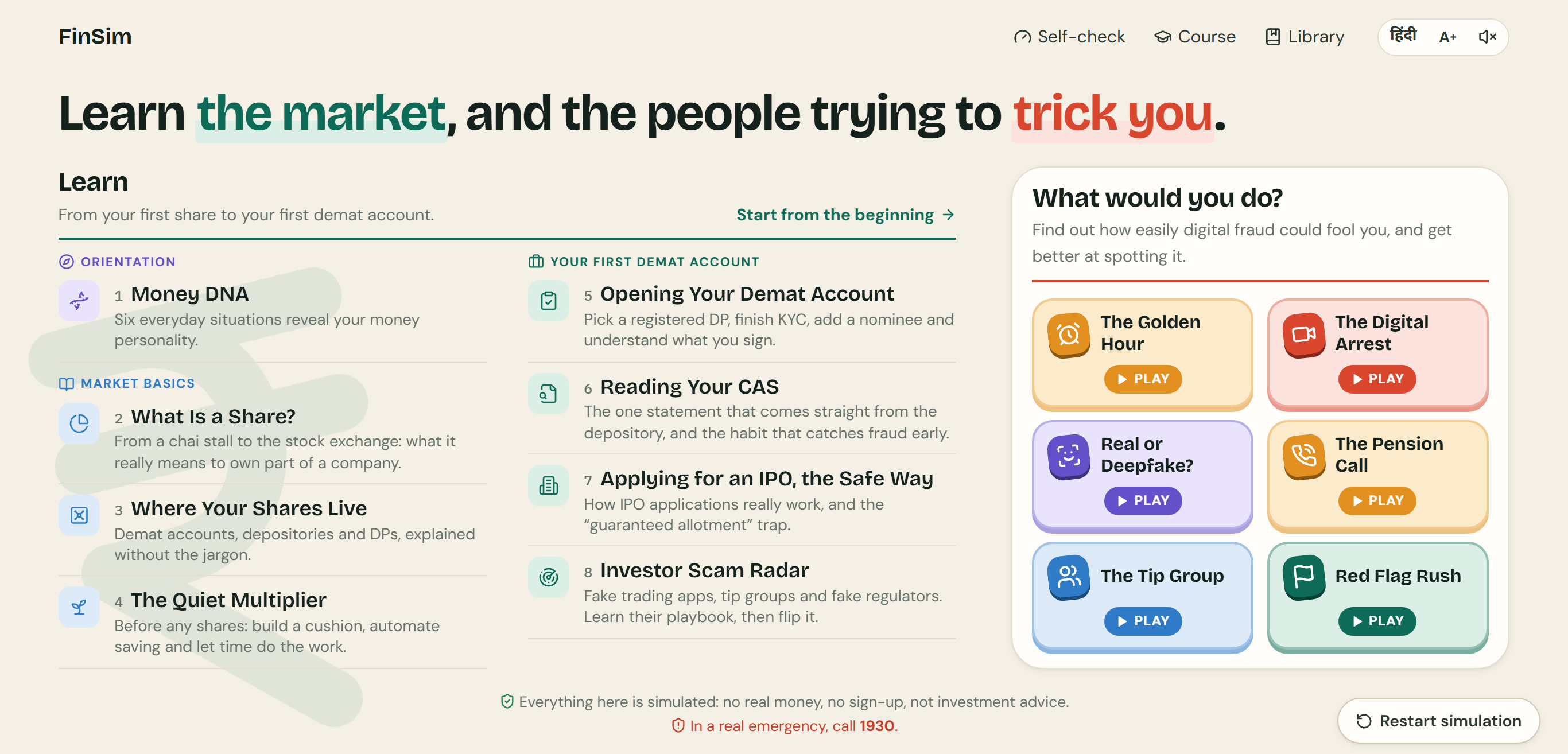
An investor course: 8 chapters and 54 interactive screens, from "what is a share?" to opening a demat account, reading your account statement (CAS) and applying for an IPO safely. It teaches through interaction first (sorting, sequencing, a price lab, a compounding lab) and quizzes second. A virtual phone with Messages, Bank, Demat and a SEBI-registration "Verify" app makes it concrete. Fall for a scam and it really debits your simulated savings, and the loss stays on your statement.
Your progress feeds a simple financial health score:
$$\text{Health score} = \overbrace{\text{Cushion}}^{40} + \overbrace{\text{Saving habit}}^{20} + \overbrace{\text{Fraud safety}}^{40} = 100$$
Built for everyone: English and Hindi with one tap, read-aloud for low-literacy users and seniors, large-text mode, and a built-in before/after self-check that measures whether you actually got better at spotting scams.
How we built it
FinSim is a React 18 + TypeScript single-page app built with Vite, routed with React Router, and with state in Zustand persisted to localStorage. Read-aloud uses the browser's built-in Web Speech API, so there's no external service. It's hosted as static files on GitHub Pages, with no server and no database.
The key design decision was content as data. Every game and every course screen is a plain TypeScript object. A small set of generic renderers turns them into experiences: a chat player, a real-or-fake player, a flag-rush player, and screen views for explore, sort, order, labs, quizzes and phone tasks. Adding a new scam or a new language needs no new components.
Screens never change state directly. Instead, they declare effects such as debit, scamLoss, buyShares, advanceDays or unlockApp, and a simulation engine applies them, moving the calendar forward, running recurring-deposit instalments and updating net worth.
Challenges we ran into
- Never charging a loss twice. Players reload, replay and jump between chapters, so the engine applies each screen's effects exactly once, even across reloads, and a scam loss is never double-counted.
- Starting anywhere. We wanted learners to open any chapter directly, but later chapters assume you already own shares or have savings. Chapters now declare what they need, and the engine quietly sets it up on entry without disturbing players who already have it.
- Realistic but responsible. Scams had to feel real enough to teach, without teaching anyone to scam or pointing to real products. Every company, bank, broker and app is fictional, and points come from verifying and pausing, never from "picking winners".
- Static hosting quirks. GitHub Pages only serves real files, so refreshing a page or opening a shared link returned 404s. We switched the Pages build to hash routes so every shared game link just works.
- Measuring learning, not memory. A before/after quiz with the same questions just tests recall, so we wrote two equivalent sets of six messages for the self-check.
Accomplishments that we're proud of
- A complete, working product: 6 games, 8 chapters, 54 screens, 15 plain-language library articles
- Fully playable in Hindi, with read-aloud, so it reaches people who would never read an English pamphlet
- Privacy by design: no login, no names, no phone numbers. FinSim never asks for a PAN, Aadhaar, OTP or password, and teaches users to treat any such request as a red flag. Share links carry only the game's id.
- Built-in impact measurement from day one
What we learned
- Behaviour change beats information. The moment a player loses their (virtual) savings and sees exactly how it happened teaches more than any list of tips.
- Accessibility is a feature, not a polish step. Read-aloud, large text and Hindi shaped the layout from the start.
- Data-driven design pays off. Treating content as data made it fast to add games, fix wording and translate.
- A lot about India's securities plumbing: depositories, DPs, the CAS, ASBA and how real investor frauds actually unfold.
What's next for FinSim
- Validate with real users at colleges and a senior citizens' association, using the built-in self-check to measure impact
- Hindi for the full course, then more regional languages
- A lite mode for slow networks
- New games as new scams appear, built from official advisories
- Distribution where investors already are: a "Can you spot the scam? Play in 2 minutes" link in broker onboarding and account-statement emails could reach millions of people at almost no cost
Built With
- css3
- github
- google-fonts
- html5
- javascript
- localstorage
- lucide-react
- node.js
- npm
- react
- react-router
- typescript
- vite
- web-speech-api
- zustand
