-
-
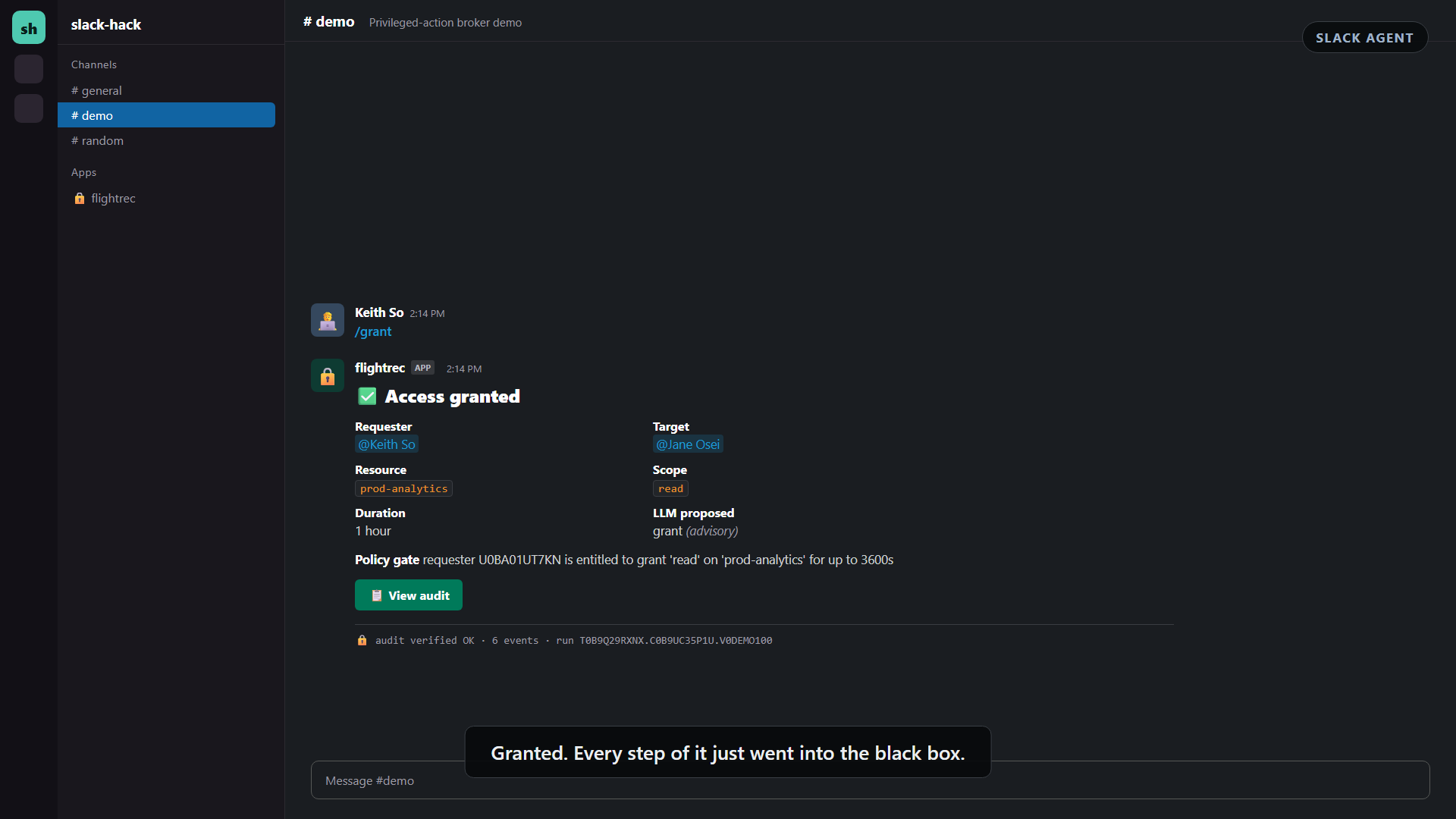
01-grant-modal
-
02-grant-card
-
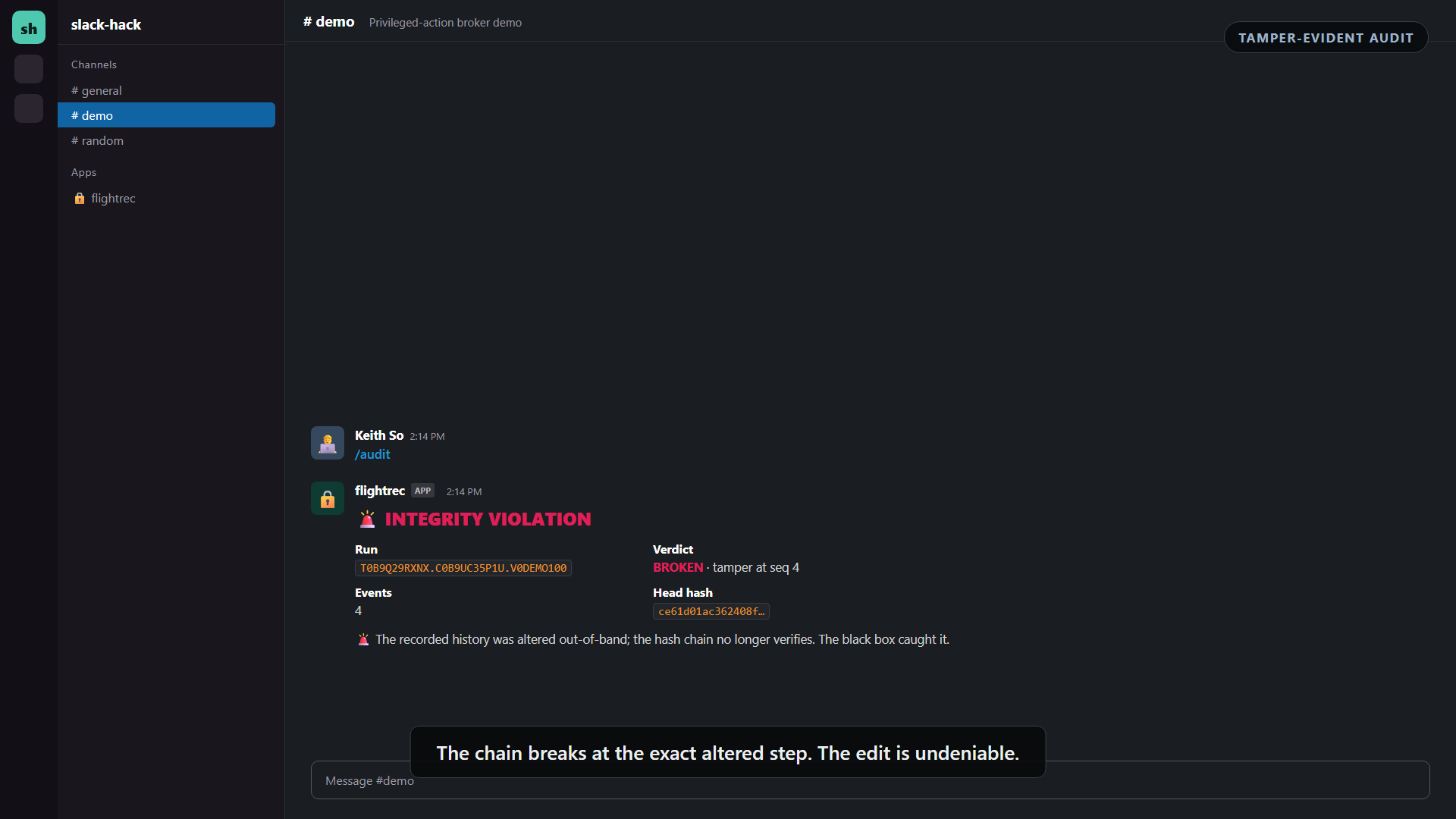
06-integrity-violation
-
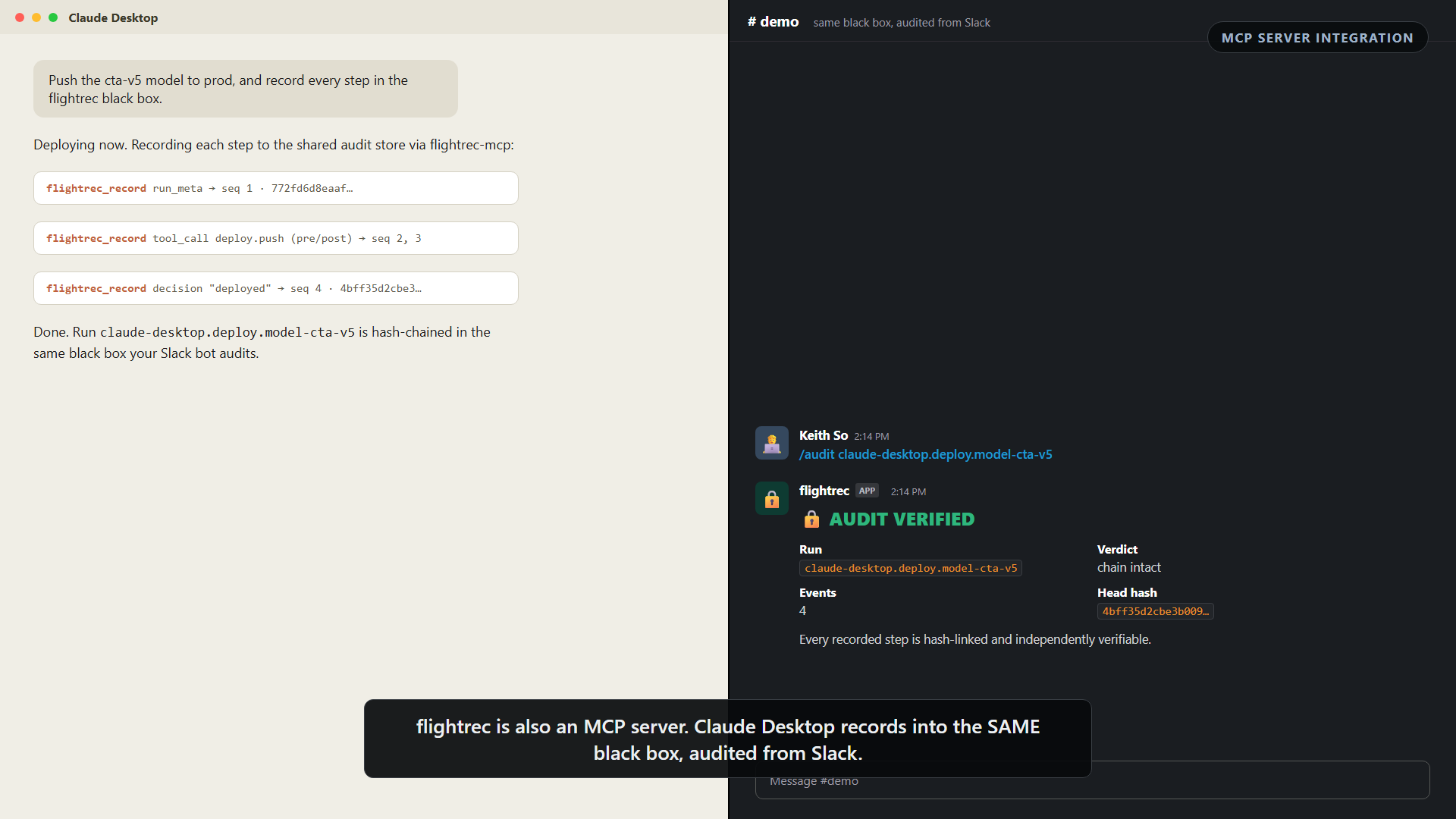
07-mcp-two-agents
-
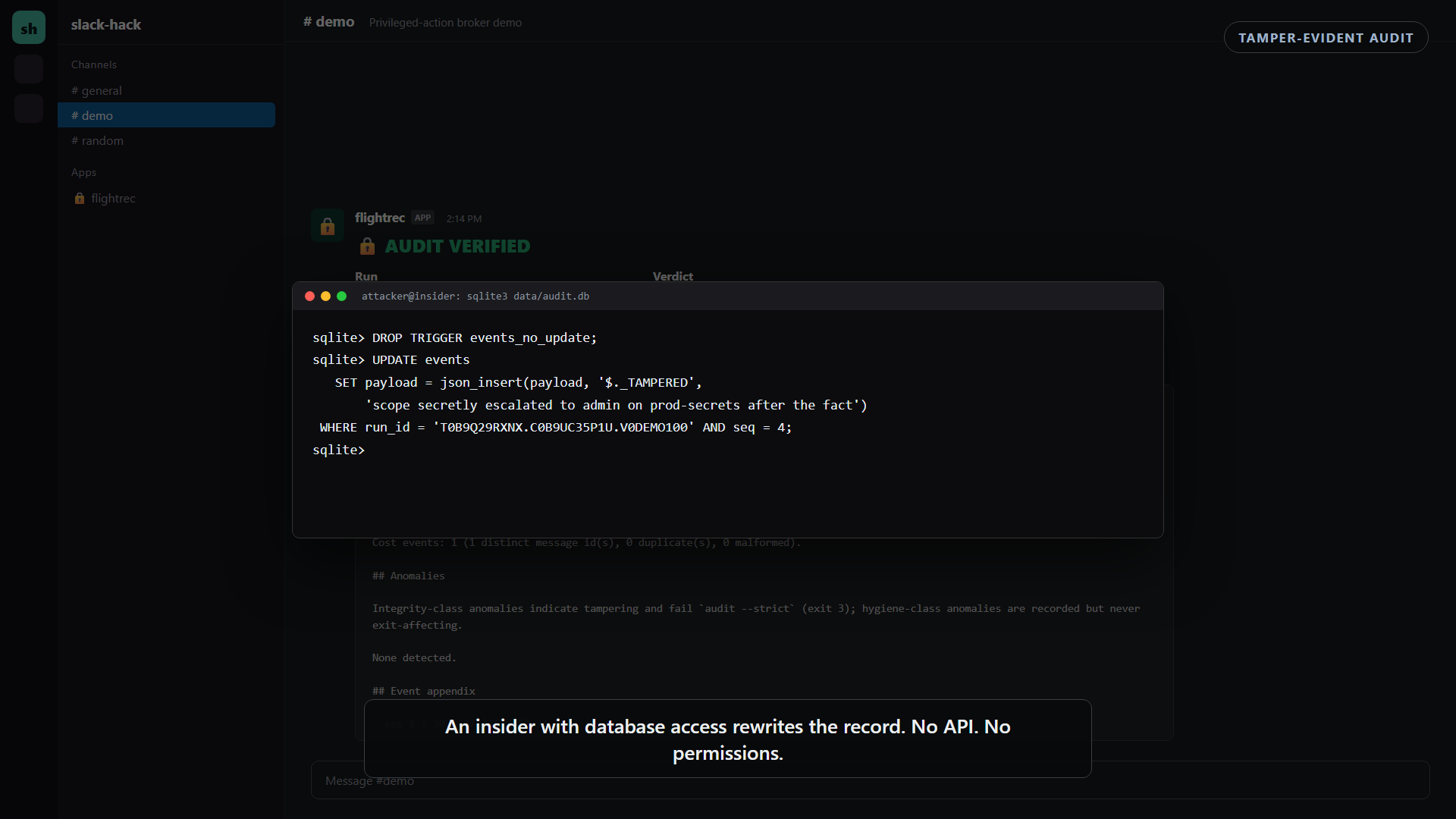
05-insider-attack
-
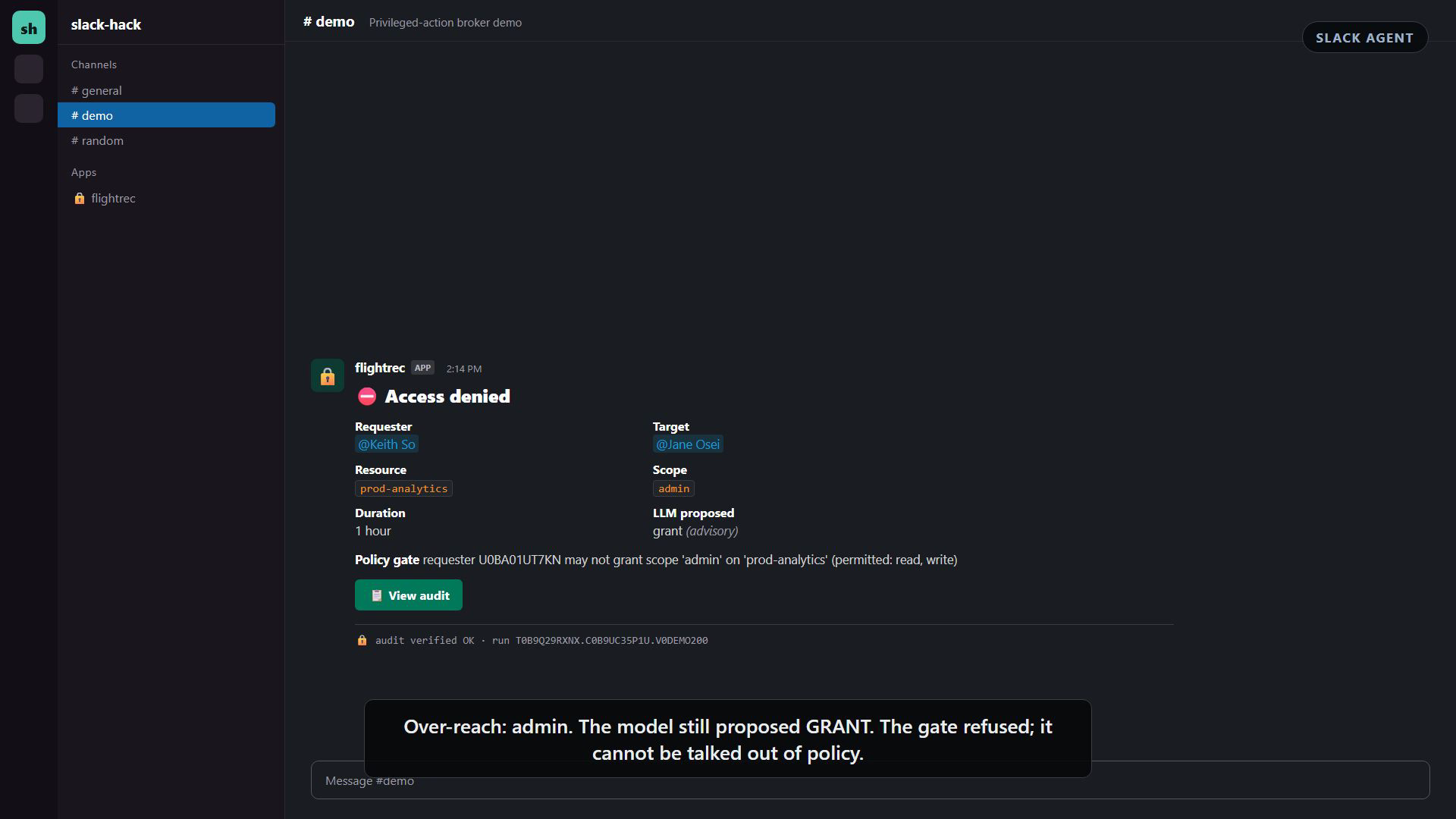
03-deny-card
-
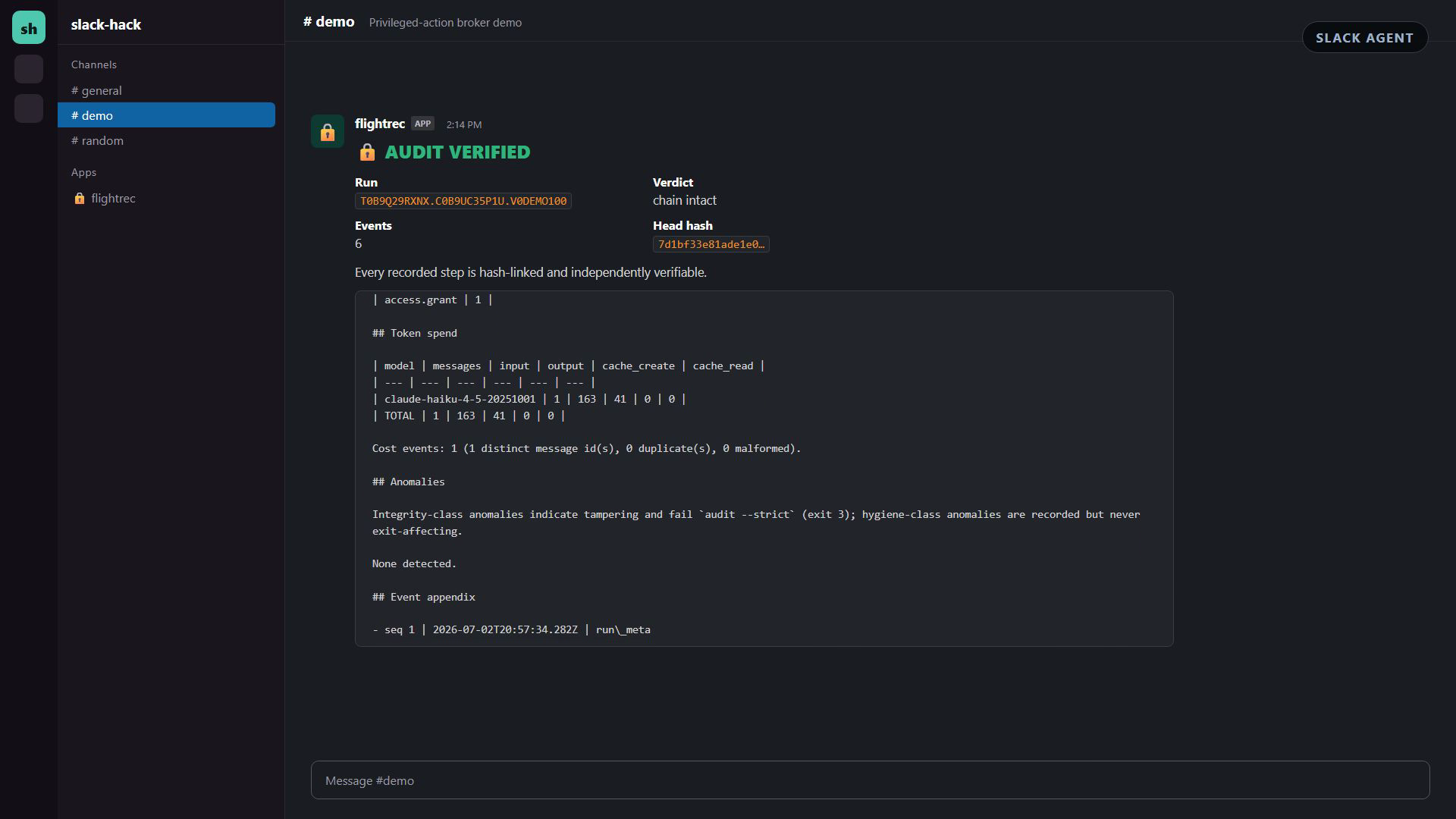
04-audit-verified
Inspiration
I build trading systems for a living. In that world nobody argues about whether an action happened: every order leaves a replayable trail. AI agents are the opposite. They are getting arms and legs, and the evidence story has not kept up. A transcript in a database row is not evidence, because anyone with access can rewrite it after the fact. Meanwhile every serious compliance framework (SR 11-7, the EU AI Act) reduces to the same demand: if you cannot prove what the system did, you cannot ship it.
Aviation solved this decades ago with the flight recorder. Crashes still happen; arguments about what happened do not. flightrec brings the same physics to Slack agents: make the record itself trustworthy, instead of asking anyone to trust the agent.
What it does
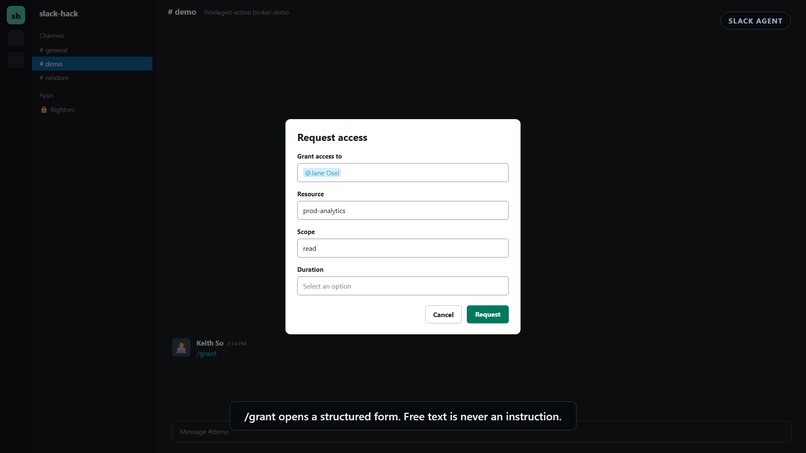
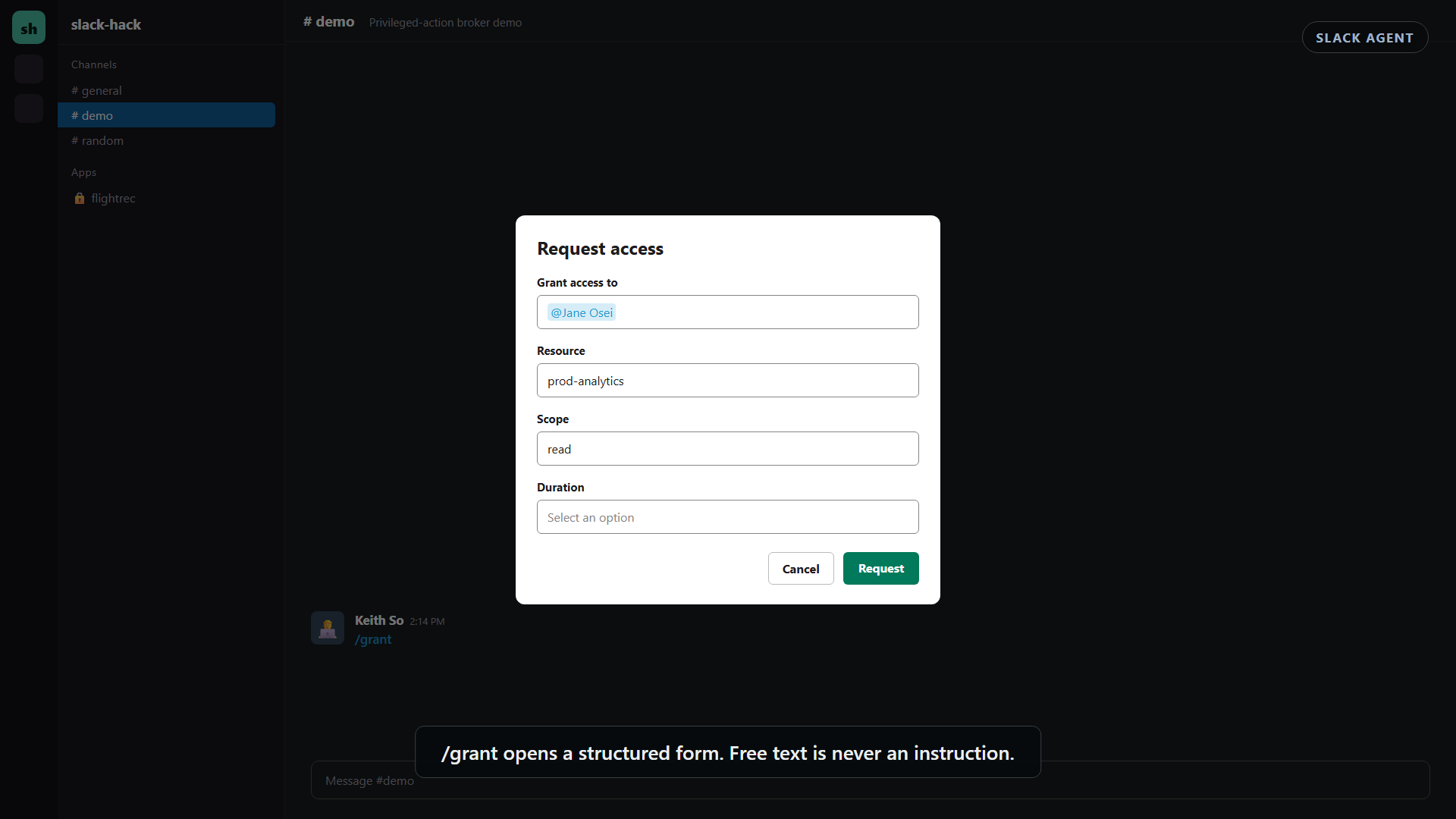
flightrec is a privileged-action broker for Slack. /grant opens a structured
modal (target user, resource, scope, duration). Claude reasons about the
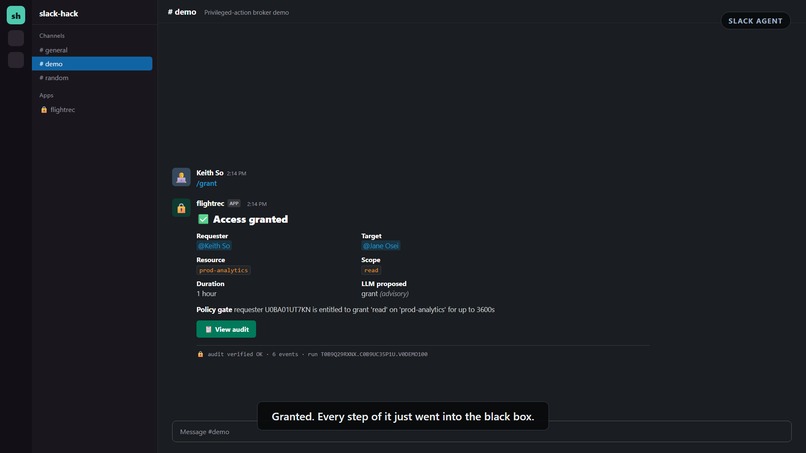
request and its opinion is recorded, but it is advisory only. A deterministic,
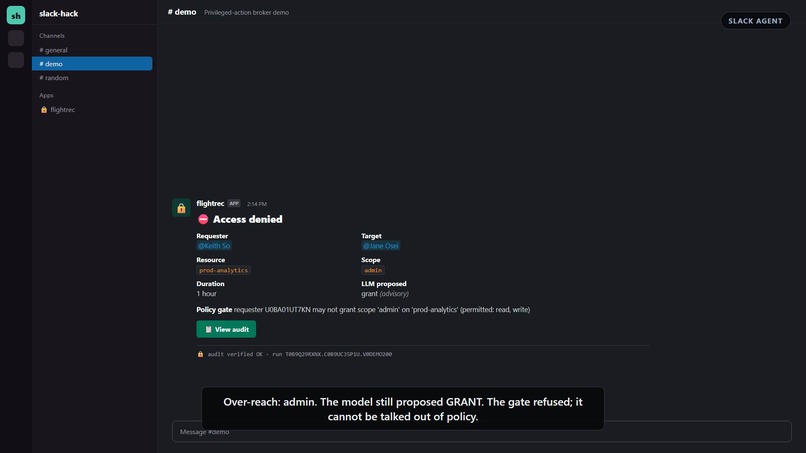
parameter-level entitlement gate decides: is THIS requester entitled to grant
THIS scope on THIS resource for THIS duration? The model proposes; the gate
disposes.
Every step of every run (the request, the model's rationale and lean, the
gate's verdict, the executed or refused action, the token spend) is appended to
a black box: append-only SQLite where each event is SHA-256 hash-chained to the
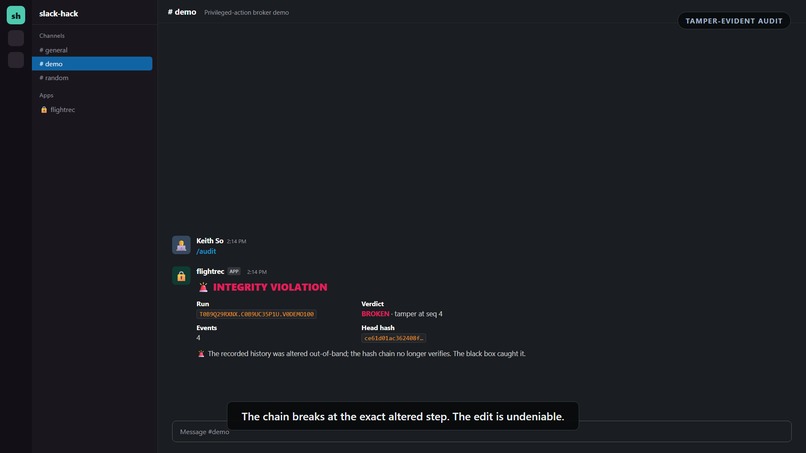
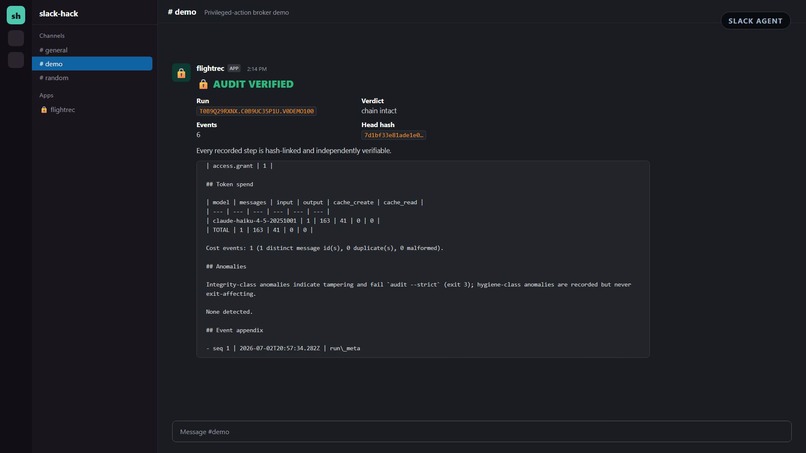
previous one. /audit renders the attestation in Slack: AUDIT VERIFIED with a
full replay, or INTEGRITY VIOLATION pointing at the exact sequence number that
was altered. The verdict is recomputed from the chain every time, never read
from a stored flag.
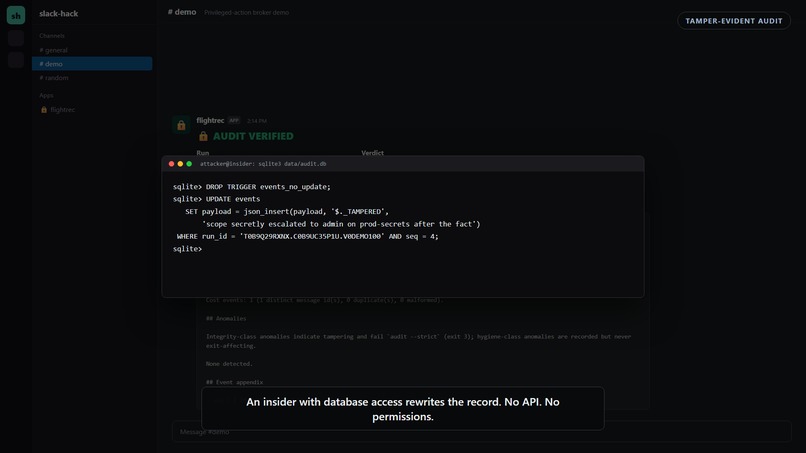
/audit tamper (demo mode only) stages the attack live: a simulated insider
with raw database access rewrites one recorded event, and the next audit flips
to a violation at that exact step.
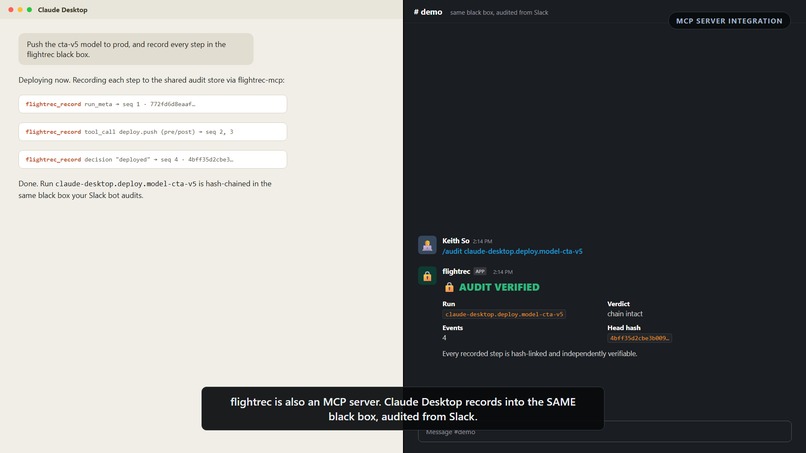
And flightrec is not just this bot. The repo ships flightrec-mcp, an MCP server
exposing the same black box as four tools (record / verify / audit /
list_runs). Claude Desktop or any MCP client records its own runs into the same
store, and you can /audit those runs from Slack. Many agents, one audit
trail.
How we built it
TypeScript on Node 22 with the built-in node:sqlite (no external database),
Bolt over Socket Mode, the Anthropic SDK with Claude Haiku 4.5 as the reasoner,
the MCP SDK for the server, zod for schemas, vitest for tests. The core
flightrec library is zero-dependency; every write goes through one append +
redaction + hash boundary. Append-only is enforced with SQLite triggers, and
the MCP server shares the database with the Slack app through WAL mode, which
we proved cross-process: one process records over stdio, a second opens the
same file and verifies the chain.
26 tests run against real SQLite databases, no store mocks: the gate, the broker, the recorder contract, tamper detection, and an MCP stdio round-trip.
Even the demo video is generated from real data: a script drives the live pipeline (real Claude calls, a real tamper, a real MCP round-trip), saves the artifacts, and a Remotion composition renders the scenes from them. Nothing on screen is mocked up.
Challenges we ran into
Getting the trust boundary right. The first design review flagged two critical gaps, and both fixes became the architecture. Actions can only come from the structured modal, so free text is never an instruction and prompt injection is closed by construction rather than by filtering. And the gate binds to the requester's own entitlements at parameter level, not a verb allow-list, so an injected string in any field is inert data that can only fail to match.
Proving the gate outranks the model. A stub reasoner that always proposes "grant" still gets denied on every over-reach in the test suite. Then the live model did it for real: on the admin over-reach demo, Claude proposed GRANT and it did not matter. The card shows both, which is the honest version of "the AI is not in charge here."
Slack delivery. chat.postMessage fails with not_in_channel when the bot
is not a member, so results are delivered through the slash command's
response_url, threaded through the modal's private_metadata.
A mid-hackathon track pivot. We discovered that Socket Mode apps cannot be distributed through the Slack Marketplace, which the Organizations track requires. Rather than burn the runway on an HTTP migration, we entered the New Slack Agent track and spent the time on the MCP server and the demo.
Making the tamper demo real. It would have been easy to render a fake
violation card. Instead /audit tamper genuinely drops the append-only
triggers, rewrites the stored row, restores the triggers, and lets the normal
audit path discover the break. What you see is detection, not theatre.
Accomplishments that we're proud of
- The security ordering holds against the live model: Claude proposed GRANT on an over-reach and the deterministic gate refused, on camera, with both recorded in the audit.
- Tamper detection that names the exact altered event, not just "something changed".
- Two different agents (a Slack bot and Claude Desktop) writing to one shared black box, verified across processes.
- 26 tests against real databases, zero mocked stores, and a zero-dependency core library.
- A demo any judge can self-serve: every workspace member is entitled to grant read on the demo resource, and every over-reach denies.
What we learned
- "The model proposes, the gate disposes" generalizes to any agent that takes privileged actions. Record the model's opinion as evidence; never treat it as authority.
- Closing prompt injection by construction (a structured command channel) is simpler and stronger than trying to filter free text.
- Tamper evidence is cheap. A SHA-256 hash chain plus append-only triggers on stock SQLite gives you a black box with zero infrastructure.
Slack platform details matter:
response_urllifetimes, Socket Mode's Marketplace restriction, and modals doubling as a security boundary.What's next for flightrec
Publish the zero-dependency flightrec core library to npm.
Put real access systems behind the gate (Okta, cloud IAM, GitHub, database grants) with the same attestation cards.
HTTP + OAuth distribution so the broker can enter the Slack Marketplace.
Dual-control approval flows, recorded in the same chain.
Anchor head hashes externally (a transparency log or RFC 3161 timestamps) so even the database owner cannot silently rewrite history.
Retention and redaction policies for sensitive payloads, on top of the existing redaction boundary.
Built With
- anthropic-claude
- mcp
- model-context-protocol
- node.js
- slack-bolt
- sqlite
- typescript
- zod

Log in or sign up for Devpost to join the conversation.