-
-
Accurate Airport Arrival Web Application Prototype
Inspiration
People for years have gone on instinct to know when to leave in order to get to the airport. Typically this is spread into two groups, the ultra prepared and the late people. Both situations are bad. Imagine thinking you have a 40-minute drive so you leave 1 hour before boarding. Seem reasonable, right? But most of the time there will be traffic, parking is a disaster, walk-time is longer than you thought, security takes longer than you thought, and you end up running to your gate in a tragic hope to get there on time only to see that they had already taken off and you need to reschedule. The other option is coming very early. You leave 4 hours early, a 40-minute drive, you end up waiting 2 hours for the boarding time. Both options are not great.
This has been a long-standing issue that no one has yet found a solution to other than get there early enough to where you won't be chastised by literally everyone. A way to know exactly, or at least an accurate estimate, of the time that it would take to get to the gate with everything considered would be very useful.
What it does**
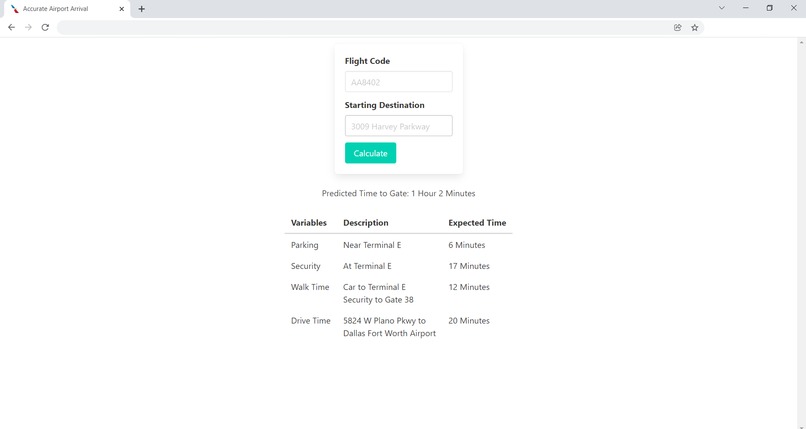
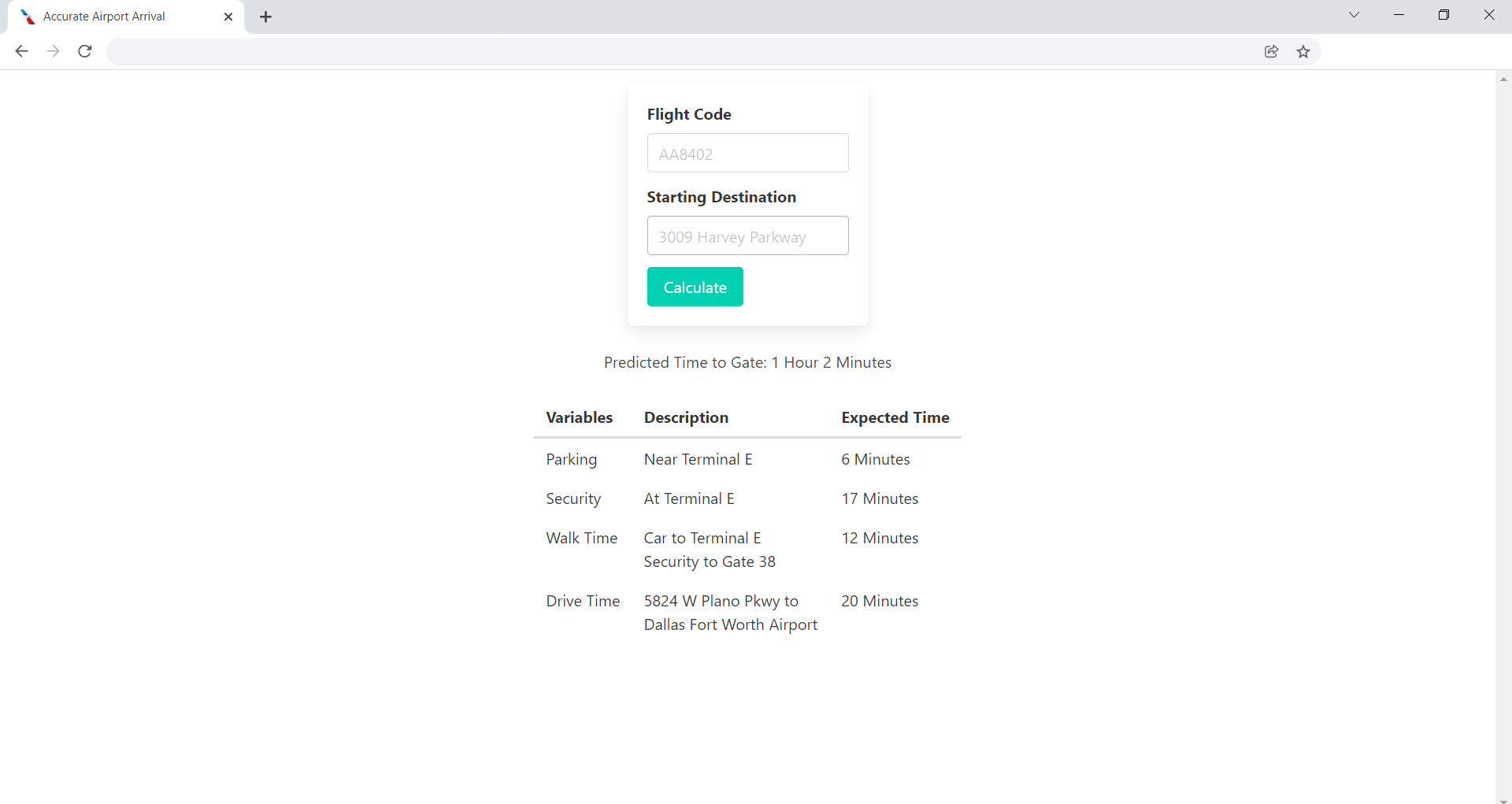
It is a program that you input your Flight ID along with your starting destination to show you the estimated time from your starting location to the correct gate given that exact time. This is based on real-time data from security lines, traffic, walk-time, and parking. It will also show the most optimal time, and how to achieve the optimal time by driver routes, walking routes, less crowded security terminals, and the best parking lots to park in.
This not only helps the user by providing the optimal timing based on data to arrive at the airport, but it also helps the airlines and airports. By having more people come on time to their planes they will have fewer flight delays and less congestion in the airport.
How we built it
We initially started with HTML and CSS to create the basic format of the website. After that, we worked on the interactive, real-time React server. We ended with building it with maint HTML, CSS, and JavaScript to where it acts as a prototype for what we want it to do in the future.
Challenges we ran into
One of the challenges we ran into was understanding the backend programming side of the project. It was difficult because we were not familiar with this and our communication on this issue was not amazing. While we were not prepared for this aspect, we all still were familiar with programming and once we had gotten to that part we had worked a lot more efficiently.
Accomplishments that we're proud of
We are proud of the creation of a functional project, the idea, and what we learned as we went through the process. In addition, we had created a video to show off the prototype that demonstrates the idea that we are also proud of.
What we learned
Next time we need to come prepared to communicate much better and we also need to ensure that we each study up on skills for next time. We also learned to not focus too much on anything that we are learning for the first time since it is much harder to do than we thought.
What's next
After further development, partnering with airports and airlines to retrieve accurate data that could be spread to the users. In the future, it could consider more aspects of the way into an airport to give more accurate estimates. In addition, the web application could include a more user-friendly experience by showing things like projected time of arrival if you leave now, the optimal time to leave, a system that projects how crowded it will be in the future from past data and analysis, and also turning it into a phone application.
Making the application user-friendly and functional are the two main goals to get the user to want to use the application.
**Data and Times shown are made out of test cases for prototyping


Log in or sign up for Devpost to join the conversation.