-
-
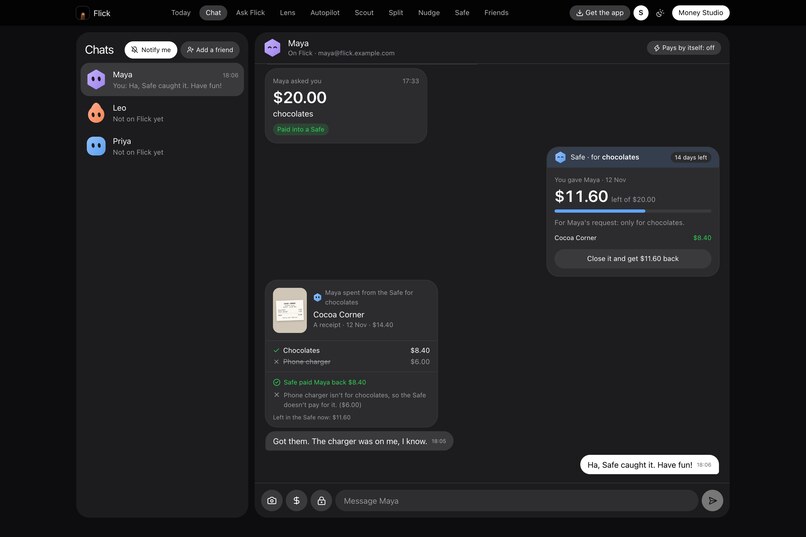
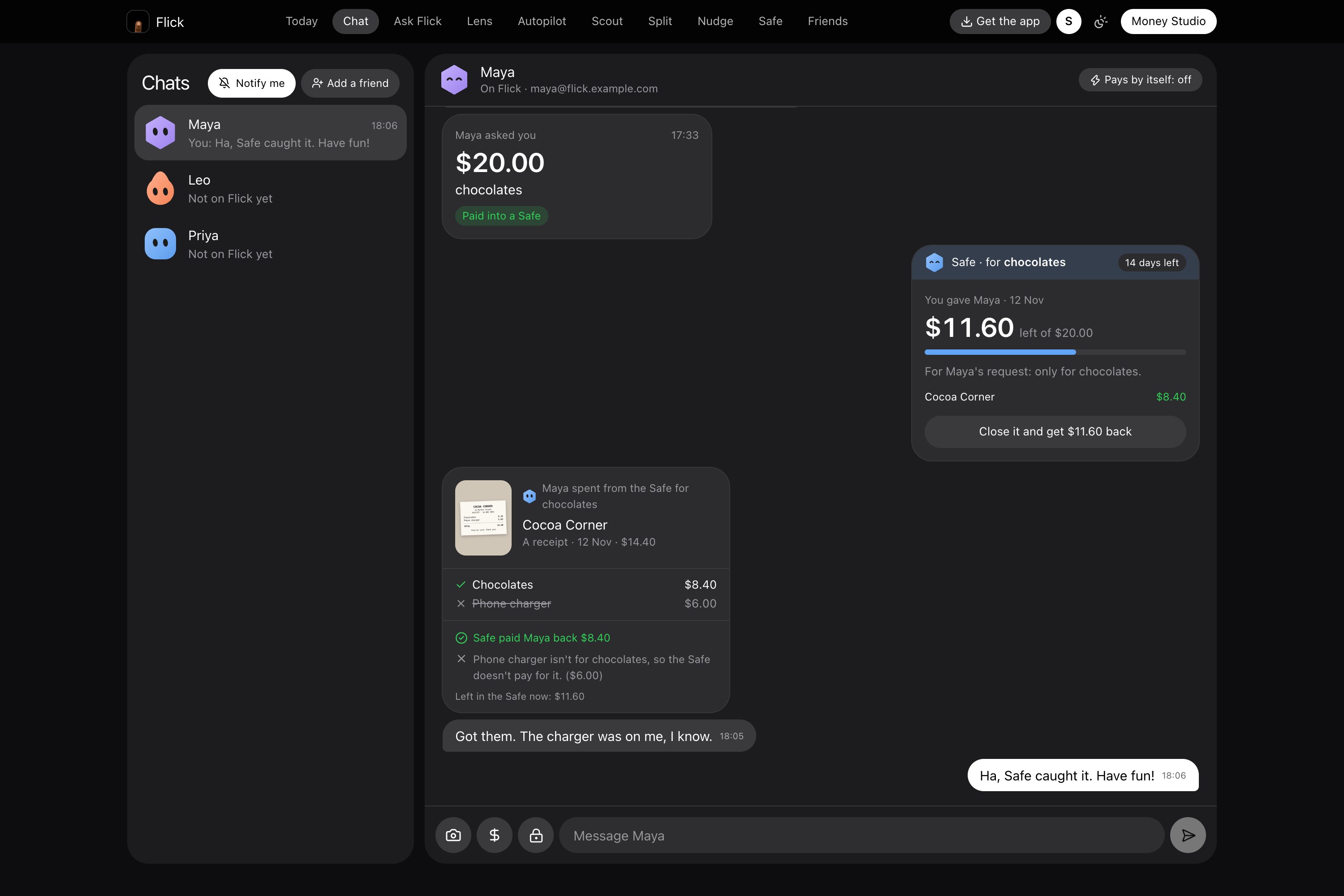
Safe: Maya's $20 for chocolates, paid into a Safe; her receipt pays $8.40 and the charger never
-
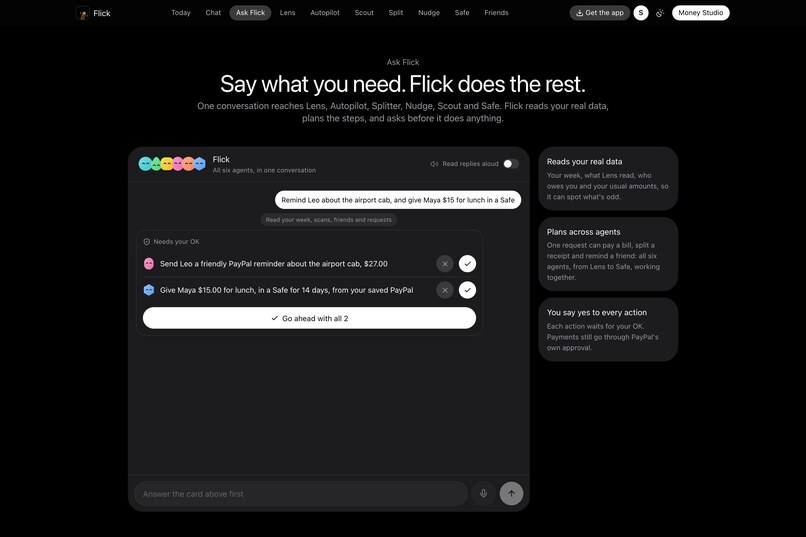
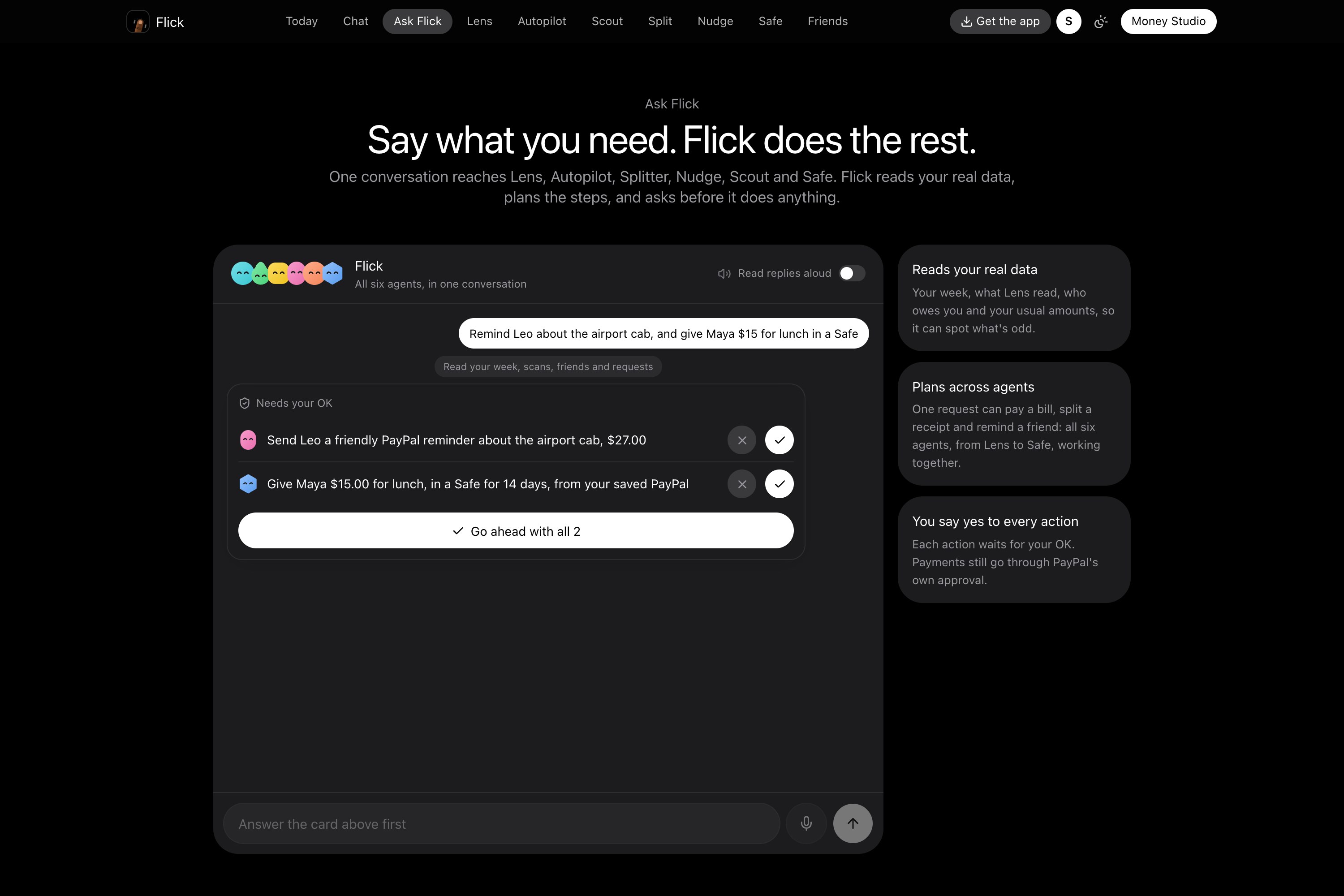
Ask Flick with the real model: one sentence, two approval cards (Nudge and Safe)
-
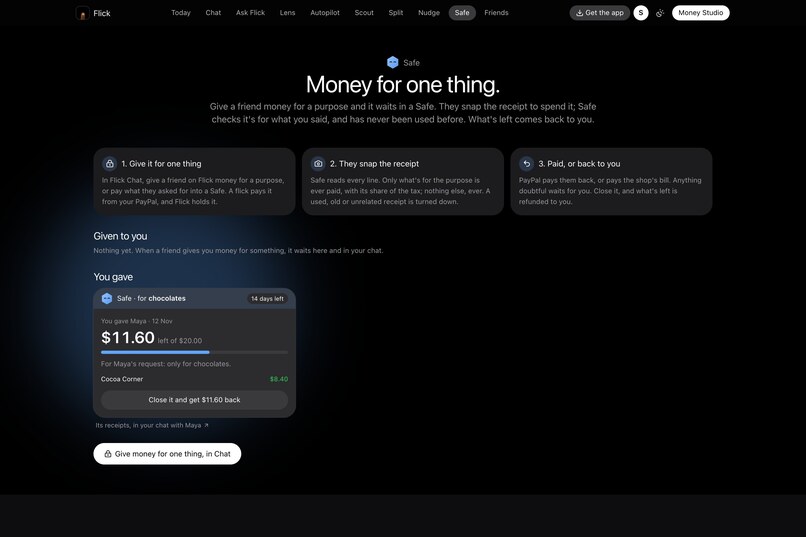
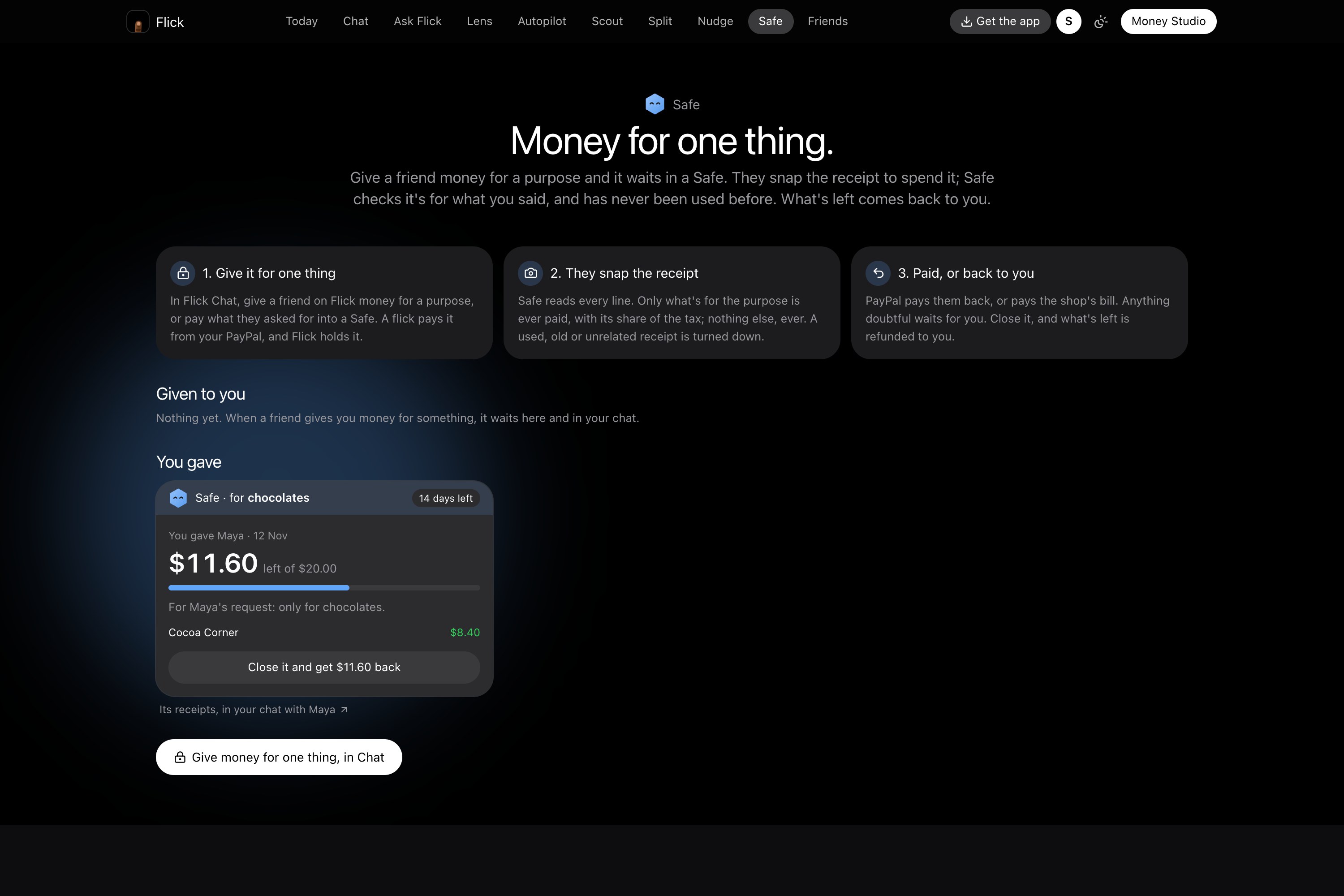
The Safe page: how it works, and your Safes
-
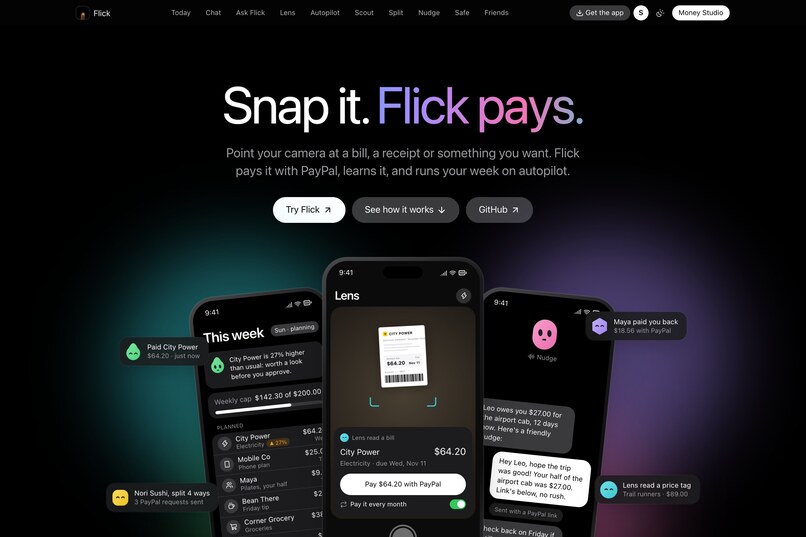
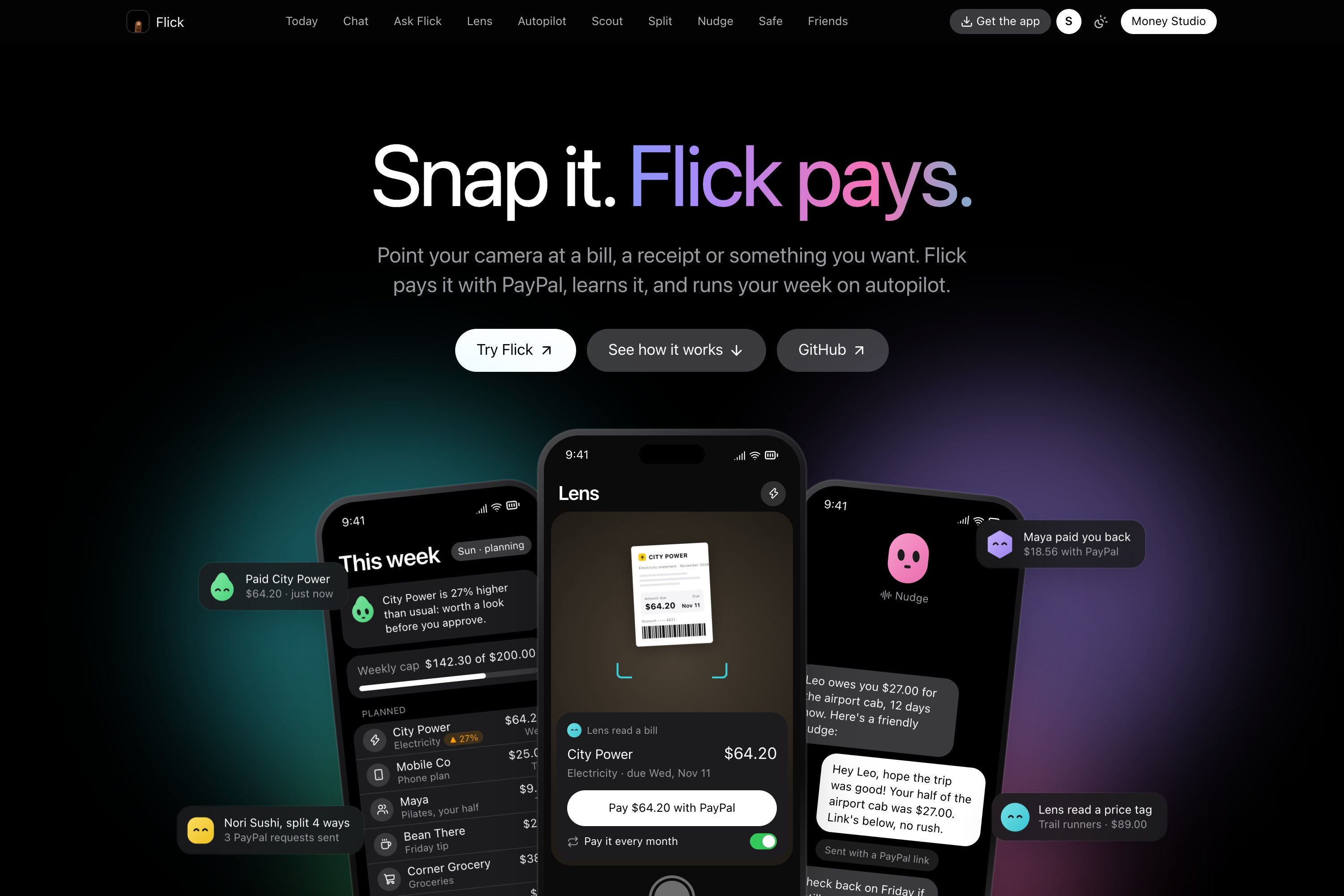
The one-pager: "Snap it. Flick pays."
-
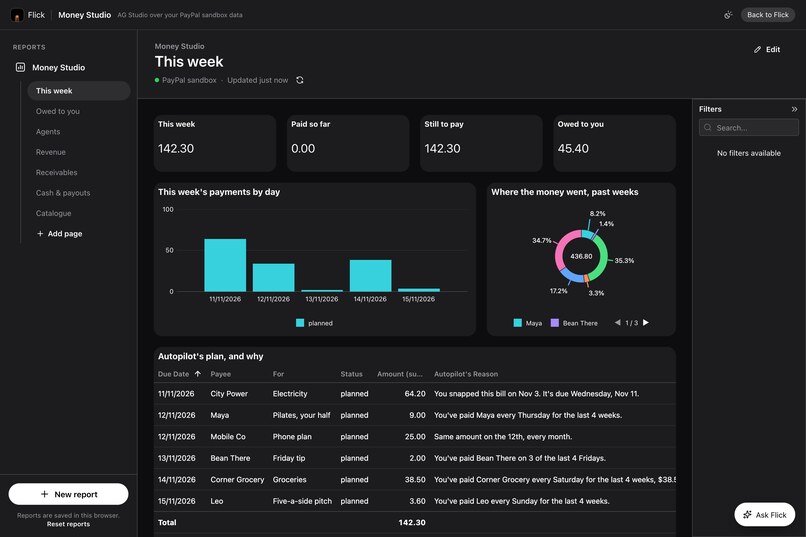
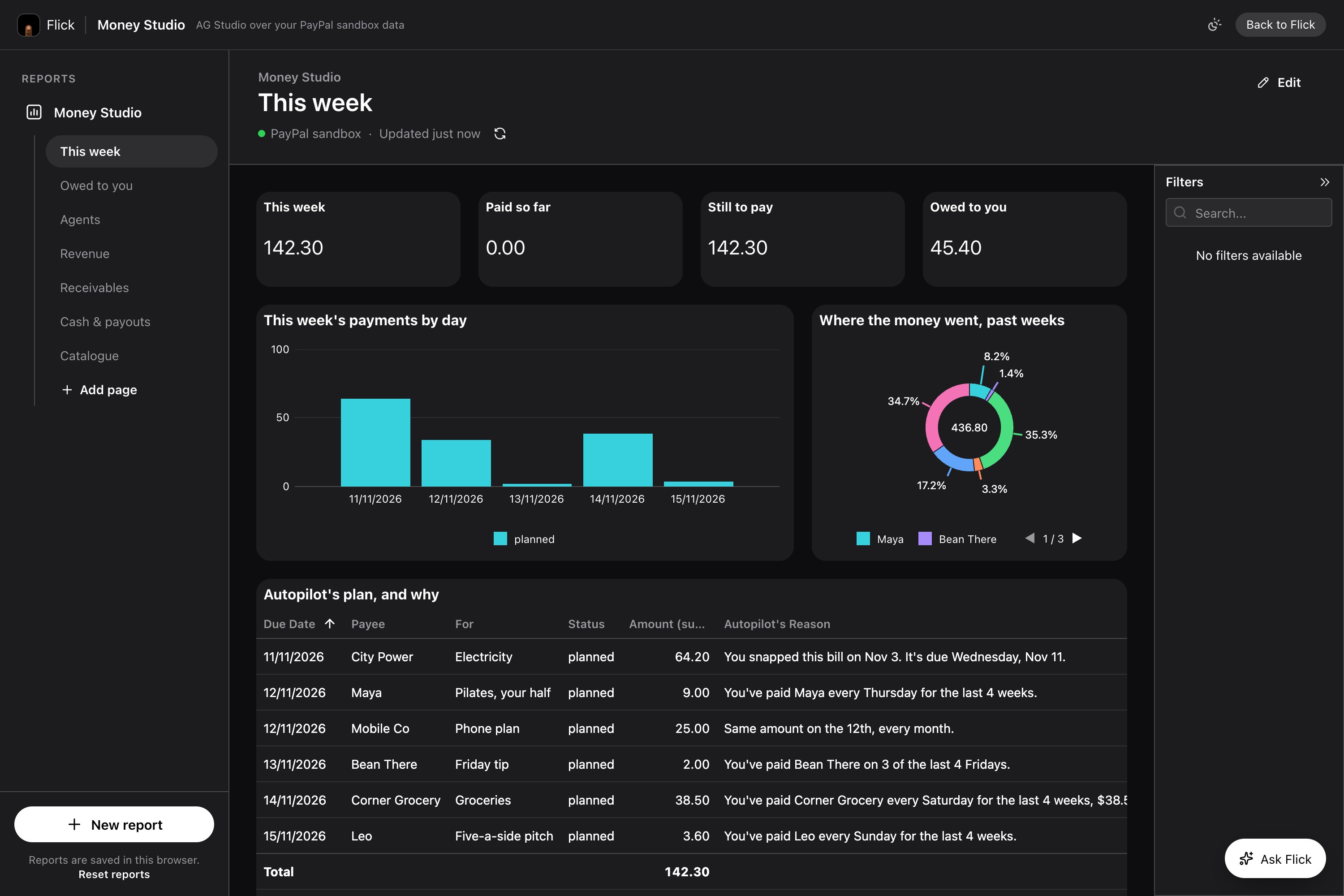
Money Studio (AG Studio) over live PayPal sandbox data
-
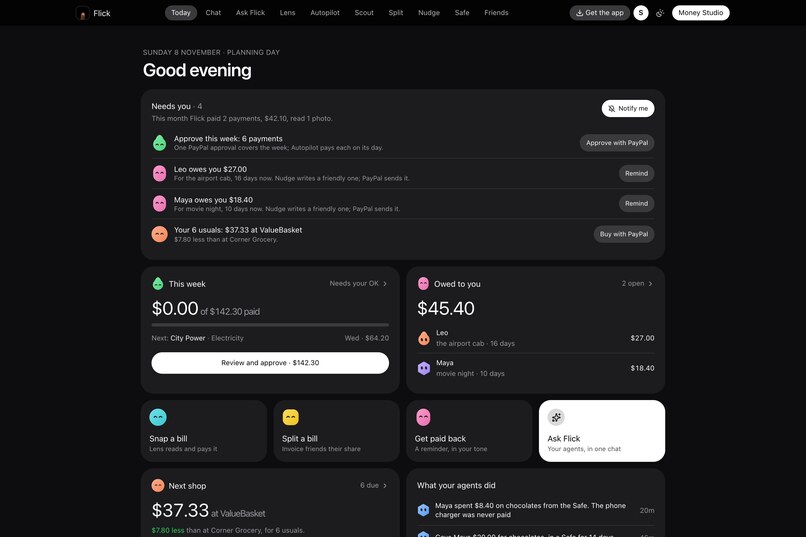
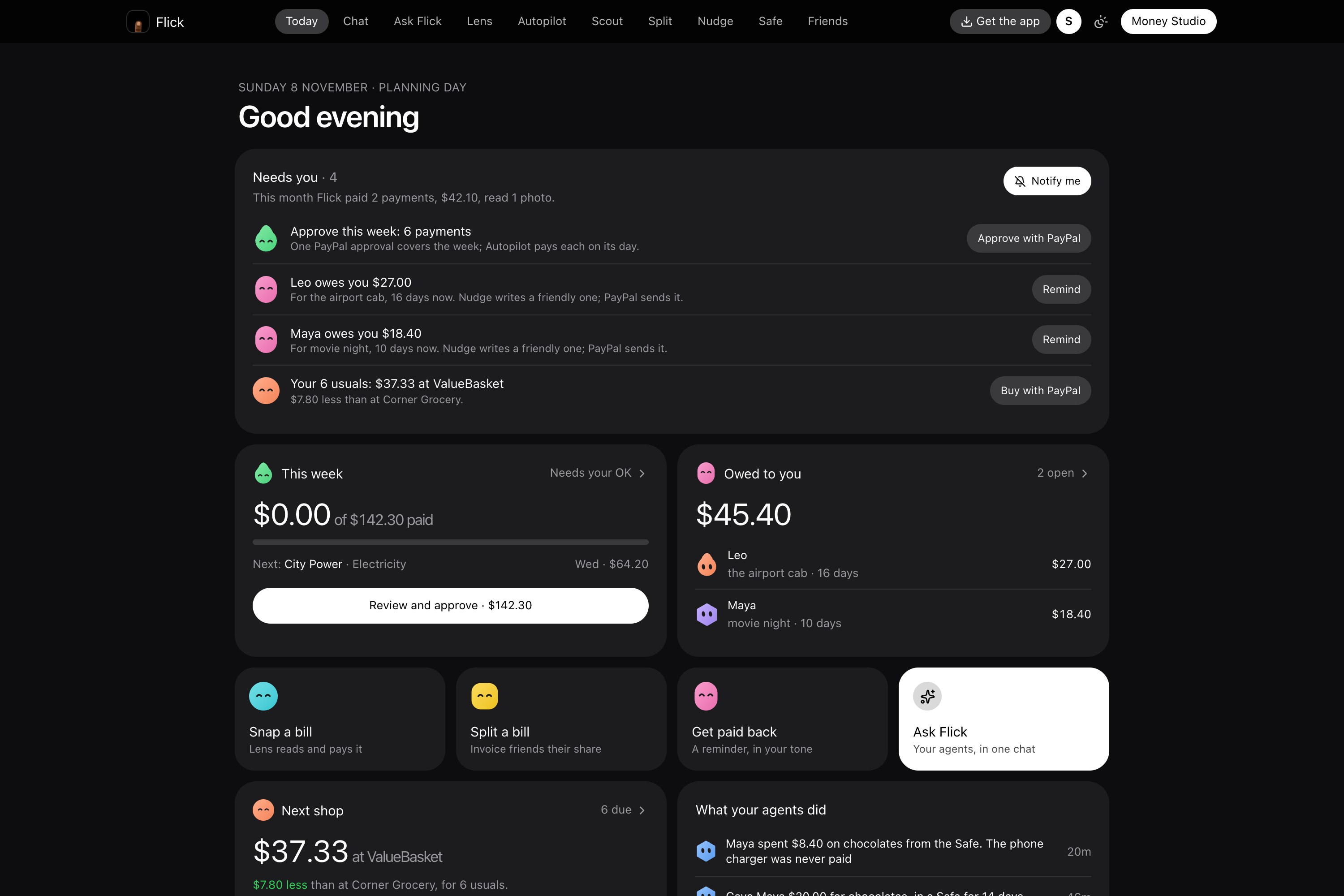
Today: what needs you, across the agents
-
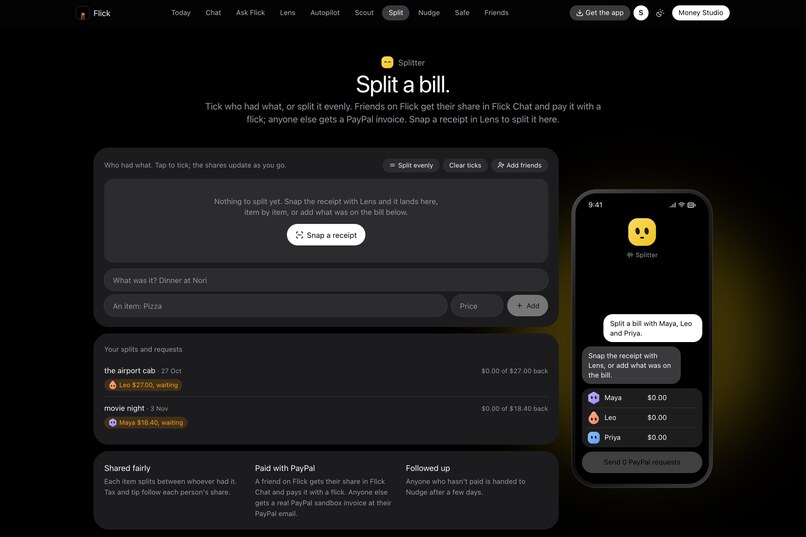
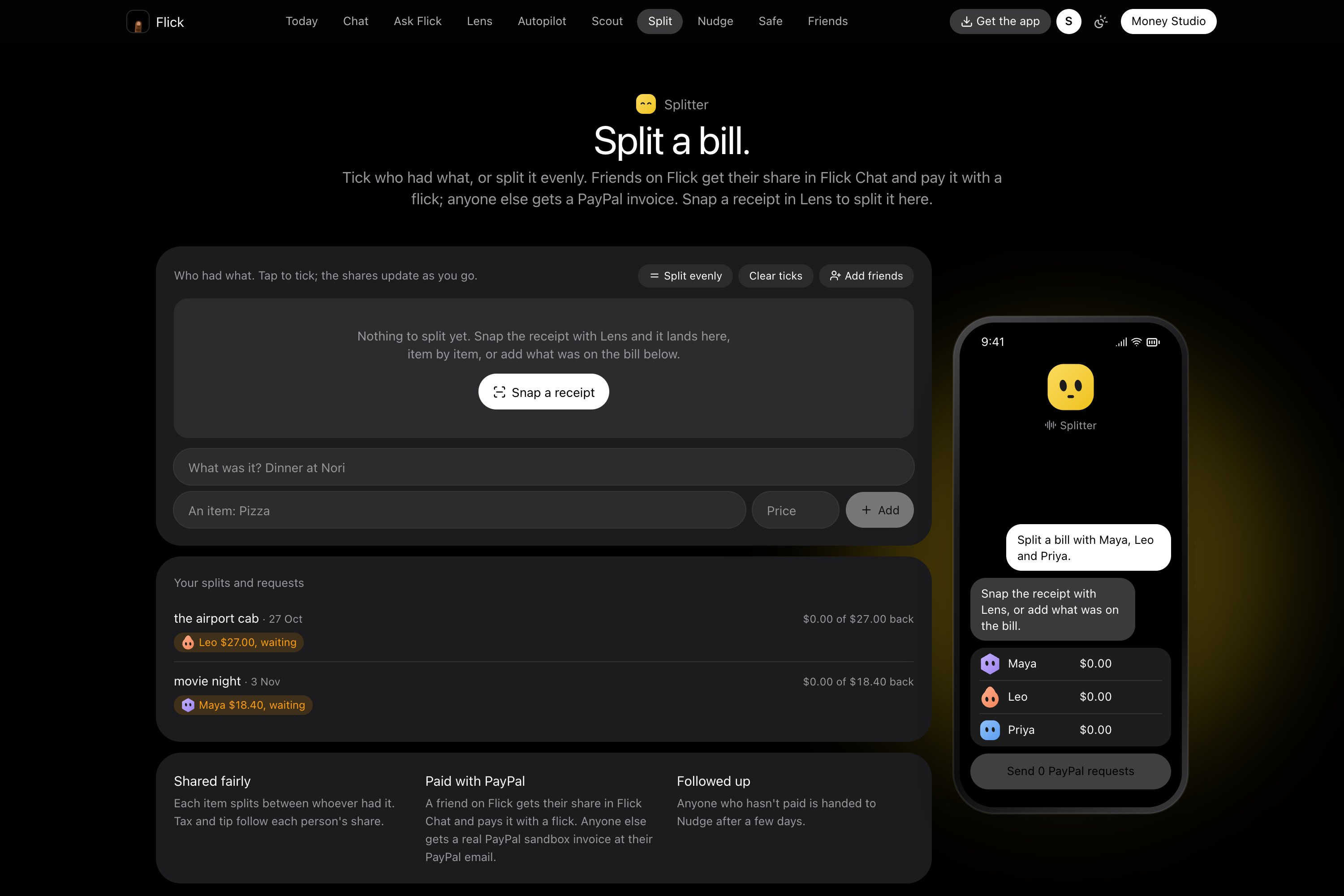
Splitter
-
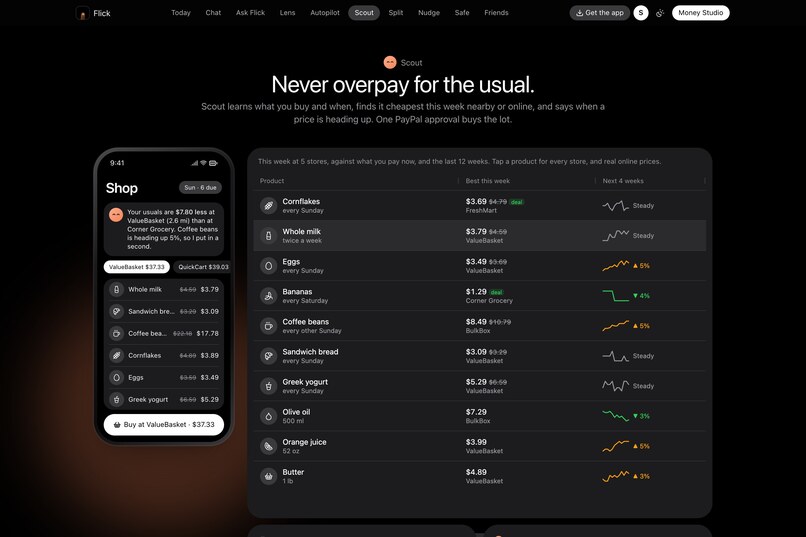
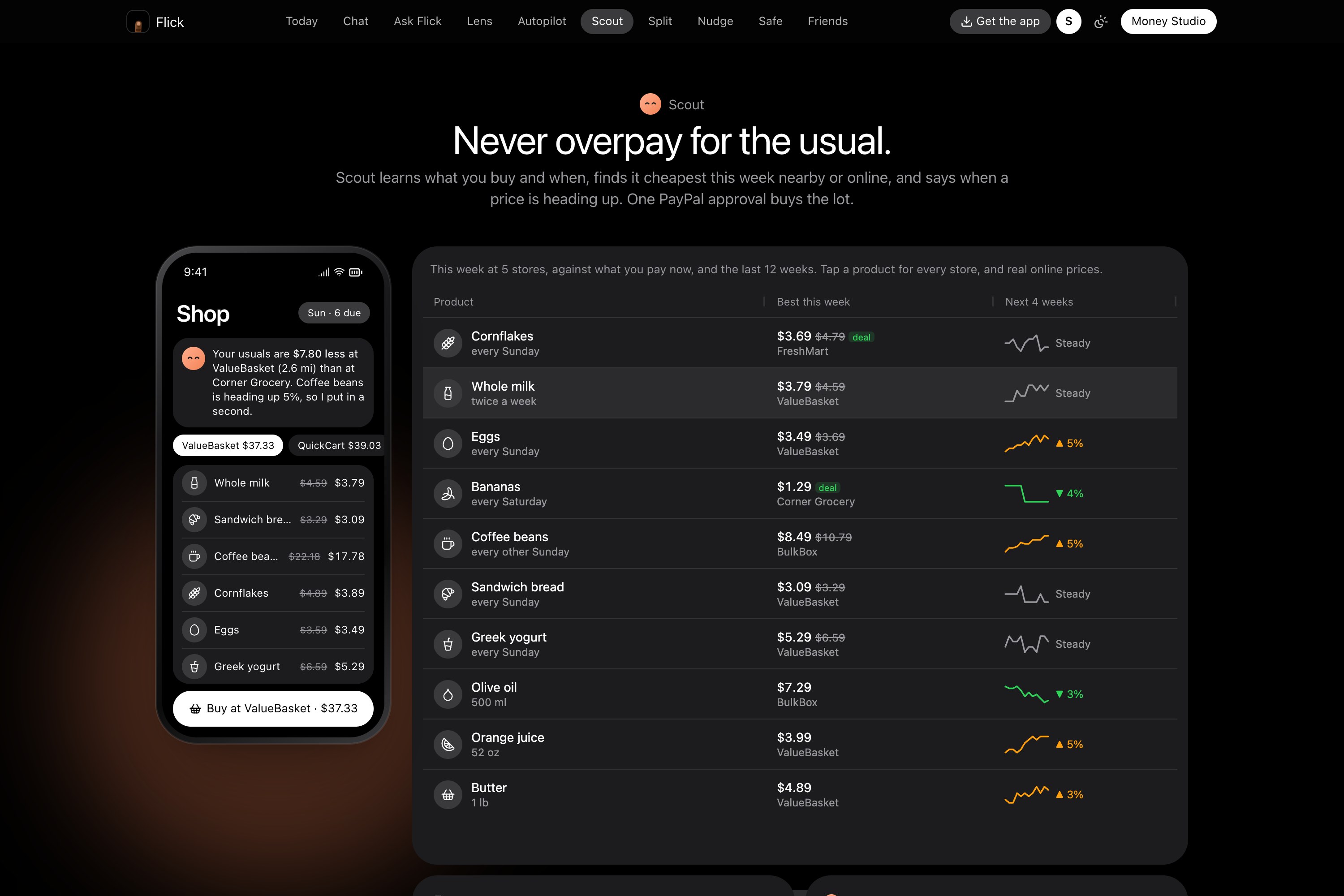
Scout: your usuals priced at every store, with trends
-
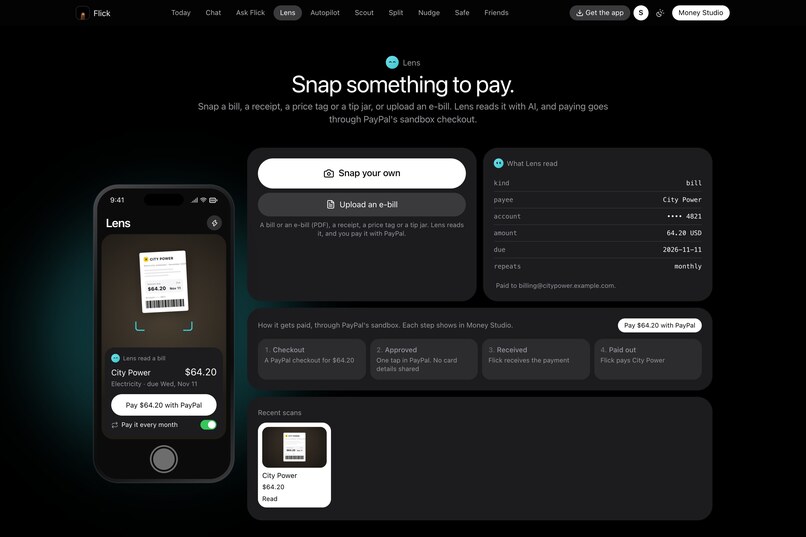
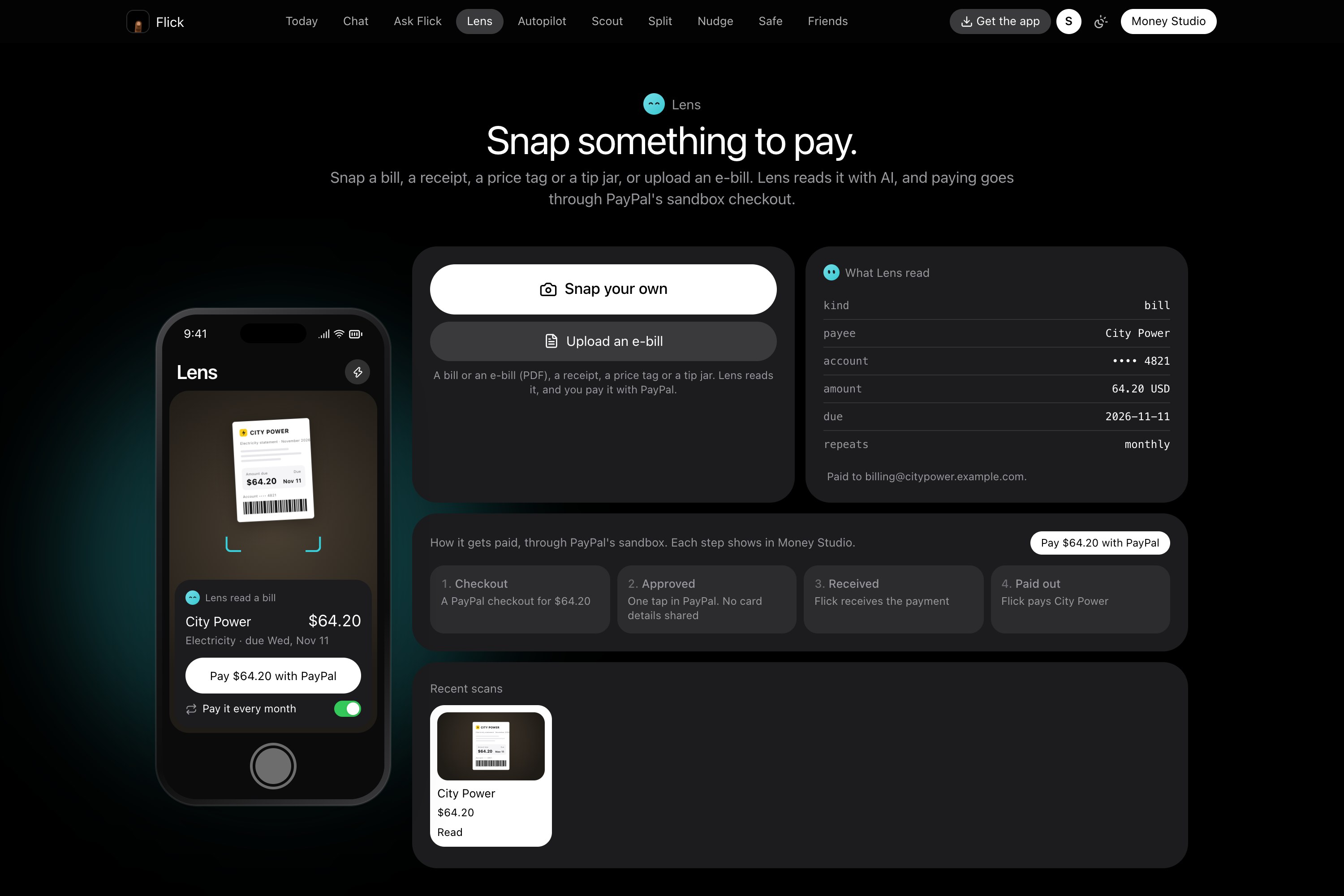
Lens reading a bill
-
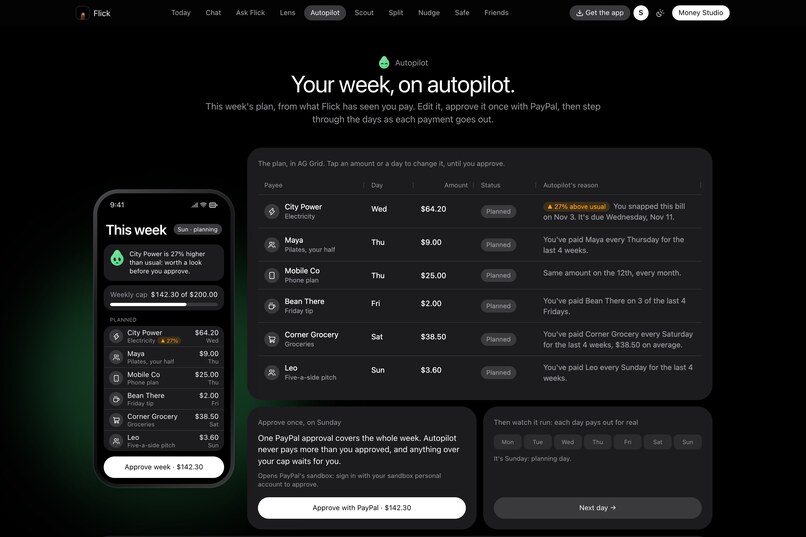
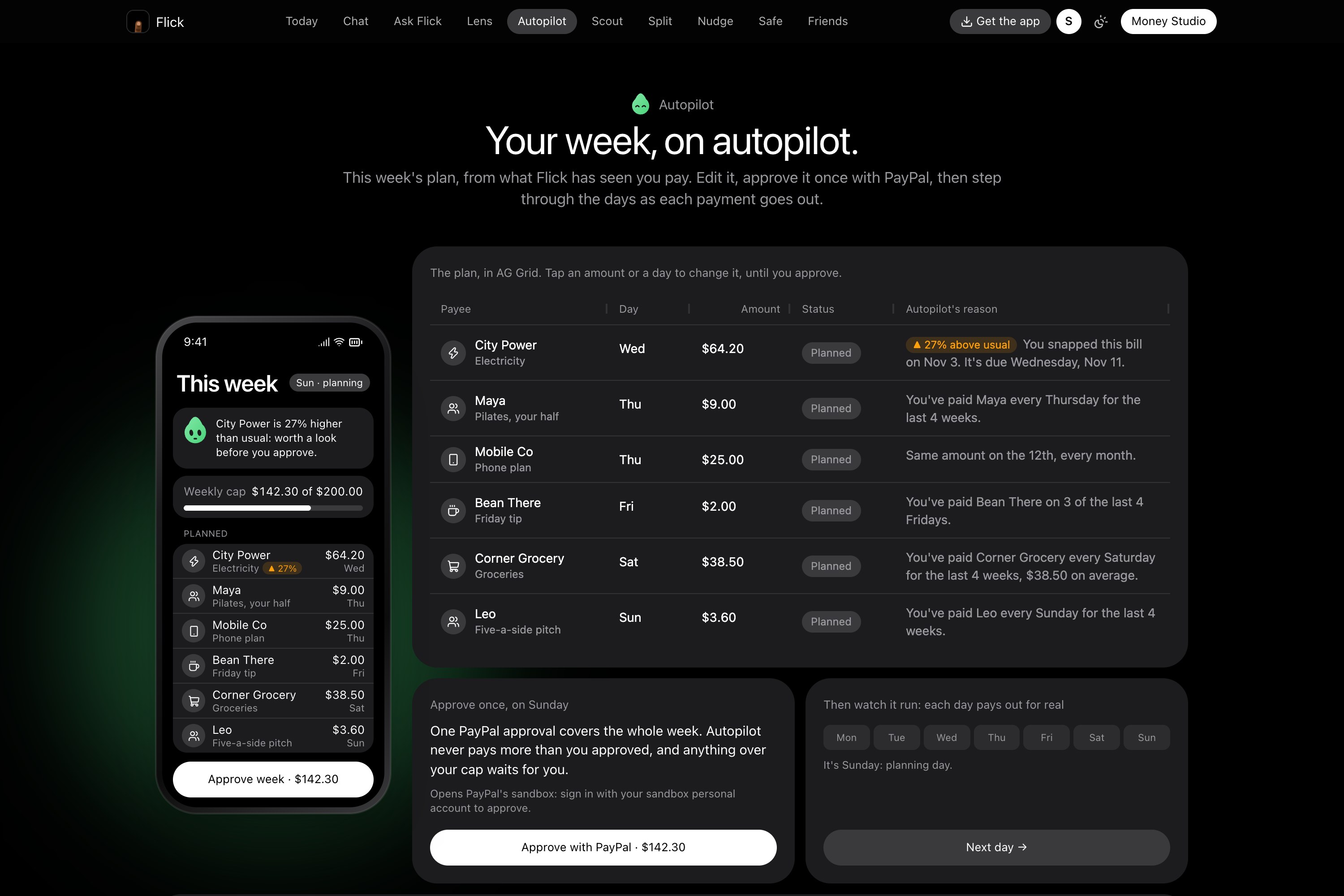
Autopilot's week, with a payment flagged 27% above usual
-
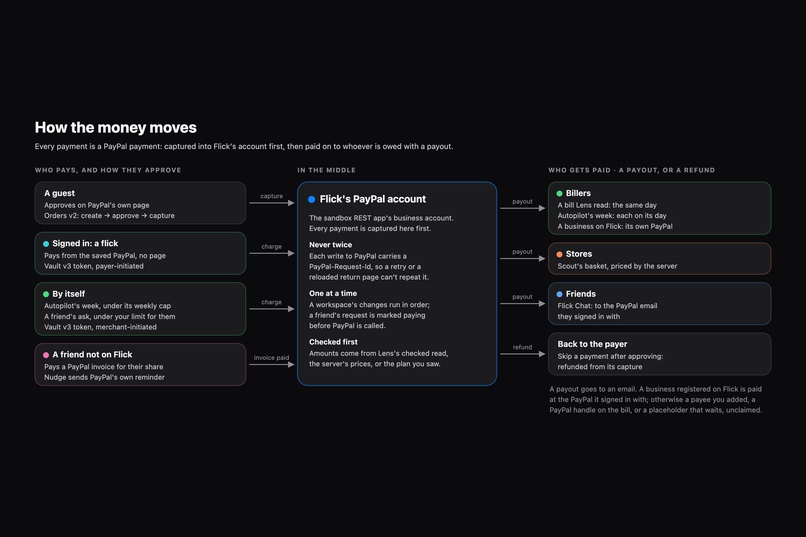
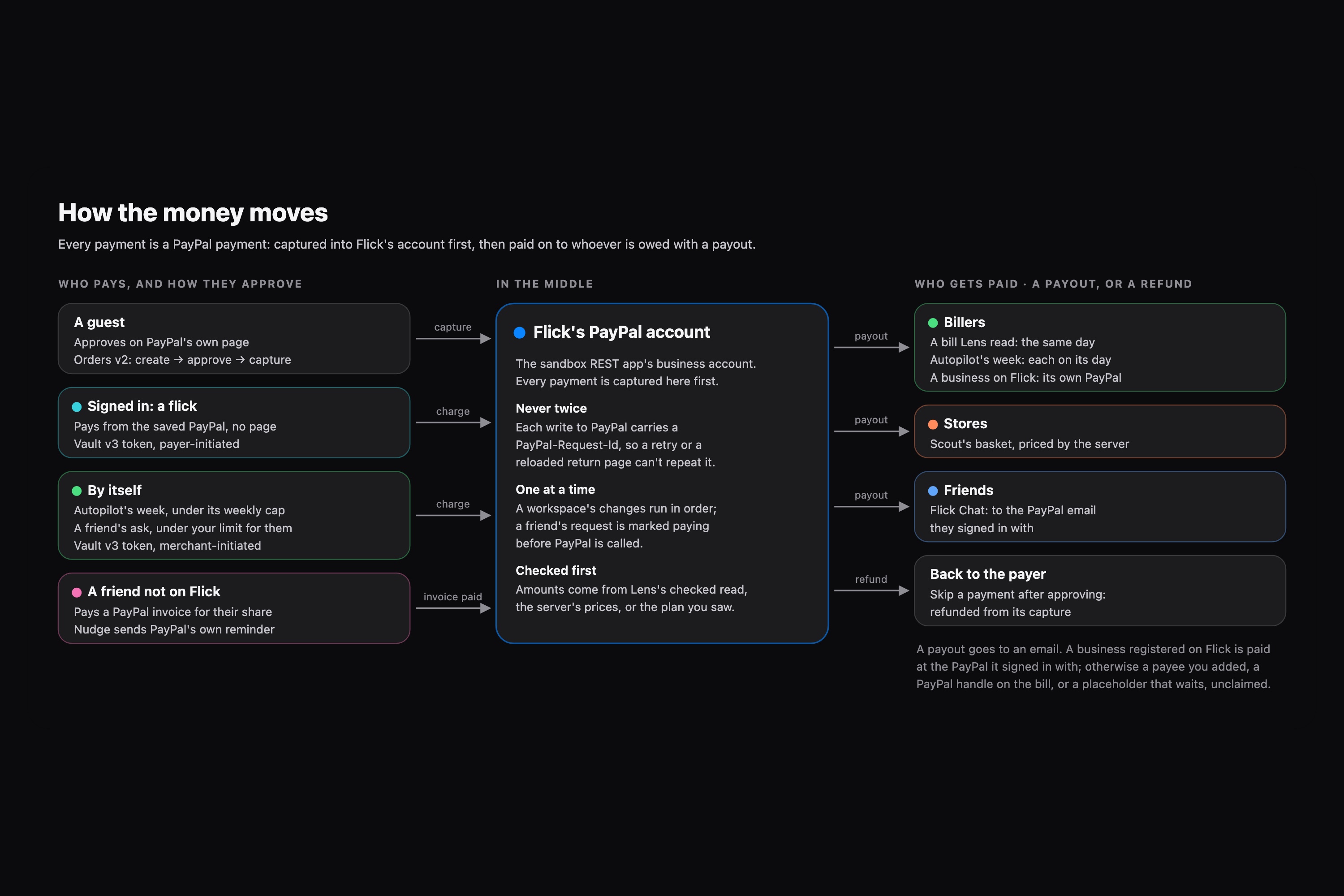
How the money moves through Flick's PayPal account
-
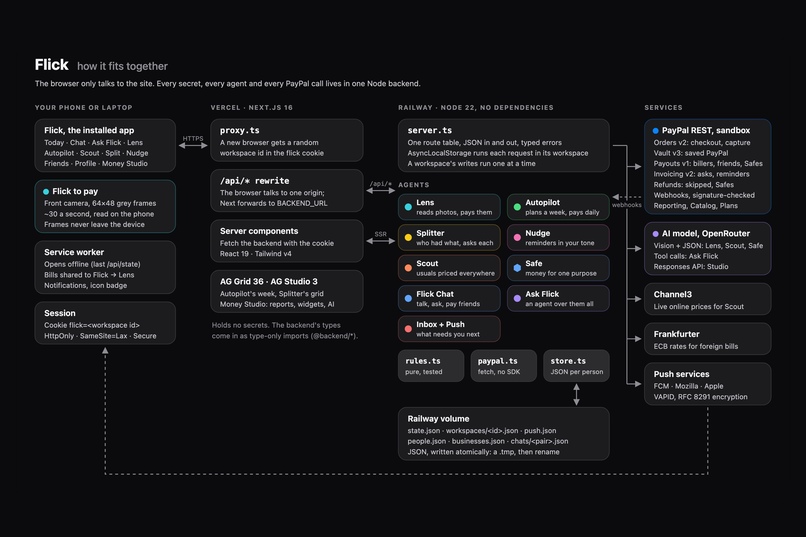
The architecture
-
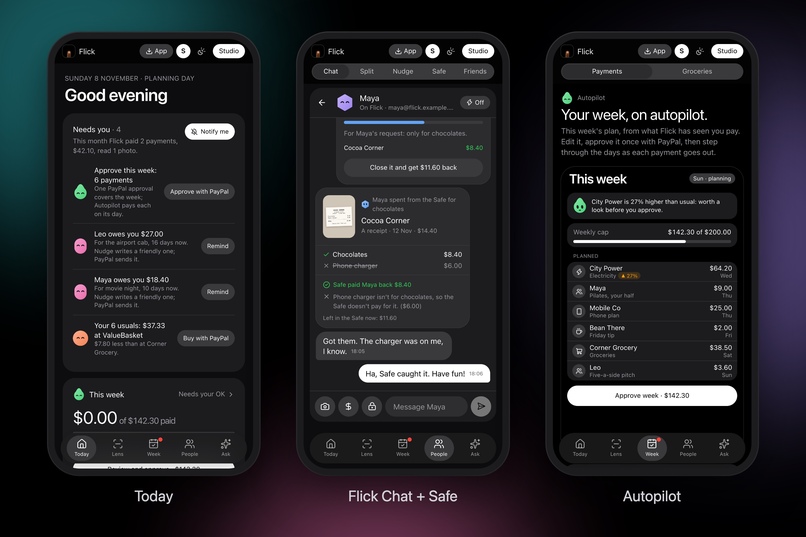
The installed app: Today, Flick Chat + Safe, Autopilot
Inspiration
Paying for things is still mostly typing. A bill arrives on paper or as a PDF, and you retype the payee, the amount and the due date. Dinner ends with a calculator and a week of "did you pay me back?". Groceries cost a little more every week. And the AI in most money apps is a chat box sitting beside the same old forms.
One of our team's own chats gave us the sixth agent. A friend asked for money "for chocolates" and joked that it should only be allowed to buy chocolates, proven with a receipt. Money sent for one thing gets spent on another all the time: pocket money, a parent's medicine, a flatmate's share of the groceries.
So we built Flick: a team of AI agents that do the money admin for you. PayPal moves every dollar, and a person approves every move.
What it does
Flick is an installable app (a PWA, no app store) run by six AI agents:
- Lens reads a bill, receipt, price tag or tip jar from the camera, an e-bill's PDF, or an e-mail shared to Flick. It converts foreign currencies at the day's ECB rate and tells you whose PayPal it will pay.
- Flick to pay: flick one finger up at the front camera and it's paid from the PayPal you saved when you signed in. The gesture is read on the phone, and no frame ever leaves it.
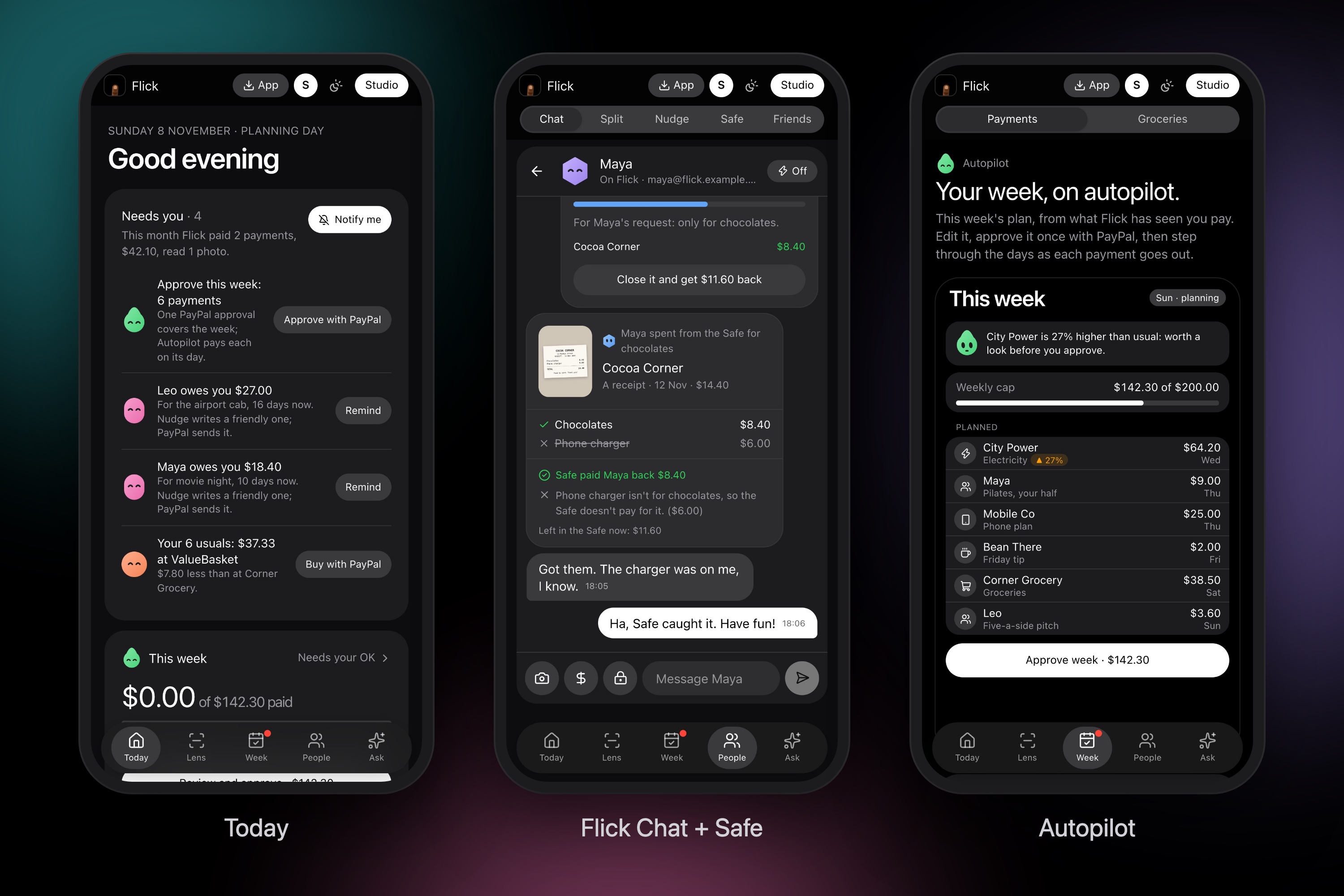
- Autopilot learns what you pay and when, plans the week and flags anything unusual ("27% above usual"). It pays everything on one PayPal approval, or by itself under a weekly cap you set.
- Splitter works out who had what, to the cent. It can take a sentence like "Maya and I shared the dumplings". Friends on Flick are asked in Flick Chat, everyone else gets a PayPal invoice.
- Nudge writes the reminder in your tone and sends it as PayPal's own invoice reminder.
- Scout learns your usual groceries and prices them at every store, with live online offers from Channel3. It forecasts which prices are rising and buys the cheapest basket in one checkout.
- Safe (new) keeps money for its purpose. A friend asks for "$20 for chocolates" and you pay it into a Safe. They snap the receipt:
- Only the chocolates are ever paid out. The phone charger on the same receipt never is.
- A used receipt is refused, and so is an old or unrelated one.
- A doubtful receipt waits for you.
- When you close the Safe, what's left is refunded to you.
Around the agents:
- Flick Chat lets friends talk, ask for money and pay with a flick, or let a friend's requests pay by themselves under a limit.
- Ask Flick plans across all six agents, typed or spoken. Every action comes back as a card you approve.
- Today shows what needs you, with push notifications on the installed app.
- Businesses register their name on Flick, so a bill with that name pays their own PayPal.
- Money Studio is an AG Studio report over your PayPal sandbox data and Flick's own, with two custom widgets and Studio's AI assistant.
How we built it
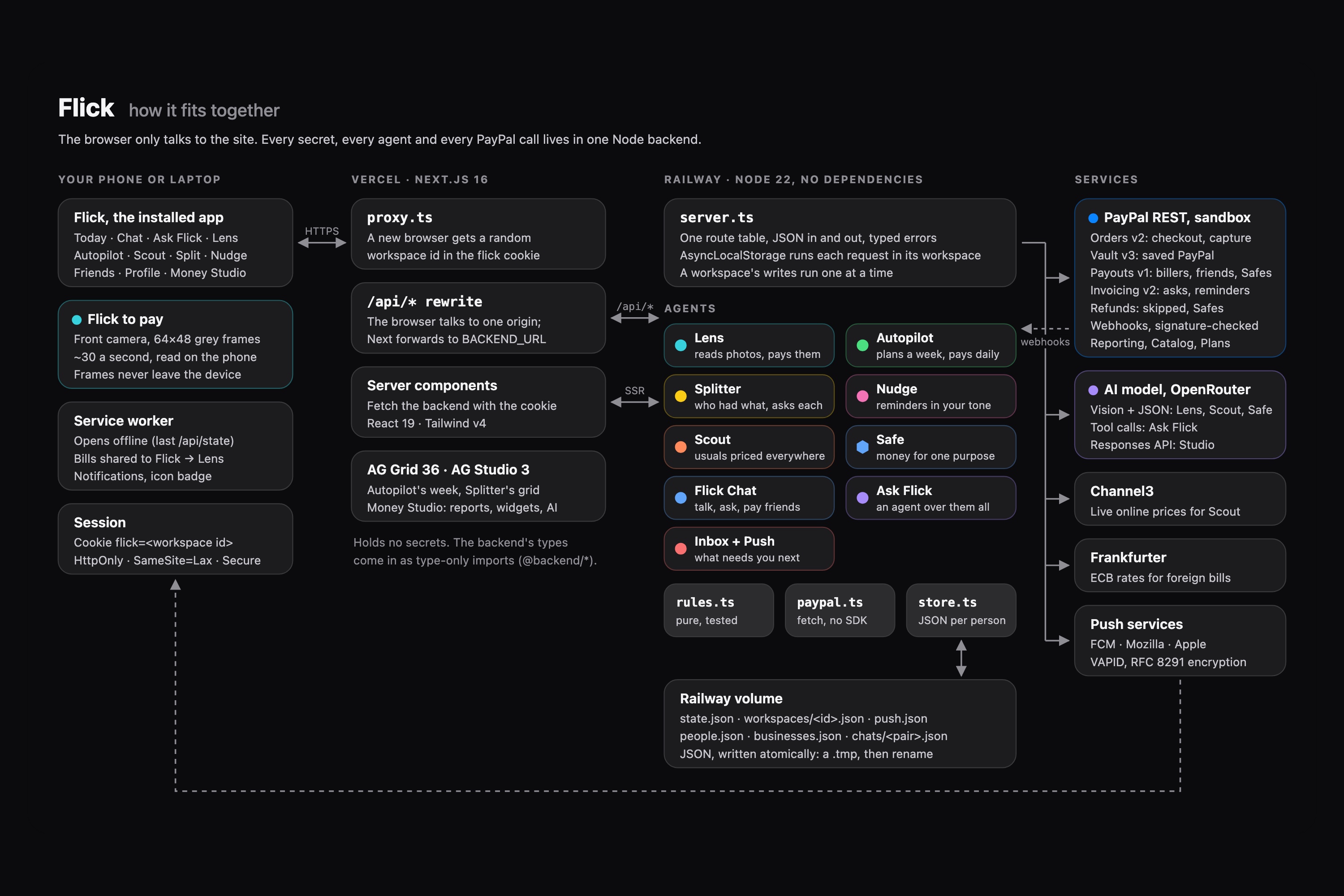
- Frontend: Next.js 16 and React 19 on Vercel. A proxy gives each browser a random workspace id in an HttpOnly cookie. Every
/apicall is rewritten to the backend, so the browser stays same-origin and never holds a secret. - Backend: Node 22 on Railway, running TypeScript directly with zero runtime dependencies.
AsyncLocalStoragescopes each request to one person's workspace, and that workspace's writes run one at a time, so nothing is ever paid twice. Each workspace is a JSON file on a Railway volume, written atomically. - Money: every payment is captured into Flick's own PayPal account, then paid on to whoever is owed. Every PayPal call is plain
fetch, with aPayPal-Request-Idon every write. We used eight PayPal APIs:- Orders v2: every checkout.
- Vault v3: sign-in, plus payer- and merchant-initiated charges.
- Payouts v1: billers, businesses, stores, friends, and Safe receipts.
- Invoicing v2: friends not on Flick, and reminders.
- Payments v2 refunds: skipped payments, and what's left of a Safe.
- Webhooks: signature-verified, routed to the right workspace, applied once.
- Reporting v1: transactions and balances.
- Catalog and Billing: products and plans.
- AI: one OpenAI-compatible client through OpenRouter. Vision reads use Gemini 2.5 Flash Lite with a fallback model. Every read is a strict JSON schema, and the output is treated as untrusted until rules check it. Ask Flick uses tool calling, and its actions only run on approval. Every AI call counts against an hourly budget.
- Our rule: AI reads and proposes, rules check, a person approves, and PayPal moves the money. No model ever sets an amount or chooses who's paid. Amounts come from pure, unit-tested rules (
rules.ts,scout-rules.ts,safe-rules.ts). - AG Grid 36 and AG Studio 3: editable grids for Autopilot's week, Splitter and Scout, and Money Studio. Everything is themed from one set of design tokens, in light and dark.
- Tests, all against the real model and the PayPal sandbox:
- 63 backend unit tests and 8 frontend unit tests.
- 91 API steps.
- A 79-step headless-Chrome run through every page on phone and desktop, with real sandbox payments. It gives, spends and refunds a Safe for real.
Challenges we ran into
- Payouts from an Indian sandbox business account fail. We moved the app to a US business account.
- Sandbox feature changes only applied after the cached OAuth token was replaced. Our check script now revokes the token first.
- PayPal's list endpoints return summaries, so Money Studio fetches each record again in full. Transaction Search can also lag by hours.
- Fake receipts. No AI can prove a receipt is genuine. So Safe's rules do the deciding:
- Each receipt counts once, anywhere on Flick, matched by shop, date and total and by the file itself.
- Receipts must be dated after the Safe was made.
- Lines must add up to the total.
- Only lines for the purpose are paid.
- Anything doubtful goes to the giver, with the photo.
- Our end-to-end test caught a real bug. The model read a plain receipt as an unpaid bill, and Safe refused it. Now a bill Flick can't pay goes to the giver to decide instead of being refused outright.
Accomplishments that we're proud of
- Every flow moves real sandbox money in our tests, from a flick to a weekly approval, a chat payment and a Safe refund.
- Paying is a gesture. One flick at the camera, read on the device.
- A backend with no dependencies, safe to retry, where no model can move money on its own.
- Safe turns a joke in our group chat into money that can only buy what it was asked for.
What we learned
- Agentic commerce works best when the agent proposes and a person, or a limit that person set, says yes.
- PayPal's Vault turns signing in and paying into one step.
- PayPal's request IDs are what make an AI-driven payment app safe to retry.
What's next for Flick
- A Safe as a PayPal authorization hold: capture only what each receipt lets out, so unspent money never leaves the giver's account.
- Paying the shop straight from a Safe, so there's no receipt to fake.
- PayPal partner onboarding, so businesses are paid directly.
- Venmo in Flick Chat, and PayPal's Agent Toolkit behind Ask Flick.
- Going live once a payments partner reviews the money flow.
Built With
- ag-grid
- ag-studio
- channel3
- frankfurter
- gemini
- llm-vision
- next.js
- node.js
- openrouter
- paypal
- paypal-orders-api
- paypal-payouts
- paypal-reporting-api
- paypal-vault
- paypal-webhooks
- pwa
- railway
- react
- tailwind-css
- tool-calling
- typescript
- vercel
- web-push

