Inspiration
Every student learns differently, yet most learning platforms offer nearly the same experience to everyone. A student who has mastered a concept may keep answering questions that are too easy, while another who is struggling may feel overwhelmed by questions that are too difficult.
We wanted to change that.
Flexdemy was born from the idea that learning should adapt to the learner, not the other way around. We envisioned an AI-powered learning companion that understands a student's own study material, identifies knowledge gaps, and creates a more personalised, accessible learning experience.
We also believe that accessibility should be an integral part of education. By incorporating dyslexia-friendly reading features and text-to-speech, we aim to make learning more flexible for students with different needs and preferences.
What it does
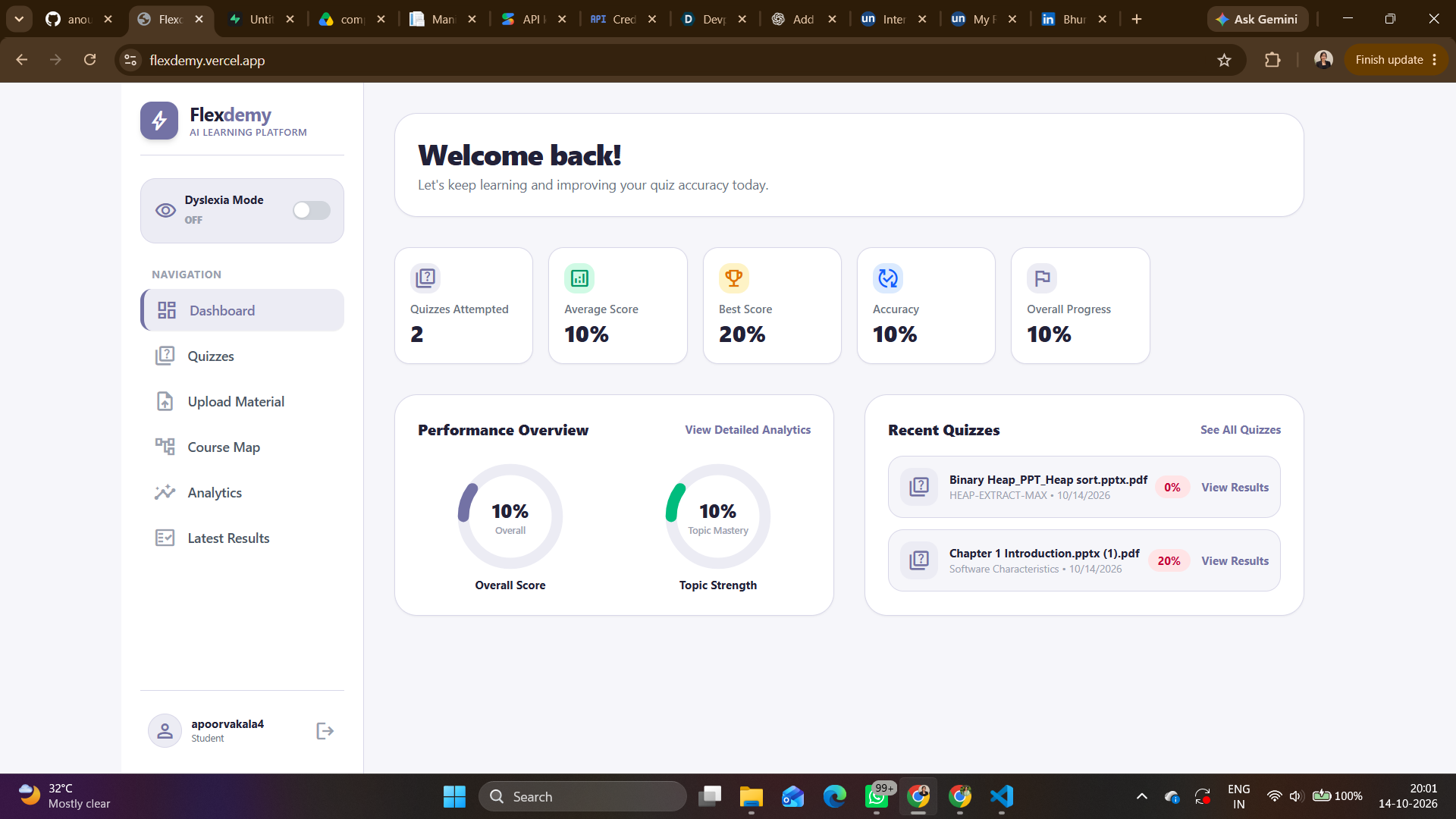
Flexdemy transforms traditional study sessions into personalised learning experiences through AI-powered content understanding, adaptive assessments, and accessibility features.
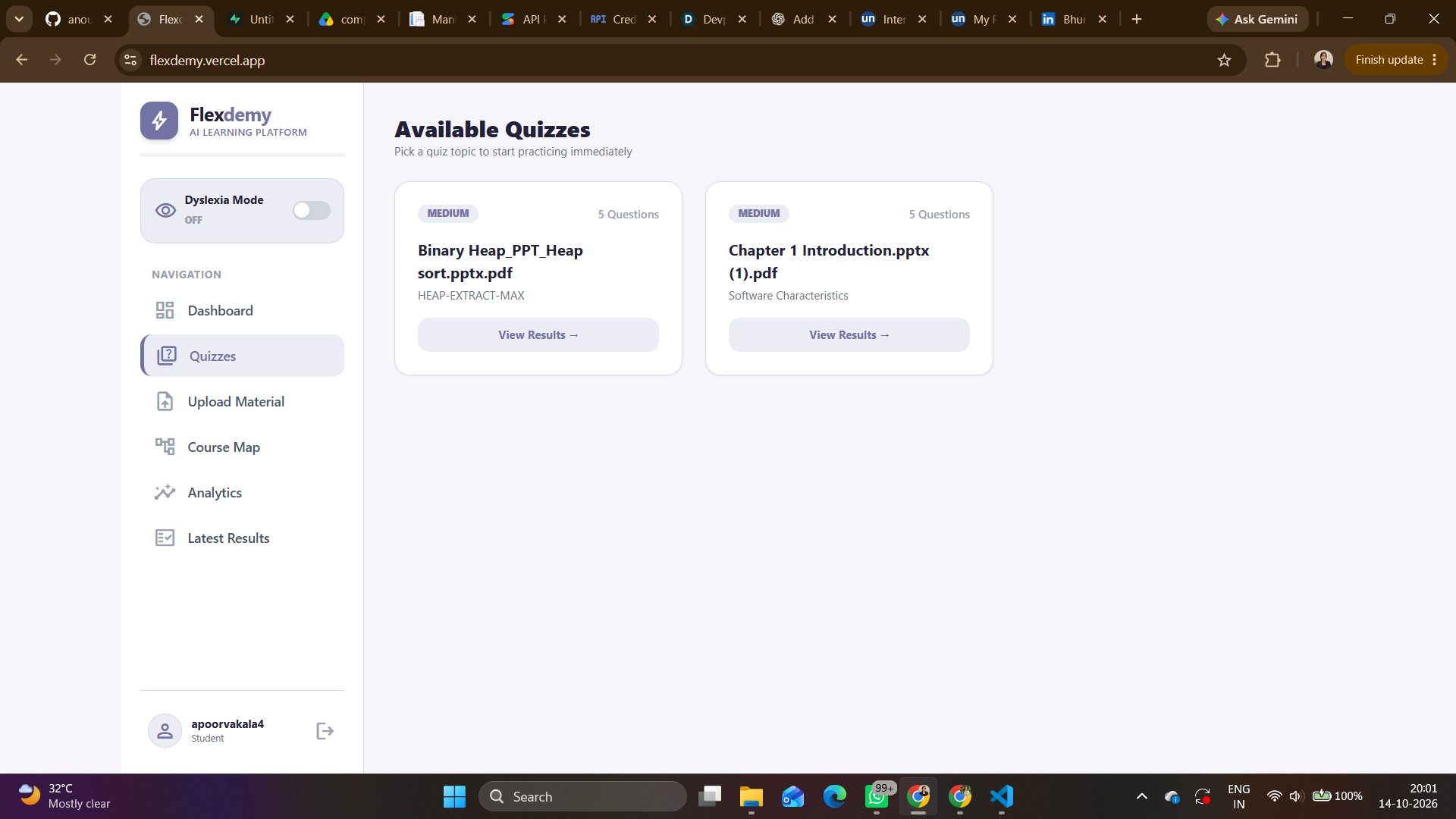
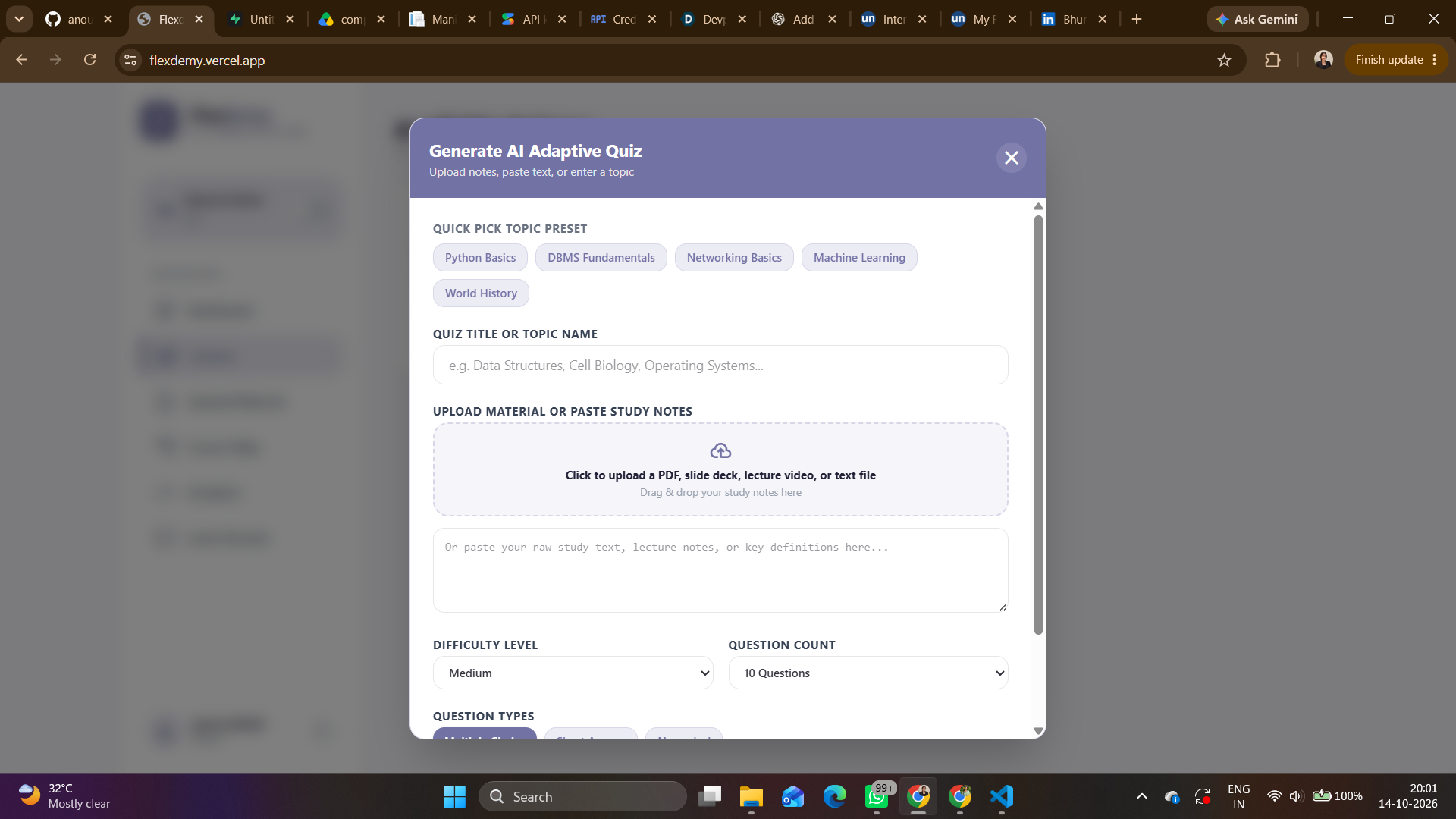
- Multimodal Learning: Designed to process study resources such as documents, lecture slides, and supported visual content, helping students turn their learning material into interactive practice.
- AI-Powered Question Generation: Uses Google Gemini to generate questions based on study content, making practice more relevant to what students are learning.
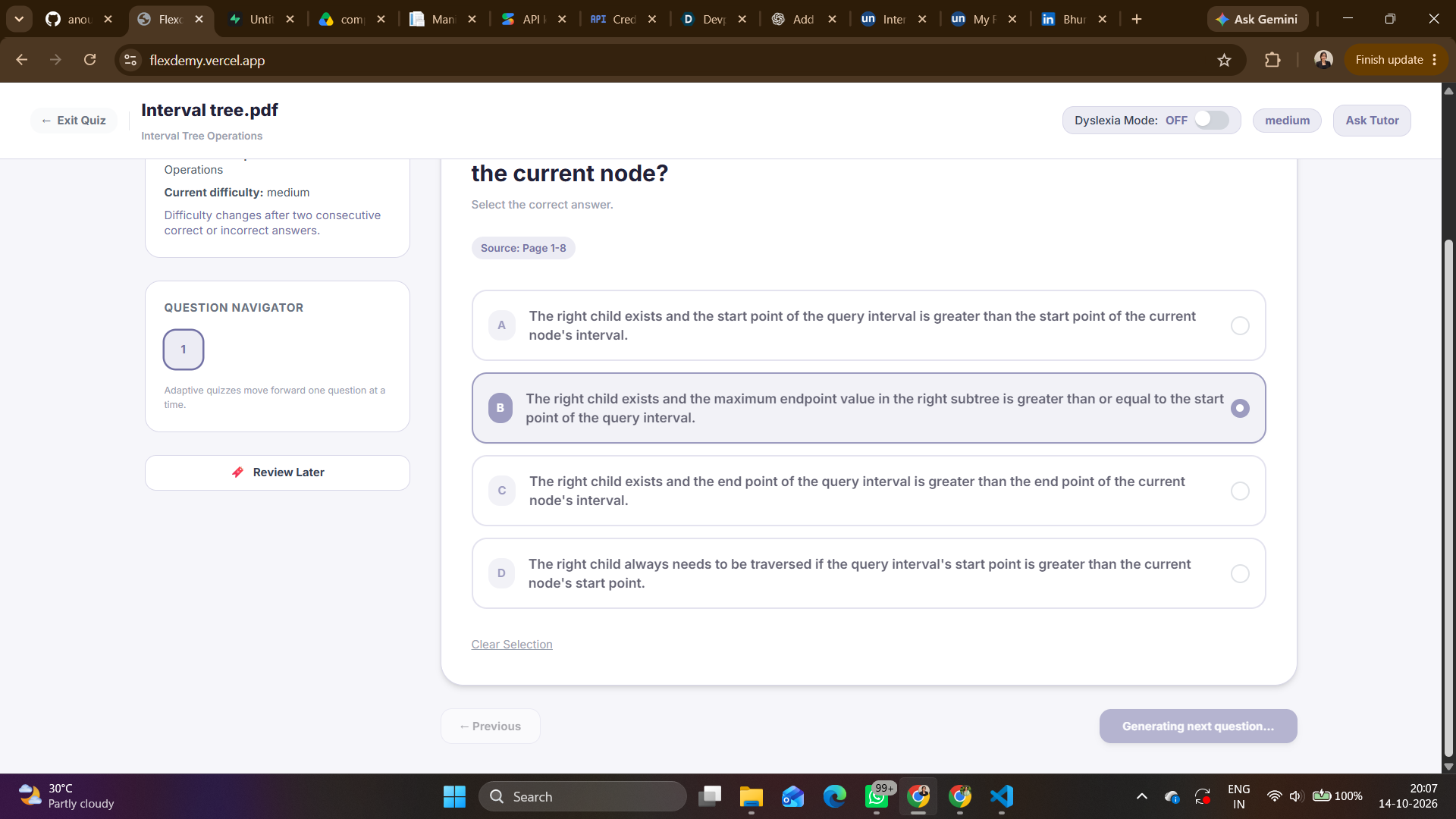
- Adaptive Assessments: Adjusts question difficulty according to student performance, helping learners practise at an appropriate level.
- Concept-Level Mastery Tracking: Tracks learning progress and helps identify concepts that need more attention, encouraging focused revision rather than repetitive practice.
- Accessible Learning: Includes dyslexia-friendly reading options, adjustable text spacing, text-to-speech, and interactive word highlighting to support different learning preferences.
- Personalised Revision: Aims to help learners focus on weaker topics and make better use of their study time.
Our goal is to make learning more targeted, interactive, and inclusive.
How we built it
We built Flexdemy by combining a modern web interface with AI-powered content processing and an adaptive assessment engine.
Frontend: React, TypeScript, Vite, and Tailwind CSS provide the interactive user interface and learning experience.
Backend: Python and FastAPI support backend functionality and assessment workflows.
Generative AI: Google Gemini powers AI-driven understanding of learning material and question generation.
Database and Authentication: Supabase supports data storage and authentication functionality.
Accessibility: Browser-based text-to-speech and interactive word highlighting help learners engage with content in different ways.
Adaptive Learning Logic: We combine AI-generated questions with explicit assessment logic to evaluate answers, update learner mastery estimates, and adjust question difficulty. This helps keep learning decisions more structured than relying on generative AI alone.
The overall workflow connects study-material processing, concept understanding, question generation, answer evaluation, and learner progress tracking into a unified learning experience.
Challenges we ran into
One of our biggest challenges was making AI-generated learning content useful, rather than simply generating questions that sound plausible. Questions need to remain relevant to the source material and appropriate to the learner's level.
Another challenge was designing adaptive assessments. Changing difficulty requires more than generating a new question; the system needs to interpret performance consistently and use that information to guide the next learning step.
We also had to think about the balance between flexibility and accessibility. Features such as text-to-speech and word highlighting need to work smoothly within the learning interface rather than feel like disconnected additions.
Finally, building an end-to-end prototype meant connecting the frontend, backend, AI services, and learner-state logic into a coherent workflow. This pushed us to think about the complete learning experience, not just individual features.
Accomplishments that we're proud of
- Built a working web-based prototype that brings AI-powered learning and adaptive assessments together.
- Integrated generative AI into a learning workflow focused on students' study material.
- Implemented adaptive difficulty and concept-level mastery logic to support personalised practice.
- Incorporated accessibility features, including dyslexia-friendly reading options and text-to-speech with word highlighting.
- Documented automated acceptance tests, with 21 out of 21 tests passing in the recorded test run.
- Evaluated the offline retrieval pipeline on a small test set, achieving a 100% retrieval hit rate across nine answerable test cases.
- Explored personalised learning behaviour through simulated student profiles, examining how mastery estimates and question difficulty change across learning sessions.
These results represent prototype-level validation. We see them as a foundation for more extensive evaluation with real course material and student feedback.
What we learned
We learned that building an effective AI learning platform involves much more than connecting a language model to a user interface.
Personalisation requires a learner model that tracks progress over time. Trustworthy AI tutoring requires attention to source grounding and answer correctness. Adaptive assessments require consistent logic for interpreting performance. And accessibility needs to be considered throughout the design process.
We also learned the importance of testing individual components and complete workflows, measuring system behaviour, and distinguishing successful technical demonstrations from proven educational outcomes.
Most importantly, we learned that AI is most useful in education when it supports a clearly defined learning need rather than being used simply because it is available.
What's next for Flexdemy
We envision Flexdemy growing into a more comprehensive personal learning companion.
Our next steps include:
- Stronger Source Grounding: Improve retrieval and provide precise citations to the relevant page, slide, or timestamp so students can verify answers against their learning material.
- Smarter Learner Models: Refine topic-level mastery estimates using additional assessment history and forgetting-aware learning strategies.
- Better Evaluation: Expand our benchmark with more answerable and unanswerable questions, evaluate answer faithfulness and context precision, and test personalisation across longer simulated learning sessions.
- Targeted Revision: Generate revision resources and study schedules based on weak topics, forgetting patterns, and upcoming examinations.
- Multilingual Learning: Explore English learning material with explanations in Hindi and other Indian languages.
- More Accessible Experiences: Continue improving reading accessibility and explore audio-based tutoring sessions.
- Real-World Validation: Test Flexdemy with students, gather feedback, and investigate whether adaptive practice improves learning outcomes over time.
Flexdemy — Your Notes. Your Pace. Your Rules.
We want to build a future where students spend less time struggling with one-size-fits-all learning systems and more time understanding, practising, and mastering what matters to them.
