-
-
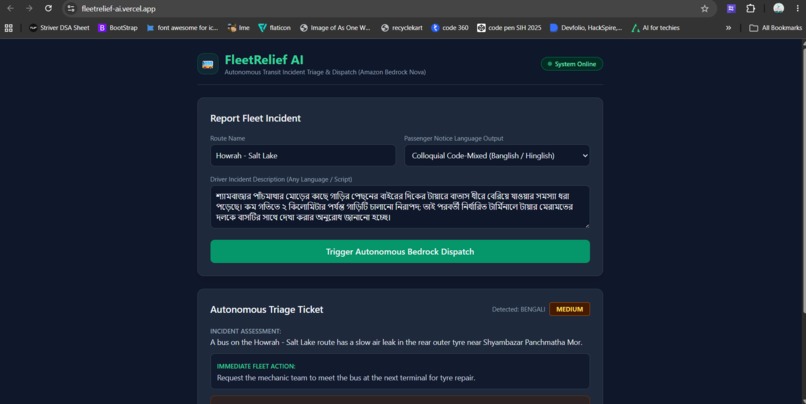
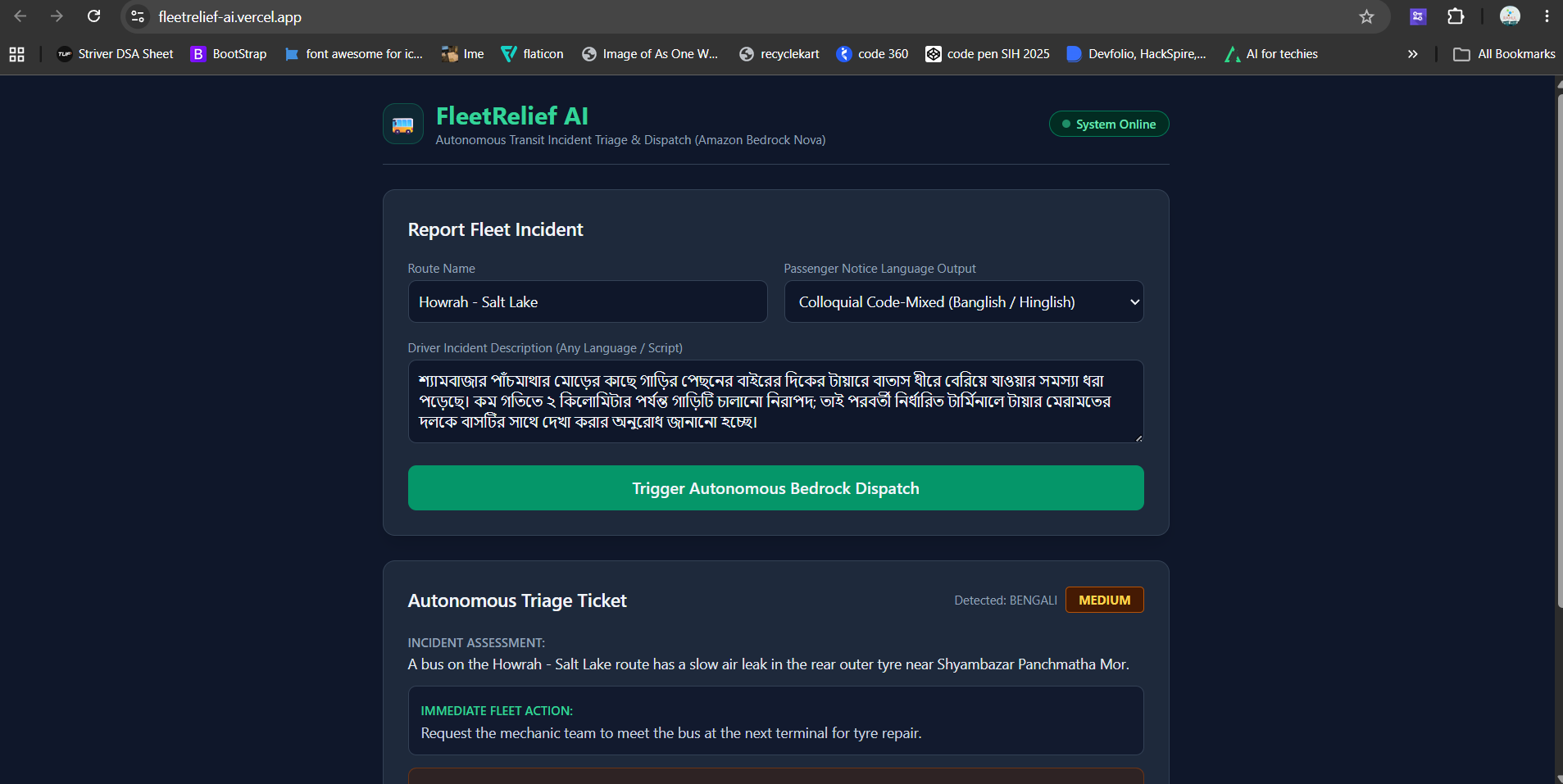
Live dispatch console ingesting raw Bengali driver reports for autonomous AWS Bedrock Nova triage and dialect steering.
-
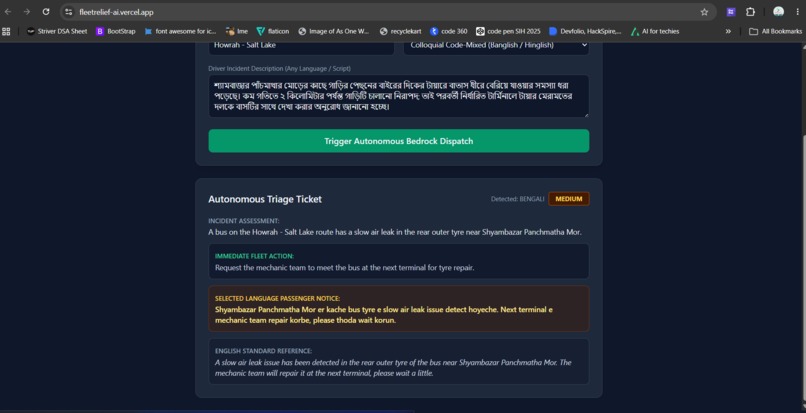
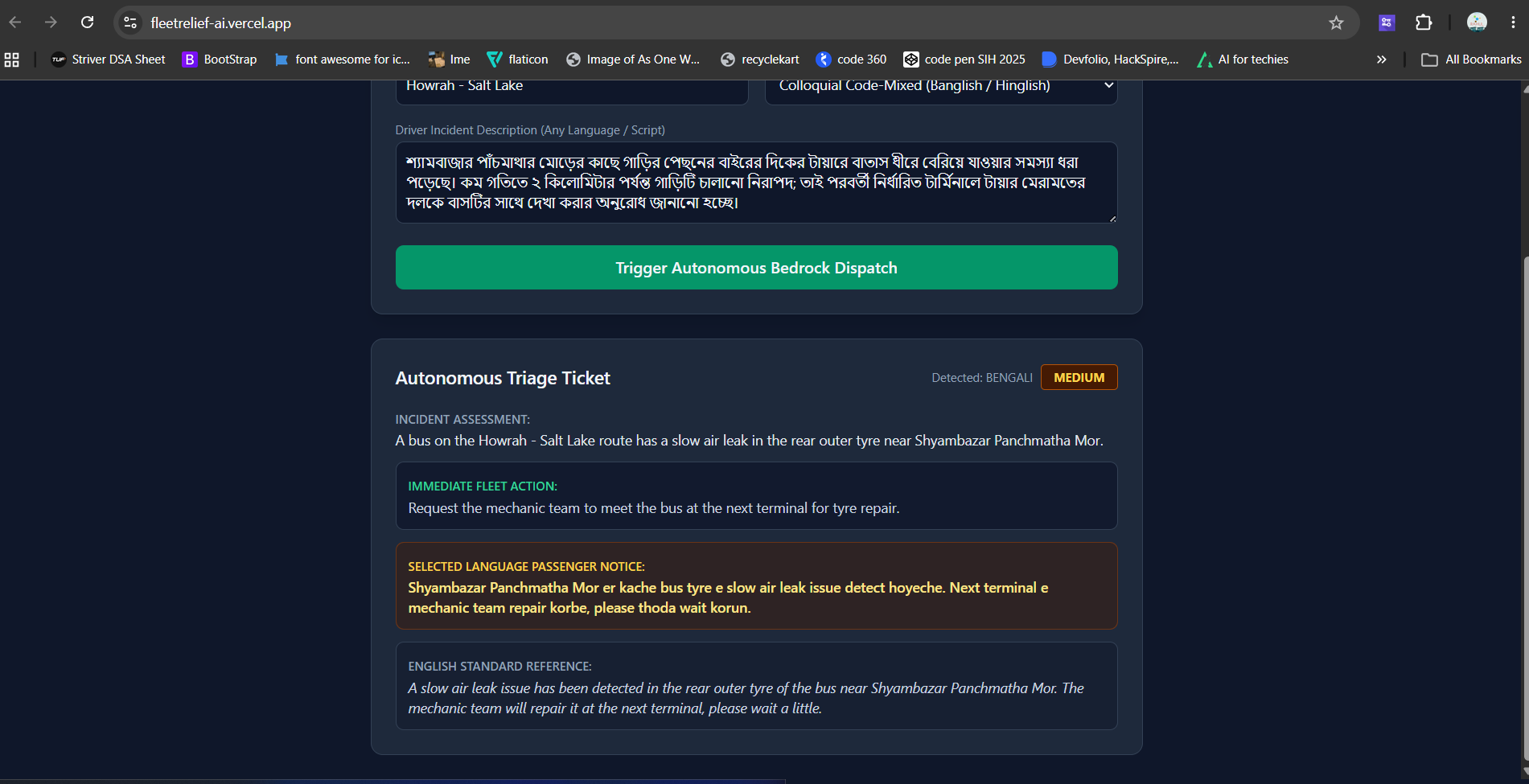
Autonomous triage ticket showing severity rating, depot actions, code-mixed Banglish passenger notice, and English logs.
Inspiration:
In high-density transit networks, unexpected mechanical failures (radiator blowouts, brake line leaks, tire punctures) cause immediate cascading delays across entire city corridors. In our parent Smart Bus Transit architecture, drivers manage routes while passengers track live arrival timelines. However, when an emergency strikes on the road, manual phone calls to central depots leave controllers guessing and commuters completely in the dark. Field drivers operating under high stress cannot navigate rigid multi-field forms, and dispatchers lack immediate clarity on fleet containment. We built FleetRelief AI as the autonomous intelligence layer to solve this emergency handover instantly.
What it does :
FleetRelief AI acts as an autonomous triage and dispatch bridge connecting all three transit stakeholders:
The Field Driver: Ingests raw, unstructured incident descriptions submitted from the road in any script or dialect (English, Bengali, Hindi, or colloquial code-mixed dialects like Banglish and Hinglish).
The Depot Controller (Admin): Evaluates incident severity (LOW, MEDIUM, HIGH) and issues precise operational containment directives (dispatching mobile tire crews, deploying heavy wreckers, or scheduling backup shuttle buses).
The Passenger: Synthesizes localized, human-readable service advisories in real time—delivering code-mixed colloquial vernaculars (such as Romanized Banglish) for transit stop display boards, alongside standardized English logs for central transit records.
How we built it :
FleetRelief AI is built on a decoupled full-stack architecture featuring a Node.js and Express REST API backend integrated with the official AWS Bedrock Runtime SDK (@aws-sdk/client-bedrock-runtime). The agent reasoning core leverages AWS's native Amazon Nova Lite foundation model (amazon.nova-lite-v1:0).
To support regional transit networks, we designed system prompts with few-shot dialect steering. This allows the model to process non-English driver reports, detect the input language, and dynamically generate both localized code-mixed notices (such as Romanized Banglish) and standardized English translations simultaneously. The application is deployed serverlessly on Vercel with path rewrites, coupled with a responsive Tailwind CSS operational dispatch console.
Challenges we ran into :
Enforcing Deterministic JSON & Sanitizing Markdown Fences: Transit operations require absolute data reliability. When generating mixed-language text, LLMs frequently wrap JSON payloads in markdown code blocks (json ... ), causing native JSON.parse() to throw fatal syntax errors. We engineered an input/output buffer sanitization pipeline that strips markdown fences and guarantees zero-crash JSON parsing across all dialect formats.
Steering Colloquial Code-Mixed Dialects (Banglish / Hinglish): Standard multilingual prompting typically defaults to formal native scripts followed by complete English translations, rather than natural colloquial speech. To generate genuine, single-sentence code-mixed advisories in Latin script (e.g., Romanized Banglish for daily commuters), we developed prompt boundaries using few-shot steering to blend vernacular phrasing and technical transit terms naturally.
High-Stress Driver UX Design: Drivers handling roadside emergencies cannot navigate complex forms with multiple dropdowns. We engineered the agent pipeline to accept unstructured natural language descriptions and autonomously extract key entities, classify severity, and assign depot actions without requiring human pre-sorting.
Enterprise Cloud Authentication & Endpoint Routing: Integrating the Bedrock Runtime SDK with bearer token authentication required configuring custom httpBearerAuth schemes to override default AWS SigV4 credential lookups. We calibrated model routing to leverage native AWS Nova serverless inference for consistent sub-two-second latency.
Accomplishments that we're proud of :
End-to-End Coordination Pipeline: Successfully bridged field drivers, central depot controllers, and everyday passengers into a unified real-time workflow.
Sub-Two-Second Bedrock Inference: Prompted and configured Amazon Nova Lite to deliver deterministic, structured JSON triage tickets in under two seconds.
True Vernacular & Code-Mixed Generation: Engineered reliable dialect handling that accepts native scripts (like Bengali) and produces authentic, romanized code-mixed commuter advisories (Banglish/Hinglish).
Resilient Production Deployment: Deployed a fully decoupled Node.js/Express backend on Vercel serverless architecture with zero routing overhead.
What we learned :
Operational Agentic AI vs. Conversational AI: The technical nuances of enforcing strict JSON schemas, managing token budgets, and preventing conversational filler from breaking downstream REST services.
AWS Bedrock Orchestration: Configuring @aws-sdk/client-bedrock-runtime with custom Bearer token authentication, handling AWS Bedrock inference profiles, and managing foundation model access.
Human-Centered Emergency Design: How to architect systems that minimize cognitive load for operators under high stress while ensuring passengers receive empathetic, clear, and localized updates.
What's next for FleetRelief AI :
Direct Smart Bus Transit Integration: Embedding the 1-tap emergency trigger directly into the driver mobile app and streaming live incident alerts to Leaflet route maps.
WebSocket Real-Time Broadcasts: Establishing Socket.IO/WebSocket connections to push instant Bedrock passenger notices to commuter stops without polling overhead.
Predictive Maintenance Data Lake: Persisting incident tickets to MongoDB to compute recurring component failure rates, distinguish driver negligence from road conditions, and generate automated safety audit reports for municipal transport authorities.
Dynamic Fleet Rerouting: Automatically calculating alternate route corridors around disabled vehicles to prevent transit gridlock.
Built With
- ai-agents
- amazon-bedrock
- aws-sdk
- express.js
- html5
- javascript
- json
- node.js
- rest-api
- tailwind-css


Log in or sign up for Devpost to join the conversation.